
What Is Social Selling and Why It Matters Now

A sales rep can spend a morning sending connection requests and repeating the same friendly opener, yet receive little response. The effort is visible, but the timing is weak. Buyers have not shown a reason to start a conversation.
What is social selling? It is a way to gather customer insight, build dialogue and relationships, and engage buyers with useful information. The strongest approach treats LinkedIn as a listening environment before using it as an outreach channel.
The useful signals are comments, profile views, topic engagement, competitor interactions, and repeat activity. Together, they indicate when a buyer has moved beyond passive awareness and begun exploring a problem or category. The seller's job is to understand that context, contribute something relevant, and reach out when the conversation has a credible reason to begin.
This reframes social selling away from posting for visibility. Content can support credibility, but buyer-state signals provide the timing advantage. A thoughtful comment, a return visit to a profile, or repeated engagement around one topic can reveal more than a static account list.
That timing matters in a buyer-led market. Gartner reports that 61% of B2B buyers prefer a rep-free buying experience, so sellers need to earn visibility and trust before a direct conversation feels welcome. Gartner-linked buyer preference data
Table of Contents
The Cold DM Problem and What Replaces It
One rep fires off 200 generic connection requests before lunch. The acceptance rate is 3%, and the inbox remains as quiet as a conference room after someone says, “Let's go around and introduce ourselves.”
Another rep watches five target accounts. One prospect comments on a competitor's post, another engages with a category discussion, and a third views the company profile twice within a week. The rep doesn't blast the whole list. They investigate the context, leave useful comments, and send messages only when the activity suggests a live business problem.
That second motion is social selling. It treats LinkedIn as a listening environment first and an outreach channel second. The relevant signals include engagement, topic affinity, seniority, company triggers, and repeated interaction, not whether a name appears in a static account list.
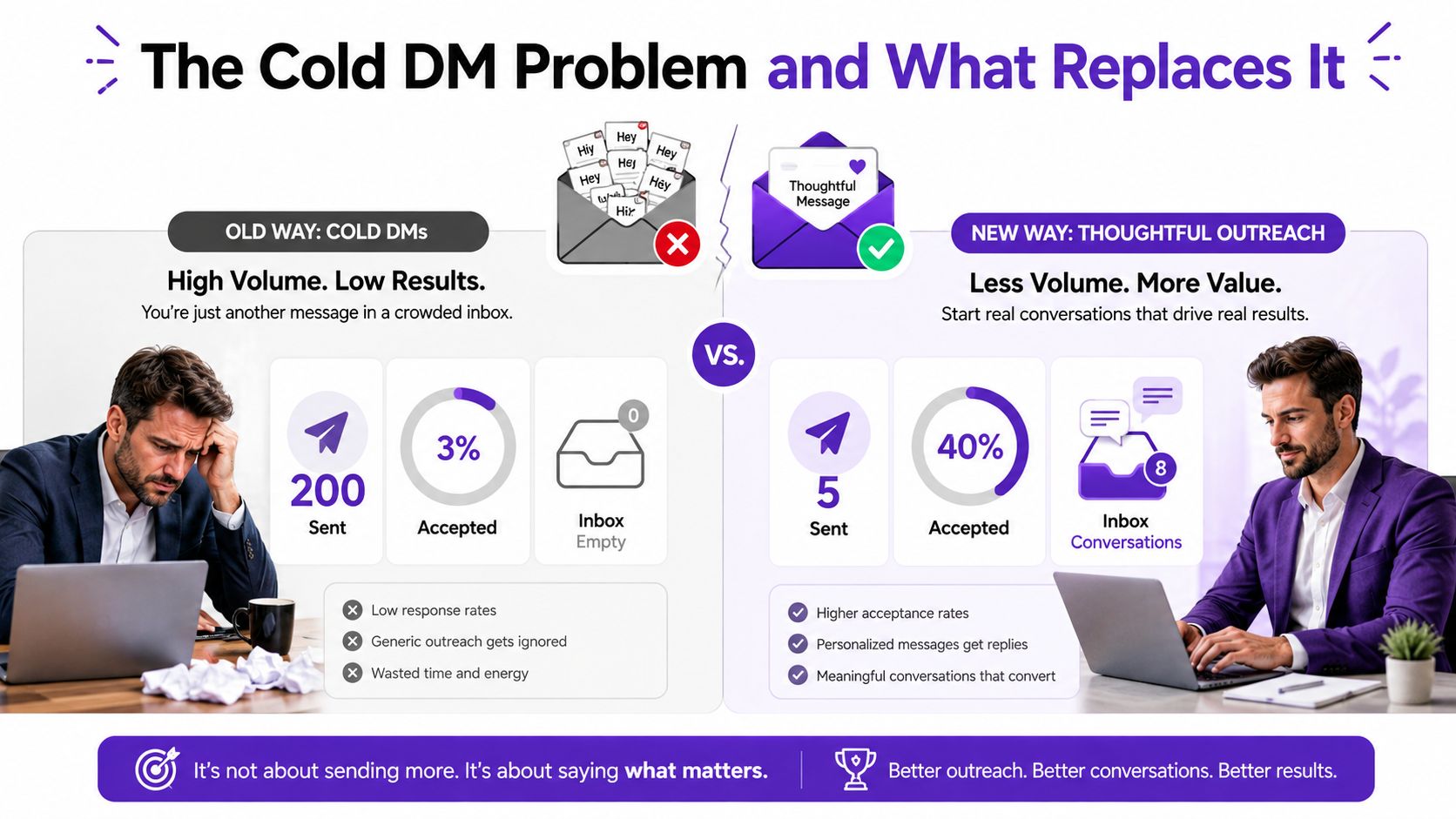
Practical rule: Volume creates activity. Timing creates a reason to reply.
The trade-off is real. Signal-based prospecting reaches fewer people in a single sitting, but it gives each conversation a stronger starting point. Cold outreach still has a place, especially when account coverage matters, but generic DMs confuse reach with readiness. A useful companion to this approach is the relationship between calling and modern outbound, where channel choice follows buyer context rather than habit.
What Is Social Selling and How It Actually Works
A practical definition has three working parts: insights, dialogue, and content. Academic B2B research describes social selling through customer insight, network and dialogue, valuable content, and the long-term conversion of those connections into business outcomes. The academic definition of social selling
Insights
Insights answer a simple question: what is this buyer paying attention to now? Review profile changes, recent posts, comment threads, topic interactions, and relevant third-party intent. This week, create alerts for the subjects your best accounts discuss and record the exact language they use.
Dialogue
Dialogue turns observation into a human interaction. Comment on a prospect's post with an informed addition, ask a precise question, or write a connection note that references the issue they raised. Don't pretend a generic compliment is personalization. If the message could be sent to 100 people without editing, it isn't contextual.
Content
Content gives buyers a reason to recognize and trust you before you ask for time. That might be a short reply, a useful link, or a 150-word teardown of a recent industry announcement. The content doesn't need to become a personal media empire. It needs to demonstrate that you understand the problem your buyers are already discussing.
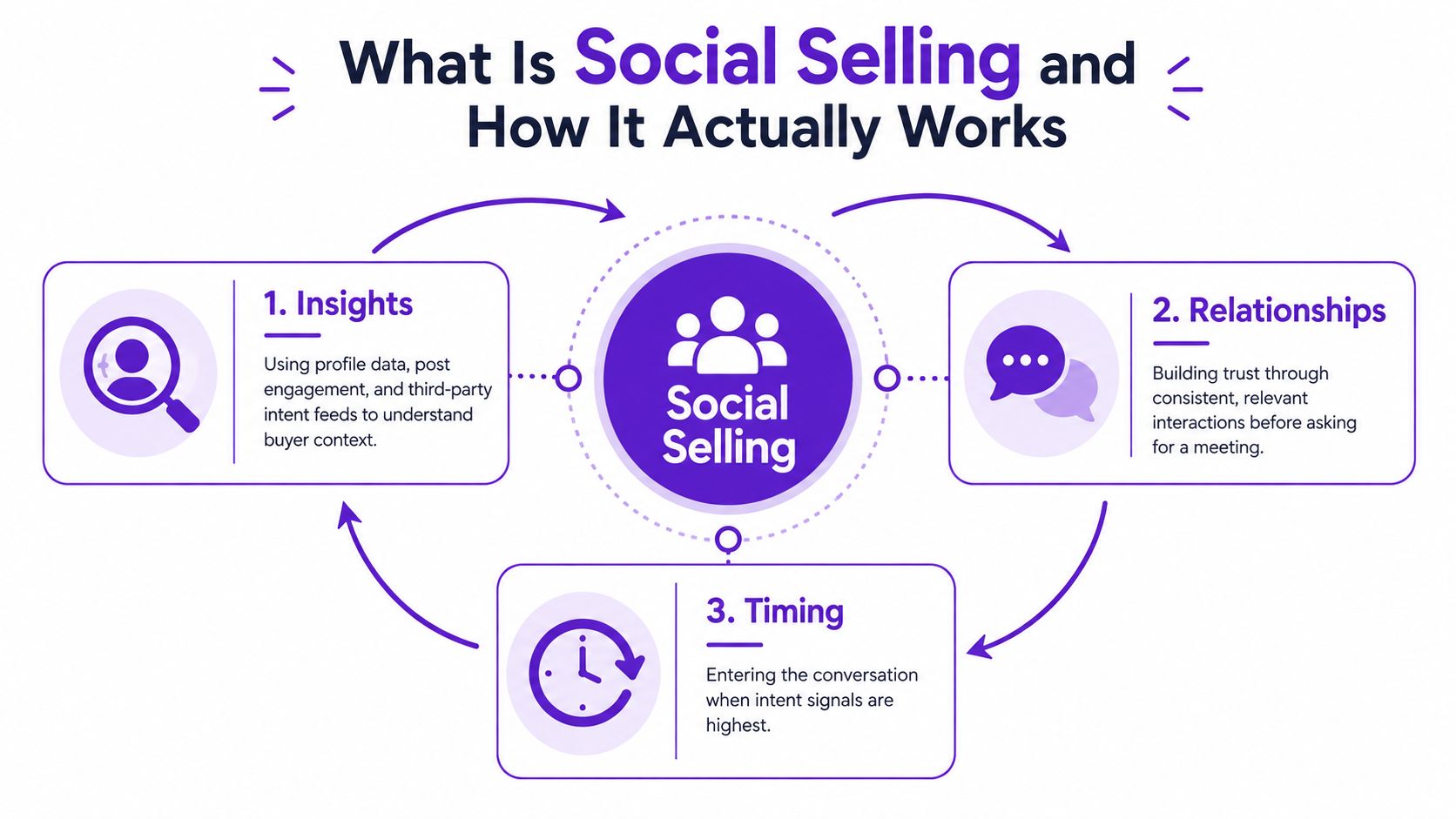
A useful operating principle is to connect the three. Insights tell you where to look, dialogue creates the relationship, and content reinforces your credibility. Teams that want to sharpen the data layer can also review what sales intelligence means in practice.
Why LinkedIn Is the Center of Gravity for B2B Social Selling
A buyer's role, company, recent activity, and professional network are visible in one place. That context makes LinkedIn useful for B2B selling because a rep can interpret intent instead of treating every interaction as anonymous engagement. A timeline of social selling's development
The platform also connects buyer research with timing signals. Comments on a category discussion, a profile view after an account interaction, or repeated engagement from people at one company can indicate a changing buyer state. Those signals help sales teams choose when to reach out, which account to prioritize, and what issue to address.
LinkedIn's four-part Social Selling Index framework covers professional brand, finding the right people, engaging with insights, and building relationships. LinkedIn's SSI framework The framework is useful as an operating checklist, but a high score does not create pipeline by itself. The commercial value comes from connecting account fit with observable buyer activity.
SSI Pillar | Practical Use | Revenue Relevance |
|---|---|---|
Professional brand | Make your expertise clear for target buyers | Establishes context |
Finding the right people | Map relevant roles inside priority accounts | Improves account fit |
Engaging with insights | Monitor and respond to meaningful discussions | Reveals timing |
Building relationships | Maintain useful contact across multiple interactions | Supports trust and access |
The benchmark figures associated with social selling are directional, not a reason to chase an index score. A credible profile and organized account research matter, but repeat engagement often gives a rep better timing than a polished content calendar. Start with saved accounts, visible buyer activity, and a focused queue of conversations.
LinkedIn remains a strong center of gravity for B2B teams because professional identity and intent signals sit together. That does not make it the correct channel for every buyer. Use LinkedIn lead generation built around relevance to keep outreach tied to the prospect's role, account context, and current interests. The advantage comes from acting on relevance while the signal is still fresh.
The Four Pillars That Move the Revenue Needle
The four SSI pillars are easy to remember and easy to misuse. A polished profile helps a buyer understand you, but it doesn't create demand by itself. A large network can improve reach, yet reach without account relevance is just a bigger room full of strangers.
Pillar | Common Interpretation | Pipeline-Generating Behavior |
|---|---|---|
Professional brand | Posting and looking credible | Explain a specific problem you solve |
Finding the right people | Collecting prospects | Prioritize relevant roles in target accounts |
Engaging with insights | Liking industry content | Add useful, specific comments |
Building relationships | Sending connection requests | Return to important conversations over time |
The revenue-bearing behavior usually sits in engagement and relationships. A B2B SaaS rep might challenge a category assumption, identify a second-order consequence of a prospect's industry change, or answer a buyer's question in a way that helps the entire thread. That public usefulness matters because buyers can self-educate without inviting a seller into the process.
Use a quick self-score without pretending the score is scientific. Can a target buyer understand your expertise from your profile? Can you identify the right people at priority accounts? Are your comments more useful than “Great post”? Do the same prospects see you repeatedly in relevant discussions? The weakest answer points to the constraint.
Posting frequency is a lagging indicator. Qualified profile views, comments from target accounts, repeat engagement, and accepted connections from priority prospects tell you more about buyer movement. Academic research also identifies content sharing, relationship-building, and salesperson social-media use as measurable activities linked to performance outcomes. Research on measuring B2B social selling
Reading Buyer Intent Before You Reach Out
Not every interaction deserves a message. A generic like on a company post may indicate mild awareness, while a prospect returning to a specific discussion, viewing your profile, and commenting on a related topic creates a much stronger case for contact.
Engagement Signal | Action Trigger? |
|---|---|
Profile view from a relevant role | Yes, investigate context |
Repeated reactions from a target account | Yes, especially around one topic |
Detailed comment on a category discussion | Yes, respond publicly first |
Generic like on a company post | Usually not alone |
Irrelevant connection request | No |
Follow growth without account fit | No |
First-party intent includes profile views, repeated reactions, comment threads, content downloads, relevant job changes, and follows of competitor pages. Third-party intent can add context through topic searches, category research, or adjacent hiring activity. The useful question isn't “did this person engage?” It's “does the behavior reveal a problem, evaluation process, or change in responsibility?”
Independent B2B research highlights repeated engagement from the same person over several weeks, along with comments and profile views from target accounts, as more actionable than generic reach. Research on LinkedIn buying signals
Watch for five moments:
A repeated profile view: A target person views your profile twice within 72 hours.
A specific comment: They discuss a problem your solution addresses.
Competitor engagement: They interact with competitor or category content.
A role change: They move into a position connected to your buying committee.
A conversation thread: They ask for recommendations, comparisons, or implementation advice.
Treat the signal as an invitation to understand, not permission to pounce. A practical guide to buying signals in sales is useful for building that distinction into an outbound process.
A Daily Social Selling Workflow That Books Meetings
A workable routine can fit into focused blocks. The point isn't to spend the day scrolling. It's to create a short feedback loop between buyer behavior and seller action.
Morning observation
Spend 15 minutes reviewing profile viewers and post reactors from target accounts. Scan competitor followers for newly relevant decision-makers, then check a curated intent feed such as RoverLead. Record the signal, the topic, the account, and the most natural reason to engage.
Engagement before outreach
Use the next 20 minutes to leave one substantive comment on each priority account's content. React to two posts from potential champions, then share one original insight connected to a buyer-state trigger. A comment should add an example, qualification, counterpoint, or useful question. “Interesting perspective” is not a strategy.

Signal-triggered outreach
Reserve 15 minutes for prospects who showed relevant intent in the last 24 hours. Use a message structure such as: “I noticed your comment about [specific issue]. The part about [detail] stood out because [relevant observation]. How are you handling that today?” The message earns its place by proving that you saw the buyer's context.
Weekly maintenance matters too. Send connection requests to engaged viewers, refresh your profile when your positioning changes, and review the pipeline on Friday. RoverLead AI is one option for surfacing live LinkedIn behavior, including comments, content interactions, creator activity, and competitor engagement, then pairing the signal with context for outreach.
Common Mistakes That Quietly Kill Reply Rates
The spray-and-pray school of LinkedIn outbound survives because activity is easy to count. Replies are harder to earn. Audit these patterns:
Mistake | Why It Fails | One-Line Fix |
|---|---|---|
Generic opener | It gives the buyer no reason to care | Reference a real post, role change, or account event |
Pitching immediately | The relationship has no context | Start with a useful observation |
Ignoring profile details | The message feels automated | Mention the buyer's actual remit or topic |
Over-automation | Repetition becomes obvious | Automate research support, not human judgment |
Mistaking likes for intent | Passive engagement rarely proves urgency | Look for topic-specific or repeated behavior |
Neglecting profile hygiene | Buyers can't verify your credibility | Clarify who you help and how |
Asking without giving | The exchange feels extractive | Offer an insight, answer, or useful connection first |
The diagnostic question is simple: could the recipient explain why you contacted them? If the answer is no, rewriting the subject line won't rescue the message.
Automation also creates a subtle trade-off. It can reduce research time, but it can't decide whether a comment reflects genuine business interest or casual browsing. Keep the human decision at the point where context becomes a conversation.
Putting It Together and Tracking the Right KPIs
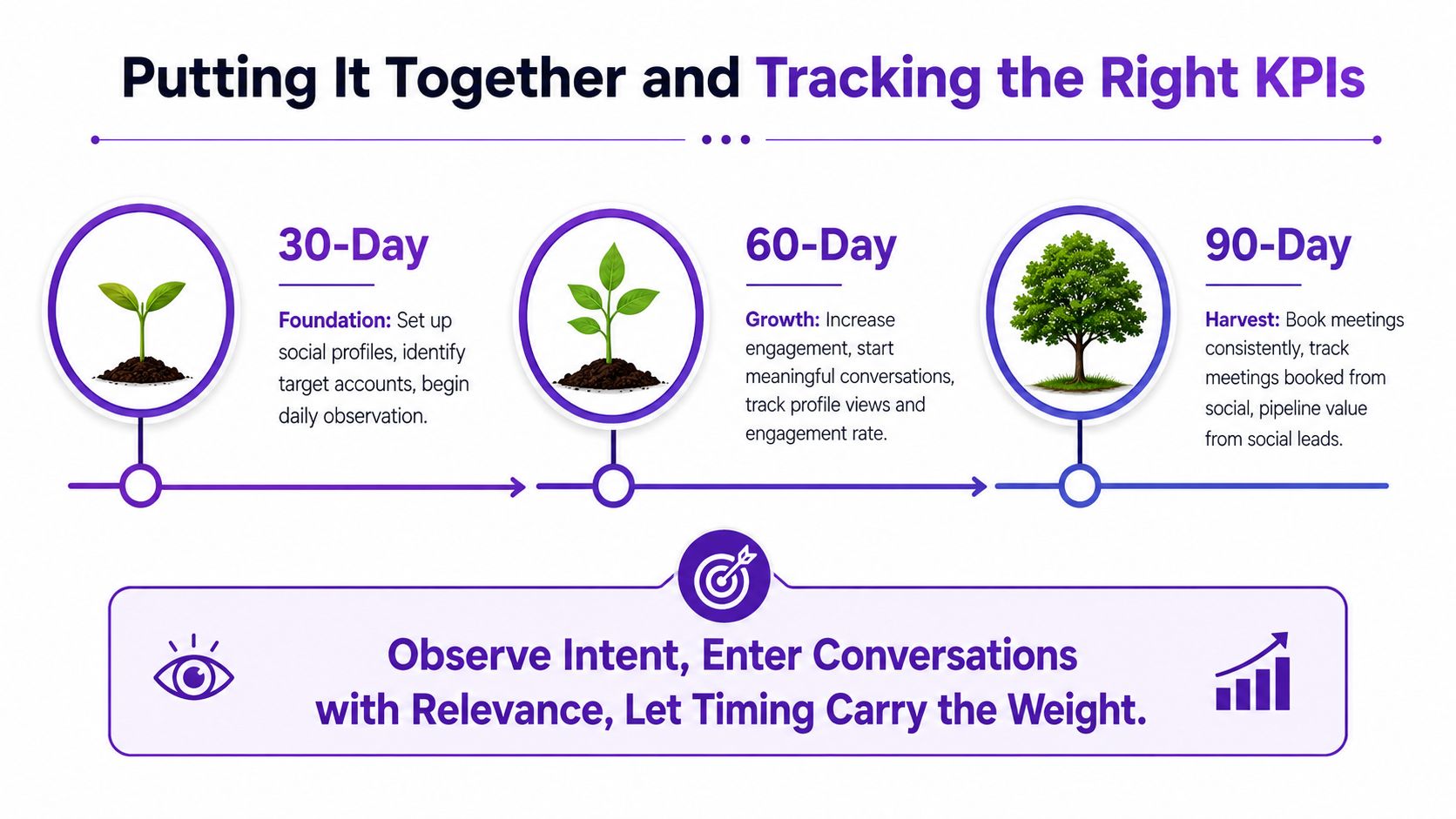
The operating model is straightforward: observe intent, enter with relevance, and let timing do more of the work. A 30-60-90 rollout keeps the change practical rather than turning it into another abandoned sales initiative.
First 30 days, foundation: Define the ICP, clean up seller profiles, identify priority accounts, establish topic monitoring, and start recording buyer signals.
Next 60 days, growth: Maintain daily engagement, run signal-based conversations, compare response quality by signal type, and review which topics attract target roles.
By 90 days, harvesting: Attribute meetings to qualified signal clusters, identify repeatable conversation patterns, and expand the workflow across the team.
Track four KPIs:
Qualified profile visits sourced from engagement, not total views.
Accepted connection rate from targeted profiles, not network size.
Reply rate on signal-triggered messages, separated from general outbound.
Meetings booked per qualified signal cluster, so repeated activity isn't counted as random noise.
Follower count is a visibility metric. It rarely explains pipeline on its own. Intent-aligned activity gives sales leaders a clearer link between what reps do and which buyers move closer to a conversation.
How long does social selling take to show pipeline?
It starts with immediate engagement feedback, but trust and commercial conversations develop through consistency. Teams should evaluate patterns over time rather than expecting one post or one message to prove the model.
Does it work for technical or niche buyers?
Yes, provided the signals and content match the buyer's domain. Technical buyers often reveal useful context through detailed questions, specialist discussions, and peer interactions, which gives sellers better material than a generic industry label.
What's the difference between social selling and social media marketing?
Marketing usually builds attention and audience demand at scale. Social selling applies professional context and direct relationship-building to identify specific buyers, join relevant discussions, and create sales conversations.
How does social selling compare with ABM?
ABM starts with selected accounts and coordinates messaging across channels. Social selling adds live individual behavior to that account strategy, helping reps decide which person, topic, and moment deserves attention.
LinkedIn's own business research reports that sellers using Sales Navigator have more than half of their revenue tied to deals involving social selling actions, reinforcing that the motion can be measured beyond brand activity. LinkedIn research on social selling and revenue
RoverLead AI helps B2B teams turn LinkedIn comments, creator engagement, competitor activity, and other live buying signals into a curated prospect feed with contextual openers. If you want to replace static list pulls with timely, signal-based outreach, visit RoverLead AI and see how it fits your social-selling workflow.