What Is Sales Intelligence and Why It Matters Now

Sales intelligence is the combined system of data, signals, and prioritization logic that helps a rep decide who to contact, when to reach out, and what message to use. A 2026 industry estimate values the category at USD 4.99 billion, up from USD 4.42 billion in 2025, with a projection of USD 9.15 billion by 2031.
The practical definition matters more than the market label. Sales intelligence isn't a prettier contact database. It's the operating layer that turns scattered information into a next action, ideally before an SDR spends the morning spraying generic messages at people who showed no reason to care.
Table of Contents
The Monday Morning Problem Every Seller Knows
Monday starts with 200 queued leads, an empty calendar, and three browser tabs open to competing intent dashboards. One tool says an account is researching your category. Another flags a hiring event. LinkedIn shows a prospect commenting on a competitor's post. The CRM, naturally, shows none of this.
So the rep does what the system encourages. They sort by company size, grab a sequence, personalize the first line with a recent funding announcement, and work through the list. By lunch, plenty of activity has happened. Very little of it was intelligently prioritized.
The problem isn't a shortage of data. Modern teams can find contact records, company attributes, technology information, website behavior, social activity, news, and buying research. The problem is that these signals arrive with different levels of reliability, urgency, and relevance. A pricing-page visit shouldn't carry the same weight as a vague third-party topic spike, but many dashboards flatten both into a glowing score.
Practical rule: If a rep can't understand why an account appeared in the priority queue, the score isn't intelligence. It's decoration.
Sales intelligence is supposed to close that gap. It should answer three operational questions quickly: who fits the ideal customer profile, what changed, and why should this rep act now? The useful system doesn't merely add another feed to the morning routine. It removes low-value research and gives the seller enough context to make a relevant move.
That makes sales intelligence a structural capability, not a test of individual discipline. Good reps still matter, but they shouldn't need detective skills to find the one account worth calling first.
What Sales Intelligence Means in 2026
Sales intelligence earns its place in the selling cycle by helping teams decide who deserves attention, what changed, and why a rep should act now. Gartner defines it as information salespeople use to make informed decisions, supported by practices and tools for collecting, tracking, and analyzing that information. IBM expands the scope to research on prospects, customers, competitors, and market conditions. Salesforce emphasizes suitable prospects, their needs, and timely engagement. The history of sales intelligence shows how the category developed around these needs.
A practitioner-friendly definition is simpler:
Sales intelligence is a connected process that gathers relevant account and buyer signals, adds context, ranks their importance, and places the resulting action inside the rep's workflow.
The process has four working parts.
Signals
Signals are observable changes or behaviors. They can include intent activity, repeat engagement, hiring, leadership changes, funding, technology changes, competitor interactions, and other events that create a plausible reason to start a conversation. A signal matters because of its timing and relevance, not because a vendor labels it “hot.”
Data sources
Sources include CRM history, company sites, public announcements, professional networks, intent providers, marketing automation, product activity, and competitive research. LinkedIn-native tools such as RoverLead can sit beside this classic data stack, surfacing activity in the channel where professional conversations happen. The source still matters. First-party behavior generally provides stronger context than an opaque external score.
Enrichment
Enrichment connects the signal to a usable account and person. It may add role, company attributes, technology context, trigger details, or the relationship between one individual action and the wider buying group. Without that context, a notification creates more research for the SDR instead of reducing it.
CRM fit
The output must reach Salesforce, HubSpot, or the system sellers already use. If a rep has to copy a signal into the CRM, then remember it from another dashboard, adoption will decline. Sales intelligence should strengthen the working record rather than create another isolated feed.
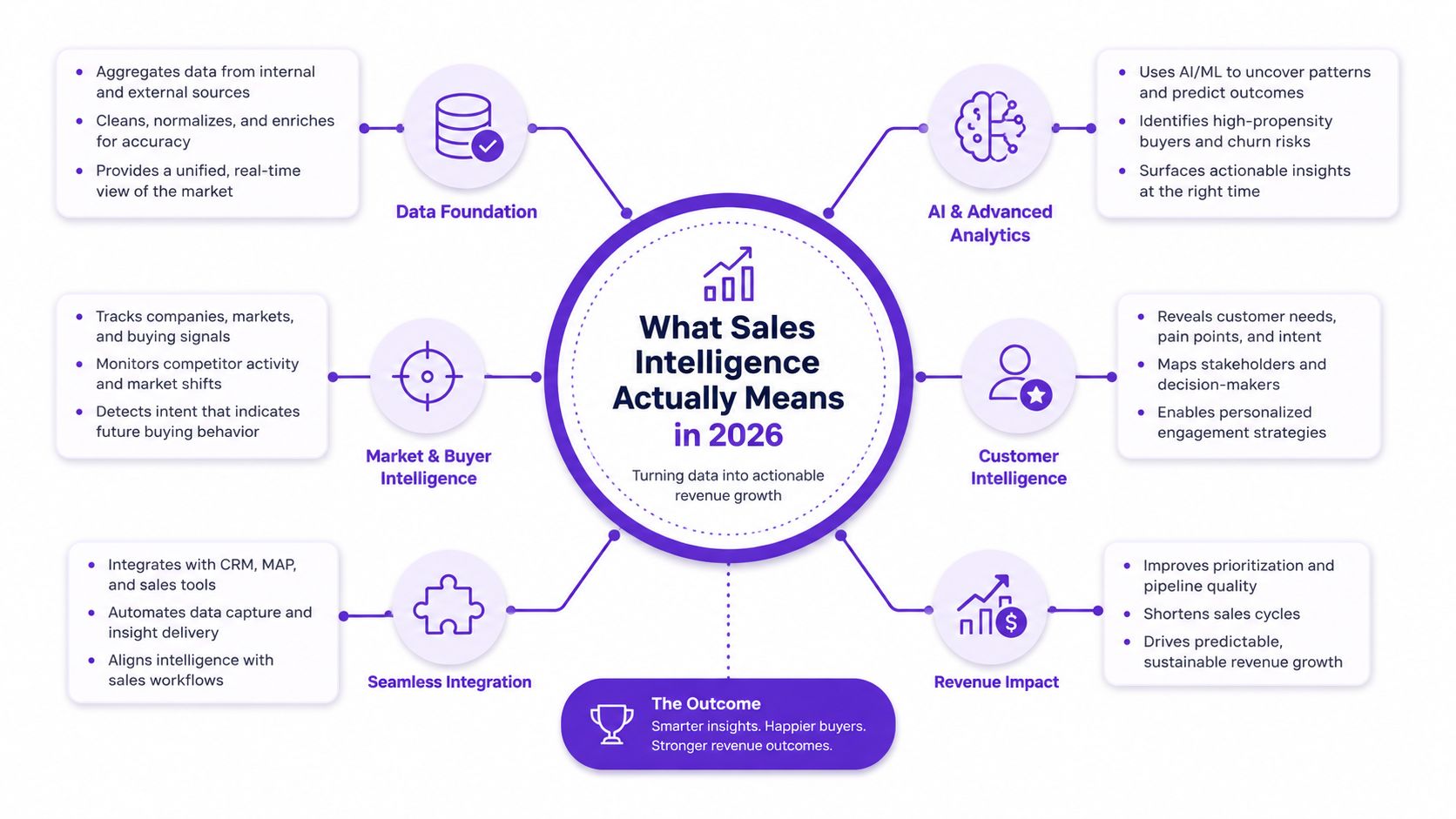
The category's expansion reflects this operating role. A 2026 market estimate from IBM places the sales intelligence market at USD 4.99 billion in 2026, compared with USD 4.42 billion in 2025, and projects USD 9.15 billion by 2031, implying a 12.89% CAGR from 2026 through 2031. The practical takeaway is that revenue teams increasingly treat signal collection and prioritization as software infrastructure, not a side project for sales support.
Sales Intelligence vs Intent Data vs Lead Scoring
These terms get mixed together because vendors often use them interchangeably. They aren't interchangeable. Sales intelligence is the broader system, intent data is one input, lead scoring is usually one decision output, and market intelligence sits farther upstream as strategic context.
Discipline | Core Question Answered | Primary Inputs | Typical Owner |
|---|---|---|---|
Sales intelligence | Who should we contact, when, and with what context? | Contact, firmographic, technographic, behavioral, intent, trigger-event, and competitive data | RevOps and sales |
Intent data | Which accounts may be researching a problem or category? | First-party behavior, third-party research, content activity, and topic engagement | Marketing and sales |
Lead scoring | Which leads or accounts deserve priority? | Fit attributes, engagement, intent, lifecycle data, and historical outcomes | Marketing operations and RevOps |
Market intelligence | What is changing in the market and competitive landscape? | Competitor moves, industry news, customer patterns, and market conditions | Strategy, marketing, and leadership |
A practical guide to intent data helps separate observed behavior from the larger intelligence workflow. A pricing-page visit, for example, may be an intent input. A score that combines that visit with account fit and a relevant trigger may become the prioritization output. The rep then uses the account view to decide whether to email, call, comment, or wait.
The mental model that keeps stacks sane
Think of the flow as:
Evidence → context → priority → action → feedback.
Intent data supplies evidence. Enrichment supplies context. Lead scoring helps set priority. Sales intelligence connects those pieces to action, while the CRM records what happened next.
Market intelligence has a different job. It helps leaders understand competitor positioning, category movement, and broader commercial conditions. It might influence territory planning or messaging, but it doesn't automatically tell an SDR which person deserves the next fifteen minutes.
The distinction matters during vendor evaluations. A platform that offers topic intent isn't necessarily a full sales intelligence system. Likewise, a scoring model isn't useful merely because it produces a number. The team needs to know which evidence produced the number and what a rep should do with it.
The Anatomy of a Signal That Actually Converts
Most explainers list signal types and stop there. That misses the hard part. A signal earns a place in a rep's morning only when it is credible, relevant, recent, and actionable.
First-party behavioral signals generally sit at the stronger end of the spectrum because the company observes them directly. Apollo identifies examples such as pricing-page visits, repeat visits, product trial activity, and high-intent content downloads as high-strength signals, while third-party research intent and firmographic triggers provide useful but weaker context in its overview of how to identify companies showing buying intent.
That doesn't make third-party data useless. It means the rep should treat it as a reason to investigate, not as proof that a buying project exists.
Four tests for signal quality
Strength asks whether the behavior is direct. A known prospect discussing implementation pain is more useful than an anonymous account appearing in a broad research segment.
Relevance asks whether the event connects to your offer and ICP. A hiring announcement can matter to a workforce platform and mean very little to a security vendor.
Recency asks whether the trigger still gives the seller a natural opening. Signals decay. A stale event may explain an account's history without justifying today's outreach.
Channel fit asks whether the behavior happened somewhere your team can engage appropriately. LinkedIn engagement can support a social conversation, while product usage may belong in an account-management motion.
LinkedIn activity deserves careful attention because it is observable, contextual, and often attached to a real person. A prospect commenting on a competitor's post, repeatedly engaging with a specialist creator, or discussing a demo question in a professional thread gives the rep more than a company-level topic label. It gives them a possible conversational entry point. A social-selling benchmark reports that 78% of salespeople who social-sell outperform peers who don't, a finding cited in LinkedIn sales statistics from Martal.
RoverLead AI illustrates this LinkedIn-native approach through Signal Agents that monitor 10+ buying signals, then organize relevant activity into a curated feed with context and an AI-written opener. The operating idea is sound even without the automation: connect a person's visible behavior to a specific, human message rather than pretending a generic score is a conversation.

For teams building the scoring layer, predictive lead scoring should remain subordinate to human-readable evidence. A model can prioritize accounts, but the rep still needs to know what happened and why the event supports contact now.
Rolling Out Sales Intelligence Without Breaking Your Stack
A rollout fails when the company buys a dashboard before deciding what a good decision looks like. Start with the action, not the feature list.
Define the target in five minutes
Write down the ICP, the people involved, the relevant competitors, the keywords that indicate a problem, and the events that create urgency. Keep the first version narrow. If every possible signal qualifies, no signal qualifies.
Next, choose sources that cover the decision you want to improve. A traditional data provider may support firmographics, contact records, and technographics. Your CRM and marketing automation can contribute first-party engagement. LinkedIn-native monitoring can add public professional behavior and conversation context. The stack doesn't need one magical provider. It needs clear ownership for each evidence type.
Connect enrichment to the workflow
Enrichment should update the account and contact record without creating duplicate records or forcing reps to maintain spreadsheets. Define which fields a source can write, which fields it can overwrite, and how the team handles uncertainty. A CRM data enrichment framework is useful here because data quality is a governance problem as much as a tooling problem.
AI deserves a similarly practical treatment. Research from Grand View Research on sales intelligence reports a market value of USD 3.7 billion in 2023 and forecasts about 10% CAGR through 2032, with AI, machine learning, and natural language processing identified as major drivers for entity extraction, pattern detection, predictive scoring, and surfacing signals before CRM stage changes. Those capabilities are real. They don't remove the need for decision logic, clean inputs, or rep feedback.
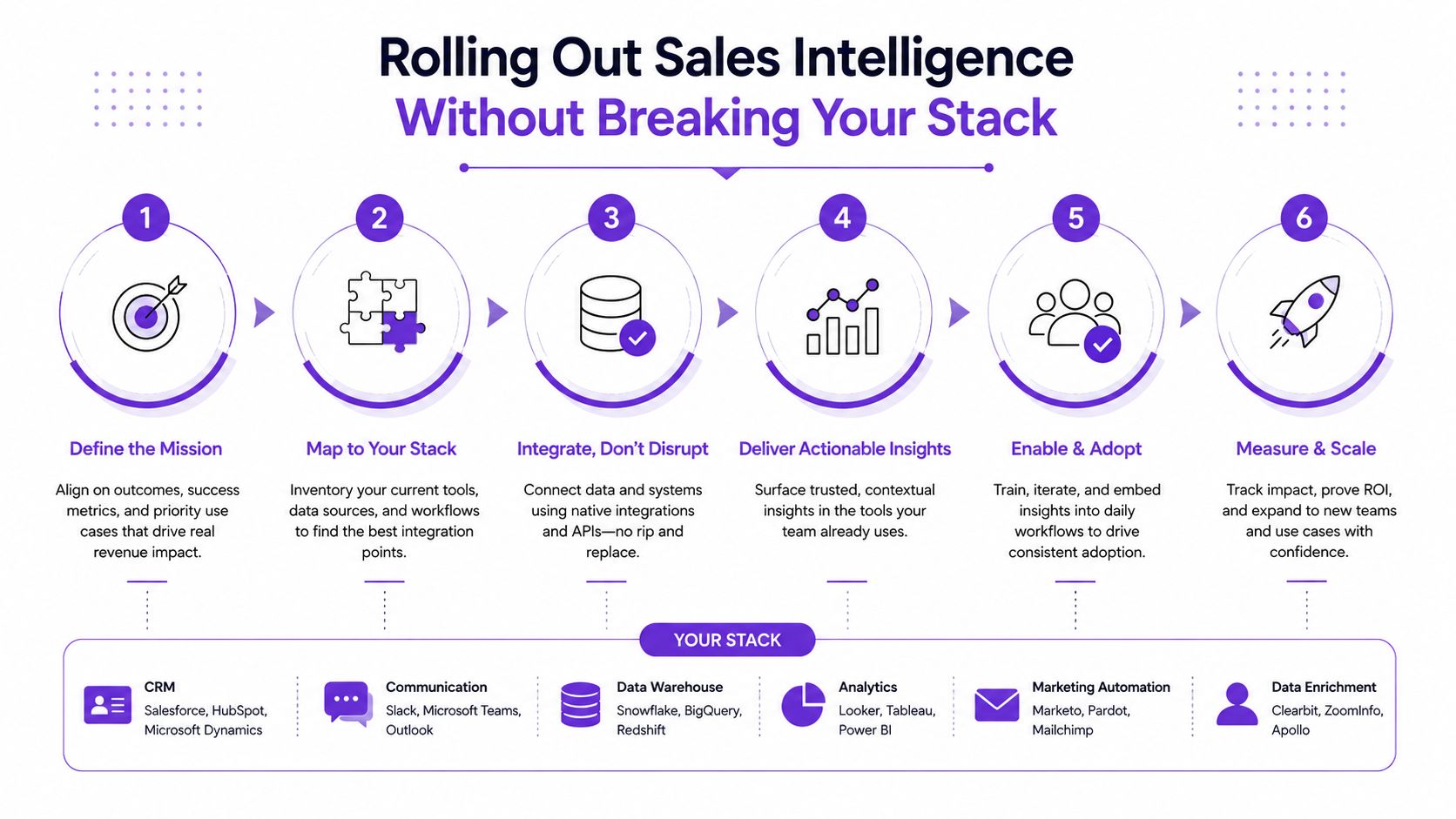
A LinkedIn-focused tool should complement, not replace, the core data stack. Sales Navigator can remain useful for account research and relationship mapping, while a signal layer identifies living behavior that deserves attention. The CRM remains the system of record. The prospecting tool supplies timing and context.
Pilot with a small rep group before broad deployment. Give them a simple feedback mechanism: useful, irrelevant, duplicate, or too late. At the end of a 30-day pilot, review reply rate, meetings booked, and research time saved. Those measures connect the system to seller behavior and pipeline motion. Vanity metrics such as alerts generated won't tell you whether the rollout improved prioritization.
Pitfalls and Vendor Selection Traps You Should Walk Into Eyes Open
Most sales intelligence failures aren't caused by a lack of data. They happen because the stack produces too many untrusted signals, the workflow hides them, or the CRM never receives the useful parts.
The classic mess starts with three intent vendors identifying the same account through overlapping sources. The team counts each alert as separate evidence, inflates the account's apparent interest, and sends an awkward message based on a conclusion no individual signal supports. More data has created less judgment.
The traps that create expensive noise
Double-counting activity: Several providers may observe the same research behavior. Ask how signals are deduplicated and combined.
Treating a score as proof: A score without evidence gives reps confidence without understanding.
Confusing traffic with intent: A website spike can reflect research, a customer, a partner, or curiosity. It needs context.
Ignoring signal decay: An old trigger may no longer justify outreach.
Overvaluing firmographic fit: The right company can still be inactive, satisfied with an incumbent, or outside a current buying window.
Burying alerts in Slack: A notification nobody acts on is operational clutter.
Failing to write back to the CRM: Manual copying breaks adoption and creates inconsistent records.
Skipping coverage checks: A vendor may look strong in a demo and perform poorly across your actual ICP.
Accepting opaque AI recommendations: If the system can't explain a recommendation, managers can't coach against it.
Ignoring compliance: Ask where data comes from, how it is used, and what controls support applicable privacy obligations.
Testing only the interface: A polished UI doesn't prove data accuracy or workflow fit.
Buying before defining success: Without a target behavior and KPI, every outcome can be rationalized.
The sales intelligence tools landscape is broad, but a useful scorecard stays small. Rate each vendor on signal coverage, freshness, CRM and workflow integration, compliance, explainability, and evidence from companies with a similar ICP. Then run real accounts through the system. Don't accept a sample built around the vendor's strongest market.
Selection test: Ask the vendor to show the raw event, the confidence logic, the recommended action, and the CRM record it creates. If they can show only the final score, keep looking.
The right question isn't “How much data do we get?” It's “How cleanly does this system help a rep choose the next action?” That is where sales intelligence earns its keep.
Putting It All Together and Where to Go Next
Sales intelligence works when signals, data sources, enrichment, and CRM fit feed one prioritization decision a rep can make quickly. The destination isn't a larger list. It's a better-timed conversation with a reason behind it.
Static list building tells a seller who might fit. Behavior-based selling adds evidence that someone may be paying attention now. That distinction brings the definition back to its practical core: sales intelligence helps a rep decide who to contact, when to contact them, and what context to use.
A LinkedIn-native approach can support that motion by using a short ICP and keyword setup, monitoring 10+ buying signals, and delivering a curated feed with context and an AI-written opener. The rep still decides whether the signal deserves a message. Automation should reduce research, not outsource judgment.
For the next step, choose one signal source, instrument one KPI, and run a 30-day pilot before adding another vendor. If the team can't explain what changed in its daily prioritization, the stack isn't ready to scale.
RoverLead AI turns LinkedIn engagement around competitors, creators, keywords, and buying discussions into ICP-matched prospecting signals, with context and AI-written openers for relevant outreach. Visit RoverLead AI to see whether a LinkedIn-native signal workflow fits your next sales intelligence pilot.