What Is Intent Data? a Guide to Smarter B2B Selling

Intent data is the collected behavioral signals that show a prospect or company is actively researching a purchase, turning the who of prospecting into the when and why. It matters because it's projected to power over 60% of all B2B marketing outreach strategies by 2026, and companies using it report a 30% increase in sales conversion rates versus relying only on firmographic data.
You can feel the old model breaking. The list is clean, the personas are mapped, the sequence is polished, and still the replies are thin. Reps keep hitting accounts that look perfect on paper but have zero reason to care right now.
That's the core purpose of intent data. Not to give you another spreadsheet of “good fit” companies. To show who is moving, what they're researching, and whether your timing is smart or painfully late.
Most guides stop at the account level. They tell you Company X is “surging” on a topic and leave you with the hard part: which human inside that company is the one raising their hand? That gap is where a lot of outbound dies. The company may be in market, but your rep still messages the wrong VP, the wrong manager, or the one person who hasn't looked at the problem at all.
Here, intent data shifts from theoretical to useful. The point isn't just knowing which company might buy. The point is finding which person is showing buying behavior, then contacting them while the signal still has a pulse.
Table of Contents
The End of Guesswork in B2B Sales
Monday morning. The SDR team has a clean target list, solid ICP filters, and a fresh sequence. By Friday, reply rates are flat, meetings are thin, and half the outreach went to people who were never in market to begin with.
That is the problem with static prospecting. Firmographics tell you who could buy. They do not tell you who is actively trying to solve the problem now. A company can match your ICP perfectly and still have zero buying motion for the next six months.
Intent data fixes that blind spot. It adds behavior to fit, so sales can prioritize accounts showing real research activity instead of treating every account on the list like an equal opportunity. In practice, that means fewer random swings and more outreach tied to timing.
Practical rule: Fit builds the list. Intent sets the order.
And there is a second layer that gets missed in a lot of intent data conversations. Knowing which company is heating up is useful. Knowing which person inside that company is driving the evaluation is what turns a signal into a meeting. If sales only sees account-level interest, reps still end up guessing which director, VP, or practitioner to contact first. That guess is where a lot of "intent-driven" outbound still falls apart.
Analysts at Gartner have long described B2B buying as a group decision, often involving six to ten stakeholders. That is why account intent alone is not enough. The account tells you where to look. The active buyer tells you where to start.
A lot of teams hear that and jump straight to tooling. Slow down. The first shift is operational. Stop treating every prospect as equally cold. Some accounts are comparing vendors. Some are reading category content. Some are back on your site for the third time in two weeks. Those are not vanity signals. They are a clue about timing, and timing is what gives outbound a real shot.
Cold outreach still works when it is relevant. Generic outreach gets ignored because buyers have better things to do than answer messages that arrived six months too early or went to the wrong person. Intent data, used well, helps sales show up with context instead of hope.
So What Exactly Is This Intent Data Stuff
Intent data in plain English
If you want the simplest answer to what is intent data, think of it as digital body language. Buyers leave clues before they ever book a demo. They read, compare, click, search, revisit, and engage. Intent data collects those actions and turns them into something sales and marketing can act on.
The most useful definition is this: intent data is a prioritization layer. It doesn't replace your ICP, territory plan, or account list. It tells you when to engage, not just who to target.
First-party intent data sits at the top of the trust ladder. First-party intent data, collected directly from your company's website, CRM, and email campaigns, is the most accurate and valuable form of intent data because the context and tracking are fully controlled by the brand, as explained in Default's overview of B2B intent data.
Second-party data is usually a partner's first-party data shared through a direct relationship. Useful, but less common in day-to-day sales workflows.
Third-party data comes from outside your owned properties. It's broader, earlier, and often noisier. That's the trade-off.
First-Party vs. Second-Party vs. Third-Party Intent Data
Data Type | Source | Accuracy & Relevance | Best For |
|---|---|---|---|
First-Party | Your website, CRM, email engagement, forms, chat, product usage | Highest accuracy and context because you control the source | Converting known demand and spotting engaged accounts already interacting with you |
Second-Party | A partner's owned audience or shared data arrangement | Often relevant, but depends on the partner relationship and data quality | Co-marketing, partner ecosystems, shared events, adjacent audiences |
Third-Party | Publisher networks, review platforms, external web activity, aggregated providers | Broad reach and earlier visibility, but less precise without filtering | Finding in-market accounts before they visit your site |
A practical setup usually looks like this:
Use first-party for certainty: Pricing page visits, repeat visits, demo-page traffic, and content engagement are direct clues.
Use second-party for context: Partner activity can strengthen the story around an account.
Use third-party for discovery: It helps surface accounts researching your category before they know your brand.
Intent data works best when you stop asking, “Who fits our ICP?” and start asking, “Who is showing buying behavior right now?”
The Digital Breadcrumbs B2B Buyers Leave Behind
A buying cycle usually starts long before anyone replies to an email or books a demo. By the time sales hears, “We're evaluating options,” the research is already underway across search, review sites, webinars, LinkedIn, and a dozen browser tabs nobody on your team can see directly.
That activity leaves clues. Some are obvious, like repeated visits to pricing or comparison pages. Others are softer, like a spike in category research, a new job post tied to your use case, or a prospect engaging with implementation content instead of top-of-funnel fluff. The point is not to admire the trail. The point is to figure out who inside the account is driving the evaluation.
That distinction matters. Company-level interest helps with prioritization. Person-level interest is what gets you to a meeting.
That trail can include:
Website behavior: Repeat visits, product-page views, and traffic to pricing, integrations, or comparison pages
Content engagement: Downloads, webinar signups, form fills, chat conversations, and return visits to the same topic
External research: Review-site activity, category reading, and competitor-related exploration
Public signals: LinkedIn engagement, comments, and posts tied to the problem your product solves
Business context: Job postings, funding events, leadership changes, and tech stack shifts that suggest a buying motion

How platforms turn activity into signals
Intent platforms collect events from different places and look for patterns that suggest active research. Some focus on account-level activity from publisher networks and web behavior. Others add review-site visits, public social activity, hiring trends, or technology changes.
Bombora, for example, is known for aggregating publisher consumption data and flagging unusual increases in research around specific topics. G2 can show buying activity closer to vendor comparison. LinkedIn signals can add a human layer, especially when someone in a likely buying role starts reacting to content about rollout speed, migration pain, or pricing trade-offs.
The trade-off is signal quality. One anonymous spike at the account level can tell you where to look. It does not tell you who to call. A surge around “sales engagement software” is useful. A revenue operations manager from that same account reading comparison content and commenting on rollout timelines is useful enough to act on.
Many teams often misunderstand a key aspect. They stop at “which company is showing intent” and hand reps a list of logos. Reps still have to guess which person cares, which person has influence, and which person is just bored on LinkedIn. That is why intent programs stall. The account was right. The contact was wrong.
A better approach is to pair account signals with buyer identification. Look for role fit, topic fit, and timing together. If the signal points to evaluation and you can match it to a likely stakeholder, outreach gets sharper fast. Teams that want that handoff to be less sloppy should tighten their lead qualification criteria and process.
Cold outreach is fading because random timing rarely works anymore. Intent data matters because it replaces guessing with evidence. The teams that get results are the ones that use those breadcrumbs to find the active buyer, not just the interested company.
How to Turn Vague Signals into Sales Meetings
A dashboard full of surging accounts won't save a weak process. Intent only works when reps know what to do next.

Prioritization beats volume
Before intent data, a rep works a flat list. Same effort for every account. Same generic sequence. Same predictable disappointment.
After intent data, the list gets triaged. Accounts showing active research go first. The rest move into slower nurture or get ignored for now. That's the shift from activity to judgment.
A useful companion to this is disciplined qualification. Teams that want a cleaner handoff between signal and pipeline should tighten how they define urgency, fit, and buying context. A practical framework for that lives in this guide on how to qualify sales leads.
Personalization that doesn't sound fake
Bad personalization means dropping in a company name and pretending that counts. Good personalization references the problem the buyer is already trying to solve.
That can look like:
Topic-led messaging: “Saw your team has been digging into outbound efficiency” is stronger than “We help B2B teams grow.”
Context-led outreach: If they're comparing vendors, send proof and differentiation. If they're early, send education.
Role-aware relevance: A sales leader and an ops manager may sit in the same account but care about very different outcomes.
Buyers respond to relevance faster than they respond to effort.
Here's a smart primer if your team is trying to align messaging with behavior instead of job title. Watch this, then compare it to your current outbound playbook.
Timing is the whole game
A good message sent too late is still a miss. Intent gives you a window. Your process needs to respect it.
The before-and-after is simple:
Before: “Checking in on priorities for this quarter.”
After: “Noticed your team is researching [topic]. We've seen this come up when teams are trying to solve [specific issue]. Worth comparing approaches?”
The second works because it meets active demand. The first assumes demand.
Putting Intent Data to Work The Right Way
A lot of teams buy intent data and still don't get meetings. The reason is usually not the signal. It's the gap between account-level awareness and contact-level action.
The account-level trap
Most providers tell you a company is researching a topic. Fine. Useful. But a company doesn't reply to your email. A person does.
That's where the usual workflow falls apart. Marketing sees “high intent” at the account. Sales still has to guess which director, manager, or VP is actively involved. Guess wrong and the whole thing starts to look like expensive cold outreach with fancier labels.
While 78% of firms use intent data for account targeting, only 34% successfully apply it for contact-level prioritization. This gap means sales teams waste cycles on inactive stakeholders, reducing reply rates by up to 60% despite high account-level signals, according to Forrester's analysis of intent data gaps.
From company interest to person-level action
The practical fix is to connect broad intent with observable individual behavior. Public social activity is one of the cleaner ways to do that. If someone is commenting on a competitor's post, engaging with category experts, or discussing the exact workflow your product addresses, you don't need to invent intent. You can see it.
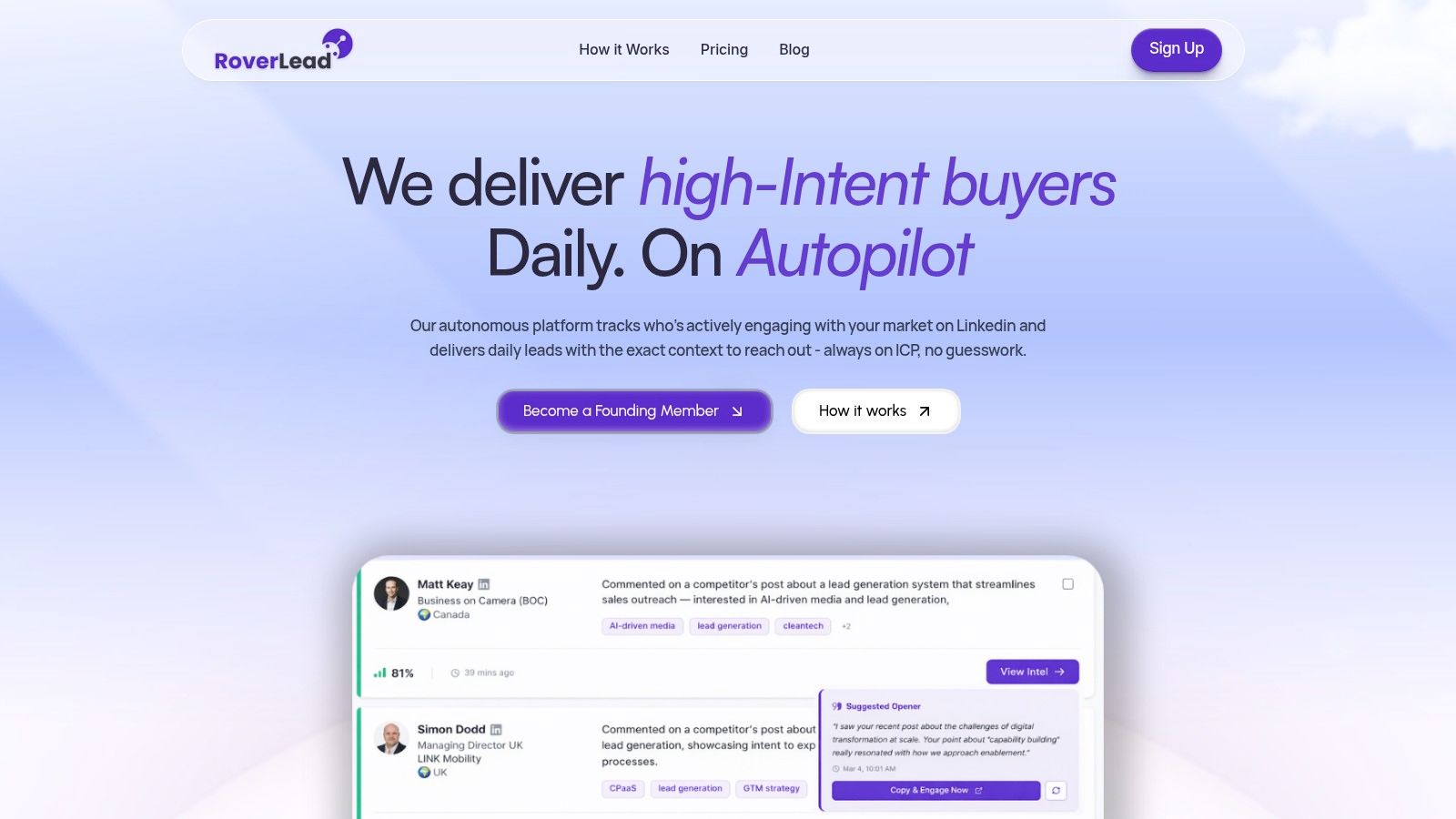
That's where newer workflows differ from older data dumps. Instead of handing reps a CSV of warm-looking accounts, some tools surface live activity with context. Platforms in this category vary, but the common idea is the same: identify the human behind the signal. For example, intent-based marketing workflows often combine account context with public engagement so teams can move from “this company is active” to “this person is likely part of the buying motion.”
One example is RoverLead AI, which monitors LinkedIn engagement patterns around competitors, creators, keywords, and buying discussions to surface contact-level signals matched to an ICP. That's materially different from broad account scoring because the rep starts with a person and context, not a logo and a hunch.
The last mile of intent data is not identifying the company. It's identifying the person who cares enough to act.
Navigating Privacy Pitfalls and Picking a Partner
Intent data has a freshness problem that vendors don't always advertise. Buyers move on. Projects stall. Priorities change. A signal can be real on Tuesday and useless by next week.
Fresh beats flashy
That's why recency matters more than a glossy dashboard. Intent data “becomes old and outdated quickly,” and ignoring signals older than 72 hours can cut 80% of the noise. In fact, 62% of buyers express frustration when contacted after their intent window has closed, according to Vector's piece on what to do with intent data.
Privacy pressure makes this trickier. As third-party data becomes less granular, teams need cleaner sourcing and better validation. In practice, that pushes a lot of smart operators toward first-party signals, public signals, or tightly defined workflows rather than giant black-box feeds.

A short vendor checklist
When evaluating platforms, ask blunt questions:
Where does the data come from: Owned properties, public activity, publisher networks, or some mystery stew?
How fresh is it: Can the team act on signals today, or are they reviewing stale activity?
Is it account-level or contact-level: If it stops at the company, reps still have a targeting problem.
Can it fit the workflow: Signals need to land where sales already works, not in a dashboard nobody opens.
Does it support ABM execution: If your team is running coordinated account plays, this guide to account-based marketing tools is a useful way to compare workflow fit.
The biggest trap is buying “intent” that creates more interpretation work than action.
Frequently Asked Questions About Intent Data
1. Is intent data just another lead list
Intent data is a prioritization layer, not a list purchase with better branding. It helps reps decide where timing is in their favor and, critically, which accounts deserve attention before the quarter gets away from them.
2. What's the difference between an intent signal and an intent score
An intent signal is the raw behavior. A pricing-page visit, review-site comparison, repeat visits from the same company, or a spike in topic research.
An intent score is the platform's summary of those behaviors. Useful, yes. But reps should still look at what drove the score, because a 78 built on junk signals is still junk.
3. What score usually counts as high intent
Many platforms treat 70+ as a common threshold for high-priority accounts, based on Hockeystack's explanation of intent score thresholds.
That said, the number matters less than the pattern behind it. A strong score with recent buying activity beats a higher score based on broad, old interest.
4. Is first-party or third-party intent data better
They solve different problems. First-party intent is usually cleaner and easier to trust because it comes from your own site, forms, product, or content. Third-party intent helps spot demand before a buyer ever lands on your turf.
The trade-off is simple. First-party is better for confirming interest. Third-party is better for finding it early.
5. Where do third-party intent signals come from
Third-party signals can come from publisher networks, review sites, public social activity, job posts, funding announcements, event participation, and external content consumption. Some sources are strong. Some are noise dressed up as precision.
Freshness and specificity matter more than volume. “Someone at Acme read about cybersecurity” is weak. “The VP of IT engaged with ransomware content this week” is far more usable.
6. Can intent data work for account-based marketing
Yes, and this is one of the few places where ABM gets more practical instead of more theatrical. Intent helps teams stop treating every target account like it has the same timing, the same urgency, and the same buyer readiness.
The catch is execution. Account-level intent can help marketing choose where to spend. Sales still needs to figure out which person is active, or the campaign turns into expensive guessing.
7. Why do teams struggle to turn account intent into meetings
Because “the account is researching” is not the same as “this buyer will take a meeting.”
That gap kills conversion. A company can show clear intent while the rep emails the wrong director, the wrong function, or someone who has zero reason to care. The main goal is finding the active buyer inside the active account.
8. How fast should sales act on an intent signal
Fast enough that the signal still reflects live research. If a rep waits two weeks, they are no longer following intent. They are following a history lesson.
Good teams treat recency as part of qualification. Fresh signals get action. Old ones get downgraded or ignored.
9. What should teams measure besides MQLs
Measure speed from signal to conversation, meeting rate from intent-sourced outreach, and how often reps identify the right contact on the first pass. Those metrics tell you whether intent is helping pipeline or just creating prettier dashboards.
For a practical benchmark, SalesIntel's guide to buyer intent data makes the same point in plain English. The value is in faster, better-timed conversations, not in piling up more scored accounts.
10. What is intent data really replacing in modern outbound
It replaces the old habit of treating every good-fit account like it is ready right now. That model gave teams static lists, generic LinkedIn messages, and lots of activity that looked busy but did not turn into meetings.
If your team is relying on static lists and generic LinkedIn outreach, RoverLead AI is built for the gap most intent tools leave open. It turns public LinkedIn engagement into contact-level prospecting signals, matched to your ICP, so reps can start with the person showing intent instead of guessing inside an account.