A Modern Guide to B2B Sales Lead Generation for 2026

Let's cut to the chase. B2B sales lead generation isn't just about finding new customers. It's about finding them before your competition does, often before the prospect even knows they need you. It’s supposed to be the high-octane engine for your pipeline, but for most teams, it feels like shouting into a void and getting nothing but a faint, sad echo in return.
Is your sales team under constant pressure for more leads? Of course they are. It’s a story as old as sales itself. But the real question, the one that keeps sales leaders up at night, is how many of those leads ever become actual, spendable revenue. That’s the gap where most sales strategies go to die—the chasm between lead volume and pipeline quality.

The old playbook of "spray and pray" is just a fast-track to burning out your reps. It clogs your CRM with contacts who have zero intent, trapping your team on a hamster wheel of wasted effort and missed targets. It's a numbers game where the house always wins, and your team is left footing the bill with their morale.
This isn't just a feeling; the numbers are brutal. Lead generation is the top goal for 91% of B2B marketers, but there's a massive disconnect. A full 61% admit that only 27% of the leads they pass to sales are even qualified. And a staggering 80% of new leads will never turn into a sale. You can find more on this broken model in the data from CirrusInsight.
The core problem isn't a lack of effort. It's a lack of precision. We've been taught to chase volume, when we should be chasing relevance and, most importantly, timing.
This guide isn’t about generating more leads. It’s about generating the right leads. We're going to ditch the outdated focus on static company data and get smart about spotting buying intent.
Table of Contents
What Exactly is B2B Sales Lead Generation, Anyway?
Okay, let's get the textbook definition out of the way so we can get to the good stuff. B2B Sales Lead Generation is the process of identifying and attracting potential business customers (the "leads") for your company's products or services. The goal is to fill the top of the sales funnel with qualified prospects who your sales team can then engage, nurture, and hopefully, convert into paying customers.
Think of it as the matchmaking service for the business world. You’re not just looking for any company; you’re looking for a company with a problem that your solution can solve, and you want to find them when they're actually ready to talk about it. It’s a blend of marketing, sales, and a little bit of detective work.
The Old Way vs. The Smart Way in Lead Generation
If your B2B lead generation feels like pushing a boulder uphill, you’re not wrong. You're just using an old, rusty lever.
You know the drill. Buy a static list, load it into a dialer, and just hope something sticks. It’s an exhausting numbers game that forces your team to become professional interrupters, bothering prospects who have shown zero interest. You’re a cold caller, an unread email, a ghosted connection request. Your targeting is based on firmographics—company size, industry, job title. This tells you who a person is on paper, but absolutely nothing about what they need right now.
The fatal flaw in old-school prospecting is ignoring the one thing that actually matters: timing. You're operating on your schedule, not your buyer's.
A More Intelligent Approach to Finding Leads
The smart approach flips this entire model on its head. Instead of blasting cold lists, you focus on identifying prospects who are already in a buying cycle.
This is about listening for dynamic buying signals—a comment on a competitor’s LinkedIn post, a question about pricing in a Slack community, or engagement with an influencer’s content. You’re not interrupting anymore. You’re joining a conversation that’s already happening. Your outreach is perfectly timed because the prospect just publicly raised their hand.
This shifts your targeting from static, outdated firmographics to dynamic, demonstrated behavior. It’s more precise, more efficient, and frankly, a lot more rewarding than cold calling your way through a list of grumpy strangers.
The difference is night and day. One method is built on brute force; the other is built on intelligence and relevance.
Here’s a side-by-side look at how the two approaches stack up.
Lead Generation Methods: The Old Way vs. The Smart Way
Dimension | Old School (Static Prospecting) | New School (Intent-Based Prospecting) |
|---|---|---|
Data Source | Static, purchased lists of contacts | Dynamic buying signals from online activity |
Outreach Timing | Interrupting prospects on your schedule | Engaging prospects at their moment of need |
Targeting Method | Broad firmographics (e.g., job title, industry) | Demonstrated behavior (e.g., comments, follows) |
Core Metric | Volume of activity (dials, emails sent) | Quality of engagement (positive replies) |
Rep Morale | Low (rejection, monotony) | High (meaningful conversations) |
Buyer Experience | Annoying, feels like spam | Helpful, feels like good timing |
It’s clear which model gives you a real advantage. One is a game of chance, hoping you get lucky. The other is a system, designed to put you in the right place at the right time, every time.
Using LinkedIn for High-Intent Prospecting
If B2B sales is a game, LinkedIn isn't just the stadium—it's the entire league. It stopped being a digital résumé file years ago. Now, it's the core playground for modern B2B sales lead generation.
The numbers don't lie. In 2026, a whopping 94% of B2B marketers are on LinkedIn for their sales efforts, and the platform is responsible for a staggering 80% of all B2B leads. You can see more data on why LinkedIn is such a powerhouse over at warmly.ai.
But this isn't about aimless scrolling. It’s about active social listening—turning the constant noise on the platform into a curated list of prospects who are all but raising their hands to buy.
How to Spot High-Intent Signals on LinkedIn
Forget cold outreach. Winning on LinkedIn means finding the high-intent buying signals people leave behind. These are the digital breadcrumbs that tell you a prospect is in-market right now. You’re not interrupting their day; you’re joining a conversation they already started.
So, what do these signals actually look like?
Content Engagement: Someone comments on a competitor’s post asking about pricing or integration capabilities.
Following Key Accounts: A decision-maker from a target account suddenly follows your CEO, your company page, and two of your product managers.
Joining Niche Groups: Your ideal buyer joins a group dedicated to solving the exact problem your product addresses.
Asking Questions: A user posts something like, "Can anyone recommend a CRM that plays nice with our existing marketing automation stack?"
The entire goal is to shift from static list-building to dynamic opportunity-spotting. It’s the difference between guessing who might be interested and knowing who is.
This chart breaks down the old way versus the smart, intent-driven approach.

The difference is clear. You stop interrupting people based on outdated data and start joining conversations based on what they're doing today.
This proactive approach is a total game-changer. For a tactical deep-dive, check out our guide on mastering LinkedIn lead generation. It’s all about turning your feed from a social network into a finely-tuned machine for finding leads and engaging buyers at the perfect moment.
Building Your Intent-Based Prospecting Engine
Theory is fine, but pipeline is better. Let's get past the concepts and build the machine that actually finds you high-intent leads.
This isn't about buying another contact list. It's about building a smarter, context-driven engine for your B2B sales lead generation that surfaces buyers who are already looking for a solution like yours.
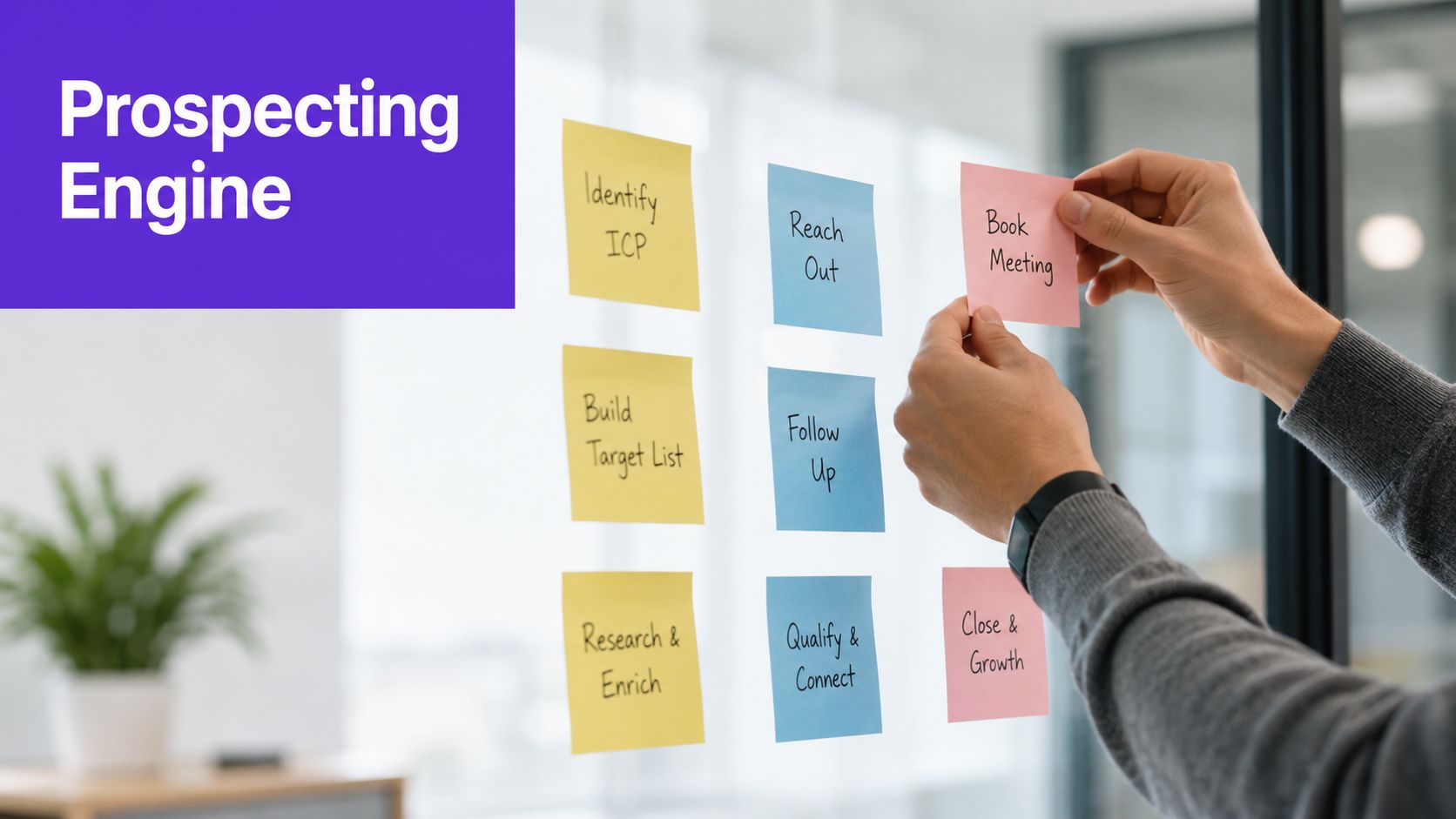
The entire system runs on three core pillars. Get these right, and you’ll stop chasing prospects and start attracting buyers.
1. Define Your ICP with Behavioral Traits
You have an Ideal Customer Profile. It probably includes firmographics like company size, industry, and job titles. That’s a start, but it’s static. It tells you who they are, not what they’re doing.
A modern ICP needs a behavioral layer.
Instead of just targeting "VPs of Marketing at SaaS companies," you need to know what they do.
What industry newsletters are in their inbox?
Which demand gen podcasts are they listening to on their commute?
Whose LinkedIn posts are they commenting on?
This adds a dynamic, real-time dimension to your targeting. You're no longer just looking for a title; you're looking for someone who acts like your ideal buyer.
2. Identify Your Digital Watering Holes
Once you know the behaviors, you can find where they happen. These are your digital “watering holes”—the online spaces where your ideal buyers gather, learn, and, most importantly, signal their needs.
Your list of watering holes should include:
Key Industry Creators: The top 5-10 LinkedIn influencers your prospects consistently follow and engage with.
Competitor Activity: The comments sections on your rivals' ads and posts are absolute gold mines for finding dissatisfied customers.
Relevant Topics: Hashtags and keywords related to the problems you solve, like #SalesEnablement or "how to improve forecast accuracy."
Monitoring these spots is like setting up camp where you know your prospects will eventually walk by.
The goal is to stop searching for needles in a haystack and start putting magnets where you know the needles will be. You're building a system to surface opportunities, not just find contacts.
3. Craft Genuinely Relevant Outreach
This is where the engine actually produces results. Armed with context from those watering holes, your outreach transforms from a cold, easy-to-ignore interruption into a timely, relevant conversation starter.
You finally have a real "reason to call." A generic cold email gets deleted instantly. A contextual message gets a reply.
Here's the difference in action:
"Hey [Name], saw your comment on [Creator]'s post about [Topic]. Your point about [Specific Insight] was spot on. We're actually helping companies like yours tackle that exact problem by [Your Solution]. Worth a quick chat?"
This approach respects the buyer’s time and intelligence. It shows you’ve done your homework, even if it only took 30 seconds.
For a deeper look into the strategy behind this, you can learn more about the principles of intent-based marketing. It's all about focusing your energy on conversation and closing, not endless, fruitless research.
Measuring Metrics That Actually Matter
Are you tracking activity or impact? It's the most important question for any B2B sales lead generation playbook. For years, we've been stuck worshipping vanity metrics: dials made, emails sent, connection requests fired off.
These numbers look great on a weekly dashboard. They create the illusion of progress. But they tell you absolutely nothing about the health of your pipeline or the revenue you're actually creating. It's time to stop measuring how busy your team is and start measuring how effective they are.
An intent-driven strategy forces this shift. When every piece of outreach is rooted in relevance and context, prospects don't just reply—they engage.
You’re not just booking more meetings by focusing on quality over quantity. You're building a pipeline that’s healthier, more predictable, and full of people who actually want to talk to you.
Key Metrics for a Modern Sales Team
Forget the raw activity numbers. If you want to know if your strategy is working, upgrade your reporting to focus on these three KPIs. They measure impact, not just effort.
Positive Reply Rate: What percentage of your outreach gets a genuinely positive response? I’m not talking about a polite "no, thanks." I mean real interest. This is the ultimate test of your message's relevance.
Meeting Booking Rate: Of those positive replies, how many turn into a booked meeting on the calendar? This measures your team’s ability to convert a flicker of interest into a real sales conversation.
Sales Cycle Velocity: How fast are leads moving from that first touchpoint to a closed deal? High-intent leads should be moving through your pipeline faster, shortening the sales cycle and bringing revenue in the door sooner.
Focusing on these KPIs is how you prove the ROI of a smarter, more targeted sales motion. It’s also how you start to get a much clearer picture of your financial model by truly understanding your cost per acquisition on a deeper level.
Frequently Asked Questions (FAQ)
Switching from cold lists to warm signals is a big move. It’s smart, but it also brings up some sharp questions from sales leaders and reps on the ground. Let’s get into them.
1. Is This Just Creepy LinkedIn Stalking?
The question always comes up: Isn't tracking what people do on LinkedIn a bit creepy? Let's be clear. This isn't about spying. It's about listening. When someone publicly comments on a post about a business problem, they’re raising their hand. They are broadcasting an interest or a pain point to their entire network. Responding to that public signal with a relevant, timely message isn't creepy. It's just good sales. The creepy part is the generic, context-free pitch that ignores who they are and what they care about. This is the opposite of that.
2. How Is This Different from Sales Navigator?
Sales Navigator is a fantastic tool for building lists based on who people are—their title, company, industry. It answers the question, "Who fits my ideal customer profile on paper?" It’s a static map. Intent-based prospecting is dynamic. It focuses on what people are doing right now. It answers the question, "Who is signaling they need help today?" The two work best together. Use Sales Nav to build your map, then use intent signals to know exactly where to go first.
3. What Kind of Results Are We Talking About?
Teams that make this switch see their positive reply rates jump. We're talking 2-3x higher than their old cold outreach numbers. Why? Your very first message is built on relevance, so prospects are just far more likely to actually engage. This leads to more booked meetings and a shorter sales cycle.
4. How much time does this really save?
Manually digging through LinkedIn feeds is a soul-crushing time sink. But when you automate the process of finding these signals, reps can cut their prospecting research time by up to 60%. Instead of hunting, they get a curated feed of warm opportunities and can spend their time actually talking to people who want to hear from them.
5. How do I get my boss to buy in?
Forget talking about features. Frame it around outcomes. This isn't about a new tool; it's a strategy to make the entire sales team more efficient, book more qualified meetings, and build a pipeline that's actually predictable. My advice? Propose a small, two-week pilot. Track the positive reply rate from this method and put it right next to your current cold outreach baseline. The numbers will do all the talking.
6. What's the difference between MQLs and SQLs?
MQL stands for Marketing Qualified Lead. These are individuals who have shown some interest based on marketing efforts, like downloading an ebook. SQL stands for Sales Qualified Lead. These are leads that the sales team has vetted and confirmed are a good fit and have a high potential to become a customer. The goal of good B2B sales lead generation is to produce more SQLs, not just MQLs.
7. What are some other B2B lead generation channels besides LinkedIn?
While LinkedIn is a powerhouse, it's not the only game in town. Other effective channels include:
Niche Communities: Slack channels, Discord servers, and private forums related to your industry.
Content Marketing & SEO: Creating valuable blog posts and guides that attract prospects searching for solutions on Google.
Webinars & Virtual Events: Hosting educational events that draw in your target audience.
Referral Programs: Encouraging happy customers to refer new business.
8. Should I buy B2B lead lists?
In 2026? Almost never. Purchased lists are often outdated, inaccurate, and full of people who have never heard of you and have shown no interest. It's the foundation of the "spray and pray" method we're trying to leave behind. Focusing on intent signals is a far more effective use of your team's time and resources.
9. What is "intent data"?
Intent data is information that indicates a prospect's interest in buying a product or service. It can be "first-party" (data you collect from your own website, like someone visiting your pricing page) or "third-party" (data collected from across the web, like someone reading articles about a specific software category). Social listening on LinkedIn is a powerful form of third-party intent data.
10. What's the single biggest mistake in B2B sales lead generation?
Being generic. The single biggest mistake is sending the same message to everyone. In a world of infinite noise, personalization and relevance are the only things that cut through. Never just say, "I see you're active on LinkedIn." You have to reference the specific comment, the topic, the creator. The context is everything. "Loved your insight on [Creator]'s post about AI in sales…" is a world apart from the usual noise and the key to getting a reply.
Ready to stop chasing cold leads and start engaging active buyers? RoverLead AI uses autonomous Signal Agents to monitor LinkedIn for you, delivering a daily feed of high-intent prospects with AI-written openers. See how our clients are booking 30-50% more meetings by visiting https://roverlead.com and starting your trial.