A Guide to LinkedIn Lead Generation That Actually Works in 2026

Let's play a game. You're a B2B professional, and you know, with the certainty of the sun rising tomorrow, that your next six-figure client is scrolling through LinkedIn right this second. The problem? Finding them feels like trying to catch a specific fish in the Pacific Ocean... with your bare hands.
On paper, LinkedIn lead generation sounds simple enough: find potential customers, connect, and convert. Easy peasy. But if you’re reading this, you probably suspect it’s more "queasy peasy."
Why Your LinkedIn Strategy Feels Like a Hamster Wheel
Be honest. Does your current "strategy" involve an unhealthy amount of time doom-scrolling through Sales Navigator, building lists of VPs who all look vaguely similar?
You spend hours crafting what you believe is the "perfect" connection request, a masterpiece of wit and value. You send it off, maybe with a personalized InMail chaser, and then... crickets. The silence is so loud you can hear your quarterly target weeping softly in the corner. You're on the modern B2B prospecting hamster wheel, and frankly, you're getting dizzy.

This isn't a "you" problem. It's an "everyone" problem. Most sales teams are stuck in an outdated playbook, a brute-force numbers game. They’re chasing static data—job titles, company size, industry—and building lists that are stale the moment they're exported.
The issue isn't LinkedIn itself. The data is clear: 89% of B2B marketers use LinkedIn for lead generation, and it's reportedly 277% more effective than other social platforms. So where's the disconnect? A revealing 62% of those marketers admit they aren't getting quality leads. Ouch. It’s a game of timing, not just shouting into the void.
The real problem isn't your work ethic; it's your workflow. Relying on static job titles and endless scrolling is a one-way ticket to Burnout City. The secret isn't more activity; it's smarter, intent-based activity.
This old-school method completely ignores the most crucial element: buying signals.
What Is LinkedIn Lead Generation, Really?
Before we fix the engine, let's agree on what we're building.
LinkedIn lead generation is the process of identifying, attracting, and converting potential customers for your business using the LinkedIn platform. This involves a mix of inbound strategies (like content marketing and profile optimization) and outbound strategies (like direct outreach and social selling).
The goal isn't just to collect connections like Pokémon cards. It's to build a predictable pipeline of qualified prospects who are genuinely interested in what you have to offer. The problem is, most people are doing it wrong. They're focused on the who (job title) but completely ignoring the when (buying intent).
This guide is about flipping that script. We'll show you how to move from static lists to active signals, transforming your LinkedIn from a time-sink into a lead-generating machine.
Need a broader primer on this modern approach? Our guide on B2B sales prospecting lays a strong foundation.
Table of Contents
The Old Grind vs. The Intent-Based Approach
If your LinkedIn lead generation efforts feel like pushing a boulder uphill, it’s because you’re probably playing the old numbers game. We've all been there.
You fire up Sales Navigator, pull a list of 500 VPs based on title and industry, and load up a generic template that starts with "I came across your profile..." You hit send, cross your fingers, and hope for a 2% reply rate—which, in this game, is considered a win. Sound familiar? It’s a strategy built on volume, guesswork, and a whole lot of prayer.
The fatal flaw in this approach? It completely ignores timing and intent. A job title doesn't tell you if someone is desperately seeking a solution, fuming about their current provider, or just trying to survive another Tuesday meeting marathon. You're just another uninvited interruption, guessing they might have a problem you can solve.
The Shift to Smarter Selling
Now, let's contrast that with a modern, intent-based approach. Instead of blasting messages into the abyss, you focus on people who are actively signaling they need help right now. This isn't about finding leads; it's about letting your ideal customers reveal themselves through their actions on the platform.
What does that look like in practice? It’s about tracking real-time behavioral signals, such as:
A prospect asking for tool recommendations in a LinkedIn group you’re in.
A key decision-maker complaining about a competitor’s recent price hike.
An executive liking or sharing a post about the exact business problem you solve.
These aren't cold leads. These are hand-raisers. By zeroing in on these moments, you stop interrupting strangers and start joining conversations that are already happening.
The old way is about finding people with the right job title. The smart way is about finding people with the right problem at the right time.
Let's break it down. The table below shows exactly why one strategy leads to burnout while the other builds a predictable, high-quality pipeline.
LinkedIn Lead Generation Methods Compared
Factor | Traditional Prospecting (The Grind) | Intent-Based Social Selling (The Smart Way) |
|---|---|---|
Lead Source | Static lists (firmographics, job titles) | Dynamic, real-time behavioral signals |
Timing | A complete guess, often poorly timed | Precisely timed to an active buying cycle |
Relevance | Low; based on assumptions | High; based on explicit user actions |
Outreach | Generic templates ("I saw your profile...") | Hyper-relevant, contextual openers |
Success Metric | High volume, low reply rate | High reply rate, booked meetings |
The difference is stark. The old way is a game of chance that requires massive volume to produce meager results. The smart way is a targeted, efficient system where every action is backed by real data, leading to fewer, but far better, conversations. It's a fundamentally different, and frankly, more enjoyable way to operate.
Building Your Intent-Based Prospecting Engine
Enough with the philosophy. Let’s get tactical. This is about building a repeatable system that brings the right prospects to you on LinkedIn. It’s not about working harder; it’s about working smarter. The mission is to create an engine that automatically surfaces high-intent leads, so you can stop scrolling and start selling.
First things first: your LinkedIn profile can't be a dusty, digital resume. It needs to be a resource hub, a magnet for your ideal customer. Your headline isn't "Sales Director." It's "I Help B2B Tech Companies Cut Churn by Fixing Their Broken Onboarding." Every part of your profile—from summary to featured posts—needs to scream "I solve your specific problem."
Define Your Signal Universe
The beating heart of this engine is what I call your "signal universe." This is the digital ecosystem where your future customers hang out, share ideas, and—most importantly—complain. Stop thinking in static lists. Start thinking in dynamic conversations.
To build it, you need to identify and monitor a few key areas:
Key Competitors: Where are their customers venting about a missing feature or asking about pricing? Those comment threads are pure gold.
Industry Experts: Who do your prospects actually follow for advice? The comments on their posts are a direct line into your market's hive mind.
Relevant Topics & Hashtags: You must track conversations around buying-intent keywords. Think phrases like “#CRMrecommendation” or posts asking, “which sales engagement platform is best for a small team?”
This is where you'll find the buying signals—the digital breadcrumbs leading you straight to a warm lead. But let's be real, tracking all of this manually is a one-way ticket to insanity. It’s a full-time job in itself.
The old way is a grind. This new, signal-driven approach is a completely different game.
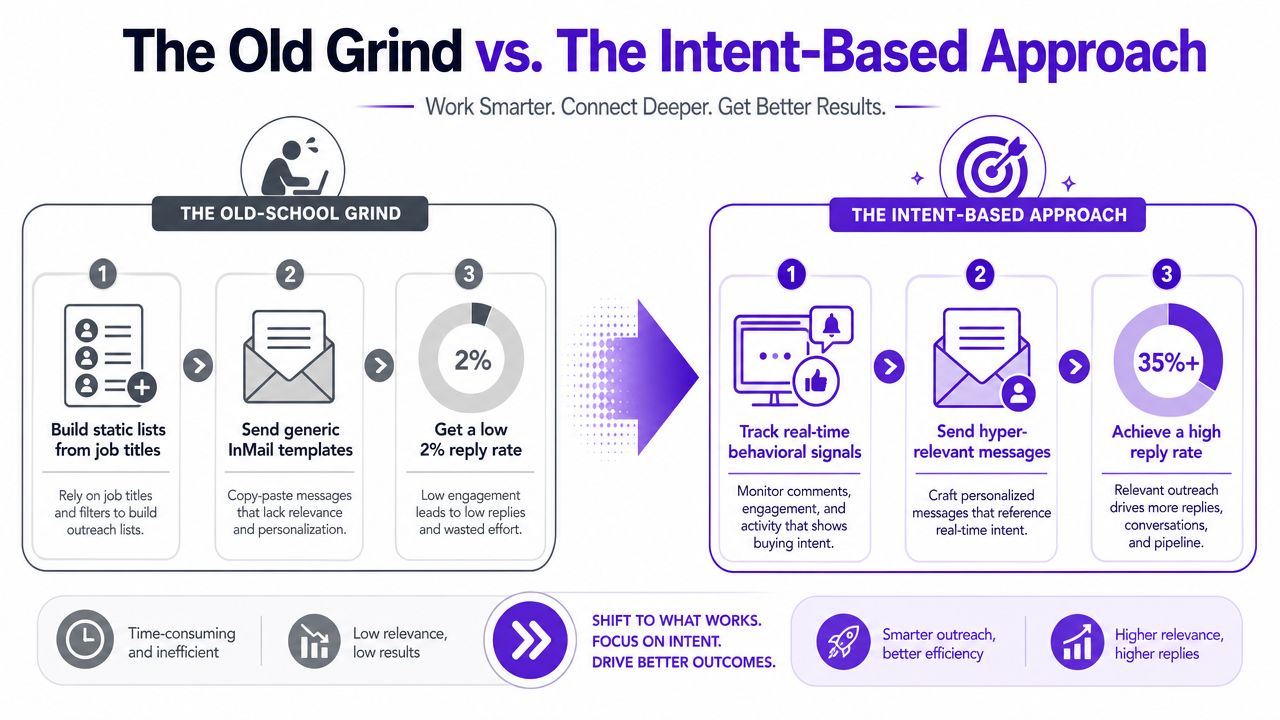
Shifting from static lists to real-time signals doesn't just improve your outreach; it changes the entire dynamic of the conversation from an interruption to a welcome solution.
Automate the Intent With RoverLead AI
This is where you bring in the robots—in a good way. Instead of spending your precious hours hunting through feeds, a tool like RoverLead AI becomes the core of your prospecting engine. You set up what we call Signal Agents to do the heavy lifting for you.
You tell the AI who your ideal customers are, which competitors to watch, and what experts to follow. It then monitors over 10 distinct buying signals across LinkedIn automatically, 24/7, so you don't miss a thing.
RoverLead AI takes all that raw engagement and turns it into a clean, actionable feed of high-intent leads. Each lead is delivered with the exact context you need to start a relevant conversation, freeing you from the manual search-and-pounce routine.
This is how you turn LinkedIn lead generation from a soul-crushing chore into a predictable, scalable system. You can see more on how to build out these kinds of systems in our guide on AI prospecting tools.
From Signal to Meeting: The Two Paths of Outreach
Okay, theory time is over. An intent-based strategy only pays off if you can turn a digital whisper—a signal—into an actual meeting. This is where most reps stumble. They see the signal but revert to the old, templated muscle memory for the follow-through.
Let’s walk through a real-world example. Meet Alex, a sales rep selling project management software to creative agencies. He’s set up his "signal universe" in RoverLead AI to monitor key competitors.
One morning, RoverLead AI serves him a piping hot lead. Sarah, a VP of Operations at a target agency, just commented on a competitor’s LinkedIn post about their shiny new feature. Her comment: "This looks great, but I’m concerned about how this will integrate with our existing client-facing dashboards. Has anyone found a solution for that?"
That’s not just a comment. That's a pain point served up on a silver platter, gift-wrapped with a bow that says "I have a budget."
The Fork in the Road
Alex now stands at a crossroads. He can take the path traveled by 99% of sales reps, or he can take the one that actually leads to a signed contract.
Path 1: The Generic, Tone-Deaf Outreach (The Path to Deletion)
This is the message that ignores all the valuable context Sarah just handed him.
Subject: Project Management
Hi Sarah,
Saw you're the VP of Ops at [Company Name] and thought I'd reach out. We help agencies like yours streamline their projects. Do you have 15 minutes to chat about your current workflow next week?
Best, Alex
What happens next? Sarah’s mouse hovers over the delete button for a nanosecond before clicking. The message is about him, not her. It's generic, lazy, and completely misses the very public problem she just shared.
Path 2: The Hyper-Relevant, Signal-Based Message (The Money Move)
Now, here’s what Alex sends instead, armed with the context from RoverLead AI.
Subject: Your comment on client dashboards
Hi Sarah,
Saw your comment on the [Competitor] post about client-facing dashboard integration. It's a common headache—many tools build new features in a silo without thinking about the full client experience.
We actually built our platform with that exact problem in mind. Our native portal gives clients real-time visibility without the integration mess.
No pressure for a demo, but if you're exploring options, I think it’s directly relevant to the issue you raised.
See the difference? It’s night and day. This message respects Sarah’s intelligence. It proves Alex is actually listening, not just spamming. He leads with her problem, not his product, and then elegantly bridges the two. This is how you start real conversations and get meetings on the books.
Want to get better at crafting these brilliant openers? We've broken down more examples in our guide to effective conversation starters.

Frequently Asked Questions About LinkedIn Lead Generation
You see the potential in an intent-based strategy for your LinkedIn prospecting, but a few nagging questions are holding you back. Good. Healthy skepticism separates the smart operators from the herd. Let's tackle those questions head-on.
1. Is this approach even allowed on LinkedIn?
The first question is always about compliance. Is tracking signals like this even allowed under LinkedIn's terms of service? Yes. The strategy we're talking about—especially when powered by a tool like RoverLead AI—is built on monitoring public information and engagement. We're not talking about shady scraping or sending thousands of automated connection requests that get your account flagged. This is what "social selling" was always meant to be: using social cues to inform smarter, more human outreach. You're not breaking rules; you're just paying closer attention than your competitors.
2. Does this really save time compared to Sales Navigator?
You're probably looking at your Sales Navigator workflow and wondering if this really saves that much time. The difference is night and day. Sales Navigator is great for building static lists that you have to grind through. An intent-based system flips the model entirely. Our customers report spending up to 60% less time on research alone. Why? You’re moving from active, manual hunting to passive, automated monitoring. Instead of you searching for leads, the Signal Agents inside RoverLead AI bring a curated feed of high-intent prospects directly to you.
3. Can small teams or solo founders actually use this?
Is this another one of those strategies that only works for massive sales teams with unlimited budgets? Absolutely not. In fact, this is the perfect system for smaller teams and solo founders. When you can't afford to waste a single minute on low-yield activity, you need every outreach to count. An intent-based system automates the most time-consuming part of prospecting: finding who is ready to talk right now. This frees you to focus your limited time on high-quality conversations that actually lead to revenue.
4. What are the best buying signals to track?
Great question. This goes way beyond a simple job change notification. The real gold is in the nuances of online behavior. You should be watching for signals like:
Comments on your competitor's posts, especially if they mention features, bugs, or pricing.
Engagement with content from the key industry experts everyone in your space follows.
Questions asking for recommendations for tools or services in your category (e.g., "Any recommendations for a good project management tool?").
Posts that describe a business pain point you were built to solve.
A platform like RoverLead AI is designed to track over 10 of these distinct buying signals automatically, so nothing falls through the cracks.
5. How quickly can I see results with this method?
Unlike traditional outbound, where you spend months trying to "warm up" a completely cold market, the beauty of an intent-based approach is its speed. Because you're engaging with people who are already in a buying cycle, you can see positive replies and meetings booked within the first couple of weeks. It's not uncommon for our customers to see a 30-50% increase in booked meetings right after getting set up. They’re finally reaching the right people at exactly the right time.
6. What's the difference between LinkedIn lead generation and social selling?
Think of it like this: social selling is a technique, while LinkedIn lead generation is the goal. Social selling is the act of using social media to find, connect with, understand, and nurture sales prospects. LinkedIn lead generation is the broader process of using LinkedIn specifically to fill your sales pipeline. An effective lead generation strategy on LinkedIn will almost always involve social selling tactics.
7. Do I need LinkedIn Sales Navigator for this to work?
While Sales Navigator is a powerful tool for building initial lists and doing deep dives, it's not strictly necessary for an intent-based strategy. The core of this approach is monitoring public activity, which can be done manually (if you have a lot of time) or automated with a tool like RoverLead AI. Many of our users find that combining RoverLead AI's intent signals with Sales Navigator's filtering capabilities creates an unstoppable prospecting machine.
8. How do I measure the success of my LinkedIn lead generation?
Ditch the vanity metrics like connection count and profile views. Focus on the numbers that actually impact your bottom line:
Reply Rate: Are people responding to your outreach?
Meetings Booked: Are those conversations turning into demos or discovery calls?
Pipeline Generated: How much potential revenue is coming from your LinkedIn efforts?
Cost Per Lead/Acquisition: How efficient is this channel compared to others?
9. Should I focus on content creation or direct outreach?
The answer is both. They work together. Your content (posts, articles, comments) acts as your inbound magnet, attracting prospects and building your authority. Your direct outreach, informed by buying signals, is your outbound spear, allowing you to proactively engage high-intent prospects. A great strategy balances both, using your content to warm up the audience that your outreach will eventually target.
10. My industry is boring. Can this still work?
Yes, a thousand times yes! "Boring" industries are often the best places for this strategy because your competitors are likely even lazier with their prospecting. Whether you sell accounting software, industrial ball bearings, or compliance consulting, your customers are on LinkedIn. They complain about their current vendors, ask for advice, and engage with industry content. Your job is simply to be there, listening, when they do.
Ready to stop guessing and start engaging with prospects who are already waiting to hear from you? RoverLead AI can turn your LinkedIn feed into a predictable source of high-intent leads. See how RoverLead AI works and start your first five-minute setup today.