10 LinkedIn Conversation Starters That Actually Convert
Your LinkedIn DMs are dying. Here's why.
You sent 50 connection requests. Ten accepted. You followed up with your best template. One replied, “Not interested.” The other nine vanished into the polite graveyard of unread messages. Sound familiar, builder?
You're not bad at LinkedIn. You're just using a playbook built for a noisier, dumber version of outbound. Generic intros, fake personalization, and “just wanted to reach out” still clog inboxes because they're easy to scale. They're also easy to ignore.
The problem isn't your script. It's your timing, your context, and your lack of signal. People reply when your opener feels connected to something already happening in their world. That's not theory. It matches how people naturally communicate. Pew Research Center found in 2024 that 69% of Americans say they talk a lot with close friends and family about what's happening with them, and it was the highest share among the topics asked about. Relevance wins because “what's going on with you right now” is how humans already start conversations.
So stop hunting for magic words. Start building messages around live context.
Table of Contents
1. The Specific Compliment Opener
The best compliment on LinkedIn doesn't sound like a compliment. It sounds like proof you paid attention.
Bad opener: “Loved your content.”
Good opener: “I saw your comment on that pricing thread. Your point about demos getting used as a qualification crutch was sharp.”
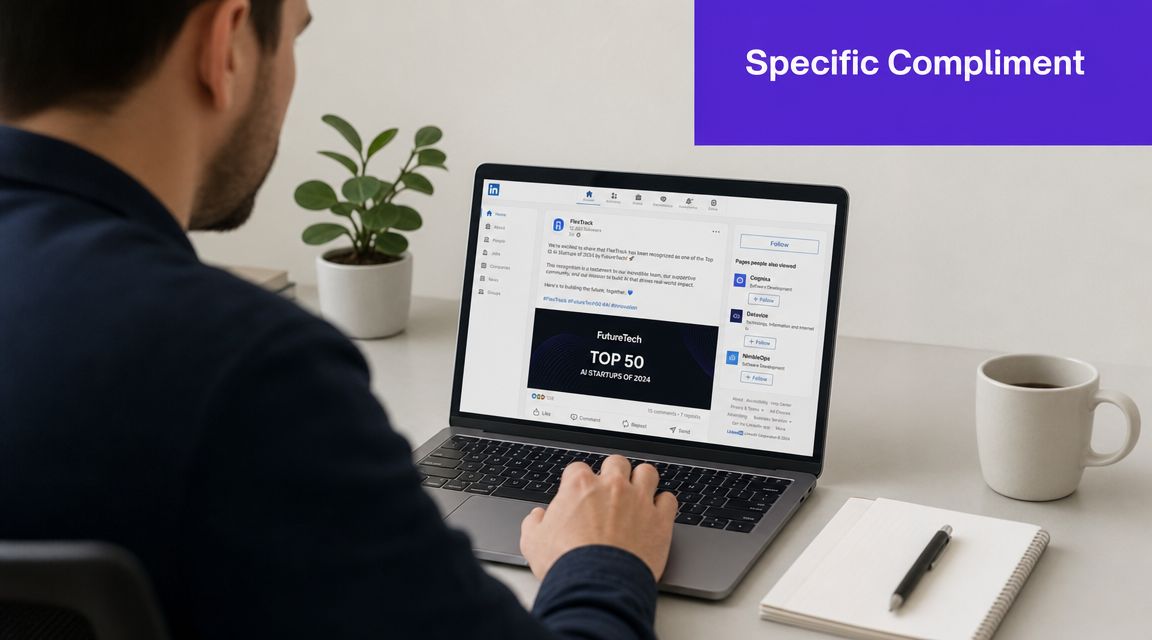
The move here is simple. Reference a post, comment, hiring move, article, or announcement, then mirror back the exact detail that mattered. You're not flattering them. You're showing signal recognition.
Why it works
People are drowning in vague approval. “Great post” is the participation trophy of LinkedIn outreach. A specific compliment cuts through because it proves your message is attached to an actual behavior, not a sequence.
A presentation training video from 2024 makes a useful point here. Starting with a statistic can capture attention, especially when you name the source immediately, and combining facts or rhetorical questions can increase engagement. The same principle applies to outreach. Specificity creates credibility first, then curiosity.
Practical rule: Compliment the prospect's thinking, not their popularity.
Try lines like these:
Comment-based opener: “Saw your take on the RevOps thread. Your point about handoff friction was more useful than the original post.”
Article-based opener: “Read your piece on onboarding. The section on manager enablement was the part often overlooked by organizations.”
Career-move opener: “Noticed you joined Acme as VP Sales. Given your background in PLG, that's an interesting mix.”
If you can't point to one precise thing they did, you don't have an opener yet. You have admiration. Keep researching.
2. The Curiosity Gap Opener
Curiosity works. Manufactured mystery does not.
A good curiosity-gap message gives the prospect a reason to lean in without feeling tricked. You hint at a relevant observation, keep the gap small, and make sure the payoff can happen in a couple of messages. If they need to book a call just to hear the punchline, you've wandered into low-budget infomercial territory.
A strong version sounds like this: “I'm seeing a pattern in how SaaS teams handle inbound demo requests after hiring their first RevOps lead. It might be relevant to what you're building.”
How to use curiosity without being annoying
Most reps overplay this one. They write things like “I found something shocking about your company.” That's not intriguing. That's spam wearing a fake mustache.
Use curiosity when you've noticed a live signal. Someone engaged with competitor content. Someone just changed roles. Someone commented on pricing, attribution, hiring, or AI workflow debates. That gives you the right to imply there's a pattern worth discussing.
Curiosity should open a door, not create a hostage situation.
A few solid examples:
Industry observation: “I'm seeing something in your category that's getting misread by a lot of teams. Curious if it matches what you're seeing.”
Role-change angle: “Your move into this new role usually comes with one immediate mess. Wondering if that's true on your side too.”
Competitor engagement angle: “You engaged with a post about outbound efficiency. There's a tradeoff often overlooked until pipeline quality slips.”
Don't use this opener unless you can deliver a useful observation fast. Builders forgive brevity. They don't forgive bait.
3. The Mutual Connection or Network Bridge
Warm intros still work because trust is borrowed before it's earned.
If you share a real connection, mention it early. If you both attended the same event, commented in the same community, or know the same operator, that context can lower resistance fast. The key word is real. Fake adjacency gets sniffed out immediately.
“We both know Sarah” is weak. “Sarah mentioned you're cleaning up SDR handoff issues after a territory redesign” is strong, assuming Sarah did say that and gave you the green light.
What good name-dropping looks like
The best network-bridge messages do three things. They establish shared context, prove it's current, and pivot quickly to the business reason for reaching out.
Use patterns like these:
Mutual operator: “James and I were talking about sales hiring, and he said you're rebuilding the top of funnel after a category shift.”
Shared event: “We were both in the GTM roundtable last week. Your point about pipeline quality over activity volume stuck with me.”
Shared community: “I've seen your posts in Pavilion on forecasting discipline. That's partly why I thought this would be relevant.”
Bulletproof rules:
Verify the relationship: Check LinkedIn before you mention anyone.
Get permission first: Don't draft your mutuals into your outbound without asking.
Move to value fast: The shared contact opens the door. It's not the entire conversation.
Name-dropping isn't the strategy. Relevance is. The shared connection just gets you past the velvet rope.
4. The Problem-First Not Solution-First Opener
Most LinkedIn outreach fails because it starts with the seller's offer instead of the buyer's headache.
Builders don't wake up wanting your demo. They wake up wanting fewer messes. If your message names a problem they already feel, you've earned a reply. If it starts with “We help companies like yours,” you've earned a deletion.
Lead with the tension
The move is to state the operational problem cleanly, then ask how they're handling it. No chest beating. No product parade.
Examples:
“A lot of sales teams hit pipeline inflation when reps optimize for booked meetings instead of qualified conversations. Curious if that's on your radar.”
“Companies adding AI tools into outbound usually create a consistency problem before they create an efficiency gain. How are you handling that tradeoff?”
“When marketing drives more intent but sales still works static account lists, follow-up quality usually breaks first.”
This style works because it sounds like a peer noticing reality, not a rep reciting positioning.
Brookings' Conversation Starter Tools describe a structured four-step process of contextualizing, gathering input, sharing findings, and then turning the discussion into strategy. Different setting, same lesson. Good conversation starters work better when they emerge from observed context and move toward action.
Start with the problem they'd admit internally, not the one you want to sell externally.
Your opener should make the prospect think, “Yes, that is annoying,” not “Ah, another vendor with a framework.”
5. The Contrarian Insight Opener
This one works when you've earned the right to challenge a default.
Most “contrarian” outreach is just recycled hot takes. It sounds edgy for the sake of attention. Real contrarian insight is different. It attacks a bad assumption that your prospect probably sees every day.
Examples:
“A lot of teams try to fix reply rates by rewriting copy. The bigger issue is that they're reaching out when no buying signal exists.”
“More personalization isn't always better. Sometimes one sharp observation beats a paragraph of stitched-together profile trivia.”
“The safest message often performs worst because it gives the buyer nothing to react to.”
Pick a fight with bad defaults, not with the prospect
If you use this opener, keep the claim grounded. Don't say “everyone is wrong.” Say what you've observed, why it matters, and where the usual playbook breaks.
A useful frame:
State the common assumption.
Offer the alternative.
Tie it to their world.
For example: “LinkedIn is often treated like a volume channel. I think it works better as a timing channel, especially when someone's already engaging around the problem you solve.”
That's interesting because it reframes the workflow. It doesn't insult the buyer.
Use this when the prospect posts strong opinions, comments on trend pieces, or clearly enjoys talking shop. Don't use it on someone who just announced a new role and has zero public appetite for debate. Read the room, operator.
6. The Social Proof Authority Opener
Social proof only works when the buyer can see themselves in it.
Saying “we work with leading companies” means nothing. Saying “we helped another Series A team tighten follow-up after a hiring spike” at least gives the prospect a comparable situation. Authority isn't about flexing logos. It's about reducing perceived risk through relevant precedent.
Authority needs relevance
Use the closest possible match. Same stage, similar motion, comparable team structure, or adjacent problem. If you don't have that, use credibility from your own process instead of forcing brand names.
Solid examples:
“We've been working with teams dealing with messy post-event follow-up, especially when SDRs and founders split the inbox.”
“A few RevOps leaders we talk with are standardizing how reps handle comment-driven inbound on LinkedIn.”
“We keep seeing the same pattern with founder-led sales teams. Strong conversations, weak follow-through.”
What to avoid:
Irrelevant logos: Enterprise proof doesn't impress a seed-stage founder unless the problem is clearly the same.
Unverifiable results: If you can't defend the claim, don't send it.
Generic praise of yourself: Buyers care less about your reputation than about whether you understand their situation.
This opener works best after a visible trigger or when the prospect already knows the category. Social proof is a risk reducer, not a cold-start engine.
7. The Timely Trigger or Moment-Based Opener
Timing beats cleverness. Every time.
The cleanest LinkedIn message often starts with a public event that explains why you're reaching out now. New job. New funding. New hire. Product launch. Hiring surge. Post that suddenly signals a change in priorities. You're not interrupting. You're showing up at the moment the conversation makes sense.
Timing beats cleverness
If a company just hired a Head of Demand Gen, a message about attribution cleanup or sales-marketing handoff has a reason to exist. If a founder just posted about pipeline inconsistency, you don't need a poetic opener. You need a relevant one.
Use patterns like these:
“Congrats on the launch. New product motion usually creates a follow-up problem before it creates a messaging problem.”
“Saw the hiring push on the GTM side. That usually means process debt shows up fast.”
“Noticed the role change. First 90 days in that seat tend to surface a short list of urgent decisions.”
Cold email templates still matter, but LinkedIn messages tied to a fresh trigger usually feel more natural because the context is already public and current.
A second useful insight here comes from modern communication behavior. Wondermind notes a broader shift toward digital-first, channel-specific interaction, which makes context and timing more important than generic face-to-face style small talk. That maps perfectly to LinkedIn. The best opener is often a specific observation, not a question.
Don't overcomplicate this one. If you can answer “why now?” in one sentence, you probably have a strong message.
8. The Question-Based Discovery Opener
Questions work best when they sound like diagnosis, not data collection.
Most reps ask lazy discovery questions because they want the buyer to do the thinking for them. Builders hate that. If you're going to lead with a question, make it informed enough that answering it feels worthwhile.
Ask like an operator
A strong question gives the prospect a useful frame. It narrows the issue and shows you understand the tradeoff.
Examples:
“When someone from your team engages with a high-intent prospect on LinkedIn, who owns follow-up today?”
“Are you optimizing outbound for positive replies, meetings, or actual sales-qualified conversations?”
“When you evaluate top-of-funnel performance, what matters more right now: speed of response or fit quality?”
Those questions work because they force a choice, reveal priorities, and feel grounded in a real workflow.
If you need a good mental model for this, lead qualification frameworks help separate curiosity from actual buying intent. Your opener should do the same thing. It shouldn't just start a chat. It should surface whether there's a real problem worth discussing.
Ask one question the prospect would ask their own team.
Keep it to one, maybe two. More than that and your DM starts looking like an intake form.
9. The Personal Human Connection Opener
Business buyers are still people. Shocking, I know.
A genuine human opener can work beautifully on LinkedIn, especially when there's real overlap. Shared hometown. Same university. Common niche interest. Similar operator path. The trick is not turning a public profile detail into a weirdly intimate cold message.

Don't get personal too fast
A useful rule is low pressure first, personal later. That matters because trust with strangers is fragile, and many mainstream conversation starter lists still focus heavily on what to ask instead of how not to make people uncomfortable. AARP highlights that lower-pressure, context-based prompts are safer early than jumping into highly personal territory.
That's especially relevant on LinkedIn, where professional and personal identity overlap awkwardly.
Good examples:
“Saw you're based in Austin too. Feels like every GTM conversation here eventually turns into a discussion about founder-led sales.”
“We both came up through agency work before moving into SaaS. That career path teaches you to spot fluff fast.”
“Noticed you're active in the alumni network at Michigan. I've had a few great operator conversations come out of that community.”
Bad examples:
Too familiar: Commenting on family details, vacation photos, or personal life too early.
Too clever: Forcing jokes about their hobbies to seem relatable.
Too detached from business: Opening with a personal note and never connecting it back to why the conversation matters.
Human works. Creepy doesn't.
10. The Benchmark or Data-Backed Observation Opener
If you're going to use data, use it like an adult. Cite it clearly, keep it relevant, and don't fake precision.
A benchmark opener works because it gives the buyer an external frame for their own situation. You're not saying, “I think you have a problem.” You're saying, “There's a broader pattern here. I'm curious where you sit inside it.”
Here's a clean version: “I keep thinking about how conversation openings perform better when they're topical and low-friction. That tracks with broader communication behavior, and it's relevant to how teams handle LinkedIn outreach.”
Use data like a grown-up
The 2024 presentation advice mentioned earlier is useful here in spirit, but the stricter lesson is simple. Name the source right away and tie the data to one practical implication. Don't stack stats just because numbers look impressive.
For example, you could say that people are more responsive to timely, specific openings because that mirrors how they already talk in everyday life, then connect it to outreach. You don't need to invent a conversion lift to make the point.
A benchmark message can also use internal operating data, public hiring signals, or visible content behavior, as long as you don't pretend it's research if it isn't.
Before you send one, ask:
Is the benchmark relevant? Industry-wide data is weak if the buyer's context is narrow.
Is the source clear? “Studies show” is not a source.
Is the implication useful? Data without a next step is decoration.
For a broader view on building prospecting around real buying behavior instead of static lists, B2B sales prospecting works better when context drives outreach.
A quick visual on this approach is below.
Comparison of 10 Conversation Starters
Opener | 🔄 Implementation Complexity | 💡 Resource Requirements | ⭐📊 Expected Outcomes | ⚡ Ideal Use Cases | ⭐ Key Advantages |
|---|---|---|---|---|---|
The Specific Compliment Opener | Medium, targeted research + signal alignment | Low–Medium, time for personalization; RoverLead reduces manual lift | ⭐ High open/reply rates (30–50% lift); builds immediate credibility 📊 | LinkedIn-native engagement; prospects with recent public activity | Differentiates from generic outreach; rapid rapport |
The Curiosity Gap Opener | Medium, craft a precise information gap without overpromising | Low, strong copy skill; use RoverLead signals for context | ⭐ High CTRs and replies; prompts back-and-forth 📊 | Crowded feeds, subject lines, warm-intent leads | Drives engagement without overt selling; conversational |
The Mutual Connection / Network Bridge | Low–Medium, verify connections and context | Medium, network data, permission for name-dropping; RoverLead helps identify overlaps | ⭐ Very high reply/conversion for warm outreach (60–80% improvements reported) 📊 | Warm introductions, executive outreach, high-ticket B2B | Builds trust via third-party validation; lowers perceived risk |
The Problem-First (Not Solution-First) Opener | Medium–High, requires domain knowledge and careful framing | Medium, industry research + RoverLead intent signals to validate problem | ⭐ High qualification and conversion; positions as advisor 📊 | Consultative selling; prospects in active buying stages | Disqualifies poor fits early; reduces defensiveness |
The Contrarian Insight Opener | High, needs credible evidence and careful tone | High, data/case studies + precise targeting via RoverLead | ⭐ Very high engagement from curious, engaged prospects 📊 | Thought leadership, competitive markets, creator-engaged prospects | Memorable first impression; establishes authority |
The Social Proof / Authority Opener | Low–Medium, straightforward but must be verifiable | Medium, credible clients/results and permissions; RoverLead for ICP matching | ⭐ Increases trust and speeds sales cycles with risk‑averse buyers 📊 | Enterprise buyers, risk-averse stakeholders, late-stage prospects | Legitimacy through third-party validation; reduces credibility questions |
The Timely Trigger / Moment-Based Opener | High, requires real-time monitoring and quick outreach | High, signal infrastructure and rapid response (RoverLead signal agents) | ⭐ Extremely high relevance and reply rates when timely 📊 | Post-funding, hires, product launches, earnings, short windows | Optimal timing and urgency; outreach feels highly relevant |
The Question-Based Discovery Opener | Medium, craft 1–2 thoughtful, research-backed questions | Low–Medium, research + RoverLead signals to tailor questions | ⭐ High engagement; reveals priorities and qualifiers 📊 | Early discovery, consultative conversations, qualification | Encourages dialogue; low-pressure and information-generating |
The Personal / Human Connection Opener | Medium, must be authentic and well-researched | Low–Medium, profile review and genuine common ground | ⭐ Strong long-term rapport and higher follow-ups 📊 | Relationship-based sales, long-cycle deals, alumni/local ties | Humanizes outreach; creates memorable connections |
The Benchmark / Data-Backed Observation Opener | Medium–High, requires recent, reputable data and source citation | Medium–High, access to current research and ability to localize with RoverLead signals | ⭐ High credibility with data-driven buyers; persuasive to execs 📊 | Data-driven stakeholders, executive briefings, industry benchmarking | Objective credibility; frames urgency with evidence |
From Starters to a System The Real Takeaway
The best conversation starter isn't the cleverest line in your swipe file. It's the one that shows up at the right moment with the right context. That's the shift most sales teams still haven't made.
They're optimizing wording when they should be optimizing relevance. They're polishing templates when they should be tracking signals. They're measuring activity when they should be measuring whether the buyer had any reason to care right now.
That's why most LinkedIn outreach feels stale. It's built from static lists and delayed research. A rep pulls accounts, skims a few profiles, sends a sequence, and hopes personalization does the heavy lifting. It won't. Not consistently.
The contrarian view is the useful one. Social selling doesn't start with “building a personal brand” or writing longer DMs. It starts with detecting intent. Public comments, content interactions, competitor engagement, hiring moves, role changes, launch announcements, and pricing-related chatter all tell you when someone is more likely to have a specific conversation. That's the raw material. The opener is just packaging.
For operators, this should feel familiar. Good systems beat heroic effort. If your team depends on each rep manually hunting for moments, quality drops fast and timing slips even faster. One rep catches a buying signal. Another reaches out a week late. A third sends a decent message to the wrong person. The workflow breaks before the copy does.
So build the process backward from the moment. Track the signals that matter to your ICP. Define which triggers deserve outreach. Match each trigger to a conversation style. A role change might call for a timely trigger opener. A thoughtful comment on a creator post might call for a specific compliment. A visible workflow debate might call for a problem-first or contrarian message.
This is also where most “conversation starters” advice falls short. It focuses on lines, not systems. It gives you prompts, not operating logic. Helpful for a networking event, useless for building repeatable pipeline.
Manual research is too slow for this. The winning setup monitors dynamic behavior and turns it into suggested next actions. That's how you stop guessing. That's how LinkedIn becomes a live source of warm context instead of another channel for cold interruption.
The takeaway is simple. Stop asking, “What should I say?” Start asking, “Why this person, why now, and what signal earned this message?” When you can answer those three questions, the conversation starter almost writes itself.
RoverLead AI helps you do exactly that. Instead of scraping static account lists and hoping your reps find something relevant, RoverLead AI tracks live LinkedIn intent signals across your ICP, competitors, creators, and niche topics, then surfaces people already showing buying behavior with context for outreach. If you want more replies from LinkedIn without turning your team into full-time researchers, it's the kind of system an operator wants.