How to Qualify Sales Leads: A No-BS Playbook for 2026
Your SDR just got a “hot” lead from marketing. The contact downloaded a guide months ago, never replied to an email, and works in a role that will never buy your product. Sales calls it junk. Marketing calls it engagement. Your CRM calls it progress. None of those labels create pipeline.
That's the core problem with most advice on how to qualify sales leads. It starts too late. It starts after the form fill, after the webinar signup, after the lead record exists. By then, a lot of the useful signal is already diluted, misread, or stale.
The better approach is simpler. Qualify people before they ever become formal leads. Watch for fit, yes, but also for timing. A person who matches your ICP and is actively circling the problem is worth attention. A person who matches the ICP and does nothing is just a name on a list.
Table of Contents
Choose Your Qualification Framework Or Just Steal the Best Parts
Why Your 'Qualified' Leads Are Already Dead on Arrival
Often, the issue isn't a lead quality problem; it's a lead labeling problem. Leads are often called “qualified” because they touched a piece of content, matched a broad industry filter, or hit an arbitrary score built by someone who hasn't carried a quota in years.
That's how reps end up chasing students, competitors, consultants fishing for ideas, and people who were curious once and disappeared.

The conversion math exposes the mess. In B2B, the average lead-to-MQL conversion rate is about 31%, while average MQL-to-SQL conversion is only 13%, according to Landbase's lead qualification statistics. In plain English, a lot of what marketing celebrates never becomes something sales should spend time on.
Your CRM is full of people, not buyers
A downloaded asset is not intent. A single site visit is not urgency. A job title match is not a deal.
What matters is the overlap between two things:
Fit: they belong in your market
Behavior: they're acting like someone trying to solve the problem now
If you skip either one, you create false positives. Fit without behavior gives you lifeless target accounts. Behavior without fit gives you noise.
Practical rule: Stop asking whether a lead is “good.” Ask whether that person is both relevant and active right now.
Dead leads usually fail in one of three ways
Too early
They're educating themselves, not buying.Wrong person
They can consume content all day and still never influence a decision.Old signal
The action happened long enough ago that it no longer means much.
The stale playbook says, “Get more leads.” That's lazy. The smarter move is to identify intent earlier, before a weak inbound hand raise gets turned into fake pipeline.
First Principles Define Your ICP and Buying Signals
If your ICP is “B2B companies with 50 to 500 employees,” you don't have an ICP. You have a census category.
Good qualification starts with precision. Not academic precision. Commercial precision. You need to know who you want, who you don't want, and what behavior suggests a conversation is worth starting.
Your ICP needs edges, not just attributes
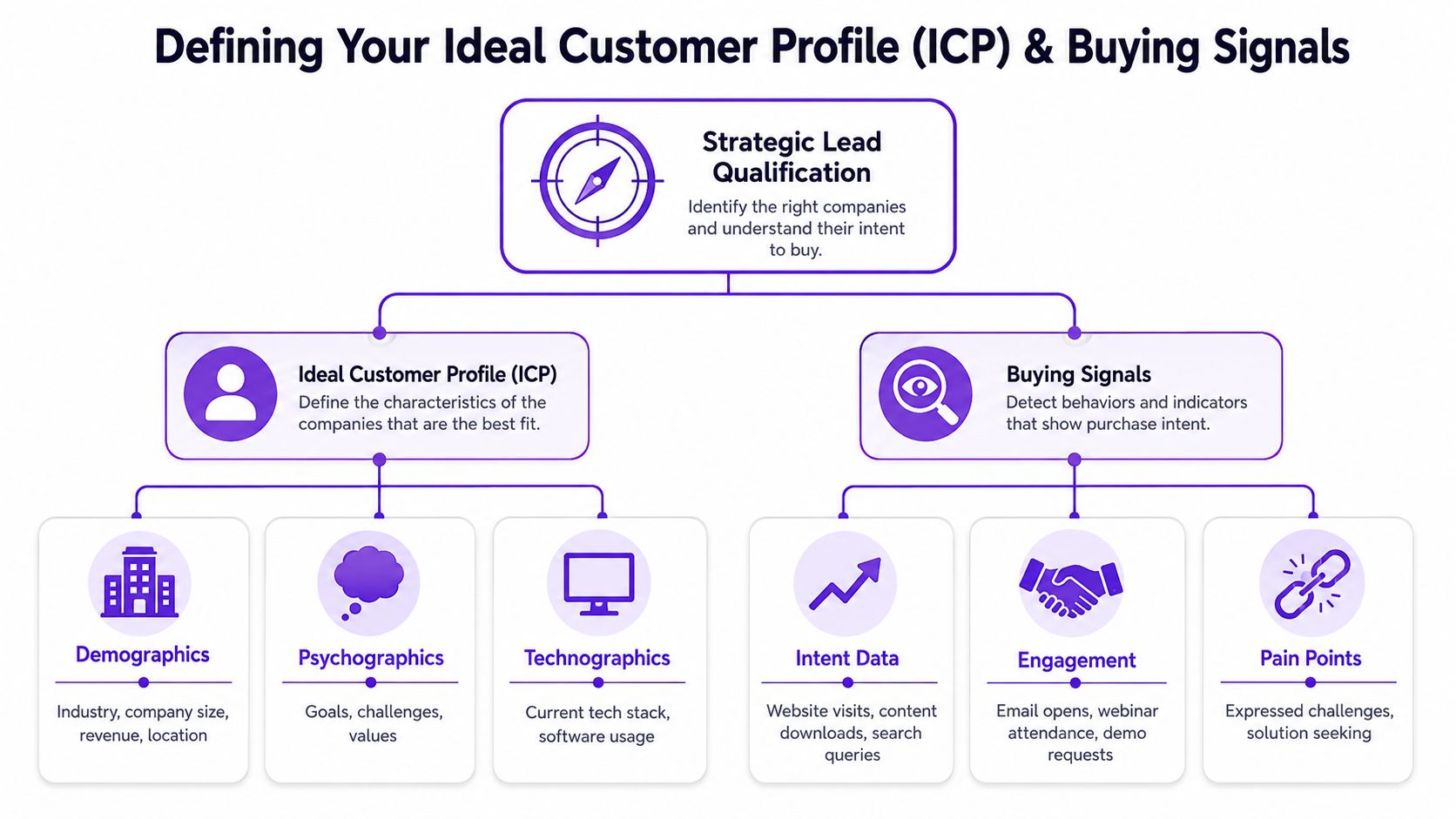
The basics still matter. Highspot's guide to lead qualification recommends combining demographic and firmographic criteria such as job title, industry, company size, with behavioral evidence like website visits, downloads, webinar attendance, and product usage signals.
That's the floor, not the ceiling.
Build your ICP with three layers:
Core fit
Industry, company size, geography, role, business modelOperational fit Team structure, process maturity, internal urgency, whether they have the problem in a form you solve
Negative fit
People you should exclude early, like agencies when you sell in-house software, tiny companies with no process, or roles that consume content but never drive evaluation
A useful exercise is to define the accounts you close fast, the accounts that stall forever, and the accounts you should've disqualified on day one.
For a broader view of the top-of-funnel side, this breakdown of B2B demand generation is worth reading.
Here's a simple gut check:
If two reps read your ICP and come back with wildly different target lists, your ICP is too vague.
Intent starts before the hand raise
Most qualification advice falls apart because it assumes intent appears when someone fills out a form. Intent often appears earlier.
Some signals are explicit. Demo requests. Pricing page visits. Direct replies asking for details.
Others are implicit, but still useful:
Commenting on a niche creator's post
Following competitor conversations
Repeated engagement with problem-aware content
Reacting to implementation or pricing discussions
Returning to the same topic over time
That's pre-CRM qualification. It tells you not just “who fits,” but “who's waking up to the problem.”
A short video if you want a visual walkthrough:
Choose Your Qualification Framework Or Just Steal the Best Parts
BANT, CHAMP, GPCT. Sales loves acronyms because acronyms make chaos feel organized. The trouble is, organizations often adopt a framework like a religion, then act surprised when buyers don't cooperate.
Use frameworks as prompts, not commandments.
Qualification Frameworks Compared
Framework | Stands For | Primary Focus | Best For | 2026 Weakness |
|---|---|---|---|---|
BANT | Budget, Authority, Need, Timeline | Fast screening | Simple deals and early rep training | Budget and authority are often unclear at the start |
CHAMP | Challenges, Authority, Money, Prioritization | Problem-first discovery | Consultative selling | Still assumes you can get direct answers early |
GPCT | Goals, Plans, Challenges, Timeline | Strategic context | Multi-stakeholder deals | Can become long-winded if the buyer is still early |
What still works
BANT is useful if your reps need discipline. It forces basic commercial sanity. But if you ask about budget too early, many decent buyers will shut down. They don't know budget yet. Or they won't tell you.
CHAMP aged better. Starting with challenges is usually smarter than starting with money. Buyers will talk about pain long before they'll talk about procurement.
GPCT is helpful when the deal is broader than a feature comparison. It gets reps to understand goals and internal plans, not just symptoms.
Use the framework that helps your rep think clearly. Ignore the parts that force awkward, premature questions.
The practical move is a hybrid:
Start with Challenges from CHAMP
Pull Timeline when urgency shows up
Confirm Authority without sounding like a gatekeeper hunter
Add Goals and Plans when the account is real
Leave Budget until there's enough value in the conversation to discuss tradeoffs openly
The mistake isn't using a framework. The mistake is using one so rigidly that your rep sounds like a form with a pulse.
Build a Lead Scoring and Routing Machine That Works
Most lead scoring models fail for a boring reason. They're too clever in a spreadsheet and too dumb in production.
A scoring system should help reps decide who to contact now, who to nurture, and who to ignore. If it doesn't change behavior, it's decoration.
Score fit and intent separately
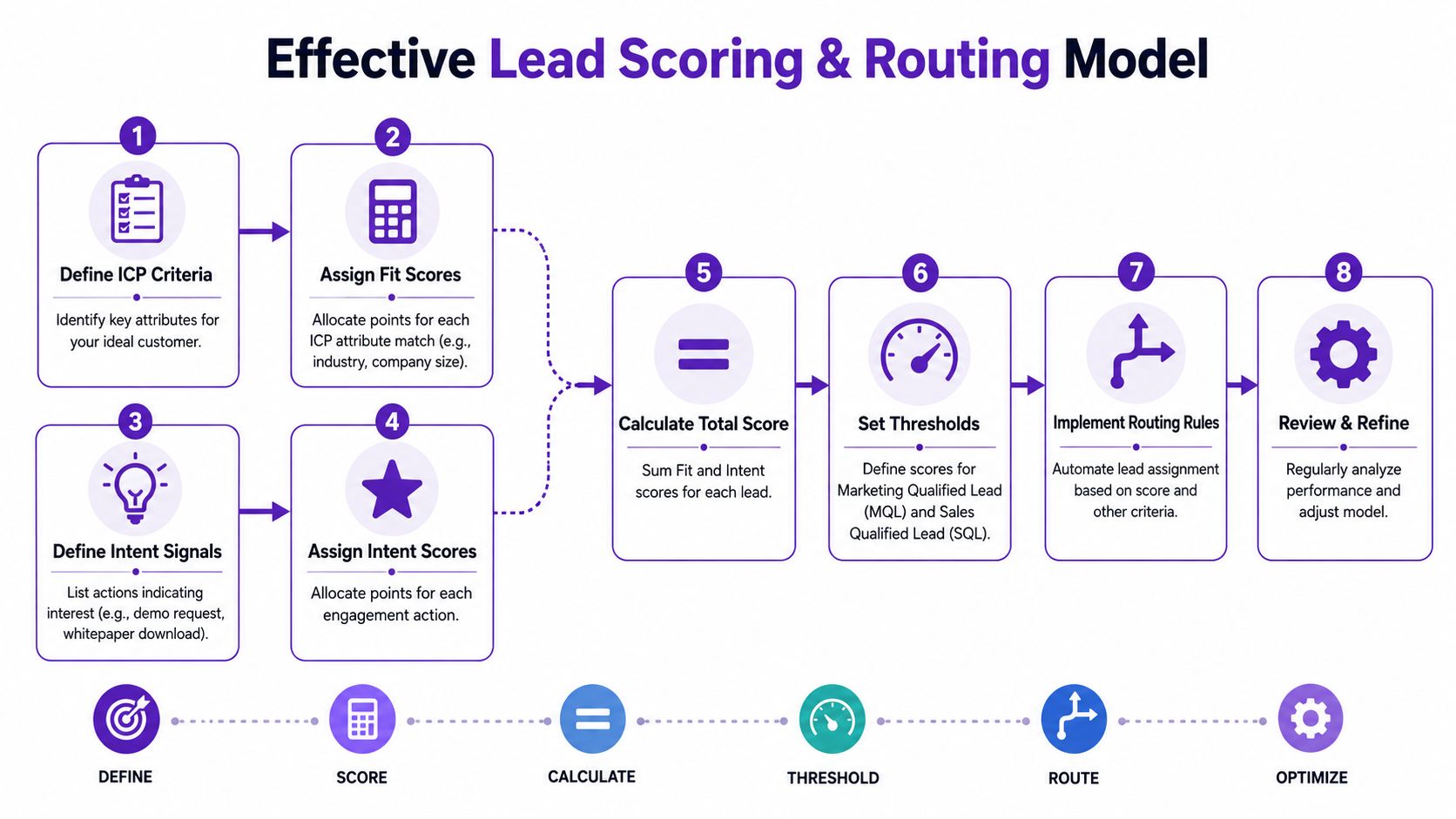
Don't mash everything into one mystery number. Keep fit and intent distinct so reps can see why someone ranks high.
A simple model works better than a grand theory:
Fit score examples
Target industry
Right company size
Relevant role
Excluded persona gets a negative score or disqualification
Intent score examples
Pricing page activity
Demo request
Webinar attendance
Product usage
Repeat visits to high-intent pages
Engagement with category-specific content on social
Then create clear actions:
Score pattern | Meaning | Action |
|---|---|---|
High fit, low intent | Good account, wrong moment | Nurture |
Low fit, high intent | Curiosity, likely noise | Review fast, usually disqualify |
High fit, high intent | Real opportunity | Route to sales now |
Route fast or lose
Speed matters more than teams admit. UserGems' article on intent data and sales-qualified leads says the vendor who responds first wins up to 50% of sales. The same piece notes that qualified leads can convert at about 40%, versus 11% for unqualified prospects.
So don't build a scoring model that waits for human review on every promising signal. Route based on rules.
A workable routing setup looks like this:
High-fit, high-intent leads go directly to the account owner.
Named inbound leads with strong activity trigger same-day outreach.
Pre-funnel social signals go to SDRs or account owners with context attached.
Low-fit leads get filtered out before they waste rep time.
For teams trying to tighten operations, this guide to sales process optimization complements the routing side well.
One warning. Business News Daily's lead qualification advice points out a common scoring failure: teams don't validate whether higher-score tiers convert better. Check whether A leads beat B and C leads. Check whether they move faster.
If they don't, your model is lying to you.
Scripts and Questions That Get Real Answers
Bad qualification scripts sound like an intake form. Good ones sound like a person who noticed something relevant.
That's the shift. Lead Forensics' piece on qualifying leads captures it well: qualification is moving from “Is this person a good fit?” to “Is this the right moment to start a conversation?”
Discovery questions that don't sound like an interrogation
Use questions that expose urgency, ownership, and friction.
“What changed recently that put this back on the radar?”
Good for identifying trigger events and recency.“How are you handling this today?”
This surfaces workarounds, incumbent tools, and pain tolerance.“Who else tends to get pulled in when this becomes a priority?”
Better than asking, “Are you the decision-maker?”“If this stays the same for another quarter, what breaks first?”
This gets to consequence without sounding theatrical.“What would make this worth acting on now versus later?”
Useful when interest is real but timing is fuzzy.
A strong discovery question doesn't collect trivia. It reveals whether the problem is live.
Intent-based outreach examples
These are better than generic “just bumping this up” messages because they use context.
LinkedIn opener after topic engagement
“Saw you joined the conversation on outbound quality this week. A lot of teams are trying to clean up lead quality before reps waste time in the CRM. Curious, are you looking at process changes or tooling?”
Message after repeated competitor-adjacent engagement
“Noticed you've been active around conversations on sales intent and qualification. Usually that means one of two things: the team is fixing top-of-funnel quality, or reps are drowning in low-signal leads. Which camp are you in?”
Email after a high-intent content pattern
“Subject: Quick question on lead quality
You've been looking at content around qualification and sales process design. Usually that points to a handoff problem, a scoring problem, or both. Is your team trying to tighten the MQL-to-SQL jump, or is the bigger issue rep time going to the wrong accounts?”
Follow-up that keeps the door open
“If now's not the moment, no issue. I'm mainly trying to understand whether this is a live priority or something you're revisiting later.”
For teams that want to pressure-test the economics behind better targeting and timing, this ROI calculator is a useful sanity check.
The point of these scripts isn't charm. It's relevance. You're not forcing a discovery call. You're starting a conversation that makes sense because the signal already exists.
Lead Qualification FAQ You Actually Need
What's the difference between an MQL and an SQL?
An MQL has shown enough interest for marketing to flag it. An SQL has enough fit and buying intent for sales to engage directly. Don't confuse engagement with readiness.
Should marketing or sales own qualification?
Both. Marketing should filter early. Sales should validate reality. If either team owns it alone, quality drops.
Can you qualify leads before they fill out a form?
Yes. Social engagement, repeat topic interaction, and intent-heavy behavior can tell you who deserves outreach before a form fill ever happens.
What if someone has strong intent but weak fit?
Review quickly, then usually disqualify. Curiosity is not a business model.
What if someone fits the ICP but shows no activity?
Keep them in nurture. Don't make reps force conversations with sleeping accounts.
Is BANT still useful?
Yes, as a lightweight screen. No, as a script you force onto every early conversation.
How often should we update lead scoring?
Regularly. If sales says the “best” leads aren't converting, the model needs tuning, not defending.
Should SDRs qualify on LinkedIn or move people straight to calls?
Qualify lightly on LinkedIn. Confirm relevance and timing first. Earn the call instead of stuffing calendars with bad meetings.
How do product-led teams qualify differently?
Product usage matters more. Logins, feature exploration, and activation behavior can tell you more than a whitepaper download ever will.
When should a lead be disqualified?
When the person lacks fit, shows no real urgency, can't connect the problem to action, or clearly won't move. Keep the record if you want. Stop pretending it belongs in active pipeline.
If your team is tired of chasing static lists and wants a cleaner way to spot real intent before bad leads clog the CRM, take a look at RoverLead AI. It helps sales teams turn LinkedIn engagement into ICP-matched, high-intent conversations so reps can spend less time guessing and more time talking to people who are in market.