What is B2B Demand Generation? A Complete 2026 Guide
You're probably doing more marketing than ever and trusting it less than ever.
The team is posting on LinkedIn. Paid campaigns are live. Someone just finished a webinar deck. Your company page gets polite engagement. A few people even say “great post,” which is internet code for “I will never book a demo.” Meanwhile, sales asks the rude but fair question: where's the pipeline?
That disconnect is why so many people search for what is b2b demand generation and end up with a cloud of jargon instead of an answer. The useful answer is simpler. Demand generation is the work of creating buying interest, capturing it when it appears, and moving it toward revenue with enough context that sales can act on it.
Table of Contents
The Real Problem with Your B2B Marketing
Most B2B marketing problems are not content problems. They're translation problems.
A team publishes useful material, runs events, boosts posts, and gets attention from the right-looking people. Then nothing happens because nobody has built the handoff between “someone showed interest” and “a rep should do something with that now.” Marketing calls it engagement. Sales calls it fluff. Both sides get a little more cynical.
The old playbook made this worse. It trained teams to treat form fills as the only moment that matters. If a buyer didn't download the gated PDF, they were invisible. Never mind that they may have read your posts for months, watched the webinar replay, visited your site, or commented on a competitor's thread about pricing. Real buying behavior is messier than the spreadsheet wants it to be.
Empty engagement usually means the signal exists, but the operating model doesn't.
Demand generation fixes that when it's done properly. Not as “brand stuff” living in a separate corner of marketing. As a pipeline discipline that connects awareness, education, timing, and sales action.
Why activity keeps getting mistaken for progress
Three patterns show up again and again:
Content without routing: Marketing produces assets, but nobody decides what sales should do when a buying signal appears.
Lead capture obsession: Teams overvalue gated responses and ignore public intent that appears before a form fill.
Channel silos: SEO, webinars, LinkedIn, outbound, and customer marketing run as separate programs instead of one revenue motion.
That's why the right question isn't “how do we get more leads?” It's “how do we build and detect demand in a way sales can use effectively?”
So What Is B2B Demand Generation Really
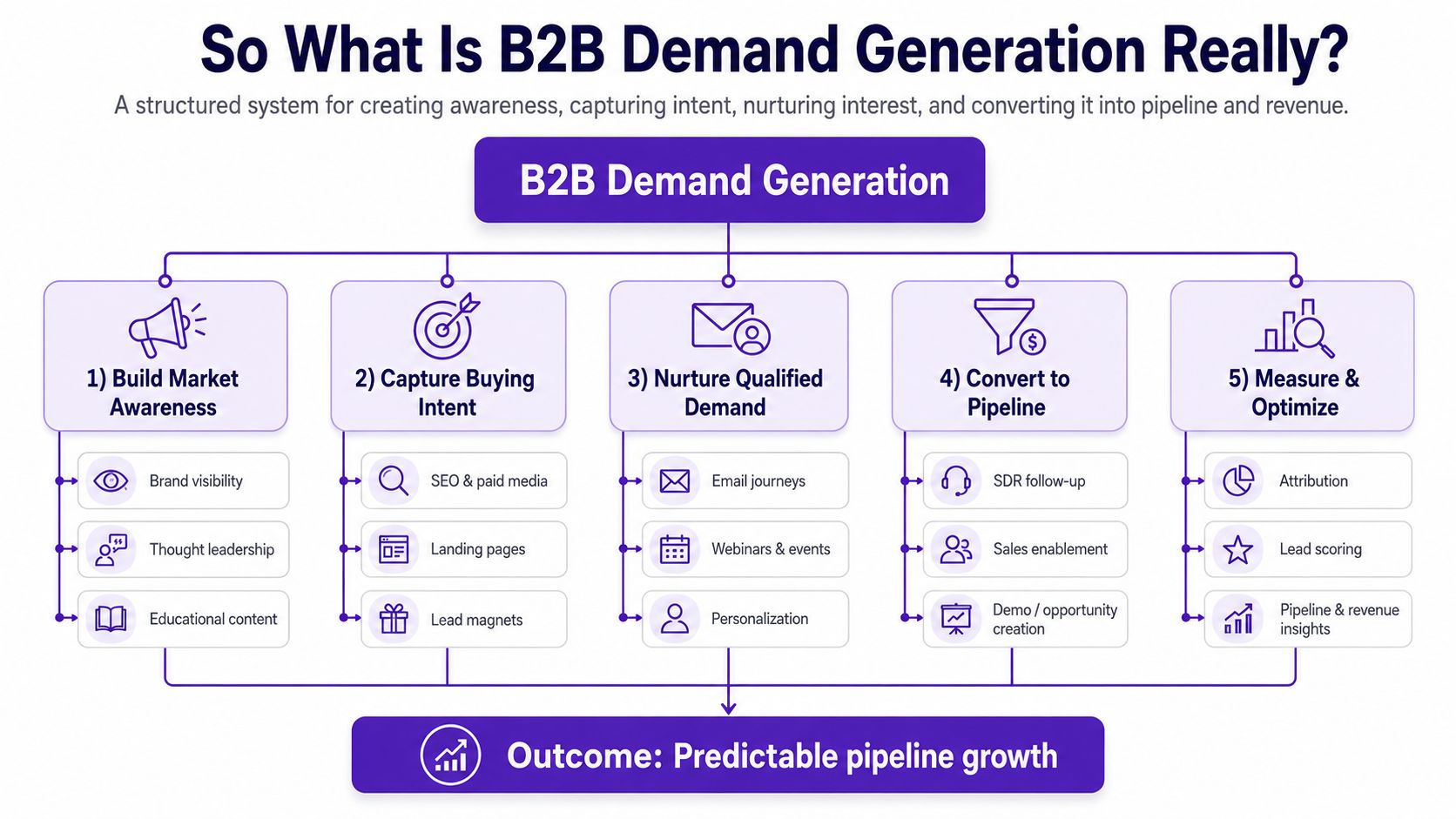
B2B demand generation is the system a company uses to create awareness, build preference, detect interest, and turn that interest into pipeline across the full customer lifecycle.
That definition matters because most watered-down versions stop too early. They describe demand gen as top-of-funnel buzz. It isn't. It starts before a buyer is ready and keeps working after the first deal closes.
It is not a campaign type
A better analogy is this. Lead generation is fishing where the fish are already biting. Demand generation is building a pond buyers trust, stocking it with the right conditions, and noticing when movement starts before the splash.
That means demand gen includes things like educational content, webinars, search visibility, social presence, nurture, retargeting, and sales follow-up informed by behavior. It also means teams need to think beyond the first conversion. If someone knows your category, trusts your point of view, and sees your company repeatedly solve the right problem, you've created demand even before they raise a hand.
It includes customers you already won
This is the part many teams still miss. Demand generation is no longer just about net-new names. In a benchmark cited by Gartner, 73% of Chief Sales Officers are prioritizing growth from existing customers, which is why lifecycle marketing, expansion campaigns, and post-sale momentum now sit closer to the center of demand gen strategy than many teams admit in public Pipeline360's demand generation statistics roundup.
Practical rule: If your definition of demand gen stops at “book the first meeting,” your definition is outdated.
The sharp version of demand gen asks better questions. Are you educating the market? Are you earning trust before the form fill? Are you creating reasons for existing customers to expand? If not, you may be running campaigns, but you're not really running demand generation.
Demand Generation vs Lead Generation The Definitive Split
People use these terms interchangeably. That's how teams end up with aggressive lead targets and weak market presence.
The clean split is this: demand generation creates interest and preference. Lead generation captures identifiable people who show enough interest to enter a sales process. Both matter. They are not the same job.
One builds interest and one harvests it
Public content, search presence, webinars, and useful social participation help buyers understand the problem and remember your company. Forms, demo requests, list building, qualification, and sequence enrollment turn some of that interest into named records a sales team can work.
This distinction gets sharper when you apply the 95:5 rule. Only a small share of buyers are actively in-market at any given time, so a strategy built only for immediate capture serves the five percent and ignores the much larger group that needs education and familiarity first Leadfeeder's explanation of the 95:5 demand generation gap.
Comparison table
Aspect | Demand Generation | Lead Generation |
|---|---|---|
Primary job | Build awareness, trust, and category preference | Capture identifiable prospects for follow-up |
Time horizon | Longer-term and continuous | Shorter-term and campaign-driven |
Best audience | Entire addressable market, especially people not ready yet | Buyers showing clearer immediate interest |
Typical tactics | Ungated content, SEO, webinars, social education, nurture | Forms, demo offers, outbound enrollment, qualification |
Success signs | Better market familiarity, stronger engagement quality, cleaner handoffs to sales | More contactable records, accepted leads, meetings created |
Common failure mode | Lots of attention with no operating path into sales | High volume of weak leads with little actual buying intent |
A healthy GTM engine needs both. But if you confuse capture with creation, you'll keep squeezing the small in-market slice while your competitors educate everyone else.
The Modern Demand Gen Playbook Core Tactics and Channels
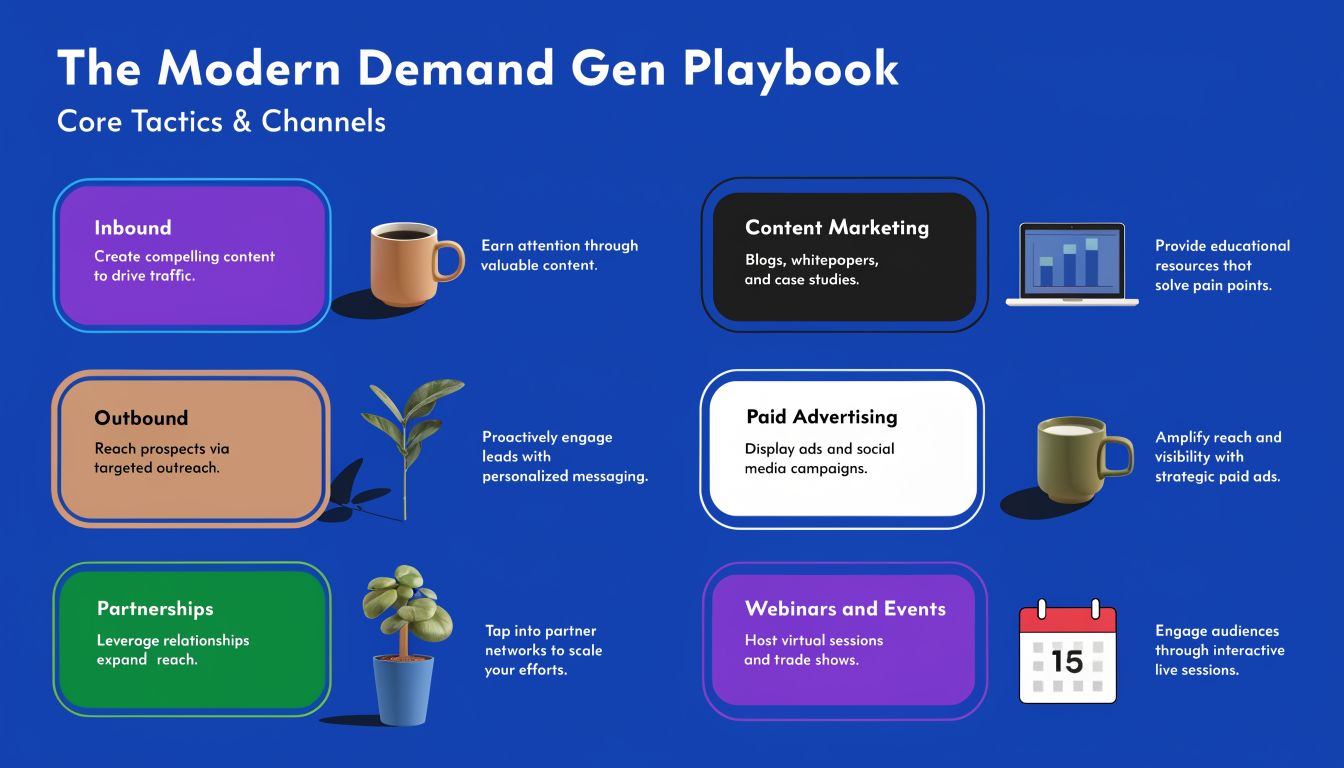
The current playbook isn't one channel. It's coordinated pressure from several channels that do different jobs well.
What still works
Content is still the foundation. In one survey roundup, 83% of marketers cited content marketing as their most effective demand generation strategy, and 53% said webinars generate the most high-quality leads The Insight Collective's B2B demand generation stats roundup. That doesn't mean “write more blog posts and hope.” It means useful education still outperforms chest-thumping.
The durable mix usually looks like this:
Content for education: Articles, guides, comparison pages, and product-adjacent explainers answer questions before buyers speak to sales.
SEO for compounding discovery: Organic search keeps your company visible when buyers research problems on their own timetable.
Webinars for active engagement: A webinar is part event, part qualification device. It shows who cares enough to spend time.
Social for distribution and interaction: LinkedIn is where category interest often shows up in public before any form is filled.
If you're exploring workflow support around outreach and prospecting, this is also where tools in the stack matter. Some teams pair content and webinar programs with outbound tooling and social prospecting platforms. Others layer in AI research and sequence support. RoverLead's own take on that broader tooling category is covered in its post on AI sales tools for modern teams.
What fails in practice
A few tactics look productive but rarely build a real pipeline on their own:
Random posting: A steady stream of content with no point of view and no ICP fit creates noise, not demand.
One-and-done webinars: If the event ends and nobody repurposes the questions, attendees, or topic signals, you wasted a useful asset.
SEO divorced from sales reality: Ranking for broad terms means little if the content doesn't connect to buyer pain or commercial conversations.
Good demand gen content teaches. Great demand gen content also tells sales who should be contacted and why.
How to Measure What Matters Demand Gen KPIs
If your dashboard ends at impressions, clicks, and MQL totals, leadership will nod politely and then ask sales what's really happening.
Mature programs track demand gen as a revenue engine. That means measuring lead-to-MQL, MQL-to-SQL, pipeline contribution, and pipeline velocity in shared CRM dashboards so marketing and sales are looking at the same funnel, not arguing over competing spreadsheets DigitalScouts' guide to B2B demand generation measurement.
The dashboard should answer revenue questions
A decent dashboard doesn't just report volume. It helps diagnose failure.
If MQL-to-SQL falls, the issue might be weak ICP fit, poor follow-up speed, a bad offer, or channel mismatch. If pipeline velocity slows, maybe the market is engaging with educational content but stalling at evaluation. Those are operational questions, not vanity metric debates.
For leadership teams that need cleaner financial language, it helps to speak in terms they already use. This breakdown of revenue vs profit vs income is a useful reminder that “marketing generated revenue” and “business profitability” are related, but not interchangeable.
Useful operating metrics for signal-based programs
For intent-heavy motions, a few practical KPIs make sense even before full CRM automation is in place:
Warm leads surfaced per week: How many relevant people the system identifies for review.
Triage load: How long reps spend reviewing signals and what kinds of noise keep appearing.
Activation rate: How many surfaced names get exported, added to lists, or worked by SDRs.
Accepted lead quality: Whether sales agrees the signals represent real commercial relevance.
These metrics won't impress anyone if they float alone. Tie them back to meetings, pipeline movement, and accepted opportunities.
Putting It Into Practice With Intent Data and Social Selling
Many demand generation strategies still assume buyers will explicitly announce their intent by filling out a form. However, real buyers do not behave that way. They conduct their research privately, discuss options in public forums, compare vendors on social media, and leave distinct signals long before they ever land on your “book a demo” page.
That's why modern demand gen increasingly includes demand detection. Not just “did we create awareness?” but “can we spot live intent while it still matters?” MarketOne's overview makes that point clearly: behavior such as commenting on competitor posts can indicate stronger intent than a traditional form fill MarketOne on acting on LinkedIn buying signals.
Stop waiting for forms
Strong teams now stack signals instead of relying on static firmographics alone. They look at company fit, tech context, engagement behavior, and whether multiple stakeholders from the same account are circling the same topic. When those signals cluster, outreach should happen quickly because intent gets stale.
That's the practical shift. Demand gen used to be described as “educate the market and wait.” The better version is “educate the market, watch for movement, then route action fast.”
A workable signal-to-pipeline workflow
One operating model looks like this:
Define ICP and monitored topics. Choose the companies, competitors, experts, and themes your market pays attention to.
Collect public engagement signals. Watch who comments, reacts, discusses implementation, pricing, or category pain in relevant conversations.
Attach context. A name alone is just a row. A name plus “why this person” is useful. What did they engage with? Why does it match the ICP?
Triage by humans. Reps or marketers review what looks strong, partial, or noisy.
Push into execution. Export the approved names into outbound sequences or the CRM for follow-up.
That's where tools can help. For example, RoverLead AI can sit upstream of outbound and CRM by monitoring LinkedIn signal sources, pulling engaged profiles and timing signals into an inbox, and then letting teams triage and export via CSV into sequences or the CRM. In plain terms, it helps turn public social behavior into workable lead records without pretending every useful buyer signal begins with a form fill. Teams thinking about the handoff side of this motion should also look at sales process optimization in practice.
“We treat LinkedIn engagement as the campaign creative and RoverLead as the instrument that turns reactions and comments into a weekly call sheet.”
That sentence captures the modern shift nicely. The campaign isn't just the asset. It's the signal stream around the asset, and whether your team can operationalize it before the moment passes.
Frequently Asked Questions About B2B Demand Gen
FAQ
1. Is demand gen just another name for lead gen?
No. Demand gen creates awareness, trust, and preference. Lead gen captures identifiable prospects and routes them into sales activity.
2. Can a small team run demand gen without a huge budget?
Yes. Start with a narrow ICP, one strong content theme, one social channel, and a repeatable follow-up process. Small teams usually fail from lack of focus, not lack of software.
3. How long does demand gen take to work?
Some signals appear quickly, especially when sales acts on timely engagement. Brand preference and search visibility take longer. That's normal. Demand gen has both short-cycle and long-cycle effects.
4. What content should we create first?
Start with content your sales team wishes buyers had already read. Objection-handling posts, comparison content, implementation concerns, and category education tend to be more useful than vague thought leadership.
5. Should content be gated or ungated?
Use both carefully. Ungated content is better for reach and education. Gated content can help with explicit capture, but don't hide every useful insight behind a form.
6. Where does ABM fit?
ABM is a targeting model. Demand gen is the broader system creating and capturing interest. Account focus can strengthen demand gen, but it doesn't replace it.
7. What role does sales play?
A big one. Sales should help define ICP, report which signals correlate with real opportunities, and follow up fast when intent appears. Demand gen breaks when marketing and sales use different definitions of quality.
8. How do we prove ROI on ungated content?
Don't force last-click logic onto education. Look at assisted pipeline, influenced opportunities, sales feedback, and whether ungated assets improve follow-up conversations and conversion quality.
9. Does demand gen matter in niche markets?
Yes, maybe more. In narrow categories, market education and reputation travel fast. A small audience doesn't reduce the need for demand gen. It raises the cost of being forgettable.
10. Is AI changing demand gen or just making more content sludge?
Both. AI helps with research, repurposing, summarization, and signal processing. It also makes generic content cheaper to produce, which means clarity and actual buyer insight matter even more.
If your team already creates interest on LinkedIn but struggles to turn that activity into contactable pipeline, RoverLead AI is built for that upstream layer. It monitors public buying signals, matches them to your ICP, and gives reps context they can effectively use before exporting names into the rest of the sales motion.