10 Best AI Prospecting Tools for 2026

Your reps start Monday with a fresh list, a new sequence, and a pipeline target. By Friday, they have sent hundreds of emails and booked almost nothing. A chunk of the contacts were outdated. Others were never a fit. The rest had no reason to care right now.
That is what bad prospecting looks like at scale.
Many first-generation AI prospecting tools merely helped teams spam cold lists faster. They added copy generation, sequence automation, and bigger databases, but they did not fix the underlying problem. Pipeline comes from relevance, timing, and signal quality. If your tool cannot improve those three things, it is just speeding up waste.
The useful way to evaluate ai prospecting tools is not by reading a feature grid. It is by asking what philosophy each tool is built around. Some win on data scale. Some win on intent signals. Some win on workflow automation and enrichment. Those are not small differences. They shape who your reps target, when they reach out, and whether outbound becomes a repeatable pipeline engine or an expensive activity trap.
Before you buy anything, run the numbers with an AI prospecting ROI calculator and decide what problem you are solving. If your team already knows its market and needs more verified contacts, buy for coverage. If your market is crowded and timing matters, buy for signals. If your reps are drowning in manual research and list building, buy for workflow speed. That is how you pick the right tool.
Table of Contents
1. RoverLead AI
Your reps open Sales Navigator, save a list, and then stall. The accounts fit. The timing doesn't. Nobody knows who is active, who cares, or who will ignore the message.
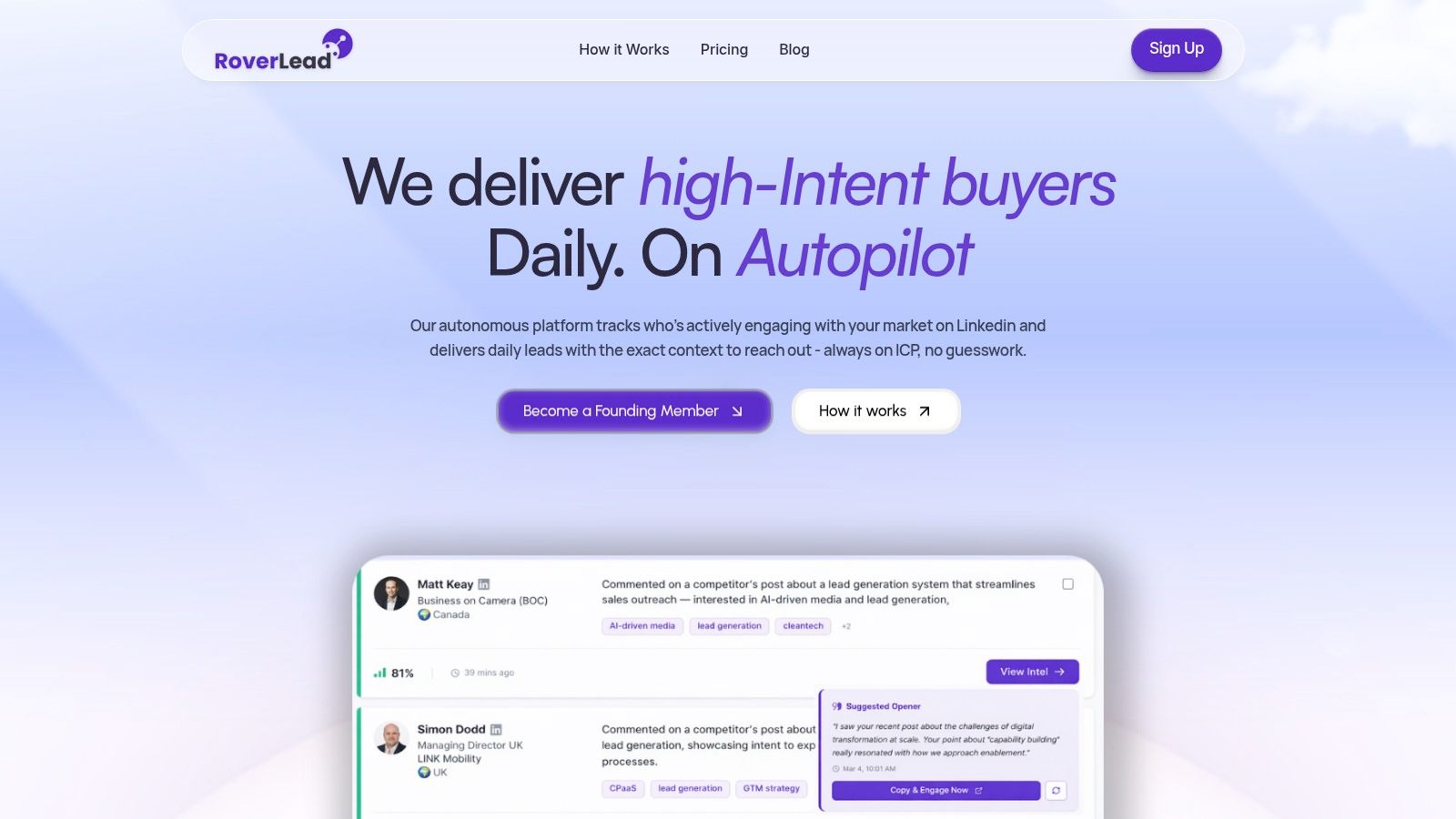
RoverLead AI takes a different route. Its prospecting philosophy is signal-first, not database-first. Instead of asking who matches your ICP in theory, it surfaces people showing relevant LinkedIn activity now.
That shift matters because good outbound depends on timing, not just targeting. Broad databases are useful for coverage. They do not tell a rep why today is the right day to reach out. RoverLead is built to answer that specific question.
Why RoverLead stands out
RoverLead is built for warm signal capture on LinkedIn. You set your ICP, competitors, keywords, creators, and topics. Its Signal Agents monitor engagement patterns and surface people with context on why they appeared.
That context is the product. The value is not another AI line generator. The value is that a rep can open the queue, see the trigger, and send a message with a real reason behind it instead of stitching together clues from five tabs.
Practical rule: If reps spend more time hunting for a reason to reach out than actually reaching out, the prospecting system is broken.
RoverLead fits founders, SDRs, and lean sales teams that run a LinkedIn-heavy outbound motion. It is a strong choice for teams that care more about relevance and timing than raw contact volume. If your strategy depends on catching warm prospects before competitors do, this philosophy makes sense.
A few blunt truths:
Best fit: Teams selling into markets where LinkedIn activity is a useful buying signal.
Big advantage: Reps spend less time watching feeds and more time contacting people with current context.
Tradeoff: It is LinkedIn-focused, so it should sit beside your outbound stack, not replace it.
Operational reality: CSV export and saved lists work well today. Deep CRM automation is not the main reason to buy it.
If you want to test whether a signal-led motion will produce enough pipeline to justify the change, use the RoverLead ROI calculator.
2. Apollo.io
Apollo.io fits a common sales scenario. You need a rep to build a list, verify contacts, load a sequence, and start outreach before lunch. You do not want that rep bouncing between four tools and three browser tabs to make it happen.
Apollo's prospecting philosophy is data scale plus execution in one system. That matters more than the AI label. If your GTM motion depends on high outbound volume, broad account coverage, and fast rep ramp time, Apollo makes sense. If your strategy depends on niche signals, custom enrichment logic, or tight workflow design, Apollo will feel limiting.
Who should buy Apollo
Buy Apollo when your primary problem is stack sprawl. It gives sales teams a large contact database, sequencing, enrichment, and CRM connectivity in one place, which keeps activity high and setup work low.
That convenience is the reason to buy it.
The tradeoff is control. Apollo works best for teams that accept a packaged workflow and want decent execution across prospecting tasks, not best-in-class depth in any one area. If your reps need a cleaner process before you add more tools, fix that first with a sales process optimization framework for outbound teams.
A blunt read on fit:
Best fit: SMB and mid-market teams running outbound at scale with standard ICP filters and repeatable messaging.
Why leaders pick it: One vendor can cover list building, outreach, and basic enrichment without a heavy RevOps build.
Why reps use it: Prospecting and sequencing live in the same workflow, so time-to-first-touch stays short.
Main drawback: Credits, seats, and plan limits can create friction once usage grows.
Reality check: Data quality varies by segment. Treat Apollo as a volume engine, then validate performance in your actual market.
Apollo is a strong choice for teams that want speed, coverage, and fewer operational decisions. It is a weaker choice for teams trying to win through signal precision or custom prospecting logic.
3. Clay
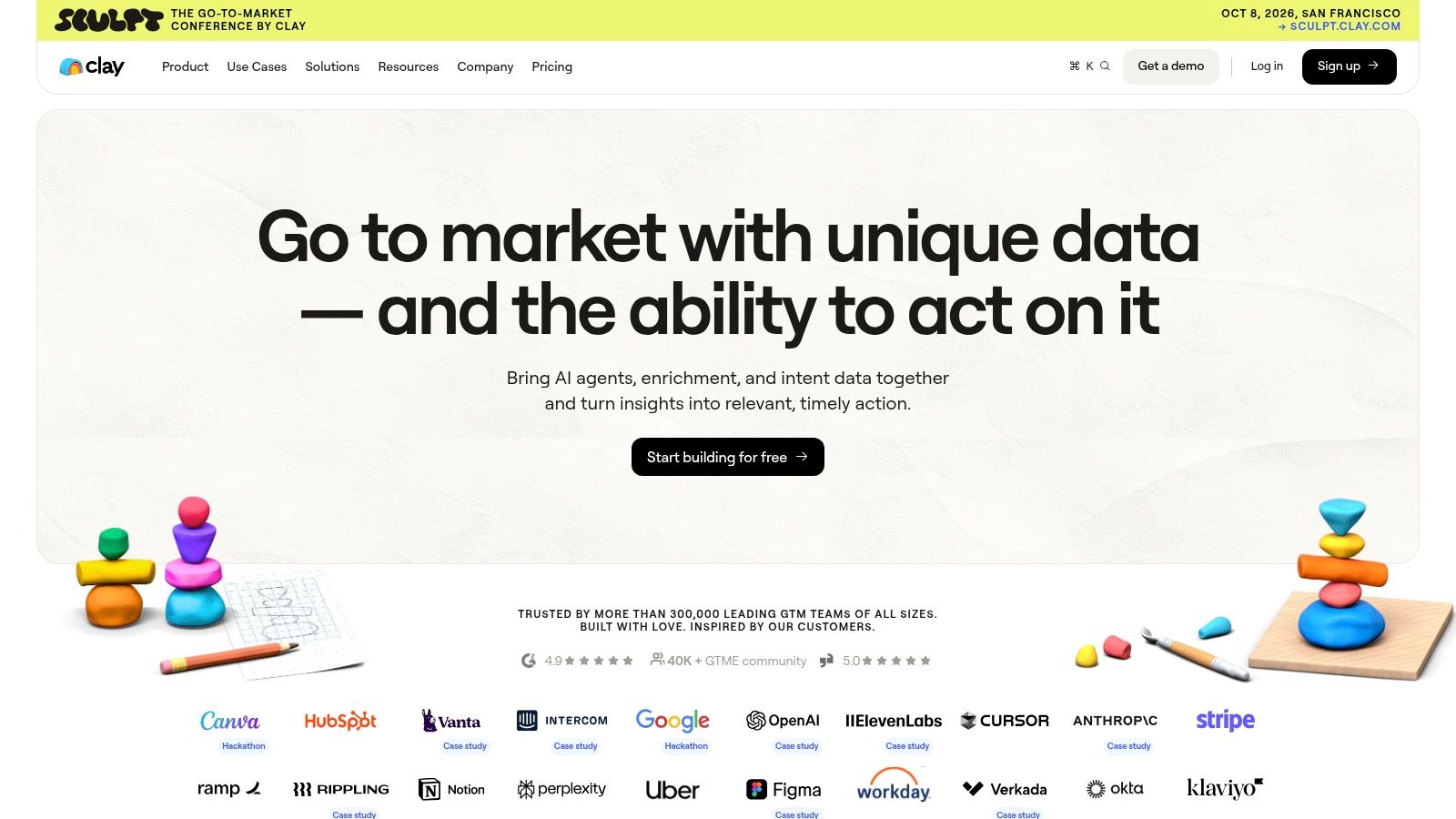
Clay is what you buy after your team realizes lists are not the strategy. Reps are missing good accounts, enrichment is split across vendors, and nobody agrees on which signals define a qualified prospect. Clay fixes that by letting you build the prospecting system yourself.
Its core philosophy is workflow-driven intelligence. Not data scale alone. Not a packaged outbound motion. You connect sources, layer enrichment, run research, score accounts, and shape custom qualification logic around your GTM motion.
That is why Clay has such a sharp divide in outcomes.
Strong operators use it to turn messy prospecting questions into repeatable workflows. Weak operators turn it into a credit-burning lab project.
Where Clay wins
Clay is at its best when your prospecting strategy depends on combinations of signals, not a basic contact filter. If your team cares about hiring trends, installed tech, funding status, job changes, intent clues, geography, and account-level research in the same motion, Clay gives you the control to combine them.
It also fits teams that treat prospecting as an operating system problem. Sales, RevOps, and growth need to agree on how accounts are found, enriched, routed, and worked. If that process is still sloppy, fix the operating model first with this guide to sales process optimization for outbound teams.
Clay is a builder's tool. Buy it because you want custom logic and can manage it.
Do not buy it because the product demo looked smart.
Best fit: Teams with a defined ICP, clear signal hypotheses, and someone who can build and maintain workflows.
Why leaders pick it: It matches a custom GTM strategy better than rigid all-in-one tools.
Why reps benefit: Better targeting reaches the workflow when the system is designed well.
Main drawback: Complexity, credits, and ownership issues can slow adoption fast.
Reality check: Clay amplifies strategy quality. If your targeting logic is weak, Clay helps you scale weak targeting.
The blunt recommendation is simple. Choose Clay when you want to build a prospecting machine around your own philosophy. Skip it when you need a tool that tells the team what to do out of the box.
4. Cognism
Cognism sells a very different promise. Not endless flexibility. Not social signals. Not an all-in-one outbound engine. It sells confidence in contact data and compliance.
That makes it useful for teams that still rely heavily on phone outreach, especially in regulated environments where bad data is more than annoying. It can create risk.
Best use case
If your reps call and text prospects in the US or other tightly regulated markets, Cognism deserves a serious look. Its compliance-forward positioning and verified contact focus are key buying reasons.
You are not buying it for novelty. You are buying fewer ugly surprises.
Strong fit: Outbound teams using calls as a core channel.
Why it matters: Compliance concerns change the tool decision fast.
Main drawback: Quote-based pricing means you'll need a real evaluation process.
Reality check: Coverage still depends on your market and ICP.
Cognism is boring in the best possible way. Sometimes boring makes quota.
5. Amplemarket
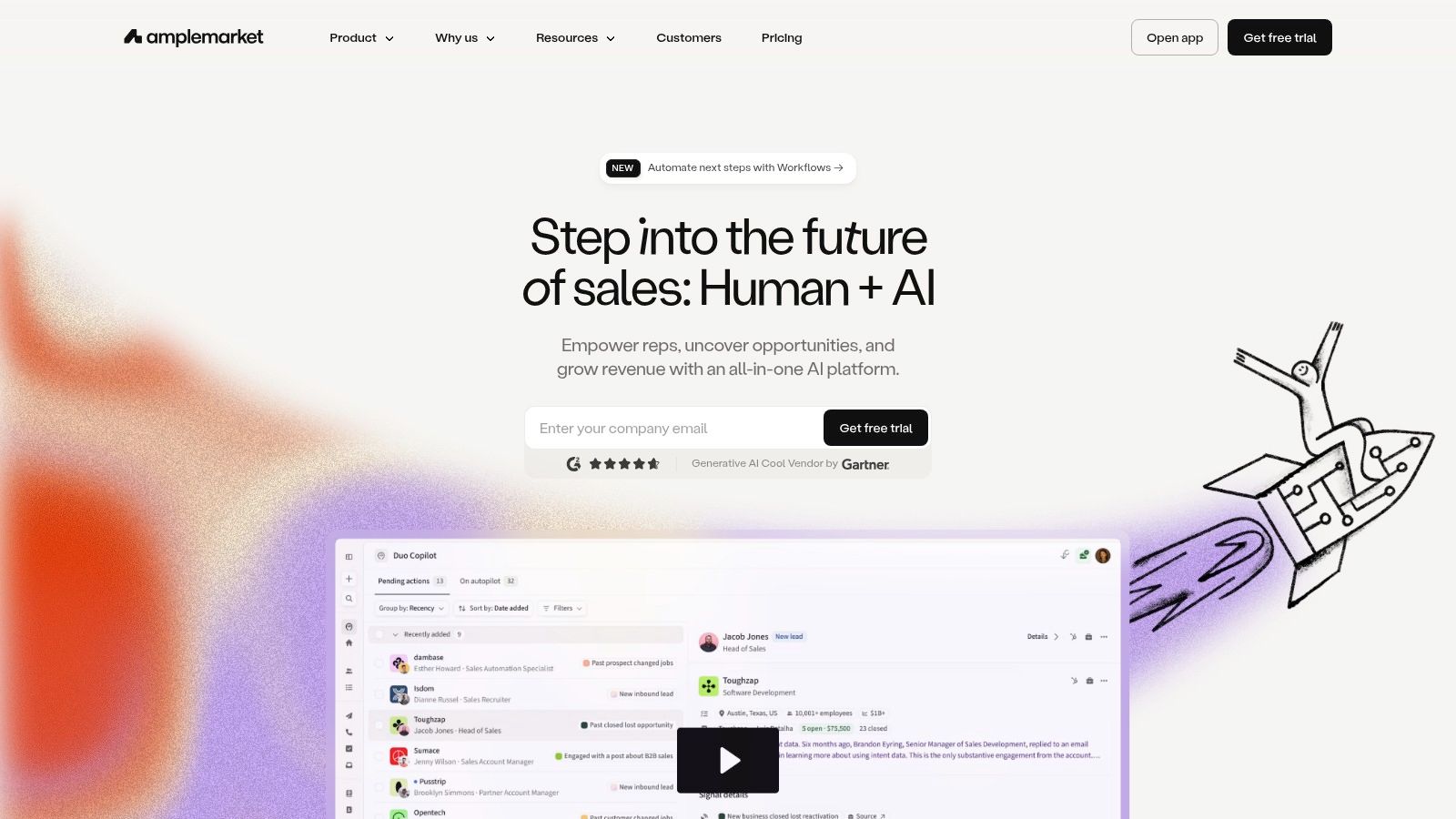
A rep spots a buying signal, pulls contact data, drafts a message, drops the prospect into a sequence, and logs the work. If that flow happens across five tools, your team loses time and context. Amplemarket is built for leaders who want that work done in one place.
Its prospecting philosophy is workflow consolidation. The category is increasingly heading in that direction, with vendors trying to combine research, enrichment, sequencing, signals, and AI assistance inside a single outbound system. Recent roundups make that positioning clear, including AiSDR's overview of AI sales prospecting tools.
What you are really buying
You are buying speed, rep focus, and fewer handoffs between systems. Amplemarket makes sense for teams that care more about execution in one operating environment than building a custom stack tool by tool.
That tradeoff is real.
If your GTM strategy depends on deep data coverage, niche enrichment sources, or heavy RevOps customization, a unified platform can feel restrictive. If your strategy depends on getting SDRs live fast with decent data, AI assistance, multichannel outreach, and less process drag, Amplemarket is a strong fit.
Best for: Teams that want one outbound workspace instead of stitching together a prospecting stack.
Why teams buy it: Faster ramp, simpler rep workflow, and less vendor sprawl.
Watch for: Pricing usually moves into sales-led conversations as needs get more advanced.
Main tradeoff: It is a workflow-first product, so pure data depth may trail the biggest database vendors.
My view is simple. Pick Amplemarket if your problem is operational friction. Skip it if your problem is market coverage.
6. 6sense
A rep books a meeting with an account that looked cold last quarter. Two weeks later, three other stakeholders show up to the call already familiar with your category. That is the problem 6sense is built to solve.
6sense fits teams that prospect at the account level, not the lead level. Its core philosophy is intent plus predictive prioritization. You use it to decide which accounts deserve attention now, which buying groups are warming up, and where sales and marketing should coordinate instead of working from separate guesses.
That makes 6sense a strategy tool before it becomes a rep tool.
What you are really buying
You are buying account selection discipline. For companies running enterprise sales, broad outbound activity is usually the wrong move. The better move is to focus budget, SDR effort, and demand gen around accounts already showing signs of movement. If your team is building a real B2B demand generation strategy, that alignment matters.
6sense works best when your GTM motion already has structure. Clear ICP. Clean CRM. Tight territory rules. Sales and marketing that agree on target accounts. Without that foundation, the platform turns into an expensive reporting layer.
My advice is simple. Buy 6sense if your bottleneck is prioritization across complex accounts. Skip it if your bottleneck is basic prospect list building or SDR productivity.
Best for: Enterprise teams running ABM or account-based sales with RevOps support.
Why teams buy it: Better account prioritization, buying-stage visibility, and tighter coordination across sales and marketing.
Watch for: Long setup cycles, change management, and the need for clean data and process discipline.
Main tradeoff: Stronger at account orchestration than fast, rep-led prospecting.
6sense is a fit for companies selling into committees. It is not the right answer for teams that just need more contacts and faster outbound execution.
7. ZoomInfo SalesOS
A rep misses quota, asks for more leads, and the team buys a bigger database. That decision often points them to ZoomInfo SalesOS.
Sometimes that's the right call. Usually, it only solves one problem: coverage.
ZoomInfo belongs in the Data Scale camp. You buy it when your GTM motion depends on finding a lot of accounts, enriching records fast, and giving sales and ops one shared data layer. If your sales strategy is broad TAM coverage, territory-based outbound, or heavy list building across multiple segments, ZoomInfo fits.
If your problem is prioritization, message quality, or timing, ZoomInfo will not fix that on its own.
That distinction matters. Sales leaders often buy ZoomInfo expecting pipeline creation. What they are really buying is reach, enrichment, and system-wide data standardization. Those are useful capabilities, especially for larger teams building a tighter B2B demand generation strategy across sales and marketing.
What ZoomInfo is actually good at
ZoomInfo works best as infrastructure. It gives reps and RevOps broad company and contact coverage, supports segmentation with firmographic and technographic data, and plugs into the rest of the stack. For companies with multiple teams touching the same accounts, that consistency has real value.
Its AI positioning matters less than its operating model. As noted earlier, AI support is now expected in modern sales software. The core buying question is simpler: do you need more records and better enrichment, or do you need sharper signals and execution?
My recommendation is straightforward. Buy ZoomInfo if missing or inconsistent data is slowing down outbound and account coverage. Skip it if your reps already have enough names and still struggle to convert them into meetings.
Best for: Mid-market and enterprise teams that need scale, enrichment, and broad territory coverage.
Why teams buy it: Large database, strong integrations, and a central source of prospect data.
Watch for: Contract complexity, uneven value by segment, and the risk of paying for data volume you do not operationalize.
Main tradeoff: Stronger as a data system than as a standalone prospecting strategy.
8. Bombora
Bombora fits a specific prospecting philosophy: intent signals. Buy it if your sales team already has account coverage and needs help deciding where to focus this week. Skip it if you still lack clean contacts, clear messaging, or a working outbound process.
That distinction matters. Bombora gives you third-party intent at the company level. It tells you which accounts are showing unusual interest in certain topics across the web. It does not tell a rep which buyer is active, what they care about internally, or why your message will get a reply.
Bombora is strongest as a prioritization layer inside a broader account-based motion. If your team is connecting marketing activity, outbound timing, and account selection, this guide to B2B demand generation is the right context.
Used well, Bombora helps teams rank accounts before they burn rep time. Used poorly, it creates a queue of companies that look interesting on paper but still require heavy manual work to turn into real conversations.
My recommendation is simple. Treat Bombora as signal enrichment, not prospecting execution.
Best for: ABM teams and enterprise sales orgs that already have data, coverage, and a defined account list.
Why teams buy it: Company-level intent helps with account prioritization, campaign timing, and topic-based segmentation.
Watch for: Weak results when reps use intent topics as a substitute for contact research and message relevance.
Main tradeoff: Better at telling you where interest may be building than helping reps turn that interest into meetings.
9. UserGems
UserGems fits a very specific prospecting philosophy. Start from relationship signals, not database scale.
That is the right bet for teams sitting on a real customer base, closed-lost history, and a CRM that reflects who bought, who championed the deal, and where those people went next. If a former customer advocate lands at a new company, your reps have a credible reason to reach out. That signal is stronger than another filtered list of "ideal" accounts that look good in a spreadsheet and reply to nothing.
UserGems is strongest when your GTM strategy already values timing and familiarity over raw volume. Sales leaders with an account-based motion, CS-to-sales feedback loop, and disciplined CRM hygiene usually get the most from it.
The weakness is just as clear. Signal-driven prospecting needs signal inventory.
If your company is early, sells into small markets, or lacks enough historical champions to track, UserGems can feel thin fast. You will not get the output of a broad contact database or a high-volume outbound engine. That is not a product flaw. It is the tradeoff of choosing relevance over scale.
My recommendation is simple. Buy UserGems if your team wins by reconnecting with known people at the right moment. Skip it if your core problem is basic list coverage, contact accuracy, or outbound capacity.
Best fit: Sales teams with strong CRM history, past customer champions, and an account-based sales motion.
Why teams buy it: Job-change and relationship signals give reps a legitimate reason to reach out.
Watch for: Weak volume if your business has limited historical data or a thin champion network.
Main tradeoff: Better for warm re-entry plays than broad top-of-funnel prospecting.
10. Seamless.AI
Seamless.AI is built for speed. Need contact info now? Open the extension, pull the lead, move on.
That workflow still has a place. Not every team needs orchestration, multi-source enrichment logic, or account scoring dashboards. Some teams just need reps to stop hunting manually for emails and phone numbers.
Who should use it
This AI prospecting tool fits SDRs who work fast, live in the browser, and care most about immediate contact discovery. It also suits teams that want a lighter-weight data tool rather than a bigger operating system.
That said, this is a contact-finding philosophy more than a timing philosophy. If your real problem is relevance, not contact access, this won't fix the core issue.
Good fit: Fast-moving SDR workflows.
Why buy: Extension-based simplicity.
Why be careful: Packaging and pricing usually require a closer look, and accuracy varies by segment.
Top 10 AI Prospecting Tools: Feature Comparison
Product | Core features | UX & Results ★ | Value & Pricing 💰 | Target audience 👥 | Unique selling points ✨ |
|---|---|---|---|---|---|
🏆 RoverLead AI | Autonomous LinkedIn Signal Agents; 10+ buying signals; AI openers; 5‑min ICP setup | 2–3x reply rates; 30–50% more meetings; up to 60% less research; ★★★★☆ | Founding members: locked lifetime rate (capped); general pricing N/A 💰 | B2B sales leaders, SDR/BDR, founders, GTM marketers | Behavior‑driven LinkedIn intent; autonomous learning agents; LinkedIn‑compliant ✨ |
Apollo.io | Large contact DB + enrichment; sequencing; native dialer; API | Consolidates data + outreach; variable data quality; ★★★★ | Credit/seat tiers; cost-friendly for budget teams 💰 | SDRs, ops teams, SMBs looking for all‑in‑one | Broad DB + multichannel outreach in one tool ✨ |
Clay | Workflow builder; 100+ integrations; research agents; personalization | Powerful customization; steeper learning curve; ★★★★ | Data credits + actions model (complex) 💰 | Teams wanting custom ICP logic & deep enrichment | Flexible canvas for custom pipelines & AI agents ✨ |
Cognism | Verified contact data (incl. mobile); AI research; DNC/TPS screening | Good for regulated calling; strong compliance; ★★★★ | Quote-based; value depends on coverage 💰 | Outbound teams that rely on calling in regulated markets | Compliance-forward verified phone data & screening ✨ |
Amplemarket | AI intent; AI reply drafting; AI voice messages; sequencing | Strong AI assistance; integrated multichannel; ★★★★ | Startup plans public; higher tiers require sales contact 💰 | Startups & growth teams wanting AI-assisted outreach | Duo Copilot + AI voice + reply automation ✨ |
6sense | Predictive AI, account scoring, multi-source intent | Advanced ABM orchestration; enterprise results; ★★★★☆ | Enterprise pricing; often expensive 💰 | Large enterprises with ABM motions & budgets | Predictive account-level intelligence & orchestration ✨ |
ZoomInfo (SalesOS) | Extensive contact & company data; technographics; enrichment | Broad coverage; core data backbone; ★★★★ | Quote-based; can be high for full suites 💰 | Mid-to-large teams needing central data layer | Market-leading data breadth & integrations ✨ |
Bombora | Topic-level Company Surge intent; taxonomy of B2B topics | Great for account prioritization; noisy for contact-level SDRs; ★★★★ | Enterprise-level pricing; signal add‑on 💰 | ABM teams and demand gen using intent layers | Widely adopted third‑party intent taxonomy ✨ |
UserGems | Tracks job-changes + 30+ signals; AI scoring; SF/HS integrations | High-leverage warm signals; strong orchestration; ★★★★ | Quote-based; mid-to-upper five‑figure typical 💰 | ABM/outbound teams with past-champion programs | Champion job-change signals & orchestration agent ✨ |
Seamless.AI | Contact/company search; enrichment; Chrome extension; alerts | Fast contact discovery; accuracy varies by segment; ★★★ | Free tier available; paid packages unclear 💰 | SDRs needing quick verified contact find | Extension-first fast prospect discovery workflow ✨ |
Stop Buying Lists. Start Building Intelligence.
Monday morning. Your SDR team has a fresh list, thousands of contacts, and no real reason for any buyer to reply. By Friday, activity looks fine on the dashboard and pipeline still looks thin. That is what happens when you buy coverage for a timing problem.
The best ai prospecting tools are not the ones with the longest feature list. They are the ones built around the right prospecting philosophy for your GTM motion. Some tools solve reach. Some solve prioritization. Some solve execution. If you pick the wrong one, you get more work instead of more meetings.
A lot of teams still buy software as if prospecting starts and ends with contact volume. Sometimes that is the right call. If your reps cannot find enough people in the right accounts, a data-heavy platform like ZoomInfo or a contact-finder like Seamless.AI will help. If your reps are juggling too many disconnected steps, Apollo or Amplemarket can tighten the workflow and get activity out the door faster.
But mature teams usually have a different problem. They already have names. They lack context, timing, and a credible reason to reach out now.
That is the split that matters.
There are three clean buying paths:
Choose data scale if coverage is the bottleneck, your TAM is broad, and your outbound process already works once reps have records.
Choose workflow automation if execution is the bottleneck, reps are stuck stitching tools together, and speed matters more than perfect signals.
Choose intent and signal tools if prioritization is the bottleneck and your team needs to know who is active, interested, or changing right now.
As noted earlier, the category has consolidated around those three models. The practical lesson is simple. More names rarely fix weak pipeline on their own. Better prioritization does.
RoverLead fits the third model. Its value is specific. It turns warm LinkedIn engagement into a usable daily queue and gives reps the context behind the signal. That matters for teams selling through relationship-driven outbound, where timing and familiarity beat brute-force list volume.
That is a different philosophy from a database-first tool. ZoomInfo is built to maximize reach. Clay is built to help operators assemble custom workflows and enrich records from many sources. Bombora and 6sense are built to surface intent at the account level. RoverLead is built for reps who need a practical answer to one question: who should I contact today, and why?
Pick the tool that matches the motion.
If your ICP is messy, your CRM is unreliable, or your reps ignore the system, no AI layer will save the rollout. Start with one clear use case. Run a focused pilot. Check adoption, meeting quality, and pipeline movement. Then expand.
Busy sales teams do not need more leads. They need sharper reasons to reach out.
FAQ
What are ai prospecting tools
AI prospecting tools help sales teams find accounts, enrich contact data, prioritize who to contact, and in some cases draft outreach. The useful ones do one job well. They either expand coverage, surface buying signals, or remove manual work from the process.
Are ai prospecting tools mainly for research or outreach
Mostly for research and prioritization. Outreach gets the attention because it is visible, but the primary value usually comes earlier. Good tools help reps decide who deserves a message in the first place.
That is the right way to evaluate this category. Start with the prospecting philosophy, not the email writer.
Do these tools replace SDRs
No. They change the job. Reps spend less time building lists and more time working live opportunities, writing sharper messages, and following up while timing still matters.
What matters more, database size or signal quality
Signal quality wins unless your core problem is market coverage.
If your team cannot find enough accounts in the first place, a large database matters. If your team already has names but struggles to prioritize, fresh signals matter more. Sales leaders confuse these two problems all the time, then buy the wrong product.
How quickly should a team expect results
You should see early adoption and workflow signal within the first few weeks. Real pipeline impact takes longer because reps need time to trust the output, use it consistently, and work deals through the funnel.
Judge the rollout in stages. First, are reps using it? Second, are they acting on the recommendations? Third, are meetings and pipeline quality improving?
Why do some teams fail with ai prospecting tools
They buy automation before they fix targeting. Bad ICP definition, weak CRM hygiene, and unclear ownership kill these rollouts fast.
Tool sprawl is another common failure point. If reps need to bounce across five systems to do basic outbound work, usage drops and the data gets ignored.
Can AI-generated outreach be trusted
Use it as a draft. Review every message that makes a factual claim, references a trigger, or sounds too polished to be believable.
AI is good at structure and speed. It is still unreliable on specifics. That matters because one bad sentence can kill reply rates and credibility.
Should startups buy an all-in-one tool or a specialist tool
Start with one core tool that matches your motion.
If you need broad TAM coverage, buy for data scale. If you already know your market and need better timing, buy for intent or relationship signals. If your process is breaking under manual work, buy for workflow automation. That decision is more useful than comparing feature grids.
Is LinkedIn-based prospecting enough on its own
For some teams, yes. It works best in relationship-driven outbound where buyer activity is visible and reps can act on warm context quickly.
It is usually not enough for a larger outbound engine. Teams selling across wider markets still need account coverage, contact data, and system discipline beyond LinkedIn activity alone.
What's the best way to evaluate a tool before rolling it out
Run a tight pilot. One team. One ICP. One workflow.
Then measure behavior before you measure vendor promises. Do reps trust the output? Do they use it every day? Are the conversations better? That is how you tell whether a tool fits your GTM strategy or just demos well.
If your team is tired of grinding through cold lists, RoverLead AI is worth a serious look. It helps reps work from warm LinkedIn signals with context on why each prospect surfaced, which is a better starting point than another giant spreadsheet of strangers.