B2B Sales Process Optimization That Boosts Revenue in 2026
Are your deals stalling? Are your reps burning out on manual tasks? If your sales process feels more like a chaotic series of habits than a well-oiled machine, you're not just losing deals—you're leaving revenue on the table. Sales process optimization isn't about working harder; it’s about working smarter by systematically eliminating the guesswork, friction, and inefficiencies that kill your sales cycle.
This isn't a minor tune-up. It's the critical shift from intuition-led selling to a structured, data-driven engine that predictably shortens sales cycles, plugs pipeline leaks, and drives growth. If your process is a black box, this guide is your flashlight.
Why Your Sales Process Is Quietly Costing You Deals
Let's be honest. Most sales teams aren't running a process; they're running a patchwork of habits held together by a CRM they hate. That chaos leaves a shocking amount of money on the table. This isn't about a few missed follow-ups. It's the massive gap between random activity and a predictable revenue machine.
Think about it. One of your reps spends half their day doing manual research on Sales Navigator, crafting one-off emails, and guessing which lead might be warm. They send a generic connection request and hope. At the exact same time, your competitor—who has their process dialed in—gets an alert that a high-intent prospect just engaged with a rival's content. They send a perfectly timed, relevant message and start a conversation.
That's the gap where deals are won and lost. An unoptimized process creates brutally predictable problems:
Leaky Pipelines: Good leads go cold because your follow-up cadence is inconsistent or, worse, nonexistent.
Vanishingly Low Reply Rates: Your generic outreach gets deleted on sight. Buyers expect you to know who they are and why you're contacting them now.
Rep Burnout: Your best sellers are buried in admin work and low-value tasks instead of closing deals. They get frustrated, and they leave.
The move from guesswork to a data-backed system isn't just a good idea anymore. Companies with a structured sales workflow see up to 28% higher revenue than those stuck in ad-hoc chaos. When buyers are ghosting 80% of cold outreach, optimization is a survival strategy.
This playbook is your path out of that chaos. The data is overwhelming: modern B2B selling demands a smarter approach. In fact, a recent 2026 report shows 72% of B2B organizations now say they rely on data-driven selling over old-school intuition, a huge jump from just 40% five years ago. Explore more data on sales process effectiveness.
First, we need to get a clear picture of where you are today. Let's start by auditing your current state to find the real bottlenecks.
Table of Contents
FAQ: Sales Process Optimization
1. What's the difference between a sales process and a sales methodology?
3. What is the biggest mistake to avoid in sales process optimization?
6. What are the most important KPIs to track for sales process optimization?
7. How do I get my sales team to adopt new tools and processes?
8. Is it better to build our own sales process or copy a standard one?
9. How does sales process optimization impact sales forecasting?
10. What's the first step I should take to optimize my sales process?
What is Sales Process Optimization?
Before diving into the fix, let's establish a clear definition. Sales process optimization is the systematic, ongoing practice of analyzing and refining each stage of your sales cycle to improve efficiency, reduce friction, and increase revenue. It involves mapping out your current process, identifying bottlenecks using data, implementing targeted changes (often through technology and automation), and continuously measuring the impact on key performance indicators (KPIs).
The goal is to move from a reactive, inconsistent sales motion to a proactive, predictable, and scalable revenue engine. It's not a one-time project but a continuous loop of measure, analyze, improve, and repeat.
Conducting a Brutally Honest Sales Workflow Audit
You can't fix a sales process you don’t understand. Before you buy a new tool or rewrite a single script, you have to look in the mirror. An honest audit is the only real starting point.
This isn't about blaming reps for missed quotas. It's a diagnostic. The goal is to map every single step—from the very first touchpoint to the ink drying on the contract—and find exactly where things break. Where do deals slow down? Where do they get stuck? Where do they go to die?
Get on the phone with your reps. Ask them where the friction is. Is it the 2-day slog to get a custom proposal out the door? Are high-intent leads falling into a CRM black hole, never to be seen again? These aren't just complaints; they're symptoms of a systemic problem.
This is what happens when a sales process is run on intuition and chaos instead of a clear system.
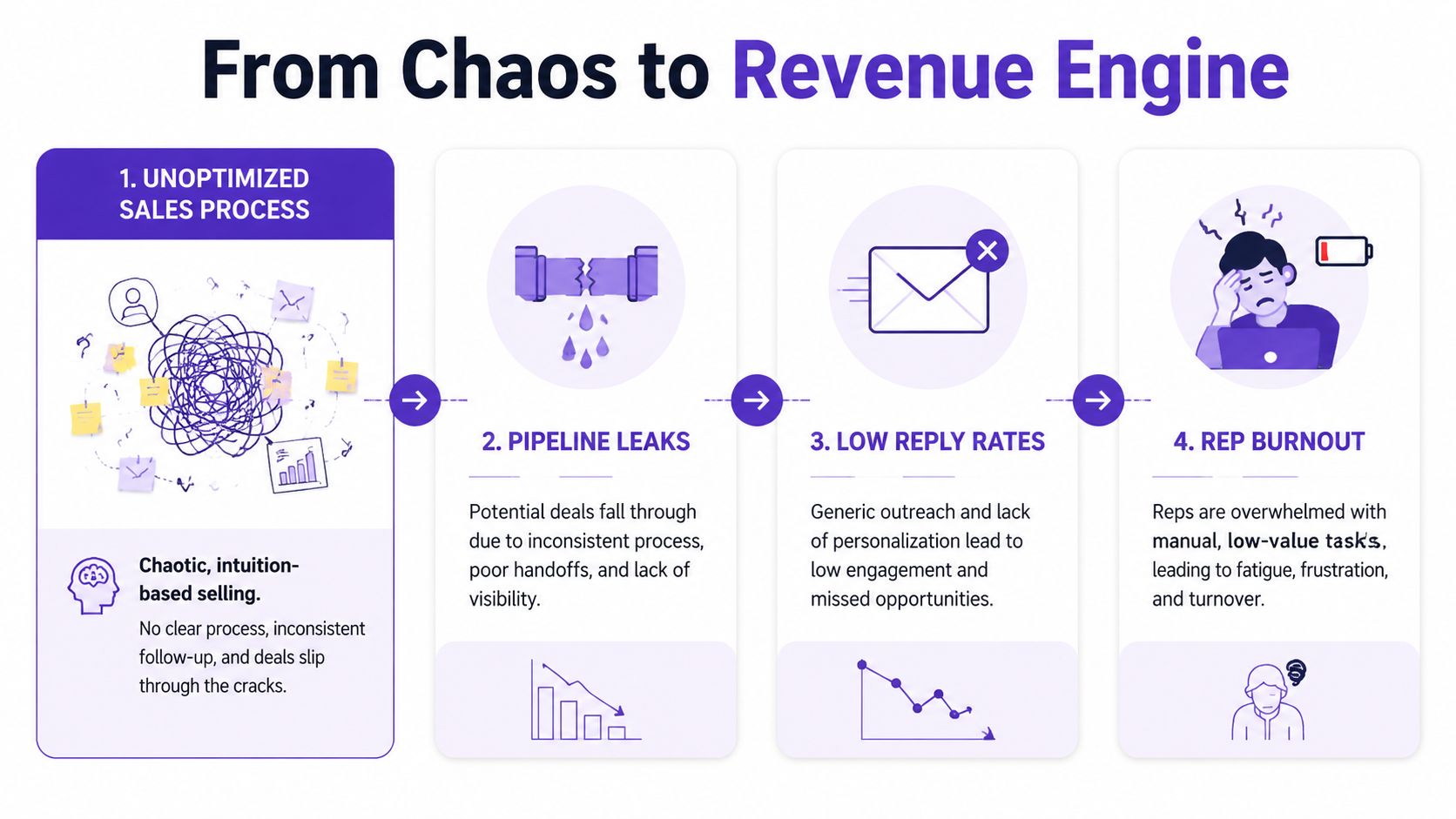
Lost deals, terrible outreach metrics, a burned-out sales team—these are the direct costs of a broken process. The infographic nails it. These issues aren't random; they are the predictable result of a flawed foundation. Your audit is how you find the cracks.
Diagnosing Your Sales Health
To get a real diagnosis, you need to look past top-line revenue. That number doesn't tell you how you got there or how much effort it took. Dig into the metrics that reveal the health and efficiency of your sales engine.
Start here:
Lead Response Time: How many minutes or hours until an inbound lead gets a first touch? In a world of instant gratification, a slow response is the fastest way to hand a deal to your competitor. This is a non-negotiable metric.
Stage Conversion Rates: What percentage of deals actually move from "Qualified" to "Demo"? Or from "Proposal Sent" to "Closed-Won"? Low conversion between specific stages is a flashing red light telling you exactly where your process is failing.
Sales Cycle Length: How many days does it take, on average, to close a deal? Is that number trending up or down? If it's getting longer, your process is creating drag, and it's costing you money.
A proper audit gives you the raw, unfiltered data you need to stop guessing and start building. It exposes the gap between your current reality and a high-functioning revenue machine. The path forward becomes painfully obvious.
If you’re ready to see what an optimized workflow could do for your numbers, let's schedule a call and talk through your specific bottlenecks.
The difference between a manual, disjointed process and a strategically optimized one isn’t subtle. It shows up every single day in what your team is actually able to accomplish.
Manual vs. Optimized Sales Process: A Comparison
This table paints the picture. On one side, you have a team drowning in manual tasks. On the other, a team focused on what matters: selling.
Activity | Manual Sales Process | Optimized Sales Process |
|---|---|---|
Prospecting | Reps spend hours on LinkedIn searching for anyone who fits a loose ICP. | Reps are alerted to prospects showing intent (e.g., engaging with content, visiting the pricing page). |
Lead Follow-Up | Inbound leads wait 4-8 hours for a response, often getting a generic template. | Inbound leads get a personalized response within 5 minutes, automatically routed to the right rep. |
Data Entry | Reps spend ~60 minutes a day logging calls, emails, and notes in the CRM. | 95% of activity is auto-logged. Reps only add context and next steps. |
Proposal Creation | Takes 1-2 days. Reps copy/paste from old documents, introducing errors. | Takes 15 minutes. Reps generate custom, error-free proposals from approved templates in the CRM. |
Forecasting | Weekly meeting is a 2-hour session of "best guesses" and anecdotal updates. | Forecasting is based on real-time deal stage data and historical conversion rates, taking 20 minutes to review. |
One team is constantly fighting its own process, burning time and energy on low-value work. The other has turned its process into a competitive advantage, giving reps more time to actually connect with buyers and close deals. The choice is yours.
Using AI and Automation to Eliminate Sales Drudgery
Your audit showed you where the machine is breaking down. Now it’s time to fix it. This isn't about piling on more tools—it's about using intelligent automation to claw back your team's most valuable asset: their time.
If your audit found reps are losing 15+ hours a week manually digging through LinkedIn, you've found your first target. That’s a massive resource drain. Instead of having humans do the tedious work, autonomous AI agents can monitor real-time buying signals—competitor mentions, relevant comments, even demo requests buried in online communities. The output? A pre-vetted list of high-intent leads lands directly in your team's workflow.
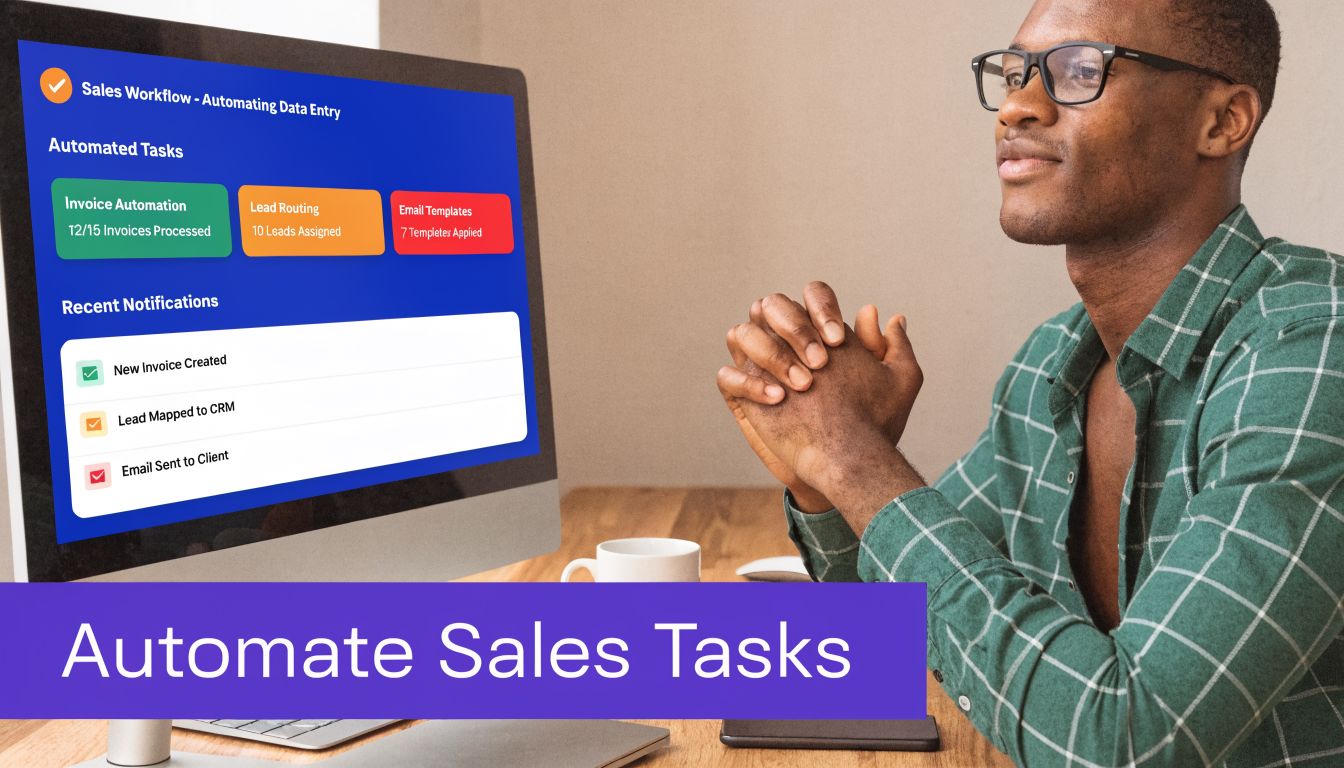
This solves two problems at once. You kill the hours wasted on fruitless research, and you fix the low reply rates that come with cold, generic outreach. Your team’s opening line is no longer a guess; it’s a hyper-relevant message based on something the prospect just did online. Suddenly, the entire conversation starts on a different footing.
Automating the Work That Isn't Selling
Prospecting is just one piece. The real goal is to get your reps back to doing what they were hired for: building relationships and closing deals. Everything else is a distraction.
Here’s where you can get some quick, high-impact wins with automation:
Kill CRM Admin: Stop forcing reps to be data entry clerks. Automatically log calls, emails, and meeting notes. Give them back those hours.
Prioritize with AI: Use AI-powered lead scoring to analyze who is actually ready to talk. This ensures your team spends their energy on the deals most likely to close, not just the newest lead in the queue.
Never Drop a Follow-Up: Trigger personalized email and task sequences based on what a lead does (or doesn't do). Good opportunities won't fall through the cracks because someone got busy.
The difference is stark. Teams that automate this kind of routine work free up 20% of their sales capacity for actual selling. This isn’t a small tweak—it leads to 25-50% boosts in productivity and can drive 10-20% more revenue.
Without it, your reps are likely spending a shocking 28% of their time selling. Just putting automated lead scoring in place can lead to 23% more calls per day. You can also explore our guide on Answer Engine Optimization to see how AI is fundamentally changing how buyers find information.
By taking the manual, repetitive work off their plates, you don’t just build a more efficient sales process. You build a more motivated and effective sales team.
Using Intent Data to Stop Guessing
Once you've automated the low-value tasks, the real optimization begins. It's about getting smarter about who you contact and, more importantly, when. Most sales teams are still stuck prospecting with static firmographic data—company size, industry, location. That tells you who a company is, not whether they need you now.
The whole game changes when you switch to behavioral intent data. This isn't about demographics; it's about tracking what your prospects do. Think of it as their digital body language, the quiet signals that show they're actively in a buying cycle.

This shift gets your team out of the "spray and pray" business and into conversations that are already happening. It’s the difference between cold calling a random list and reaching out moments after a prospect engages with a competitor's content. One is an interruption; the other is perfectly timed and immediately relevant.
From Static Lists to Active Signals
Traditional prospecting is like shouting into a void. You build a list, blast out a hundred messages, and cross your fingers for a few replies. It’s a great way to burn out your reps and your budget.
Intent-driven prospecting flips that model on its head. You stop guessing and start acting on clear buying signals. These aren't vague theories; they're specific, actionable events like:
A key decision-maker at a target account commenting on a competitor's LinkedIn post.
Multiple people from the same company suddenly researching a solution like yours online.
A prospect asking a pointed question about pricing in a private community or forum.
When your outreach is tied to a specific, recent action, you are no longer an interruption. You are a timely and relevant resource, which is exactly how you achieve higher reply rates and book more meetings.
The secret here is unifying all this data. After a quick setup to define your ideal customer profile (ICP), modern AI can track over ten different intent signals (like discussions about demos or pricing) and hand your reps context-rich leads. We've seen teams cut their research time by 60% and boost reply rates by 2-3x with this approach. You can learn more about how AI is fundamentally changing sales ops on Intent Amplify.
Rolling Out and Measuring Your New Sales Engine
Here's where the rubber meets the road. A perfectly optimized process on paper is useless if your reps won't use it. Just sending a memo announcing the "new way" is a fast-track to failure and quiet rebellion.
This is all about change management. And for a sales team, that means one thing: showing them the money. Salespeople are coin-operated, and that's not a bad thing—it's a predictable one. You have to frame every change in terms of their personal success.
Forget "we're streamlining our workflow." Think: "This new AI tool will save you 10 hours of grunt work, giving you that time back to go close two more deals this month." See the difference? One is a corporate mandate; the other is a direct path to a bigger commission check.
Driving Adoption and Proving ROI
A rollout isn't an event; it's a campaign. The first step is training, but not the boring, click-through-the-software kind. Your training needs to be built around role-playing real-world scenarios. Use the new tools, the new scripts, the new workflow—and let them feel how much faster it is.
From day one, you need a feedback loop. Set up a dedicated Slack channel or a weekly huddle where reps can flag friction points, ask dumb questions, and pitch their own ideas. This does two things: it helps you quickly patch holes in the process, and it gives the team ownership. They stop being subjects of an experiment and start feeling like co-architects.
The most important move you can make is tracking the exact same KPIs you audited at the beginning. Get a live dashboard up and running. Monitor lead response time, stage-by-stage conversion rates, and the total sales cycle length in real-time.
When the team sees those numbers improve—when they see deals closing faster—it's not just a win for the company. It's validation for them. It proves the new way works, kills the skepticism, and locks in the new habits.
This is how you prove the value of sales process optimization. You connect your team's efforts directly to financial results. You can even use our free tool to calculate the potential ROI of your sales process improvements and show the C-suite exactly what you've accomplished.
This is how you build a culture where the sales process is a living thing—constantly measured, tweaked, and sharpened for peak performance.
FAQ: Sales Process Optimization
1. What's the difference between a sales process and a sales methodology?
This trips up a lot of people. It’s actually pretty simple. Your Sales Process is the what—the concrete stages a deal moves through in your CRM (e.g., Lead > Qualified > Demo > Proposal > Closed). Your Sales Methodology is the how—the playbook or philosophy you use to move deals along that process (e.g., MEDDIC, Challenger Sale). You need both.
2. How often should I review my sales process?
Conduct a deep-dive audit annually, but monitor key metrics quarterly. Your sales cycle length, conversion rates, and lead response times should always be on your radar. Crucially, create a culture where reps can flag issues anytime. If you implement a major new tool, schedule a 90-day review to assess its impact.
3. What is the biggest mistake to avoid in sales process optimization?
Forcing a new tool or process on your team without their buy-in. If reps see it as just more admin work, they will resist it. Get them involved from day one. Frame every change in terms of how it helps them hit their goals and earn more commission.
4. Can small teams or solo founders benefit from this?
Absolutely. It’s even more critical when your time is your most limited resource. For a small team, optimization might be as simple as creating standardized email templates or using an AI tool to automate prospecting, freeing up hours every week to focus on closing deals. The principles of identifying time-sinks and using technology to solve them apply at any scale.
5. How do I know if my prospecting is based on real intent?
Real intent is a behavior, not just a job title. Outdated prospecting targets "VPs of Marketing at SaaS companies." Intent-based prospecting targets "the VP of Marketing who just asked a question about integrations on a competitor's post." One is a cold guess; the other is a warm, timely buying signal.
6. What are the most important KPIs to track for sales process optimization?
Start with these four:
Sales Cycle Length: The average time from first contact to closed deal.
Lead Response Time: How quickly you engage with a new inbound lead.
Stage-by-Stage Conversion Rate: The percentage of deals that advance from one stage to the next.
Win Rate: The percentage of all opportunities that result in a closed-won deal.
7. How do I get my sales team to adopt new tools and processes?
Focus on "What's In It For Me" (WIIFM). Show them how the change will save them time, reduce manual work, and help them close more deals (and make more money). Celebrate early wins publicly to build momentum and prove the new way works.
8. Is it better to build our own sales process or copy a standard one?
Start with a standard framework (e.g., a 5- or 7-stage process) as a baseline, but you must customize it to your specific product, buyer, and sales cycle. A process that works for a $50/month SaaS product will fail for a six-figure enterprise deal. Use a standard model as a template, not a rigid mandate.
9. How does sales process optimization impact sales forecasting?
It makes forecasting dramatically more accurate. An optimized process with clear stage-entry criteria and historical conversion data replaces guesswork with data-driven probability. Instead of relying on a rep's "gut feel," you can predict revenue based on how many deals are in each stage and the proven likelihood they will close.
10. What's the first step I should take to optimize my sales process?
Map your current process. You can't optimize what you can't see. Sit down with your team and document every single step a deal takes, from lead creation to close. Identify the tools used, the people involved, and the actions taken at each stage. This initial map will immediately reveal obvious redundancies and bottlenecks.
Stop guessing and start acting on real buyer intent. RoverLead AI delivers a daily feed of high-intent leads from LinkedIn, complete with the context and AI-written openers you need to start better conversations. See how it works.