Revenue vs Profit vs Income: The Sales Leader's Guide
Your dashboard says the team is winning. New pipeline is up. Closed revenue looks healthy. Reps are celebrating.
Then the CEO asks a brutal question: “Why does cash still feel tight?”
That's the moment most new sales leaders realize they've been managing one number and ignoring the ones that keep a business alive. Revenue tells you that customers are buying. It does not tell you whether those deals were worth winning. If your team brings in the wrong customers, discounts too aggressively, burns time on low-fit accounts, or forces the company to spend too much to deliver and support each deal, top-line growth becomes expensive theater.
This matters more in B2B than most sales teams admit. A bloated pipeline can hide weak deal quality. A big quarter can mask bad margins. “More sales” can still leave the business less healthy than before.
You need to understand revenue vs profit vs income the way a CFO does. Not as textbook definitions, but as operating signals. These numbers tell you whether sales activity creates value, whether pricing is strong enough, whether customer acquisition is efficient, and whether growth is funding the business or draining it.
Table of Contents
Why Your Revenue Target Might Be a Trap
A lot of sales teams get measured like slot machines. Pull the lever, produce bookings, repeat. That works until the business needs more than bragging rights.

I've seen this play out the same way again and again. The sales leader hits quota by pushing discounts, chasing custom deals, and accepting any customer willing to sign. Finance closes the quarter and finds a mess: implementation costs are high, support tickets spike, renewals look shaky, and margins get squeezed. Sales calls it growth. Finance calls it expensive revenue.
What the trap looks like
The trap starts when revenue becomes the only headline metric. Reps optimize for contract value. Managers optimize for forecast coverage. Leadership celebrates booked business without asking harder questions:
Was the deal priced well
Will the customer stay
Did we spend too much to win it
Does the account fit the product and the support model
Will the company keep enough after delivery and overhead
Those questions separate performance from vanity.
Practical rule: If a sales motion increases revenue while creating delivery strain, support burden, or acquisition waste, it is not a growth strategy. It's margin leakage.
Why sales leaders need financial literacy
This isn't an accounting side quest. It's part of the job. Sales activity changes the cost structure of the business. The customers you target, the channels you use, the discounts you allow, and the effort required to close and serve each deal all shape the bottom line.
A new sales leader who only knows the top line is operating half blind. You don't need to become a controller. You do need to know how a booked dollar turns into actual profit, and where it gets eaten along the way.
The Three Core Financial Metrics Defined
A rep brings in a big deal. The dashboard flashes green. Then finance opens the file and sees heavy discounting, expensive onboarding, and a support load that wipes out the win. That is what happens when a sales team knows revenue but not the numbers below it.
Use these terms precisely. Each metric answers a different business question, and each one should change how you prospect, price, and qualify deals.
Revenue
Revenue is the total sales recognized before expenses. It sits at the top of the income statement, so people call it the top line.
For a sales leader, revenue answers one question: Are customers buying?
That matters. It does not tell you whether the deals are worth winning. Revenue goes up when reps close more business, push larger contract values, or offer discounts that speed signature. Only one of those reliably improves the company. The other two can fill the pipeline with low-quality accounts and leave operations to absorb the cost.
If your team tracks revenue without looking at deal mix, discounting, sales cycle length, and retention risk, you are measuring volume, not performance.
Profit
Profit is what remains after costs come out. That is the metric that separates busy sales teams from productive ones.
Gross profit = Revenue - Cost of goods sold
Operating profit = Gross profit - Operating expenses
Net profit = Operating profit - Interest - Taxes
Those layers matter because sales decisions hit each one in different ways.
Gross profit
Gross profit shows what is left after the direct cost to deliver what you sold.
In software, that often includes hosting, implementation, customer success, and support tied to the account. In services, it includes the labor required to serve the client. For a B2B sales leader, gross profit is the first test of pipeline quality. If your team keeps winning deals that need custom work, deep discounts, or white-glove support, revenue can rise while gross profit gets thinner.
Gross profit answers: Was this deal worth delivering?
Operating profit
Operating profit goes one step lower. It includes the cost of running the business, such as sales salaries, commissions, marketing spend, admin overhead, and product investment.
Prospecting efficiency manifests here in financial form. If your team requires too many meetings, too much rep time, or too much paid acquisition to close business, operating profit suffers even if gross profit looks healthy. A sales motion with weak targeting and poor qualification does not just create pipeline noise. It raises the cost of growth.
Operating profit answers: Is our go-to-market engine efficient?
Net profit
Net profit is what remains after interest and taxes. This is the bottom line.
It is the clearest measure of whether the company keeps money after every obligation is paid. Sales leaders do not control taxes or financing structure, but they do influence the quality of revenue feeding the entire chain. Better-fit customers, stronger pricing discipline, and cleaner handoffs improve the odds that revenue reaches the bottom line instead of leaking out along the way.
Revenue gets attention. Net profit funds the business.
Income
Income is the broadest term here, and the one that creates the most confusion.
On financial statements, income usually refers to a specific stage of profit:
Gross income
Operating income
Net income
In many business conversations, net income and net profit mean the same thing. The problem is sloppy language. If someone says "income is up," you need to ask which income they mean. Gross income can look strong while operating income is weak. Net income can fall even when revenue rises.
A sales leader who hears "income" and assumes the company has more room to spend can make bad calls on hiring, discounting, or channel investment.
The simplest way to remember it
Use this version in forecast meetings:
Term | Real question it answers |
|---|---|
Revenue | How much did we sell? |
Gross profit | How much is left after delivery costs? |
Operating profit or income | How much is left after running the business? |
Net profit or net income | How much do we keep? |
If you remember one line, make it this: revenue measures sales output, profit measures economic quality, income only means something when you name the type.
Revenue vs Profit vs Income at a Glance
Keep this table handy. It's the fast way to stop mixing up numbers in forecast meetings.
Metric | What It Measures | Formula | Primary Audience |
|---|---|---|---|
Revenue | Total sales before expenses. Good signal of demand and market traction. | Sales recognized before deductions | Sales leaders, founders, growth teams |
Gross Profit | Money left after direct delivery costs. Useful for pricing and deal quality. | Revenue - COGS | Sales leadership, finance, product leaders |
Operating Profit | Profit from core operations after operating expenses | Gross Profit - Operating Expenses | CFO, CEO, department heads |
Net Profit | Final profit after all expenses, including taxes and interest | Operating Profit - Interest - Taxes | Executives, investors, owners |
Income | A context-dependent label that usually refers to gross, operating, or net stage | Depends on type of income used | Finance teams, accountants, executives |
The cheat sheet version
If you're in sales, focus on the sequence, not just the first line.
Revenue tells you whether you can sell.
Gross profit tells you whether what you sold makes economic sense.
Operating profit tells you whether the whole go-to-market machine is efficient.
Net profit tells you whether the company is creating value.
The Financial Waterfall From Revenue to Net Profit
Your team closes a big quarter. Bookings are up, the board is happy, and everyone wants to celebrate. Then finance closes the month and the picture changes. The new deals came with heavy discounts, expensive onboarding, and support needs your team never priced in. Revenue went up. Profit did not.
That gap is what trips up new sales leaders.
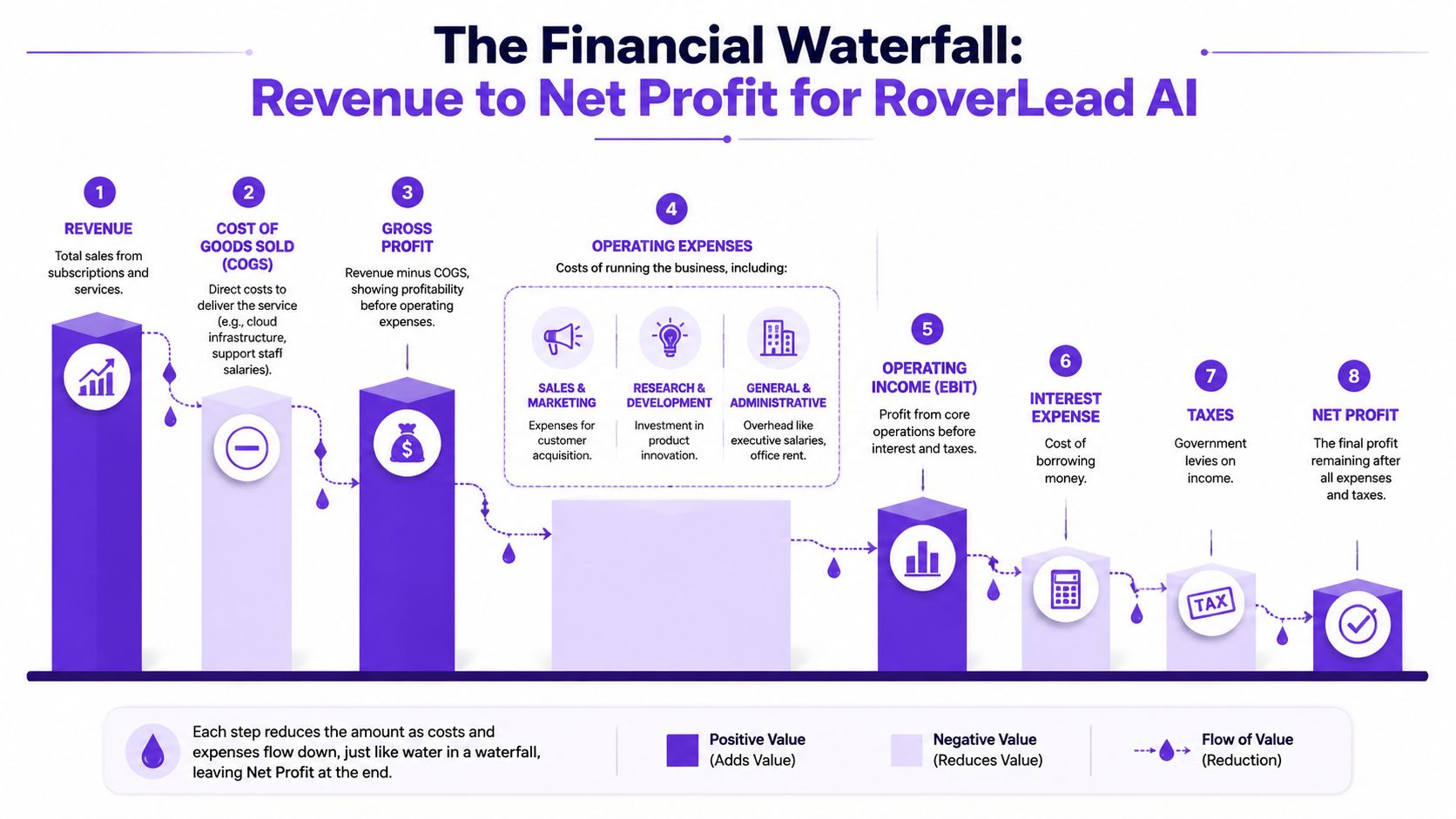
A CFO reads the income statement as a funnel that gets narrower at every step. Sales leaders should do the same. Each layer removes a different cost bucket. Each layer also exposes whether your pipeline is producing customers the business can serve, retain, and grow without waste.
Revenue starts the story. It does not finish it.
Assume a B2B SaaS company ends the year with $1 million in revenue.
Good. The market bought something. But revenue alone cannot tell you whether those deals were priced well, acquired efficiently, or built on accounts that will drain post-sale resources. If your team chases volume without screening for fit, the top line rises while the economics get worse.
That is why high activity can still produce a weak business.
Gross profit shows whether the deals were worth winning
Now subtract cost of goods sold. In SaaS, that usually includes hosting, implementation labor, delivery-related support, and any service work required to make the product usable for the customer.
What remains is gross profit.
Sales quality becomes visible in this comparison. A contract can look strong in the CRM and still be poor business if it needs custom work, high-touch support, or pricing concessions that wipe out margin. Sales leaders who ignore gross profit train reps to close work the company should not want.
A large deal with ugly delivery economics becomes an operating problem a few months later.
Operating income reveals whether your go-to-market engine is efficient
Next, subtract operating expenses. These usually include sales and marketing, product and engineering, and general overhead such as finance, HR, and leadership.
What remains is operating income, often called EBIT.
This is the number that separates a busy sales team from a productive one. It shows whether the company can generate demand, close business, onboard customers, and keep the machine running without burning too much money to do it. For B2B sales leaders, this connects directly to prospecting efficiency and pipeline quality. Better targeting, tighter qualification, and stronger messaging reduce wasted meetings, shorten sales cycles, and lower acquisition cost. If your team is building pipeline through low-fit accounts, poor data, or weak positioning, operating income absorbs the hit.
If you want a practical example of how positioning affects pipeline efficiency before it shows up in operating income, study answer engine optimization for B2B demand capture. Better-fit inbound interest usually costs less to convert than brute-force outreach to the wrong accounts.
Net profit is what the company actually keeps
After operating income, the company still has to pay interest and taxes. Once those are deducted, you get net profit.
This is the final score. Owners cannot spend revenue. They keep net profit.
You do not need a flashy market statistic to understand the point. Plenty of companies post impressive revenue and still disappoint on net profit because too much leaks out through delivery costs, bloated acquisition spend, overhead, financing, and taxes.
What sales leaders should take from the waterfall
Every dollar booked at the top gets tested on the way down. Your job is to bring in revenue that survives those tests.
Use pipeline reviews to press on the right points:
Which deals keep strong margin after onboarding and support costs
Which segments close with less discounting and expand with less handholding
Which reps are creating revenue with healthy economics, not just high volume
Which channels produce customers that retain well and do not overload customer success
Strong sales leadership improves all four layers of the waterfall. You improve revenue by winning more of the right accounts. You improve gross profit by protecting pricing and avoiding bad-fit deals. You improve operating income by making prospecting and pipeline generation more efficient. You improve net profit by feeding the company customers it can serve at a profit.
When Each Metric Should Drive Your Decisions
Your team crushes quota for the quarter. Then finance closes the books and asks a harder question: did those deals improve the business?
That is the decision test.

A sales leader who manages every choice off revenue will miss what really matters. Revenue tells you whether deals are landing. Profit metrics tell you whether your targeting, pricing, and pipeline motion are producing customers worth keeping.
Use revenue when you need proof the market will buy
Revenue should lead when you are testing a new market, new offer, or new segment. At that stage, the first question is simple. Can the team turn conversations into signed business?
Use revenue to judge traction. Then move quickly to tighter filters.
A full pipeline can still be weak if reps are booking poor-fit accounts, stretching discounting, or filling the funnel with deals that stall in procurement. If you are reviewing territory performance, pair booked revenue with conversion by segment so you can see whether prospecting is creating demand in the right places.
Use gross profit when deal quality matters more than deal volume
Gross profit should lead pricing, packaging, discount approval, and segment selection. This metric shows whether the revenue your team brings in survives delivery.
That matters fast in B2B sales. A deal with heavy implementation, custom reporting, or high support needs can look great in the CRM and look awful in the P&L. If your reps keep winning business that needs exceptions to make the customer happy, gross profit will expose it.
Set rules around it. Protect floor pricing. Track margin by segment. Review which opportunities hold price with less sales effort and less post-sale drag.
Use operating profit when you are managing sales efficiency
Operating profit should guide headcount decisions, outbound strategy, channel mix, and pipeline generation. This is the metric that connects sales activity to business performance.
Analysts at McKinsey note that B2B companies can improve growth and sales productivity by focusing on the right accounts, cleaner coverage, and better commercial execution, not just more activity, in their research on sales productivity in B2B growth. That is the operating profit lens. More meetings do not matter if prospecting is expensive, qualification is weak, and managers are spending time inspecting pipeline noise instead of real opportunities.
Use net profit when the question is business quality
Net profit should lead when you are judging whether growth is sustainable, whether the company can fund itself responsibly, and whether shareholders are getting real returns.
Sales leaders do not own taxes or interest expense, but they influence the result more than they admit. Customer mix, discounting, churn risk, and expansion quality all flow downstream. A quarter packed with low-quality bookings can hurt net profit long after the celebration call ends.
Revenue answers, "Did we sell it?" Net profit answers, "Was it worth selling?"
A practical decision map
Decision | Metric that should lead |
|---|---|
Testing demand in a new market or offer | Revenue |
Setting discount limits and pricing guardrails | Gross profit |
Improving prospecting efficiency and sales productivity | Operating profit |
Judging whether growth is sustainable | Net profit |
Pick the metric that matches the decision. Then hold your team accountable to that number, not the one that makes the dashboard look good.
What Every B2B Sales Leader Must Know About Profit
Your team celebrates a big quarter. Bookings are up, the board is happy, and the forecast looks full. Then finance closes the month and asks a harder question. Did those deals create profit, or did they just create work?
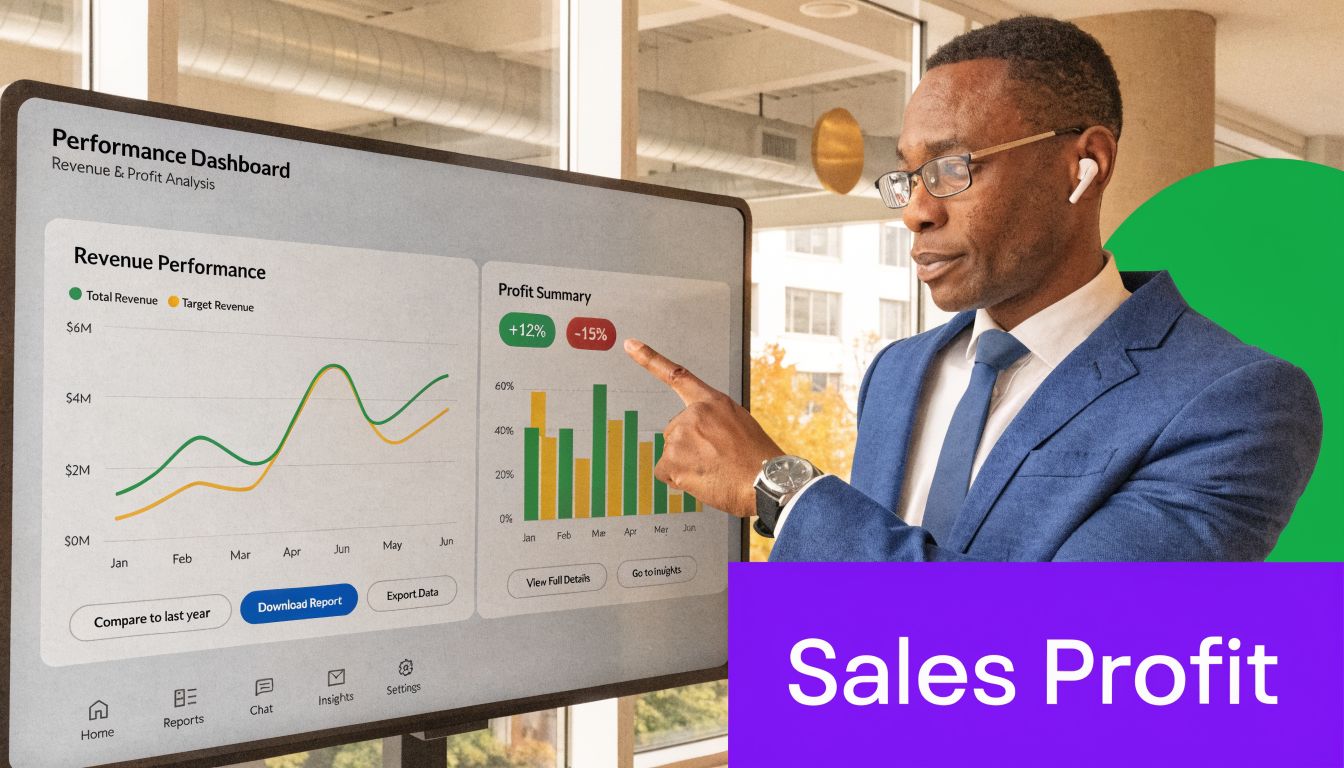
Profit is where sales leadership gets exposed. Revenue can hide bad behavior for a while. Profit cannot.
Profit is shaped before the contract is signed
Sales leaders often treat profit like a finance output. It is an operating result. The quality of your targeting, qualification, pricing discipline, and deal selection determines whether revenue survives the trip to the bottom line.
That starts at the top of the funnel.
If reps chase weak-fit accounts, the business pays for it several times. Prospecting takes longer. Conversion rates fall. More discounts show up late in the cycle. Customer success inherits accounts that need extra support. Renewals get harder. Margin slips a little at each step until a “good sales quarter” turns into an average business quarter.
Pipeline quality is profit quality.
The sales behaviors that protect profit
You do not need reps reciting accounting terms. You need them making better commercial decisions.
Coach to these points:
Target accounts your company can serve efficiently: A bad-fit logo is expensive even when it closes.
Hold price with intent: Discounting should solve a defined competitive problem, not rescue weak discovery.
Qualify for delivery reality: If implementation, support, or customization will be painful, the deal is weaker than it looks in CRM.
Prioritize channels that produce clean opportunities: Cheap-looking lead sources often become costly once rep time and low conversion are counted.
Use prospecting methods that improve relevance: Better timing and tighter messaging improve meeting quality, not just meeting volume. For one example, answer engine optimization for B2B pipeline quality can help your team capture higher-intent demand earlier in the buying process.
What profit-aware pipeline reviews sound like
A weak sales review asks, “Can we close it this quarter?”
A strong sales review asks a better set of questions. Will this customer hold price? Will they implement without drama? Will they renew on the standard model? Will the account team spend six months cleaning up a bad sale?
That is how a sales leader starts managing profit without turning into a controller.
Train reps to connect daily choices to the income statement
Make the link explicit:
A discount cuts revenue immediately and usually cuts gross profit faster.
A poor-fit customer raises service cost after the deal is booked.
Manual, low-yield prospecting pushes acquisition cost up.
Better-fit opportunities convert more cleanly and create healthier accounts.
Show reps that sales efficiency is not just a productivity issue. It is a profit issue.
A short explainer helps:
Sales leaders who understand this stop praising volume in isolation. They build teams that bring in customers the business can keep, serve, and grow profitably.
Your Action Plan for Profitable Growth
You don't need more financial theory. You need a tighter operating rhythm.
Do these next
Audit your dashboard: Keep revenue, but add gross profit by segment or deal type. If you can't see which revenue is healthy, you're managing blind.
Review your comp plan: Don't pay the same way for every dollar booked. Protect price and reward deals that fit your delivery model.
Clean up qualification: Make customer fit a hard standard, not a soft preference. The wrong customer hurts margin after the contract is signed.
Calculate acquisition accurately: Count rep time, tools, and channel costs when you evaluate pipeline sources. If you want a simple framework, use an ROI calculator for sales efficiency.
Run pipeline reviews with finance logic: Ask what survives after delivery cost, operating expense, and account servicing friction. That habit alone will upgrade decision-making fast.
The mindset shift
Sales leaders who understand revenue vs profit vs income stop chasing volume for its own sake. They build a cleaner revenue engine, one that creates customers the business wants more of.
Frequently Asked Questions
A sales leader hits quota, celebrates the quarter, then finance closes the books and shows weak operating income. That gap is the whole point of this topic. Sales activity creates revenue first, but the business only benefits when enough of that revenue survives delivery cost, support load, overhead, and the cost to win the deal.
Is revenue the same as income
No. Revenue is the money booked from sales before expenses. Income usually refers to what remains after some level of costs, so you need to ask which version you mean: gross income, operating income, or net income.
Is net income the same as net profit
Usually, yes. In day-to-day business conversations, both terms mean what is left after all expenses, including operating costs, interest, and taxes.
Why can a company have strong revenue and weak profit
Because bad revenue is expensive revenue. Heavy discounting, high service demands, poor-fit customers, bloated acquisition cost, and implementation drag can all shrink profit even while bookings rise.
Which number should a sales leader watch most closely
Track revenue, gross profit, and operating profit together. Revenue shows volume. Gross profit shows deal quality. Operating profit shows whether your sales motion still makes sense after the business pays to support it.
What is the biggest mistake teams make with revenue vs profit vs income
They use the terms like they mean the same thing. That mistake shows up fast in pricing decisions, loose qualification, and comp plans that reward booked volume without caring what the company keeps.
How should solopreneurs think about taxes
Base tax planning on profit, not revenue. As explained by Huddleston Tax CPAs in their guide to misunderstanding income versus profit, taxable income comes after deductible business expenses, not from top-line sales alone.
Is gross profit more useful than net profit for pricing decisions
Yes. Gross profit is closer to the economics of the deal. If your team cuts price to win business, gross profit shows the damage quickly, while net profit includes many costs outside that single pricing decision.
Does higher revenue always mean a healthier business
No. Higher revenue can come from weak-fit accounts, low-retention segments, and prospecting channels that waste rep time. For B2B sales leaders, pipeline quality matters as much as pipeline size because bad-fit opportunities consume selling and delivery capacity.
How can sales activity improve profit without raising prices
Tighten targeting. Qualify earlier. Reduce time spent on low-probability accounts. Protect discount discipline. Push reps toward prospects with a real problem, a clear budget path, and a delivery profile your team can support efficiently.
When should I bring finance into sales planning
Bring finance in before headcount plans, territory changes, and compensation design are finalized. If you want help aligning prospecting strategy with profitable pipeline goals, book a call to discuss sales and finance alignment.
RoverLead AI helps B2B teams turn LinkedIn buying signals into higher-intent pipeline instead of wasting effort on static lists and bad-fit outreach. If you want more qualified conversations and a sales motion that supports profitable growth, take a closer look at RoverLead AI.