What Is a Sales Enablement Platform? The 2026 Guide to Not Winging It
Let's be real. Half your sales team can't find that new case study. The other half is making up their own messaging on the fly. This isn't just an annoyance; it’s a quiet revenue leak, turning your sales floor into a free-for-all of missed targets and wildly inconsistent pitches.
You’re not running a sales team; you're herding cats. And it's costing you.
Table of Contents
Defining the Sales Enablement Platform: More Than a Digital Junk Drawer
Sales Enablement vs. CRM vs. Sales Engagement: What’s the Difference?
Answering Your Top Sales Enablement Questions
3. How Do We Measure the ROI of a Sales Enablement Platform?
5. We Already Have a Sales Engagement Tool. Do We Need Both?
6. What's the Biggest Shift Happening in Sales Enablement Right Now?
7. How Does Real-Time Intent Fit into an Enablement Strategy?
8. What Kind of Content Does a Signal Tool Like RoverLead Surface?
10. How Long Does It Take to Implement a Sales Enablement Platform?
Why Your Sales Team Is Flying Blind and Costing You Deals
If you’ve ever listened to a rep describe your product and winced because their version sounded… creative… you know the feeling. The modern sales floor is pure chaos. Your top performers hoard their secret stash of content that works, while new hires waste months just trying to figure out which deck isn't from 2021.

This misalignment creates a string of expensive problems that most leaders feel but can’t quite name. It’s the operational drag that grinds your pipeline to a halt.
The Hidden Costs of Sales Chaos
This disorganization isn't just messy—it has a direct, painful impact on your bottom line. Every minute a rep spends hunting through shared drives or Slacking a coworker for "that one-pager" is a minute they aren’t selling.
Think about these all-too-common scenarios:
Wasted Marketing Spend: Marketing spends weeks building a killer case study. It promptly dies in a folder somewhere because reps can't find it, or worse, don’t even know it exists.
Painfully Slow Ramp-Up: New hires are thrown into the deep end, taking months to become productive. You're losing revenue from what should be your most eager sellers, right when you need them firing.
Inconsistent Buyer Experience: A prospect gets three different stories from three different reps. Trust erodes. Your brand looks amateur. In a world where buyers demand a smooth journey, this inconsistency is a deal-killer.
The real problem is this: without a central command center, every rep is an island. They're forced to reinvent the wheel every single day, and you're paying for that inefficiency in lost deals and stalled pipeline.
This is where a sales enablement platform comes in. It’s not just another tool; it’s the central nervous system for your entire sales motion. It brings order to the chaos.
It ensures every rep has the right content, the right training, and the right guidance at the exact moment they need it. It’s about turning random acts of selling into a predictable, repeatable machine.
Of course, a tool is only as good as the process it supports. You can learn more about nailing your core workflows in our guide to sales process optimization.
Defining the Sales Enablement Platform: More Than a Digital Junk Drawer
So, what is this thing, really? A sales enablement platform is your team's single source of truth—the command center for everything they need to actually close deals.
Think of it like a master mechanic’s workshop. Instead of reps rummaging through a messy garage of outdated decks, random one-pagers, and old email templates, every tool is perfectly organized and right at their fingertips when they need it.
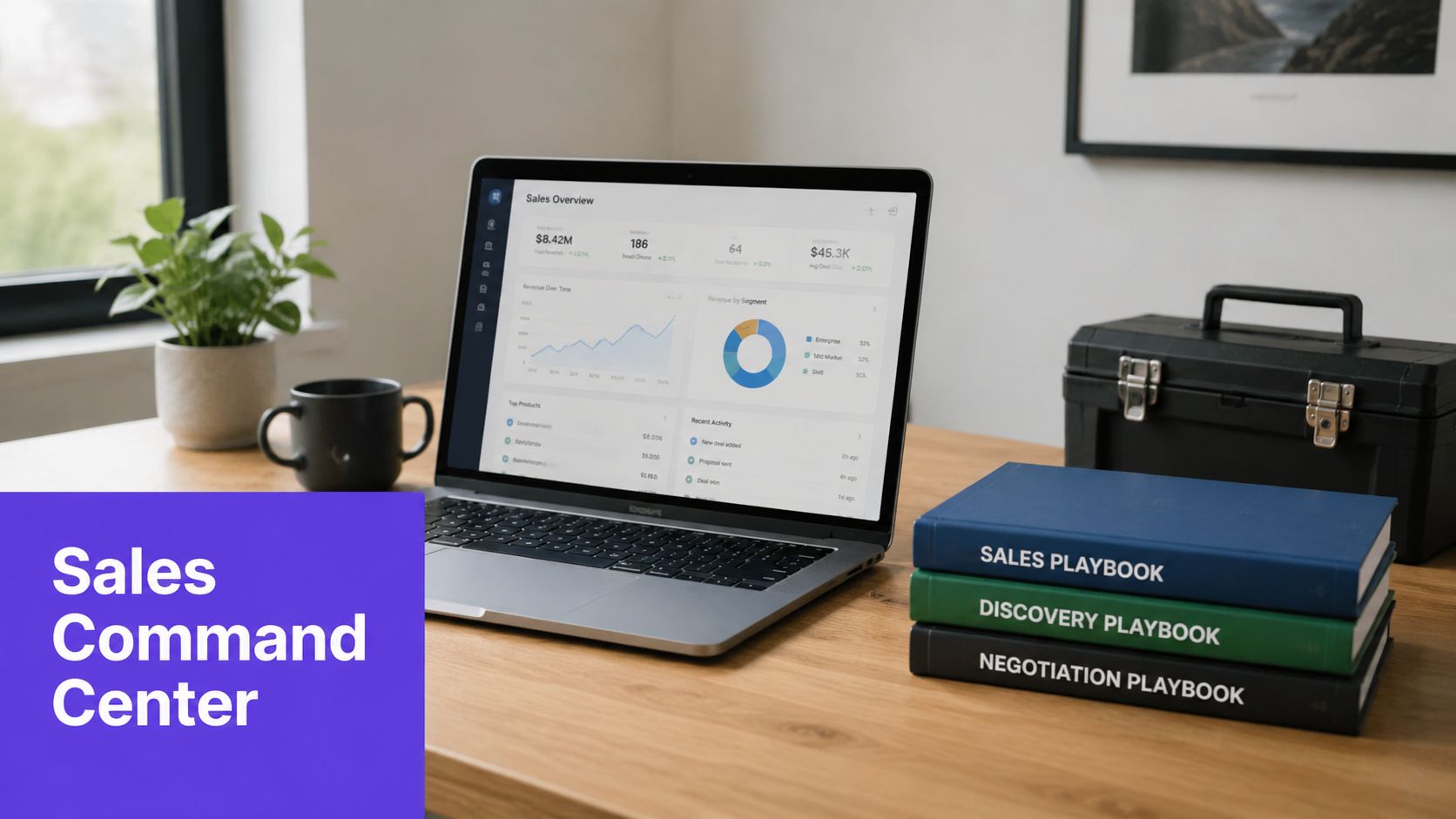
But it's more than just a digital filing cabinet. A modern platform is an intelligent system that connects what your reps need to know (training), what they need to show (content), and what they need to do (actions). It’s the engine that makes sure every single seller is on-message, confident, and effective.
Beyond a Glorified Dropbox
Let's be clear: the goal isn't just to store your case studies. It’s to arm your reps with the right resource at the exact moment it matters in the sales cycle. We're talking about proactively surfacing the perfect one-pager the second a competitor gets mentioned on a call.
A great sales enablement platform doesn’t just store your best plays; it helps your team run them. It turns your sales strategy from a theoretical document into a daily, repeatable practice for every single rep.
This approach delivers real, measurable results. The data doesn't lie: organizations with a formal sales enablement strategy see a 49% higher win rate on forecasted deals. You can see more data on how enablement drives measurable sales performance on G2.
Ultimately, the platform acts as the bridge that closes the all-too-common gap between marketing’s content and sales' real-world conversations. It ensures the best messaging isn't just created, but is consistently delivered, turning your B-players into A-players.
Core Features of a Modern Sales Enablement Platform
Most sales enablement platforms are just glorified filing cabinets. A place to dump case studies and one-pagers that reps can never find when they actually need them.
A modern platform isn't storage. It’s the central nervous system connecting your team’s content, coaching, and actions directly to revenue. This shift from a digital junk drawer to an intelligent engine is why the market is exploding.
The sales enablement platform market hit $7.1 billion in 2026 and is on track for $12.78 billion by 2030. That growth isn’t just about buying more software. It’s a sign that companies are finally ditching disconnected tools for a unified system. You can dig into the numbers in the full Grand View Research market report.
So, what separates a real platform from a fancy folder? Let’s break down the three pillars that actually matter.
1. Intelligent Content Management
This isn't about having a folder for "Case Studies" and another for "Battlecards." That’s a library. What you need is an intelligence layer.
Modern intelligent content management knows your rep is in a late-stage deal, facing a specific competitor, and targeting a certain persona. It doesn't just show them the newest asset; it surfaces the exact battlecard that has the highest win rate in that exact scenario. It's storage with a brain.
2. Just-in-Time Training and Coaching
Onboarding can’t be a four-week information dump that reps forget by month two. The goal is continuous, on-demand learning and coaching, integrated right into their workflow.
This means bite-sized training modules a rep can pull up three minutes before a discovery call. It means using conversation intelligence to analyze what’s actually happening on calls, so managers can provide targeted feedback on real skill gaps, not just theories. The aim is constant improvement, not a one-time exam.
3. Analytics That Tie to Revenue
If you can’t measure it, you're just guessing. A true sales enablement platform delivers robust analytics and reporting that ties directly back to closed deals.
Forget vanity metrics like content downloads. A modern platform answers the only question that matters: "Which assets and training programs are actually helping us win?" It shows you what’s moving the needle on deal progression and win rates, so you can double down on what works and kill what doesn't.
Sales Enablement vs. CRM vs. Sales Engagement: What’s the Difference?
Let's address the elephant in the room. Your tech stack is already crowded. You’ve got a CRM, a sequencing tool, maybe a dialer, and now we’re talking about a sales enablement platform.
Is this just another icon for your reps to ignore?
Not at all. The confusion is understandable, but these tools have very different jobs. Thinking they're interchangeable is like thinking your GPS, your engine, and your driver’s ed manual are all the same thing. They all help you drive, but they solve wildly different problems.
A sales enablement platform doesn’t replace your other tools; it makes them smarter. Let's compare.
Category | Sales Enablement Platform | CRM (Customer Relationship Management) | Sales Engagement Platform |
|---|---|---|---|
Primary Job | The brain: content, training, and plays | The address book: customer data and history | The megaphone: outreach at scale |
Core Function | Arm reps with what to say and how to say it | Act as the single source of truth for all contacts | Automate sequences of emails, calls, and social touches |
Key Users | Sales Reps, Sales Enablement, Sales Leadership | Sales Ops, Leadership, all customer-facing teams | SDRs, BDRs, Account Executives |
Main Metric | Win Rate, Ramp Time, Content ROI | Forecast Accuracy, Pipeline Coverage | Activities, Meetings Booked, Reply Rate |
Analogy | The recipe book and culinary school | The rolodex | The automated dialer and email sender |
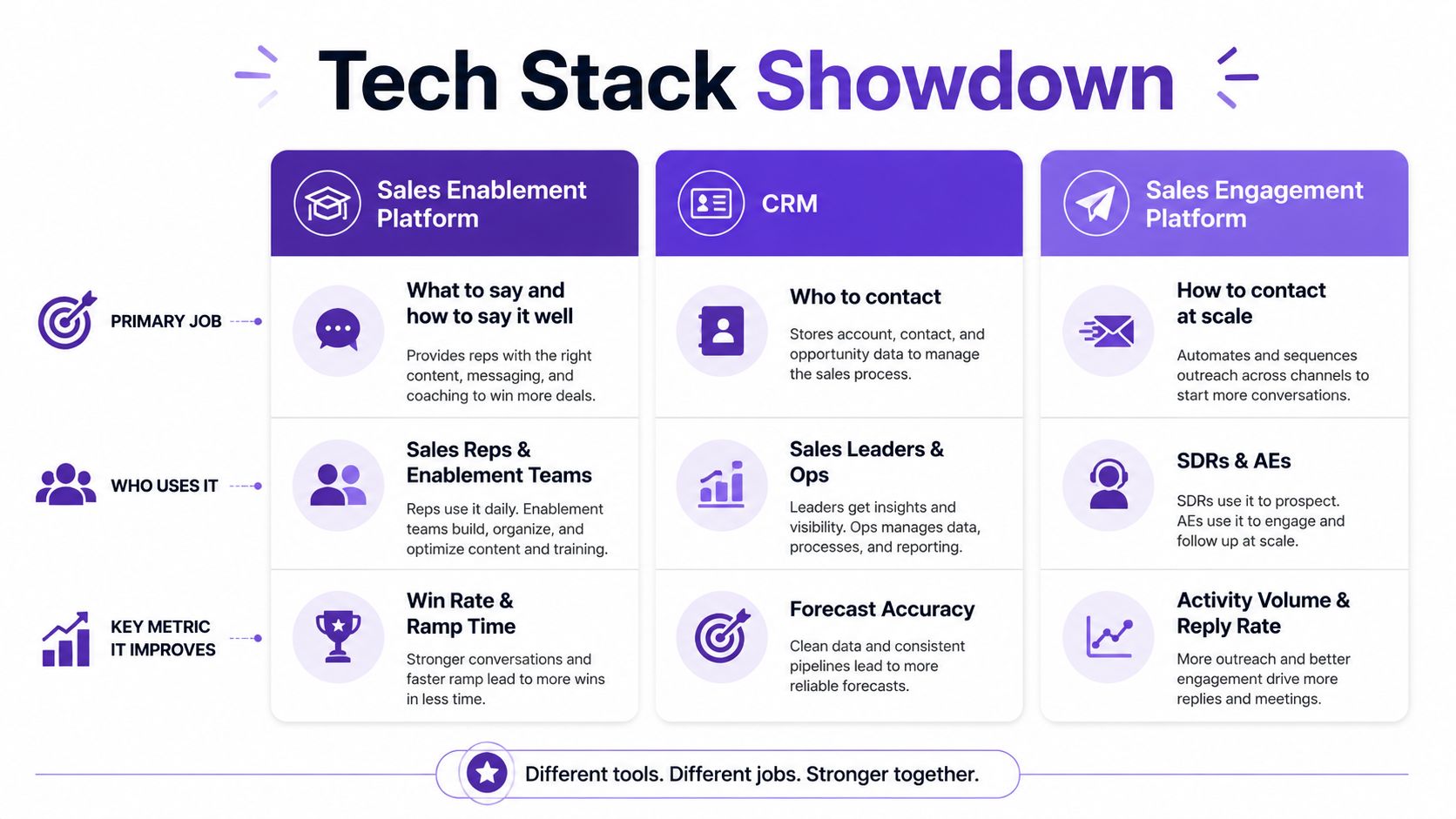
As the chart makes clear, each platform serves a distinct user and improves a different core metric. A CRM helps ops forecast. An engagement tool helps SDRs hit activity targets.
But a sales enablement platform is squarely focused on making every single rep more effective, directly impacting win rates and ramp time. You can learn more about how different technologies impact sales in our guide to the top AI sales tools.
Augmenting Your Strategy with Real-Time Intent Signals
So, you’ve dialed in your sales enablement platform. You have the playbooks. You have the content. Your team knows exactly who to sell to and what to say.
But what if you could nail the when?
This is where sales enablement is headed next. It’s about taking that perfectly tuned strategy and layering in real-time intent signals. It's the difference between having perfectly trained reps and perfectly timed reps.

Think of it this way: your existing platform is the playbook, but a tool like RoverLead provides the trigger. It’s a signal layer that sits before your CRM and your sequences, feeding warmer, faster opportunities into the machine you already spent so much time building.
From Static Lists to Live Conversations
Instead of your reps burning through static lists, they're now applying that same training to leads who are raising their hands right now on platforms like LinkedIn. This single shift changes the entire game for outbound.
A rep's day looks completely different:
They're not scrolling LinkedIn for hours. They’re triaging a curated inbox of scored leads.
They’re not guessing who's ready for a conversation. They're acting on prospects with unified scores and crystal-clear "match reasons."
They’re not starting cold. They're opening with context, referencing something the prospect said yesterday.
This isn't about replacing your sales enablement platform. It's about giving it better fuel. The playbooks don't change, but the conversations start warmer and convert faster because they’re built on timely relevance.
This radically improves the time from signal to first touch—a metric that should be an obsession for any modern sales team.
Here's a real example. A rep saw a VP of Sales comment on a competitor’s LinkedIn post about rebuilding their SDR tooling. RoverLead scored her in the high 70s and surfaced the exact comment. The rep cold-called, skipping the deck and the intro, and opened with that thread. She took the meeting. Why? Because the opener proved he’d read what she wrote, not just that she was on some list.
The "prompt" for personalization stops being a blank field and becomes evidence-backed context. This is how you tether your enablement strategy to the active market, turning your passive content into active pipeline. To see how this fits into a broader strategy, explore our guide on what B2B demand generation is.
Answering Your Top Sales Enablement Questions
You’ve got questions. It’s normal. When you’re looking at something as central as a sales enablement platform, it’s smart to have a few doubts. Is this just another tool? How do you even measure if it's working? What happens if your team ignores it?
Let’s cut through the noise. Here are the ten most common questions we hear from sales leaders and reps, with straight answers.
1. Isn't This Just a Glorified Dropbox?
We get it. You’ve been burned before by a “single source of truth” that just turned into a digital junk drawer. The difference isn't storage; it's intelligence. A Dropbox holds files. A sales enablement platform tells you which file to use and when.
Think of it like this: a library has books, but a great librarian knows exactly which one you need before you even have to ask. A modern platform does that for your sales content. It uses data from your CRM to surface the perfect case study for a deal at a specific stage, when you’re up against a specific competitor.
2. My Team Hates Learning New Tools. How Do I Get Adoption?
This is the million-dollar question, isn't it? The secret is that adoption isn’t about forcing logins. It’s about solving real pain. If your platform makes a rep's life genuinely easier, saves them time, and helps them hit their number, they will use it. Period.
The key is embedding it into their workflow. Don’t make reps go to the platform; bring the platform to them. Surface battle cards inside Salesforce. Provide templates directly in their email client. Offer coaching tips based on live call data. When the tool is part of the job, not just another tab to open, adoption follows.
3. How Do We Measure the ROI of a Sales Enablement Platform?
Forget vanity metrics like content downloads or weekly logins. Those don’t pay the bills. The only ROI that matters is the one you can tie directly to revenue.
Focus on the metrics that actually move the needle:
Time to First Deal: How fast are new hires becoming productive? A good platform should slash your ramp time.
Win Rate by Stage: Are you seeing a lift in conversion rates, especially from demo to proposal? This shows your message is landing.
Sales Cycle Length: Are deals closing faster because reps have the right answers at their fingertips?
Content-Influenced Revenue: Which specific assets are actually tied to closed-won deals?
A true sales enablement platform doesn’t just report on activity; it proves its connection to pipeline. If you can’t draw a straight line from the tool to a closed deal, you’re measuring the wrong thing.
4. How Is a Sales Enablement Platform Different from a CRM?
They’re partners, not rivals. Your CRM is your system of record—it tells you who your customers are and tracks the entire history of your interactions. It's the address book.
A sales enablement platform is your system of action. It tells your reps what to say and how to say it. It’s the recipe book and the culinary school, all in one. It takes the raw data from your CRM and turns it into smarter, more effective conversations.
5. We Already Have a Sales Engagement Tool. Do We Need Both?
Yes, because they solve two completely different problems. A sales engagement tool (think Outreach or Salesloft) is your megaphone. It helps you contact prospects at scale through automated sequences and cadences. Its entire job is to get a response.
A sales enablement platform is your brain. Its job is to make sure that when you do get that response, the conversation you have is compelling, relevant, and actually moves the deal forward. One helps you start conversations; the other helps you win them.
6. What's the Biggest Shift Happening in Sales Enablement Right Now?
The game is moving from static, pre-planned plays to dynamic, real-time action. The biggest shift is from generic sales support to AI-driven, behavior-based selling. Gartner expects that 80% of B2B sales interactions will happen in digital channels by the end of 2026. This data-rich, remote selling environment is where AI thrives. In fact, one report shows AI adoption has already shot up 156% in 18 months, with tools that can boost response quality by 26% while cutting the time it takes by 38%. You can learn more about how AI is shaping the sales enablement landscape on SiftHub.
7. How Does Real-Time Intent Fit into an Enablement Strategy?
It's the ultimate force multiplier. Your enablement strategy defines your playbooks. Real-time intent—like the signals people leave on LinkedIn—tells you exactly when and where to run those plays.
A tool like RoverLead acts as the "signal layer" that sits on top of your other tools. It surfaces prospects who are showing clear intent on LinkedIn this week. Reps don't have to scroll endlessly; they get a feed of warm leads with the exact context they need for outreach. Suddenly, your highly trained reps are applying their skills to perfectly timed opportunities, which is why users see a huge jump in reply rates.
8. What Kind of Content Does a Signal Tool Like RoverLead Surface?
It's all about evidence. Instead of a vague prompt to "personalize this," a rep sees the raw proof of intent. This includes:
The source post the prospect engaged with (e.g., from a competitor or an influencer).
The exact text of their comment or question.
A plain-English "signal phrase" summarizing what they did (e.g., "asked about pricing," "mentioned rebuilding their tech stack").
A unified score showing how well they match your Ideal Customer Profile.
The prompt is the proof. Reps can open a conversation by referencing the prospect's own words, which instantly builds credibility and shows they've done their homework.
9. Which Enablement Metric Improves First with Intent Data?
Time from signal to first touch. Hands down. The biggest initial win is cutting the hours reps waste on manual LinkedIn research down to a quick, daily inbox review. That means more qualified, warm leads are actually getting a response each week.
The second metric to improve is the reply rate on those touches. When your opener proves you’ve been paying attention, prospects are far more likely to engage. Pipeline follows, but the first victory is a massive gain in efficiency and relevance.
10. How Long Does It Take to Implement a Sales Enablement Platform?
It depends. A bloated, all-in-one system can take months of painful setup. But modern, focused platforms can start delivering value in days or weeks.
The key is to prioritize time-to-value. Start with your single biggest pain point—is it content chaos? Slow onboarding? Inconsistent messaging? Solve that first. A successful implementation isn't a massive "big bang" launch; it's a series of quick wins that build momentum and prove the value to your team.
Ready to stop guessing and start selling with precision? RoverLead acts as the intelligent signal layer for your sales motion, delivering high-intent leads from LinkedIn directly to your team every day. Stop scrolling and start having conversations that matter. See how RoverLead can fuel your sales enablement strategy.