
Master B2B Sales Prospecting in 2026
You can feel when your prospecting motion has gone stale. Reps are busy all week, calendars are still thin, and everyone starts blaming copy, channels, or effort. Usually the problem is simpler. The team is talking to the right people at the wrong time.
That old workflow still shows up everywhere. Build a list. Filter by title, company size, and industry. Find emails. Launch a sequence. Hope somebody happens to care this week. It looks organized in a CRM. It also creates a lot of polite silence.
Modern b2b sales prospecting works better when you reverse the logic. Start with behavior, then check fit. Hunt for live signals, not just names. If someone is already commenting on category content, reacting to a competitor discussion, or asking a question in public, you're not manufacturing interest. You're catching it while it's warm.
Table of Contents
The B2B Prospecting Grind Is Broken
A lot of reps are still doing digital door-knocking with nicer software. They send connection requests, queue cold emails, maybe sprinkle in a few calls, then stare at activity dashboards like motion equals progress. It doesn't.
The bigger issue is timing. Most prospecting advice still obsesses over channels and cadence while ignoring whether the buyer is paying attention at all. That's backwards. With 91% of B2B buyers arriving at the first meeting already familiar with a company, generic outreach often lands late and feels irrelevant, as noted in SPOTIO's guide to B2B sales prospecting.
Practical rule: If your first touch could have been sent to the same title at a hundred companies, it's probably too early, too generic, or both.
That's why the old question, “Who should we target?”, isn't enough anymore. Fit still matters. But fit without timing is just a tidy list of strangers.
The real shift is from who to when
The reps getting traction now don't start with static exports. They start by asking different questions:
Who showed intent recently: Comments, topic engagement, competitor discussion, hiring activity, or research behavior
What did they engage with: A pain point, workflow, pricing topic, or category debate
How fresh is the signal: Yesterday matters more than last quarter
Does the account still fit: ICP filters come after the signal, not before it
That change sounds small. Operationally, it changes everything. Prospecting becomes less about filling sequences and more about catching buying windows before they close.
The Old Way vs The New Way of Prospecting
What b2b sales prospecting actually is
b2b sales prospecting is the work of finding likely buyers, qualifying whether they match your market, and starting conversations that can turn into pipeline. That definition hasn't changed. The method has.
Buyers do more research before they ever talk to sales. Social selling is no longer a side tactic. According to Grow With Ghost's 2026 social selling roundup, companies with high social selling adoption see 51% higher revenue attainment, reps using it are 78% more likely to outsell peers, and 75% of B2B buyers use social media to research vendors before engaging sales.
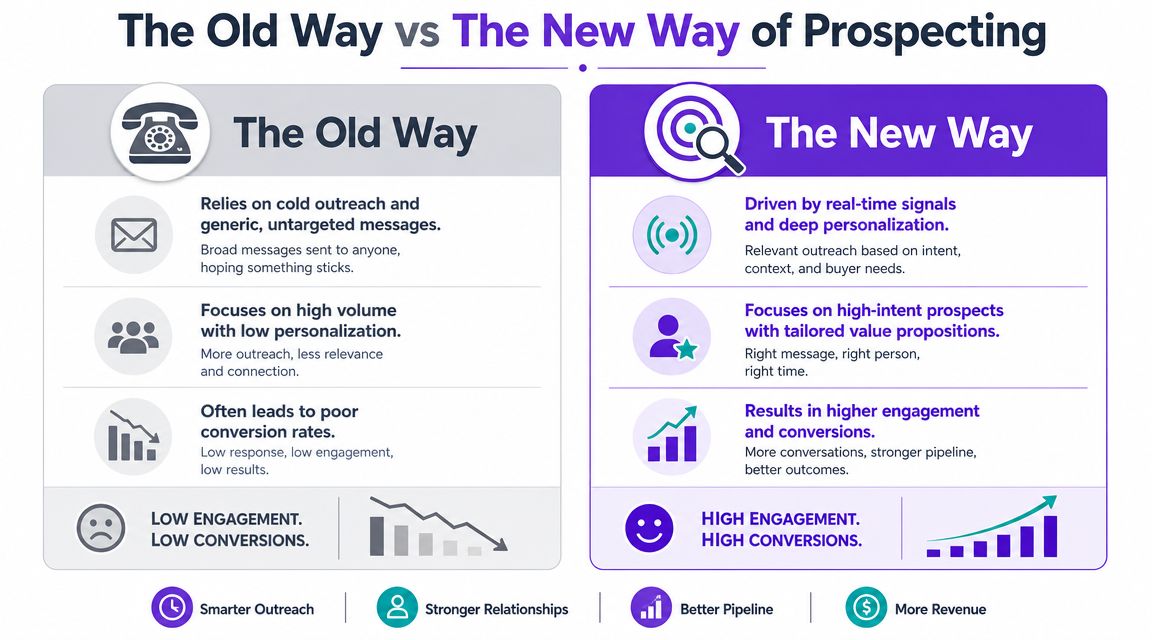
Traditional prospecting vs signal-first prospecting
Aspect | Traditional Prospecting (The Old Way) | Signal-First Prospecting (The New Way) |
|---|---|---|
Starting point | Title, company size, industry lists | Recent behavior and public engagement |
First rep task | Export contacts and build sequences | Review signals and prioritize intent |
Core assumption | More volume creates more luck | Better timing creates better conversations |
Personalization | Light firmographic references | Context pulled from live activity |
Main metric | Activity volume | Pipeline impact and meeting quality |
Rep experience | Repetitive, list-heavy, slow feedback | Triage-based, sharper, more relevant |
Expected outcome | Lots of touches, uneven relevance | Fewer wasted touches, warmer openings |
The old way isn't useless. It still helps with territory coverage, backfill, and net-new account mapping. But it's a poor primary motion when your team needs efficiency.
If you're redesigning the rest of your outbound engine around this logic, sales process optimization matters just as much as better targeting. A signal-first motion fails fast when the handoff, follow-up, or CRM hygiene is messy.
Traditional prospecting asks, “Can I reach them?” Signal-first prospecting asks, “Why now?”
That second question usually wins.
Your Signal-First Prospecting Playbook
A good signal-first system doesn't require magic. It requires discipline. The workflow is straightforward when you stop treating prospecting like list production.
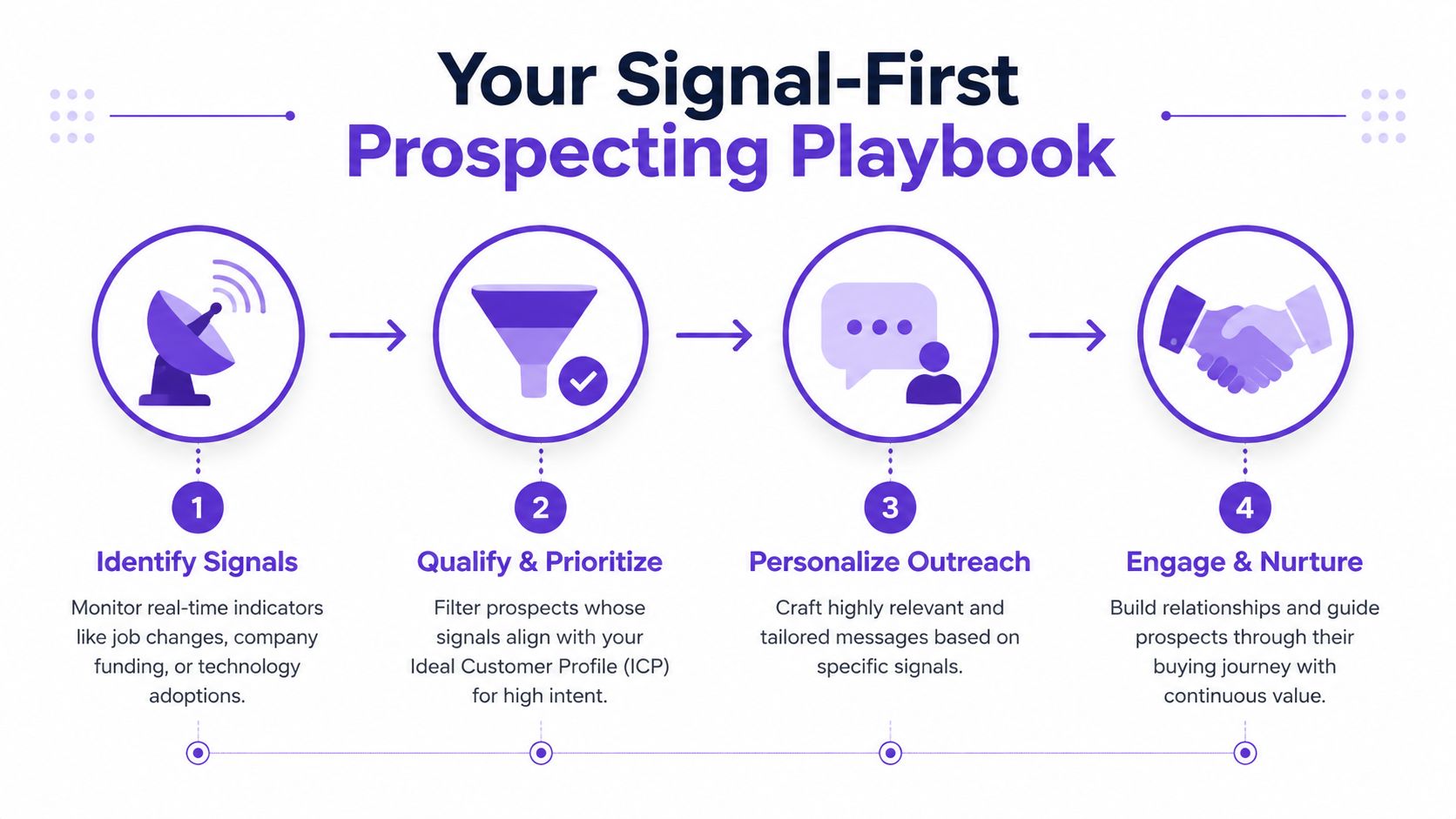
Start with signals, not spreadsheets
First, define what counts as a useful trigger for your market. High-performing teams monitor real-time events like content engagement, then move quickly when the signal appears, according to Autobound's B2B sales prospecting guide.
A practical watchlist usually includes:
Competitor engagement
Comments on competitor posts, especially when the buyer mentions process pain, tooling, or switching friction.Category conversations
People interacting with creators or operators discussing the exact problem you solve.Company-level events
Funding, leadership changes, hiring patterns, or signs of tech adoption.Research behavior
Signals that suggest active evaluation, not just casual browsing.
The point isn't to collect every signal. It's to decide which ones deserve a rep's attention today.
If your team wants tighter alignment between prospecting and broader pipeline creation, B2B demand generation should inform the signal list. Sales shouldn't hunt one set of pains while marketing publishes content around another.
A short walkthrough helps if you're building this motion for the first time:
Qualify fast and act faster
Once the signal appears, check fit. Don't reverse the order.
Use firmographic, technographic, and role filters to answer a simple question: is this a real opportunity or just interesting internet noise? Strong teams enrich account and contact data, then move into outreach while the context is still current.
Track a different scorecard than the old “calls made” nonsense:
Connection rate: Are you reaching the right people?
Response rate: Are they replying to signal-led outreach?
Meeting conversion rate: Are responses turning into live conversations?
Pipeline per rep: Is this motion creating actual opportunity?
Signal-to-meeting correlation: Which triggers produce meetings most often?
Time-to-first-touch: How fast did the rep act after the signal?
Fast follow-up matters more when the opener is tied to something the buyer did in public. Wait too long and the context goes cold.
Many teams stumble at this stage. They build a clever signal list, then route it through the same sluggish process they used for cold outbound. The workflow has to be built for speed, not admiration.
LinkedIn Tactics for High-Intent Signals
LinkedIn isn't just another place to post thought leadership and farm likes. By the mid-2020s, it had become the center of B2B prospecting activity. Digital Applied's LinkedIn roundup reports that LinkedIn accounts for roughly 80% of B2B social leads and 46% of social traffic to B2B websites. That's why it's the densest place to spot buyer intent in public.

Where the strongest signals show up
The highest-intent signal on LinkedIn usually isn't a reaction. It's a substantive comment, especially when a decision-maker asks a question in-thread or describes a problem in their own words.
The richest places to watch are often:
Competitor founder posts
People comment more openly there than they do on vendor pages.Niche operator threads
Good creators attract buyers who are already trying to solve the problem.Discussion around workflow pain
Tooling rebuilds, process bottlenecks, CRM issues, attribution debates, and team scaling pain all tend to pull out intent.
One useful example came from monitoring competitor founder posts alongside in-house thought leadership threads. A VP of Sales at a mid-sized SaaS company left a detailed comment on a competitor's post about rebuilding SDR tooling and connecting LinkedIn engagement to the CRM. The signal was strong because it wasn't applause. It was operational detail.
The rep used one line from that public comment in the cold call opener. She took the discovery call because the rep had clearly read the thread and understood the context. That meeting came from competitor monitoring, not from exporting a database and hoping.
What to say when you reach out
Don't overdo it. Referencing public context should sound attentive, not creepy.
Try angles like these:
For a DM: “Saw your comment on SDR tooling and CRM workflow. You mentioned the challenge around wiring engagement into the system. Curious how you're handling that today.”
For an email opener: “Your note on that competitor thread about rebuilding outbound caught my eye. Many still treat LinkedIn activity as noise, which usually creates blind spots.”
For a cold call opener: “I'm calling because your comment about [topic] was more specific than the usual LinkedIn small talk, and it sounded like something your team is actively fixing.”
Public intent gives you a reason to be relevant. It doesn't give you permission to write a five-paragraph essay.
Keep the first touch short. The job is to start a conversation, not win the deal in a paragraph.
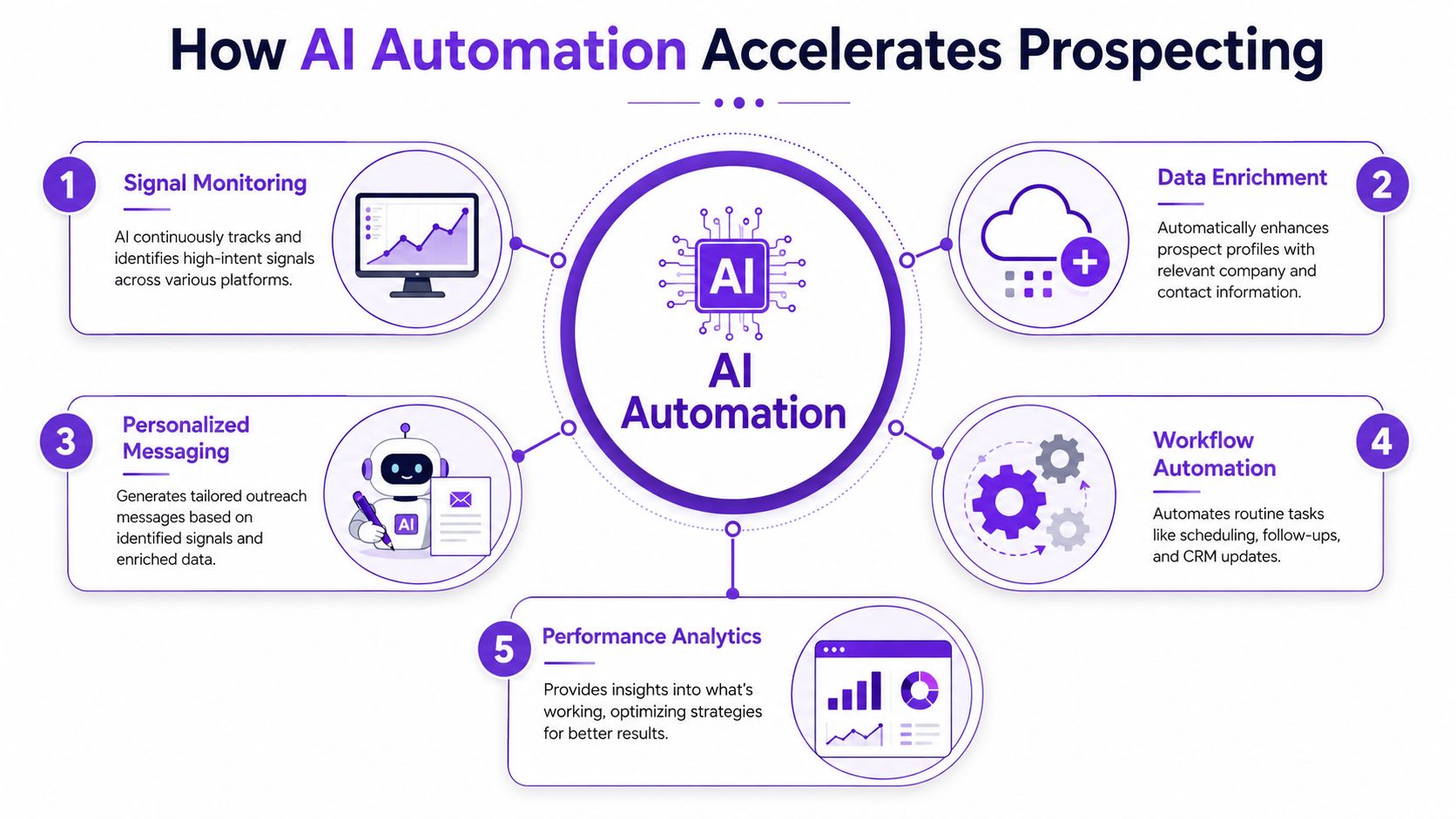
How AI Automation Accelerates Prospecting
A rep starts the day with 40 tabs open, half-read LinkedIn threads, and three accounts that looked promising yesterday but went cold overnight. That is not a prospecting system. It is manual surveillance with a sales quota attached.
Why manual monitoring breaks down
Signal-first prospecting sounds smart until a team tries to run it by hand for a full quarter. Reps miss comments, save weak accounts because they already spent time researching them, and waste the best timing window while stitching context together from five tools.
Small teams feel this first. Coverage looks fine on paper, but the constraint is attention. As noted earlier from ZoomInfo's prospecting guidance, narrower social selling tied to live engagement often beats broader outbound for lean teams. The problem is consistency. Manual tracking falls apart fast.
AI helps by handling the repetitive work that slows reps down:
Watching posts, comments, and threads continuously
Flagging why a person or account matches your ICP
Adding account and contact context before the rep opens the record
Scoring signals so strong intent rises above passive noise
Drafting a usable first touch while the context is still fresh
If you are sorting through AI prospecting tools for signal-based outbound, judge them on three things. Signal quality, context depth, and how quickly a rep can move from alert to outreach.
How the workflow changes in practice
RoverLead AI is a practical example. It turns LinkedIn engagement into a daily queue of prospects that match your ICP, along with the reason they surfaced. That detail matters because the win is not “more automation.” The win is better sequence.
Old prospecting started with a static list. Then reps filtered accounts, found contacts, wrote messages, and hoped the timing happened to be right. A signal-based workflow reverses that. Buyer behavior comes first. Fit comes next. Outreach follows while the context is still alive.
That shift changes rep behavior in useful ways. Teams spend less time building lists no one asked for and more time choosing which live signals deserve a response now. Lists still have a role, but mostly as backfill when signal volume is light. In practice, that is the difference between hunting where something moved and wandering the woods because the spreadsheet said there might be deer.
Frequently Asked Questions
1. What is b2b sales prospecting in plain English
It's the work sales teams do to identify likely buyers and start qualified conversations before an opportunity exists in the pipeline. In a modern motion, that means combining ICP fit with live buying signals.
2. Is cold outreach dead
No. Blind cold outreach is just less forgiving. Cold still works when the message is timely, specific, and tied to context the buyer cares about.
3. What's the biggest mistake teams make
They confuse coverage with relevance. A giant list feels productive, but a smaller list with active signals usually gives reps better odds.
4. Should reps still use firmographics
Yes. Firmographics still matter for qualification. They just shouldn't be the starting point if you want better timing.
5. What signals are strongest
Substantive comments, especially when a buyer describes a problem or asks a question in public, are usually stronger than passive engagement. Company events and research behavior also matter when they align with your offer.
6. Does this only work on LinkedIn
No, but LinkedIn is often the cleanest place to see professional intent in public. Other channels can support the motion once the initial signal appears.
7. How fast should reps act on a signal
Quickly. The value of the signal drops when the context gets stale. A strong opener loses force if it references a thread from long ago.
8. How do you keep signal-based prospecting accurate
Use data enrichment. Teams often combine multiple providers to fill gaps in contact and company data, and they use technographic data to tailor pain hypotheses around the prospect's current stack, as explained in Upcell's guide to B2B prospecting techniques.
9. What should managers measure besides meetings
Look at response quality, pipeline created per rep, time-to-first-touch, and which signals correlate with real opportunities. Activity volume is easy to count and easy to game.
10. What if my buyers aren't very active publicly
Then use signal-first prospecting where signals do exist, and use traditional outbound for the rest. This isn't a religion. It's a prioritization method. Start where intent is visible, then expand coverage as needed.
If your team is tired of building static lists and hoping the timing works out, RoverLead AI is built for the newer motion. It tracks LinkedIn engagement, matches signals to your ICP, and gives reps context they can use before the moment goes cold.