10 Best B2B Lead Generation Tools for 2026
Your lead gen stack is leaking money. Fix that first.
It's Monday morning. Your SDR team is scraping LinkedIn, your AE is complaining about bad data, marketing is celebrating MQLs that sales ignores, and finance is wondering why you're paying for four tools that all claim to do prospecting. The problem is not “more leads.” The problem is buying tools with overlapping features and no clear job.
That mistake gets expensive fast. One tool finds contacts. Another enriches them. A third claims to show intent. A fourth promises automation and mostly adds noise. You end up with bloated workflows, duplicate records, and reps wasting prime selling hours stitching systems together instead of talking to buyers.
The channel mix has also changed. Teams still need email and LinkedIn, but they also need content, inbound capture, enrichment, routing, and account signals working together. Dux-Soup's 2025 survey says 87% of B2B businesses rely on email and 97% of businesses using social for lead gen use LinkedIn (Dux-Soup B2B lead generation report 2025). So yes, the old channels still matter. The difference is speed, signal quality, and how little patience buyers have for sloppy outreach.
Here's the useful way to evaluate B2B lead generation tools. Sort them by the job they do. Database. Enrichment. Intent. Prospecting workflow. Account prioritization. Then decide what your team needs right now, who each tool is for, and where it fits in a real stack.
That's how this guide is built. It groups the best B2B lead generation tools by core job-to-be-done, gives blunt best-for recommendations, shows how to stack them without building a CRM landfill, and includes a transparent look at RoverLead AI as a newer option in intent-based prospecting.
Table of Contents
1. RoverLead AI
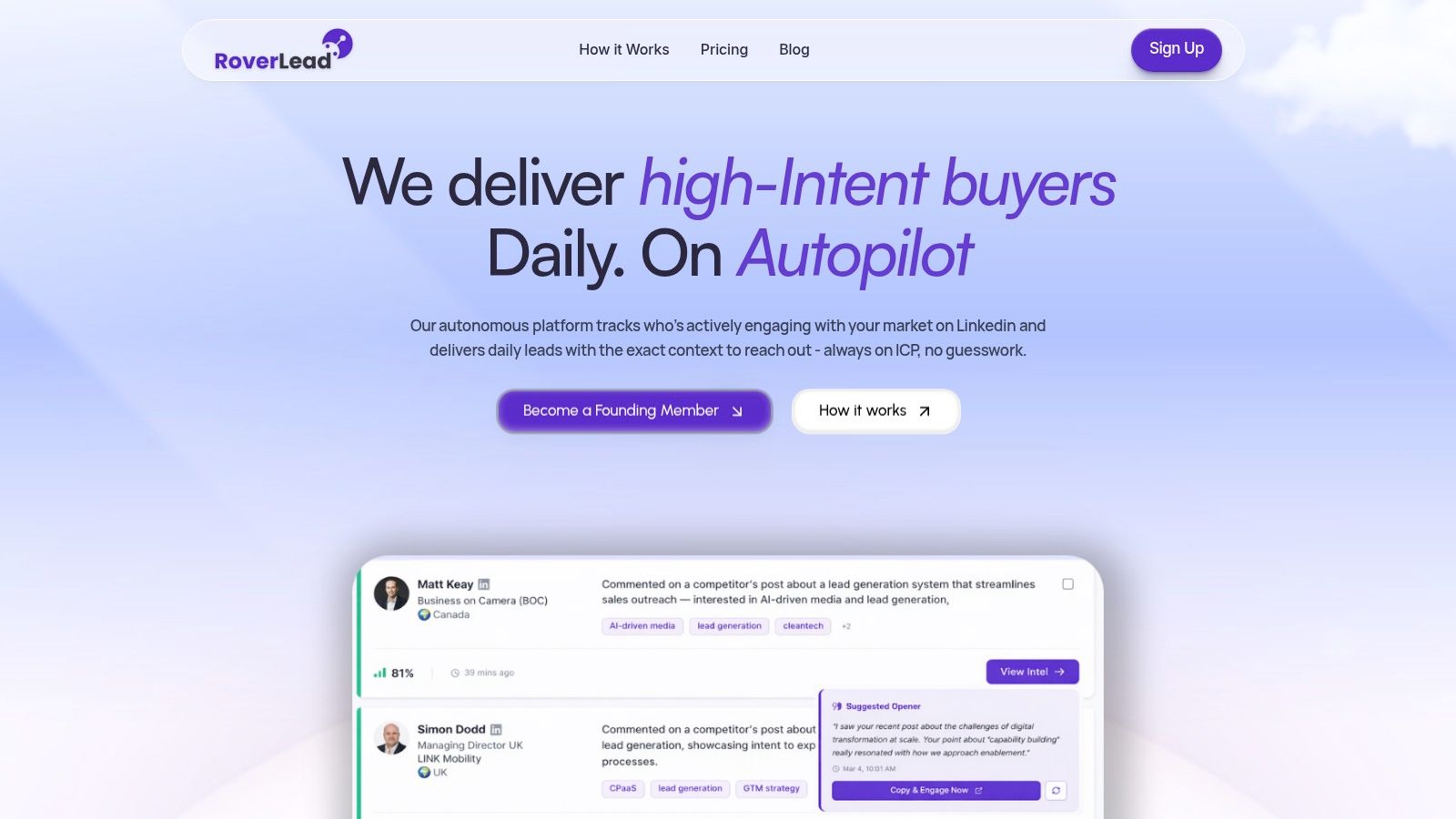
RoverLead AI is the most interesting tool on this list because it solves the part most tools ignore. Timing. Static databases tell you who fits your ICP. They don't tell you who's stirring, researching, commenting, comparing, or poking around the problem you solve.
RoverLead watches real LinkedIn engagement and turns it into a daily feed of high-intent prospects matched to your ICP. You define your ICP, keywords, competitors, and experts. Then its Signal Agents monitor behavior across creator content, competitor conversations, niche topics, and buying-adjacent activity. You get context, not just names.
Why RoverLead stands out
This is what makes it different from the usual B2B lead generation tools:
Intent from behavior: It surfaces prospects based on real LinkedIn activity, not just firmographics.
Context for outreach: You see the actual interaction and get an AI-written opener, so the rep doesn't sound like they scraped a list at 2 a.m.
Fast setup: The platform says setup takes about five minutes.
Learning loop: It learns from your responses and tracks 10+ buying signals over time.
Workflow fit: It's built to replace manual Sales Navigator list pulling with living signal data.
Early customer feedback is strong, but let's stay disciplined. RoverLead says customers report 2 to 3x positive reply rates, 30 to 50% more meetings, and up to 60% less research time. Those are company-provided claims, not third-party benchmarks, and they come from RoverLead AI.
Practical rule: Buy RoverLead if your reps already sell on LinkedIn and waste time figuring out who to message today. Don't buy it if your buyers aren't active on LinkedIn.
There are tradeoffs. RoverLead is LinkedIn-dependent, so quiet buyers won't throw many signals. Public standard pricing also isn't listed. The current offer is a capped founding membership with a locked lifetime rate, priority support, roadmap input, and direct founder access.
My take: if your outbound motion is shifting from list building to signal-based prospecting, RoverLead is a smart first bet. It's especially strong for founders, lean SDR teams, agencies, and sales leaders who want warmer conversations without buying a giant enterprise platform.
2. Apollo.io
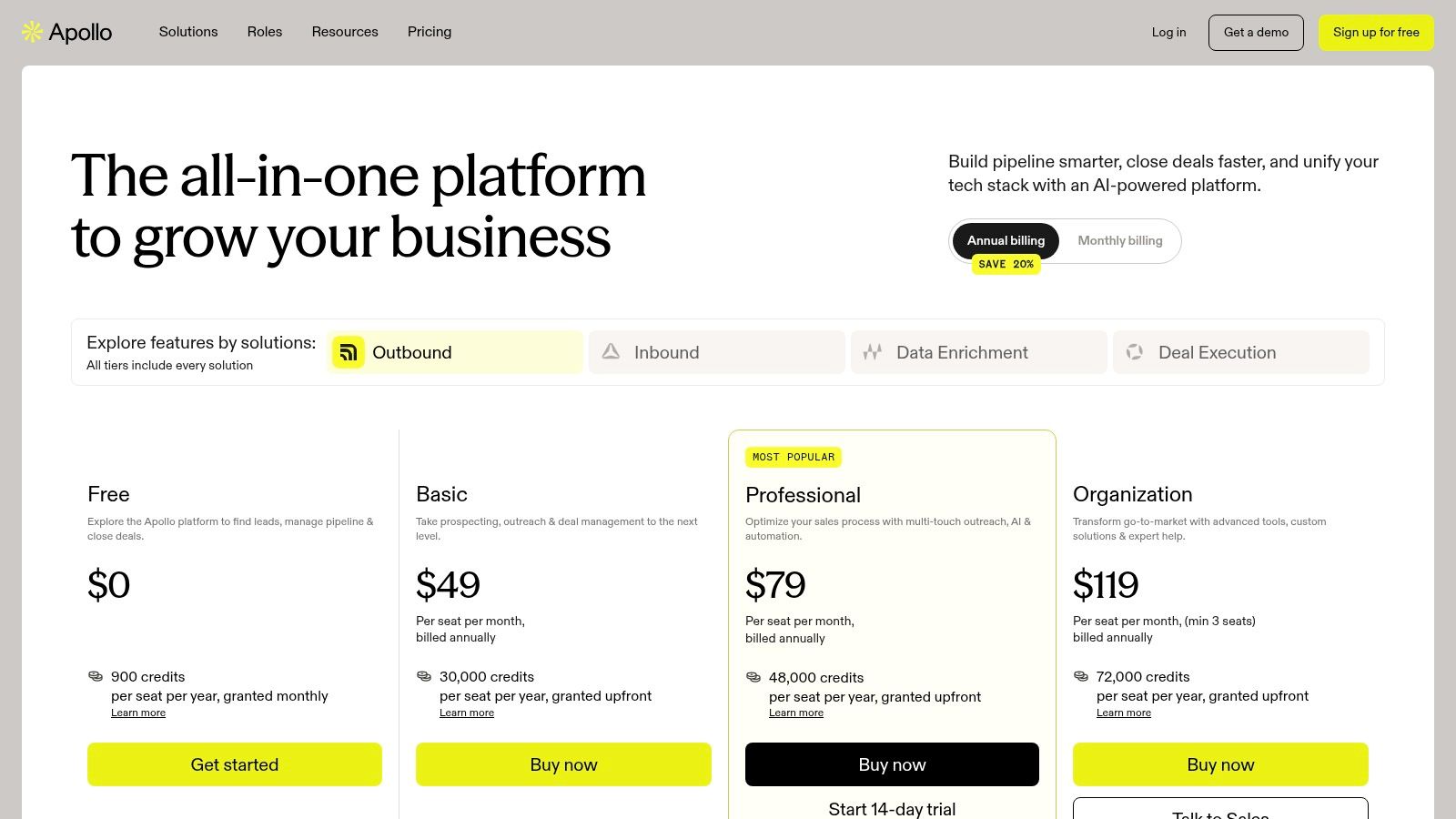
Apollo.io is for teams that want one login to do a lot of things decently. Database, sequences, dialer, Chrome extension, exports, and add-ons for inbound and visitor ID. It's broad. Sometimes that's exactly what you need.
For an early-stage team, that breadth is the selling point. You can get moving fast without stitching together three point tools and a prayer.
Best for one platform buyers
Apollo works best when your bottleneck is operational sprawl, not deep specialization. If your reps need contact data, list building, sequencing, and a basic engagement layer in one place, Apollo is a sensible choice.
It also fits teams still tightening their qualification muscle. If that's you, sharpen your process before you crank volume. This guide on how to qualify sales leads is worth a read before you let reps loose with export credits.
A few things to watch:
Broad coverage: Good fit if you want fewer vendors.
Quick trial path: Easy to test and get initial value.
Credit complexity: The plan and usage model can get confusing fast.
Fair-use caveats: "Unlimited" rarely means what reps hope it means.
Apollo is not the king of intent. It's not the cleanest enterprise data layer either. It's the practical middle ground. If your team says, "Can we just get one tool that does enough?" Apollo is on the shortlist.
3. ZoomInfo (SalesOS + Copilot)
ZoomInfo is what happens when prospecting becomes procurement. Big database. Big workflows. Big contracts. For larger teams, that's not a bug. It's the point.
SalesOS gives you company and contact data, org charts, intent signals, and workflows. Copilot adds AI-guided recommendations and next-best-action support. If you're running a serious outbound or ABM motion with multiple territories and a defined sales process, ZoomInfo has the muscle.
Best for enterprise sales intelligence
This is not a casual lookup tool. It's built for teams that need depth across accounts, committees, and process layers. It also makes more sense when sales ops, marketing ops, and leadership all need to work from the same data spine.
If your team is building a mature outbound engine, this primer on B2B sales prospecting fits the kind of rigor ZoomInfo expects.
ZoomInfo is overkill for teams that just need names and emails. If you're not operationally ready for it, you'll pay enterprise money to create enterprise confusion.
The downside is obvious. Pricing isn't public, contracts are custom, and smaller teams often buy far more platform than they'll use. But if you need broad coverage, AI-guided workflows, and structured account intelligence, ZoomInfo earns its reputation.
4. Cognism
Cognism is the tool you buy when your legal team, compliance team, or European sales motion keeps ruining your appetite for "growth hacks." It leans hard into privacy governance, verified mobile data, and Do-Not-Call screening.
That makes it a strong option for teams selling into the US and Europe, especially where outbound mistakes are expensive and embarrassing.
Best for compliance-first outbound
Cognism's phone-verification program is the main attraction. If your reps live on the phone, verified mobiles matter. Raw scraped numbers create a lot of fake activity and very little conversation.
The pitch is straightforward:
Compliance posture: Strong fit for regulated or privacy-sensitive teams.
Phone verification: Better for teams that care about connect quality.
Operational discipline: Better value when you use the verification workflow.
Custom pricing: You will need to talk to sales. Joy.
Cognism isn't trying to be your all-in-one GTM platform. Good. It knows its job. If your outbound program needs safer data and stronger dialing confidence, it's one of the sharper tools in the category.
5. Lusha
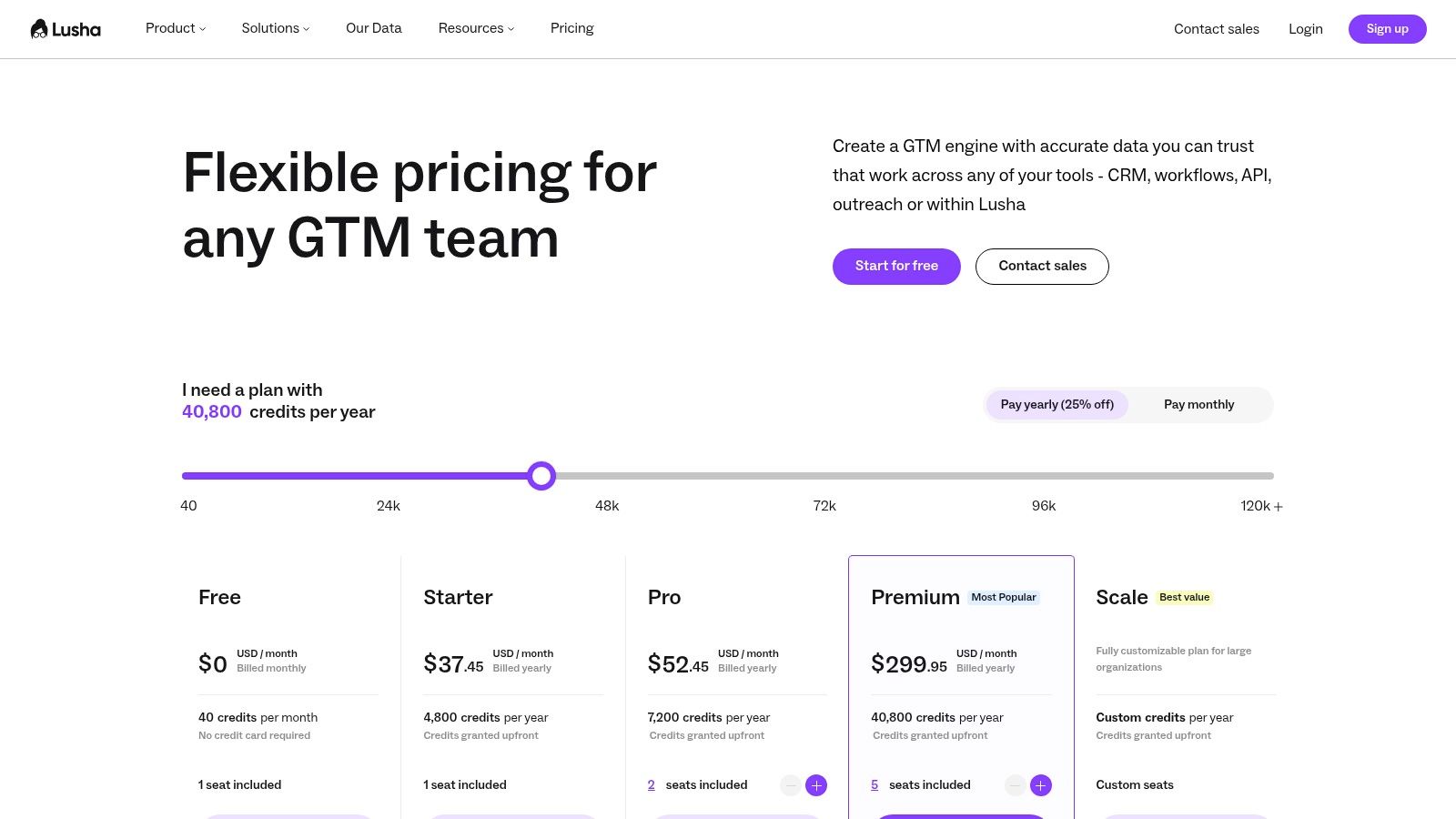
Lusha is for teams that want prospecting to be simple. Not "enterprise flexible." Not "revenue orchestration enabled." Simple. Pull contact data from LinkedIn and the web, manage credits, sync to CRM, move on with your day.
That simplicity is why a lot of SMB and mid-market teams like it. You can estimate usage without needing a spreadsheet and a therapist.
Best for simple LinkedIn prospecting
Lusha is a clean fit for sales teams that prospect heavily from LinkedIn and want a straightforward browser-based workflow. It doesn't pretend to be a full GTM operating system. That's refreshing.
The tradeoff is feature breadth. If you need deeper intent, richer orchestration, or a bigger all-in-one suite, you'll outgrow it.
Still, Lusha gets points for being honest software:
Transparent credit logic: Easier budgeting than many competitors.
Fast deployment: Reps can start using it quickly.
LinkedIn-friendly workflow: Good fit for day-to-day prospecting.
Phone cost tradeoff: Heavy dialers will feel the credit burn.
If your current stack is too complex and your reps just need contact capture without the circus, Lusha is a solid choice.
6. LeadIQ
LeadIQ is built for rep speed. That's why SDR teams like it. It lives where reps already work, especially LinkedIn and the wider web, and pushes captured prospects into CRM and engagement tools without forcing everyone into a giant platform migration.
Some tools try to become your whole stack. LeadIQ doesn't. It helps reps find someone, capture the contact, and keep moving.
Best for rep workflow speed
This is the practical choice when your team already has Salesforce, Outreach, or another engagement tool and just needs a faster front end for prospect capture.
Its strengths are obvious:
LinkedIn-to-CRM flow: Fast path from discovery to action.
Lighter footprint: Easier to adopt than full sales intelligence suites.
Useful personalization layer: Helpful for reps who need quick copy support.
Not a full intent platform: You'll still need something else for account prioritization.
If your SDRs complain that prospecting feels like tab tennis, LeadIQ fixes a real problem. Not glamorous. Very useful.
7. 6sense (Revenue AI Platform + Sales Intelligence)
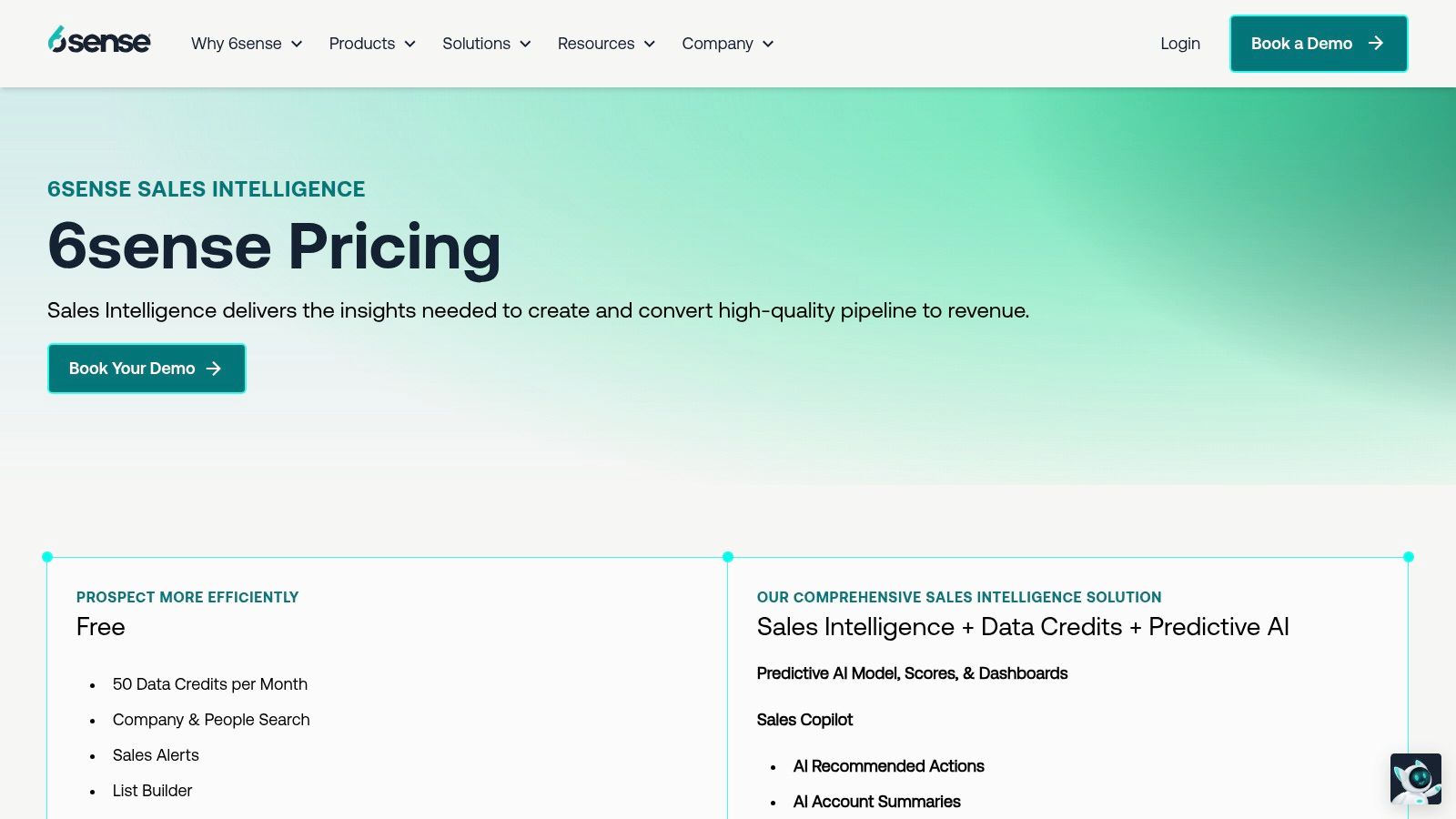
6sense is for teams selling complex deals where buying committees drift, timelines stretch, and one curious stakeholder is not a sales-ready account. It combines intent, first-party signals, identity resolution, and orchestration into one account-based system.
This is not light software. It expects a grown-up GTM team.
Best for big-ticket account prioritization
6sense shines when account selection and prioritization matter more than raw lead volume. If your average deal needs coordinated outreach across multiple people, this kind of platform earns its keep.
It also aligns with where the market is heading. Modern lead generation stacks increasingly combine intent data, AI SDR capabilities, visitor identification, outbound, and form-free pipeline generation, according to Knock AI's lead generation tools review.
If your ACV is high and your team keeps chasing the wrong accounts, 6sense is often a targeting fix disguised as software.
The free Sales Intelligence tier is useful for testing fit. The full platform is a bigger commitment. Buy it when account orchestration is your bottleneck, not because someone said "dark funnel" in a board meeting.
8. Demandbase One
Demandbase One is what you buy when sales and marketing are both targeting the same accounts but somehow still acting like exes. It brings intent, account scoring, visitor intelligence, list building, and seller workflows into one system built around accounts.
For companies doing ABM seriously, that's valuable. For everyone else, it can feel like bringing a marching band to a two-person acoustic set.
Best for sales and marketing alignment
Demandbase is strongest when you need one shared view of target accounts across ad spend, website behavior, and seller action. It also helps when marketing wants to influence pipeline and sales wants proof that the handoff wasn't nonsense.
If ABM and demand generation are colliding in your org, this explanation of what B2B demand generation means frames the broader motion well.
A few realities:
Full-funnel ABM strength: Very good for coordinated account programs.
Seller visibility: Useful alerts and watchlists for reps.
Platform breadth: More than some teams need.
Custom pricing: Not a lightweight buy.
Demandbase isn't the tool I'd hand a five-person outbound team. It is a serious option for companies where sales and marketing finally decided to stop running separate plays.
9. Bombora
Bombora is not your whole lead gen stack. It's the intent layer you add when firmographic lists start feeling dumb. Its Company Surge data flags companies researching specific topics across a publisher co-op, which helps teams prioritize outreach based on actual interest.
That matters because static targeting only gets you so far. Timing is half the battle.
Best for adding intent to an existing stack
Bombora is best paired with something else. A CRM. An ABM platform. A sales engagement tool. Even a database provider. On its own, company-level intent is useful but incomplete.
There's also a broader stack trend behind this. Market and vendor summaries point to AI-driven analytics, automated lead scoring, and personalized outreach as major adoption drivers, and one market report projects the B2B lead-generation software market will grow from USD 6.78 billion to USD 15 billion by 2035 (WiseGuy Reports B2B lead generation software market).
Bombora fits that shift well:
Intent layer: Better timing than cold firmographic targeting alone.
Partnership ecosystem: Works well with larger ABM stacks.
Company-level signal: Useful, but not magically precise.
Enterprise orientation: Usually not the cheapest route.
If your reps are asking, "Why this account, right now?" Bombora gives you a better answer than "because it's in our TAM."
10. LinkedIn Sales Navigator
Sales Navigator is still the default discovery tool for B2B sellers. That hasn't changed. LinkedIn remains the dominant social channel for prospecting, and an independent statistics roundup reports that about 89% of B2B marketers use LinkedIn and roughly 80% of B2B social media leads come from it (Martal lead generation statistics).
So yes, if your team sells B2B, you're probably going to live in LinkedIn whether you like it or not.
Best for native buyer discovery
Sales Navigator is best at person-level discovery, account tracking, list building, alerts, and relationship mapping. Native filters are still hard to beat.
But there's a limitation. Sales Navigator is a discovery tool, not a complete system. It helps you find and follow people. It doesn't solve timing, enrichment quality, attribution hygiene, or orchestration on its own.
That matters because data quality gets ugly fast as stacks grow. One consulting source recommends an 80% enriched-record rate, duplicate rate under 2%, and lead source attribution rate of at least 95% when integrating capture channels into CRM (Directive Consulting on B2B lead generation tools).
Sales Navigator is still essential. It just shouldn't be your whole strategy.
Pair it with enrichment if your reps need contact data. Pair it with intent if they need timing. Pair it with RoverLead if manual list pulling is eating their week.
Top 10 B2B Lead Generation Tools Comparison
Product | Core features | UX / Quality (★) | Value & Pricing (💰) | Target audience (👥) | Key differentiator (✨) |
|---|---|---|---|---|---|
RoverLead AI 🏆 | Behavior-driven Signal Agents (LinkedIn); AI-written openers; 5‑min ICP setup; 10+ buying signals | ★★★★☆, 2–3x replies; 30–50% more meetings; ≤60% less research time | 💰 Founding membership (locked lifetime rate); no public pricing yet | 👥 Sales teams focused on social-selling / LinkedIn outreach | ✨ Behavior-based intent from LinkedIn engagement + contextual AI openers; LinkedIn‑compliant |
Apollo.io | Large B2B contact DB; email sequences; dialer; Chrome extension | ★★★★☆, fast time-to-value; generous free trial credits | 💰 Credit-based exports; modular add-ons; free trial | 👥 Teams wanting an all‑in‑one prospecting + engagement stack | ✨ Broad feature coverage (data + sequences + dialer) |
ZoomInfo (SalesOS + Copilot) | Deep company/org charts; intent signals; Copilot AI guidance | ★★★★☆, enterprise-grade data & workflows | 💰 Custom enterprise contracts; typically annual | 👥 Large/US-focused enterprises with complex ABM | ✨ Extensive US data + AI-driven next-best-action (Copilot) |
Cognism | Phone-verified contacts (Diamond Data); DNC/TPS screening; compliance docs | ★★★★☆, high accuracy for mobile numbers | 💰 Custom pricing; verification workflows often required | 👥 Regulated teams selling into US/EU needing compliant data | ✨ Compliance-first with phone verification and DNC screening |
Lusha | Browser extension; workspace & API; transparent credit pricing; free plan | ★★★★☆, quick LinkedIn capture; easy UX | 💰 Clear credit model; free tier (≈40 credits/mo) | 👥 SMB & mid-market LinkedIn-centric prospectors | ✨ Simple, predictable credit pricing for emails/phones |
LeadIQ | Chrome capture; CRM sync; list building; AI personalization (Scribe) | ★★★★☆, very fast discovery→CRM flow for reps | 💰 Tiered/contract pricing; confirm inclusions with sales | 👥 SDR teams and individual reps focused on efficiency | ✨ Rapid capture-to-CRM pipeline & lightweight SDR tooling |
6sense (Revenue AI) | Predictive models; identity resolution; Sales Intelligence free tier | ★★★★☆, strong for complex buying-committee motions | 💰 Free Sales Intelligence tier; full platform costly | 👥 Enterprise GTM teams with large ACV deals | ✨ Predictive scoring + orchestration; free tier to test data |
Demandbase One | Intent, account scoring, site visit intelligence, seller workflows | ★★★★☆, robust ABM/full‑funnel coordination | 💰 Custom enterprise pricing | 👥 Marketing + Sales aligned GTM teams (ABM) | ✨ Unified ABM + sales-side watchlists and account orchestration |
Bombora | Company Surge intent scores; publisher co‑op content signals | ★★★★☆, trusted third‑party intent data | 💰 Enterprise pricing; best paired with activation tools | 👥 Teams enriching ABM stacks with external intent | ✨ Widely recognized Company Surge intent dataset |
LinkedIn Sales Navigator | Advanced person search; saved leads; InMail; alerts | ★★★★★, unmatched person-level discovery & relationship mapping | 💰 Predictable per-seat plans (Core→Advanced Plus) | 👥 Sellers whose motion is LinkedIn-led | ✨ Native LinkedIn coverage, relationship insights & filters |
Stop Buying Tools, Start Building a System
Your reps do not have a lead problem. They have a workflow problem.
One team buys a giant database and still cannot decide who to call first. Another buys intent data and pipes it into a CRM full of bad records. A third team pays for an enterprise platform, then wonders why pipeline still depends on one SDR with decent instincts and too many browser tabs. That is not a tooling win. That is expensive confusion.
B2B prospecting breaks when the stack does the wrong job in the wrong order. Bad fit creates the same mess every time. Duplicates pile up. Signals get ignored. Reps waste half the day researching people who were never likely to reply.
Pick tools by job-to-be-done. Then stack them in that order.
If you need a source of people and accounts, start with discovery. If your records are thin or outdated, fix enrichment next. If timing is a primary concern, add intent. If your team still cannot act on the signals, orchestration will not save you. It will just make the mess look more complex.
Here is the setup I recommend most often:
Discovery first: LinkedIn Sales Navigator, Apollo, or ZoomInfo
Enrichment second: Cognism, Lusha, LeadIQ, Apollo, or ZoomInfo
Intent third: RoverLead AI, Bombora, 6sense, or Demandbase
Orchestration last: Only after reps and RevOps prove they can use the data consistently
That order matters.
Sales Navigator is great for finding people. It is not your data hygiene plan. Bombora is useful for account-level intent. It is not enough if reps still need person-level context and a reason to reach out today. 6sense and Demandbase make sense for complex account-based motions. They are overkill for a small team that still has not nailed targeting, ownership, and follow-up discipline.
RoverLead AI deserves a straight description here because it fills a specific gap. It is built for intent-based prospecting from LinkedIn engagement signals, then adds context and suggested outreach. That means it sits between raw discovery and full-blown account orchestration. If your reps are still pulling names manually, guessing who is warm, and writing the same tired opener ten times a day, that is the kind of bottleneck RoverLead is meant to fix.
Keep the stack boring. Boring works.
A simple system that reps trust beats a bloated one that needs a consultant, a playbook nobody reads, and weekly cleanup from RevOps. Buy fewer tools. Assign each one a clear job. Make sure the handoff between tools is clean. Then hold the team to using the system instead of freelancing their way around it.
If your team is tired of scraping lists, guessing intent, and sending cold messages that feel cold, take a hard look at RoverLead AI. It turns real LinkedIn engagement into daily, high-intent prospect recommendations with context and AI-written openers, so your reps spend less time researching and more time starting relevant conversations.