10 Best Account Based Marketing Tools for 2026
You're probably here because your ABM setup feels expensive, fragmented, and a little too proud of itself. Sales says marketing sends “engaged accounts” that never reply. Marketing says sales ignores intent signals. RevOps sits in the middle, duct-taping dashboards together and pretending this is fine.
That's a fundamental problem with account based marketing tools. Many organizations don't fail because they picked a “bad” platform. They fail because they bought a big shiny system before deciding what job they needed done. Some tools are built to orchestrate campaigns. Some are built to detect intent. Some are built to create better buyer experiences. If you use an experience tool like an orchestration engine, or an intent tool like a CRM replacement, you'll burn budget fast.
The upside is that ABM is no longer a niche experiment. In a Foundry roundup of ABM statistics, 76% of B2B marketers using ABM reported increased ROI versus other forms of marketing, and 87% said ABM's ROI outperforms other marketing investments. That's why this category matters.
You don't need one monolith. You need a stack that matches how your team works.
Table of Contents
1. RoverLead AI
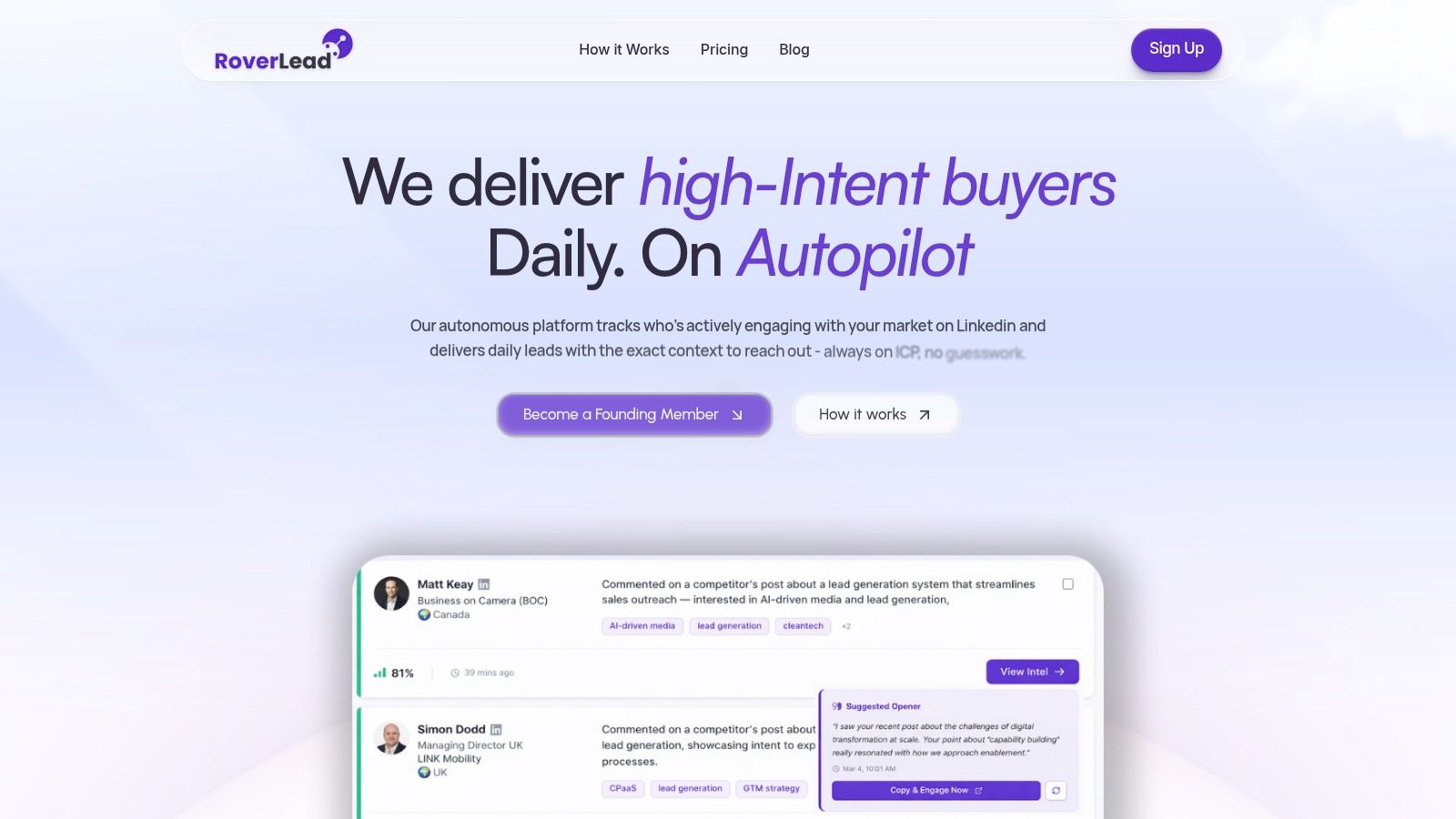
RoverLead AI is the most interesting option on this list if your team's ABM motion starts on LinkedIn and dies on static lists. It doesn't begin with firmographics, then hope timing works out later. It starts with behavior.
Instead of pulling another stale list from Sales Navigator and pretending job title equals intent, RoverLead watches LinkedIn activity around your niche. Its Signal Agents track things like comments, content interactions, and pricing or demo discussions, then surface people who already look like they're leaning into a buying problem. That changes the quality of outreach immediately.
Why RoverLead AI stands out
Setup is intentionally simple. You define your ICP, keywords, competitors, and expert voices, then the system starts learning from what you engage with. It monitors 10+ buying signals and sends a daily feed with context attached, including an AI-written opener tied to the exact conversation or post.
That matters because ABM tools often drown reps in “account engagement” with no practical next step. RoverLead does the opposite. It hands you a smaller set of warmer people and gives you a usable reason to message them.
Practical rule: If your reps still spend mornings researching who to contact and what to say, your ABM stack is missing the point.
Early customer stories on the RoverLead site describe it as a replacement for manual list pulls and guesswork-heavy LinkedIn prospecting. The product is also positioned as LinkedIn-compliant, which matters if you'd rather not build pipeline on top of rule-bending hacks.
Best for
RoverLead AI is best for teams that want intent-driven social selling instead of broad account targeting.
Best for SDRs and BDRs: You get daily, context-rich leads instead of generic lead lists.
Best for founders: You can run a focused outbound motion without hiring a full ops layer first.
Best for agencies: You can build outreach around live buyer behavior, not recycled target lists.
Best for sales leaders: You can tighten rep workflows with signal-based prospecting and fewer random acts of outreach.
If you're evaluating modern selling workflows, RoverLead also fits naturally with broader AI sales tools for outbound teams.
You won't find public standard pricing on the site. Access is currently positioned around a founding-member model, which makes this a high-upside pick for early adopters, but not the safest choice if your procurement team needs a giant pricing PDF and six committee meetings to feel alive.
For LinkedIn-first prospecting, though, this is the sharpest tool in the box.
2. 6sense
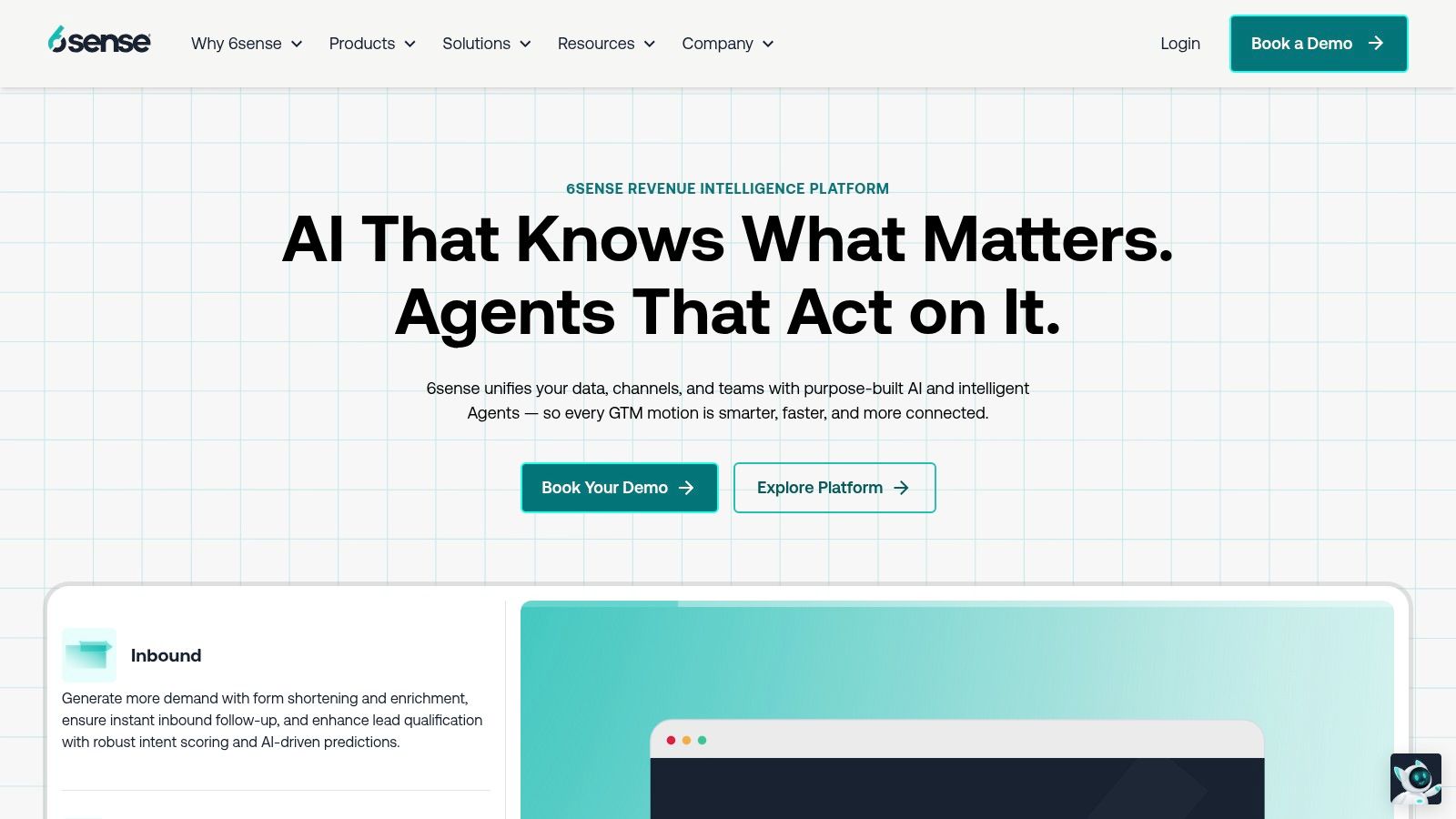
Your team has a target account list, ad spend, SDR coverage, and plenty of meetings. Revenue still stalls because nobody knows which accounts are in market right now. That is the problem 6sense is built to solve.
In a modular ABM stack, 6sense sits squarely in the intent and prioritization layer. It helps you spot buying signals, rank accounts by likelihood to act, and give sales and marketing a shared view of where to focus. If your biggest GTM problem is bad timing, 6sense deserves serious attention.
Where 6sense earns its keep
6sense is strongest in complex B2B motions where multiple people influence the deal and interest shows up long before a form fill. Instead of treating account selection like a quarterly planning exercise, you get a living prioritization system. That matters if you're trying to connect account-based execution with a broader B2B demand generation strategy, not just run isolated campaigns.
Here's the blunt truth. A lot of ABM programs fail because the team bought a smart platform and kept a dumb process. 6sense will not fix weak routing, vague ownership, or reps who ignore signals. It will expose those problems fast.
What it does well:
Best for intent-led prioritization: Sales stops wasting time on accounts that fit your ICP but show no sign of movement.
Best for aligning marketing and sales around timing: Campaigns, outreach, and account reviews can run off the same signal set.
Best for teams with RevOps discipline: The platform gets stronger when scoring, routing, and follow-up rules are clearly defined.
The catch is simple. 6sense is not the first ABM tool you buy when your process is messy and your team still argues over what counts as an engaged account. It is the tool you buy when you are ready to operationalize intent at scale.
If your main job-to-be-done is knowing which accounts to work now, 6sense is one of the best options in the category. If your problem is execution chaos, fix the process first or prepare to pay premium pricing for a very pretty dashboard.
3. Demandbase One
Your ABM stack starts to rot when every core job lives in a different tool. One platform scores accounts, another runs ads, a third handles reporting, and RevOps spends half the week stitching together a version of the truth everyone distrusts. Demandbase One exists for that problem.
It is the pick for teams that want a true orchestration layer, not another narrow point solution. Demandbase pulls together account intelligence, activation, measurement, and web personalization in one system. If your program is mature and your team already knows how accounts move from target list to pipeline, that consolidation matters.
Where Demandbase One fits
Demandbase earns its keep when account-based advertising sits at the center of your motion. Its DSP is a serious advantage for teams that need tight control over audience selection, spend, and account-level engagement in the same environment. You are not bouncing between disconnected tools just to answer a basic question like, “Did the accounts seeing our ads progress?”
It also makes sense if you are building a modular stack on purpose. Use Demandbase as the orchestration spine, then add specialized tools only where they clearly beat the suite. That is a smarter approach than buying five shiny products and calling the mess a strategy.
A few clear use cases stand out:
Best for orchestration-heavy ABM: Strong choice when you need account selection, activation, and measurement to work together.
Best for ad-centric enterprise programs: Worth the investment if display and account-based media are core channels, not side experiments.
Best for reducing stack chaos: Useful when your team wants fewer handoffs, fewer sync issues, and less reporting nonsense.
Here is the catch. Demandbase is a bad purchase for teams still arguing about ICP, account stages, or sales follow-up rules. Great tool, no process, same old mess. If your foundation is shaky, fix the operating model first and get clear on how B2B demand generation strategy should support ABM before you buy a platform this broad.
My recommendation is simple. Buy Demandbase One when your main job-to-be-done is orchestration across a serious ABM program. Skip it if you are still looking for software to rescue weak execution.
4. Terminus
Terminus is one of the better orchestration picks if you want native ABM channels in the same environment. Ads, website experiences, chat, email signature marketing. It's built for teams that want to run coordinated plays without assembling a Frankenstein stack.
Where Terminus fits
This is a practical operator's platform. It's not just theory and intent modeling. It's execution. That's why it appeals to teams trying to operationalize ABM across acquisition, acceleration, and even retention.
The strongest use case is simple. You already know your target accounts, and now you need consistent touches across channels without losing your mind.
A few reasons teams like it:
Multi-channel activation: Helpful when your program extends beyond display ads.
Measurement support: Better for organizations that need to connect activity back to revenue outcomes.
Playbooks and services: Useful if your team needs guidance, not just software access.
The tradeoff is that Terminus still requires discipline. If your sales and marketing teams can't agree on target accounts, lifecycle stages, or what counts as meaningful engagement, the platform won't fix that. It will just broadcast the confusion across more channels.
A lot of ABM “tool problems” are really process problems wearing a fake mustache.
Best for B2B teams that want an orchestration layer with enough built-in channels to get moving without buying five extra products on day one.
5. RollWorks
RollWorks is the practical choice for teams that want ABM capabilities without jumping straight into heavyweight enterprise tooling. It's easier to approach, easier to launch, and better suited to companies that need momentum more than a grand digital transformation speech.
Why RollWorks works
RollWorks sits in the sweet spot between advertising platform and approachable ABM system. Journey stage reporting, audience playbooks, and integrations with systems like Salesforce and HubSpot make it a solid fit for teams getting serious about account based marketing tools without wanting a year-long implementation saga.
Its self-serve option is part of the appeal. If you want retargeting and account-based activation with a lower barrier to entry, RollWorks makes sense.
Best for budget-aware ABM teams: Lower friction than many enterprise-first platforms.
Best for first ABM program expansion: Useful when you've outgrown basic retargeting but aren't ready for a giant suite.
Best for marketing-led teams: Good if marketing is driving the initial motion while sales catches up.
There's still some plan and packaging complexity, and advanced capabilities move into quote-based territory. But that's manageable. What matters more is whether your team has enough data hygiene and account selection discipline to feed the machine something useful.
If not, no worries. You'll just automate confusion faster.
6. ZoomInfo MarketingOS
ZoomInfo MarketingOS is what happens when a large data cloud grows ABM limbs. If your team already trusts ZoomInfo for contact and company data, MarketingOS gives you a natural extension into audience building, advertising, visitor identification, and conversion tooling.
What MarketingOS is good at
This product is strongest when data coverage is your starting point. You want to build audiences from firmographics, technographics, and intent, then activate those audiences through ads and site experiences without exporting CSVs like it's still 2014.
That integrated motion is valuable. Especially for U.S. go-to-market teams that already live inside ZoomInfo.
A few situations where it fits:
You already use ZoomInfo heavily: Easier adoption and less stack fragmentation.
You care about website visitor identification: Helpful for turning anonymous traffic into account clues.
You want data and activation tied together: Better than stitching together multiple vendors manually.
The catch is that ZoomInfo products can get expensive, and packaging can become messy when add-ons pile up. You need a clear operating model, otherwise your team buys lots of data and still runs sloppy campaigns. If that sounds familiar, fix the motion before adding more surface area. A cleaner sales process optimization approach will help more than another dashboard.
For data-rich ABM execution, though, MarketingOS is a serious contender.
7. Triblio (Foundry ABM Software)
Triblio is a strong pick when your ABM strategy leans hard into website experience and personalized content journeys. It combines account-based ads, web personalization, content hubs, and sales activation in one package.
Where Triblio makes sense
Some ABM programs overfocus on targeting and underinvest in what happens after the click. That's where Triblio earns attention. It gives teams tools to personalize pages, CTAs, and content experiences for specific accounts rather than sending everyone to the same generic site and hoping the logo swap does all the work.
It also benefits from its connection to Foundry's broader media and data footprint. That combination makes it appealing for organizations that want media activation plus account-level web experiences in one motion.
What it's best for:
Best for web-personalization-first teams: Strong if your site is part of your ABM engine, not a brochure.
Best for content-heavy motions: Good for microsites, hubs, and account-specific experiences.
Best for marketing teams that need sales triggers: Useful when seller follow-up depends on account behavior.
The main drawback is clarity. Branding and documentation can feel transitional because of the Foundry connection. That's not a dealbreaker, but it does mean you should buy with a clear use case, not because “personalization” sounds nice in a meeting.
8. Madison Logic
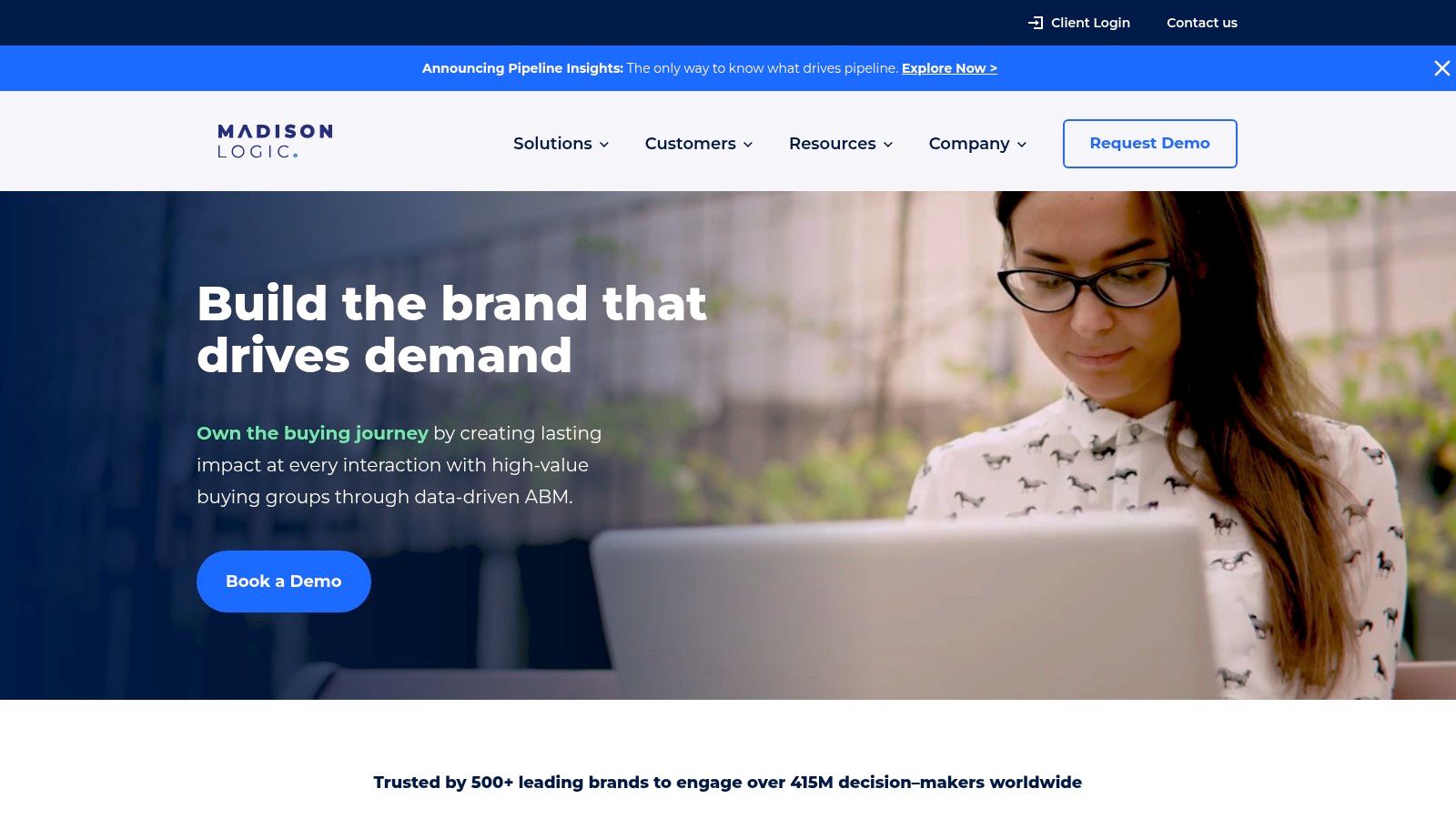
Madison Logic is built for teams that want media reach tied to account prioritization. If your ABM strategy depends on content syndication, display, LinkedIn, audio, or even Connected TV, this platform belongs in the conversation.
Why media-heavy teams pick it
Madison Logic isn't pretending to be an all-purpose ABM command center. That's a strength. It's focused on omnichannel activation and measurement for teams that believe targeted media is a major lever in pipeline creation.
That focus makes it especially useful when marketing needs broad buying-group coverage across paid channels and wants cleaner signal handoff back into the revenue team.
Best for paid-media-led ABM: Strong fit if your strategy starts with account reach and engagement.
Best for content syndication programs: Better than trying to duct-tape that workflow into a pure orchestration platform.
Best for teams that want managed activation: Useful if you want support along with software.
Madison Logic is less compelling if you're looking for a complete ABM operating system. It's a specialized weapon. Use it for reach, channel execution, and account-level measurement. Pair it with stronger orchestration or sales workflow tooling if needed.
9. Influ2
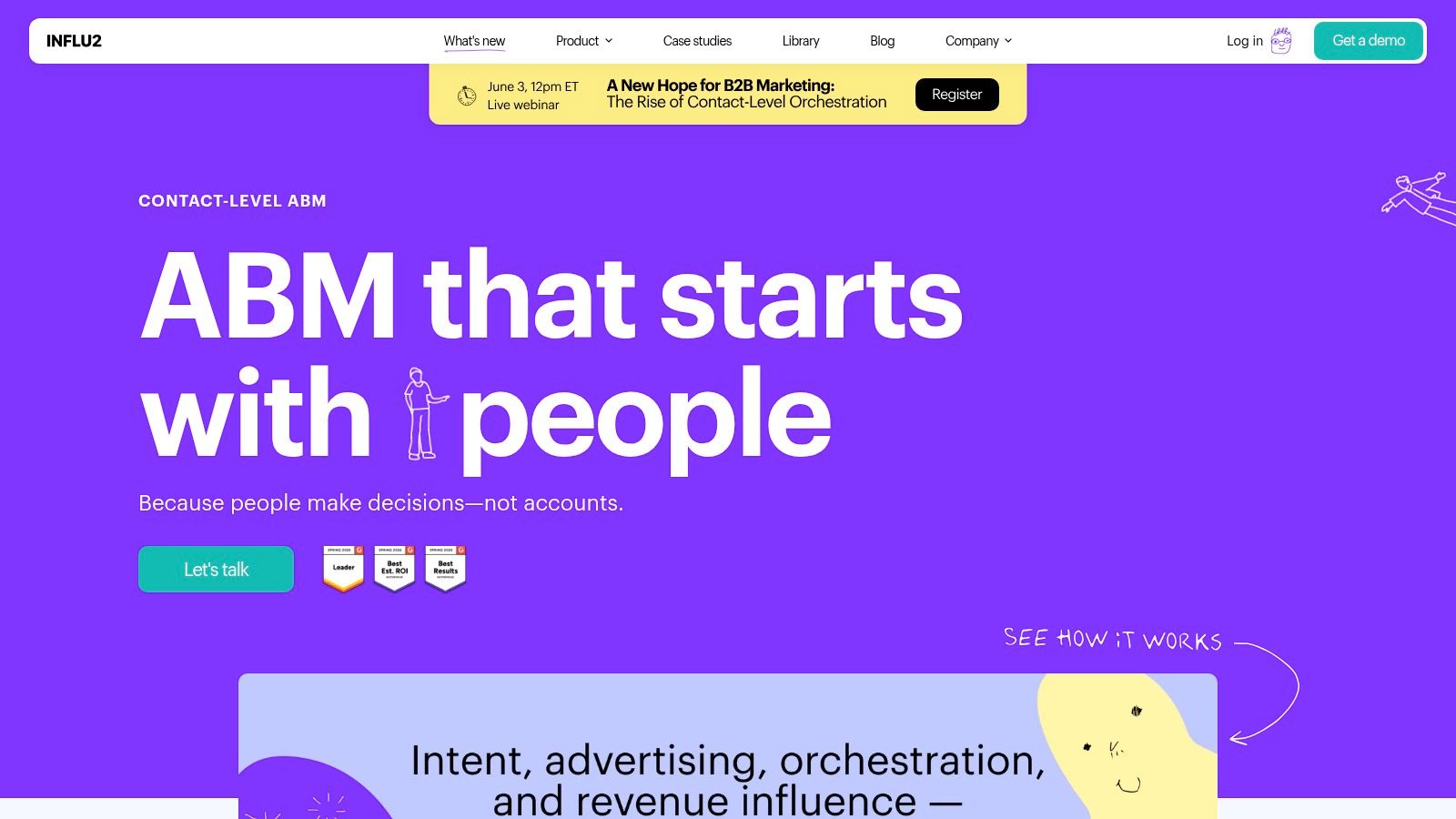
Influ2 takes a different angle. It's person-based advertising, not just account-level targeting. That matters when you care about named stakeholders, not just whether “someone from the account” saw an ad.
Where Influ2 shines
A lot of ABM reporting is fuzzy. The account engaged. Great. Which person? Was it the right person? Did sales follow up with anyone who mattered? Influ2 gets more precise by focusing ad delivery and engagement data at the contact level.
That makes it a strong complement to broader ABM platforms.
Use cases where it's especially good:
Best for named-account programs: Helpful when you already know the stakeholders you want to influence.
Best for sales follow-up timing: Reps can act on signals from actual people, not just account aggregates.
Best as a layer, not a replacement: It works well alongside orchestration or intent tools.
When an SDR says, “This account looks warm,” the next question should be, “Warm with whom?”
The catch is obvious. Influ2 depends on strong first-party contact data. If your target contact list is weak, incomplete, or stale, contact-level advertising becomes a lot less magical. But for high-value accounts and coordinated sales plays, it's one of the more useful specialist tools in the market.
10. Folloze
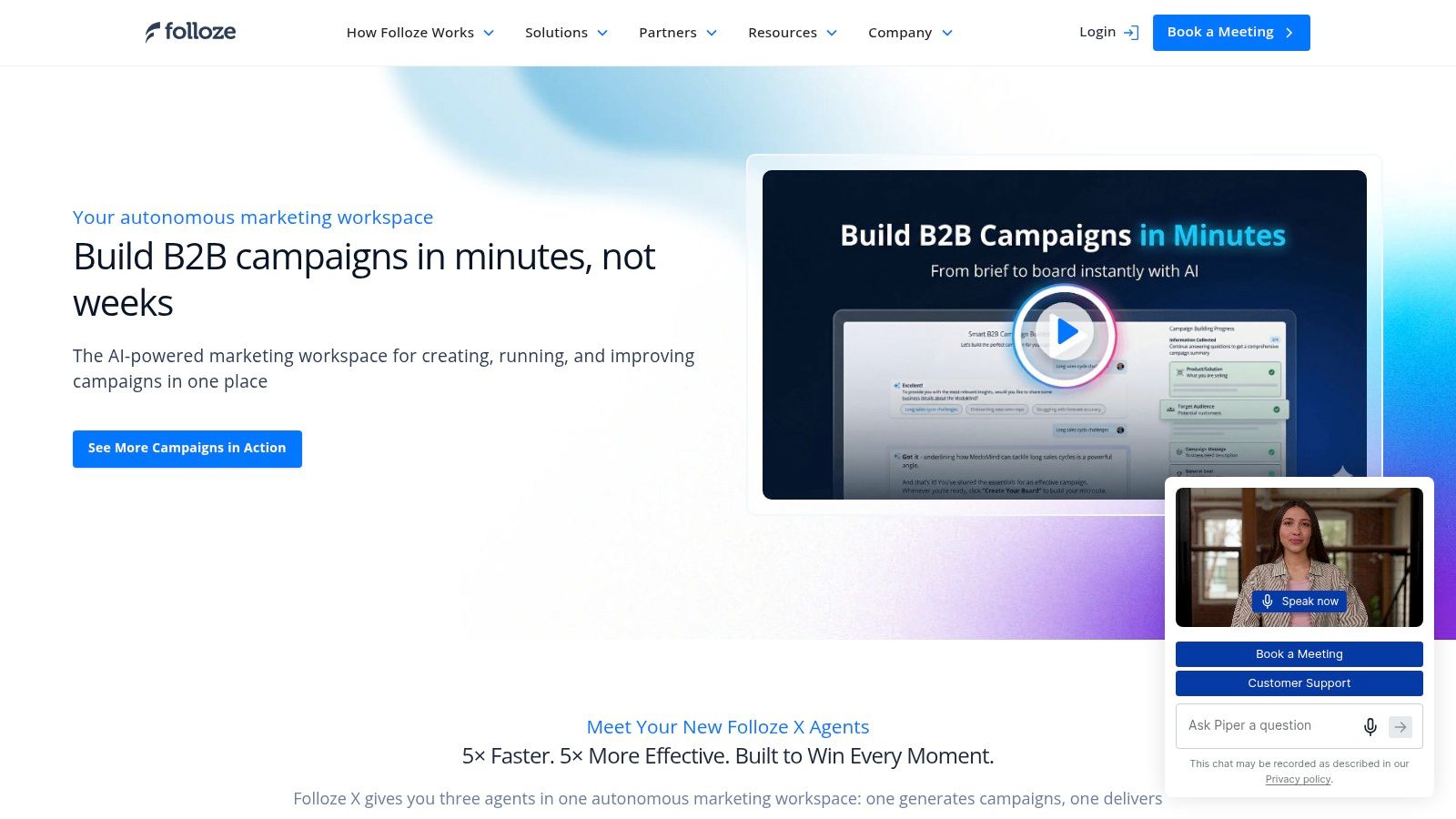
Folloze is the buyer-experience pick on this list. It's built for personalized microsites, account journeys, and content experiences that feel more like guided buying environments than regular landing pages.
Why buyer experience teams like Folloze
Some ABM teams are great at getting attention and terrible at sustaining it. They run ads, trigger email sequences, and then dump interested accounts into a bland web experience with no continuity. Folloze fixes that problem.
It lets marketing and sales teams create customized boards and microsites for 1:1 or 1:few campaigns, using first-party signals and integrations with the rest of the stack. That's especially useful for deal acceleration and executive-level outreach where generic nurture tracks just won't cut it.
Where it fits best:
Best for personalized buying experiences: Ideal when you need customized destinations for strategic accounts.
Best for sales-assisted ABM: Reps can share relevant content experiences without waiting on web teams.
Best as an experience layer: Strong add-on to an existing ABM stack.
Folloze usually isn't the first tool you buy. It's the one you add when your targeting is already decent and your next bottleneck is experience quality. If your paid traffic and outbound are doing their jobs, Folloze helps you stop wasting that hard-won attention.
Top 10 ABM Tools, Feature Comparison
Product | ✨ Unique Features | 👥 Target Audience | 💰 Pricing / Value | ★ Quality / Outcomes |
|---|---|---|---|---|
🏆 RoverLead AI | Behavior + context LinkedIn signals, autonomous Signal Agents, AI-written openers | SDRs/BDRs, sales leaders, founders, agencies | 💰 Founding program (locked lifetime rate, priority support) | ★★★★☆ 2–3× replies, +30–50% meetings |
6sense | Predictive AI + intent, account scoring, orchestration & ads | Mid-market & enterprise RevOps and GTM teams | 💰 Custom/enterprise (high) | ★★★★★ Proven at scale for complex buying committees |
Demandbase One | B2B DSP, proprietary intent & scoring, end-to-end ABM orchestration | Enterprise marketing + sales ABM teams | 💰 Custom pricing; can be significant | ★★★★★ Mature enterprise ABM suite |
Terminus | Multi-channel (ads, web, chat), Data/Measurement Studio, playbooks | B2B marketers running full-funnel ABM | 💰 Quote-based; substantial investment | ★★★★ Practical playbooks & channel execution |
RollWorks (NextRoll) | Journey-stage reporting, playbooks, free self-serve retargeting tier | SMB → mid-market GTM teams, self-serve users | 💰 Self-serve retargeting (pay-for-media); advanced tiers custom | ★★★★ Accessible ABM + ad activation |
ZoomInfo MarketingOS | Data-first graph, in-platform DSP, visitor ID & conversion tools | Data-driven marketers and ops teams | 💰 Opaque/high; add-ons raise total cost | ★★★★ Strong targeting when ops mature |
Triblio (Foundry) | Website personalization, content hubs, cross-channel ads & sales triggers | Teams prioritizing site experiences + media activation | 💰 Custom; contact sales | ★★★★ Strong site experience tooling |
Madison Logic | Intent-led content syndication, CTV, display, LinkedIn, pipeline measurement | Media-centric B2B teams & agencies | 💰 Media-driven/custom engagements | ★★★★ Broad media reach & buying-group coverage |
Influ2 | Person-based ads, contact-level engagement insights, CRM/MAP sync | ABM teams targeting named accounts/contacts | 💰 Annual contracts; pricing not public | ★★★★ Highly granular contact-level targeting |
Folloze | Microsites/boards, AI-assisted personalization, engagement dashboards | Sales enablement & ABM content teams | 💰 Custom/add-on to ABM stacks | ★★★★ Fast, scalable personalized experiences |
Final Thoughts
The best account based marketing tools don't all solve the same problem. That's where a lot of buying mistakes start.
If you need buying signals and rep-ready outreach on LinkedIn, RoverLead AI is the sharpest pick here. It's built for behavior-driven prospecting, not static list worship. If you need predictive account prioritization at scale, 6sense is a strong choice. If you want a broad enterprise platform with deep advertising and orchestration muscle, Demandbase One is the heavyweight. If you need practical multi-channel execution, Terminus belongs on the shortlist. If you want a more accessible entry point, RollWorks is a sensible move.
Then there's the second layer. ZoomInfo MarketingOS is useful when data depth is the center of your motion. Triblio and Folloze are better when experience personalization matters more than another pile of dashboards. Madison Logic is the media-forward option. Influ2 is the precision add-on when “the account engaged” isn't a good enough answer.
There's also a bigger market signal behind all this. Grand View Research estimates the global account-based marketing market at USD 1,410.5 million in 2024 and projects it to reach USD 3,811.4 million by 2030, with a 17.9% CAGR from 2025 to 2030. That growth makes sense. Teams want systems that can combine intent, prioritization, and activation without relying on static firmographic guesses.
But don't confuse market growth with operational maturity. A UserGems summary of ABM benchmarks notes that only 46% of marketers were satisfied with the tools they use for ABM programs. That tracks with what most operators see in the wild. Too many teams own plenty of software and not enough process.
So build your stack like an adult:
Choose one core job first: Orchestration, intent, or experience.
Match the tool to the motion: Don't buy enterprise software for a founder-led outbound team.
Fix process before layering tools: Routing, ownership, ICP clarity, and follow-up rules matter more than feature count.
Prefer signal over vanity: “Engagement” without context won't help sales close anything.
If you want the blunt recommendation, start with the bottleneck closest to revenue. If your reps don't know who to contact today, solve signal and timing first. If marketing can't coordinate channels, solve orchestration. If target accounts click but don't convert, improve the experience.
That's how you build an ABM stack that earns its keep.
If you want to replace cold list pulling with live buyer signals, RoverLead AI is the tool I'd test first. It gives your team a faster path from LinkedIn activity to relevant outreach, with context your reps can use. For B2B teams that want warmer conversations instead of more noise, that's a very good trade.