How to Use AI in Sales in 2026: Your Guide to High-Intent Leads
Are you tired of hearing about "how to use AI in sales" as if it’s some far-off, robot-apocalypse fantasy? Let's get real. If you're still thinking about cold outreach and static lists, you’re playing a game that’s already over. The secret isn't blasting more messages into the void; it's about finding the handful of people who are already raising their hands, waving their wallets, and practically begging for a solution.
AI is your secret weapon to find them. It lets your team show up at the perfect moment with a message that actually matters, turning a cold shoulder into a warm conversation.
Table of Contents
The Old Grind vs. The New Playbook: A Tale of Two Sales Teams
Deep Analysis: How to Use AI in Sales to Find High-Intent Leads
Crafting AI-Assisted Messages That Don’t Sound Like a Robot Wrote Them
Why Your Sales Team Is Drowning (and It’s Not in Leads)
Let's be brutally honest. Your sales team is probably spending more time digging through LinkedIn Sales Navigator, updating CRM records, and chasing ghosts than they spend talking to people who actually want to buy something. It’s a familiar, frustrating cycle. Reps are buried under mountains of manual tasks while the real buying signals—the LinkedIn comments, the frustrated rants in Slack groups, the job postings for a new tool—get lost in the noise.
This isn't just inefficient; it's a morale-crushing, soul-sucking disaster. Reps spend a staggering 66% of their day on activities that don't involve selling, like admin and data entry. That leaves almost no time for what they were hired to do: build relationships, solve problems, and, you know, close deals.

This is the old grind. It’s a numbers game where everyone loses. But what if you could change the rules?
So, What Is AI in Sales, Really? (Hint: It’s Not Skynet)
When we talk about using AI in sales, forget the sci-fi fantasies about robots replacing your top reps. It’s not about that at all. Think of it as a superpower for your team—a highly-caffeinated, all-knowing research assistant who can see the future. It’s the ability to know exactly who to talk to, when to reach out, and what to say, without spending eight hours a day scrolling through feeds.
At its core, AI in sales is about using intelligent, intent-based software to automate the mind-numbing grunt work of finding interested buyers. It shifts the entire game from "who could we sell to?" to "who is ready to talk to us right now?"
This guide is your playbook for making that shift. We're going to walk through, step-by-step, how to find leads who are already signaling their interest so your team can swoop in and be the hero.
The goal is simple: stop drowning in busywork and start having more conversations that lead to revenue.
The Old Grind vs. The New Playbook: A Tale of Two Sales Teams
Let's get one thing straight. There are two ways to do sales prospecting in 2026.
There's the old way: the traditional, soul-crushing grind. It’s a world of static lists bought from data brokers, educated guesses, and reps burning out while blasting out hundreds of templated messages. You pull a list of 500 companies in the SaaS space, filter by 50-200 employees, and start dialing for dollars.
This is prospecting based on firmographics, and it has a fatal flaw: it completely ignores timing. You have zero idea if these companies actually need your solution, are locked into a competitor's contract, or are even thinking about the problem you solve. It's like showing up to a party you weren't invited to and trying to sell everyone insurance. Awkward.
A Smarter Way: Following the Digital Breadcrumbs
Then there's the new playbook, powered by AI. Instead of guessing who might be a good fit someday, you focus on who is actively showing interest right now. This is prospecting based on dynamic, real-time buying signals.
The old way was about interrupting strangers at scale. The new, AI-powered way is about joining conversations already in progress. It's the difference between cold calling a random phone number and walking up to someone at a conference who just asked a question about your specific industry.
AI’s real job isn't to find more people who fit your Ideal Customer Profile (ICP). It’s to find the handful of people within your ICP who are signaling they might be ready to buy, today.
These signals are everywhere if you know how to look. It could be a VP of Sales asking for tool recommendations in a private Slack group. It could be a target account’s marketing team suddenly hiring for a "customer data platform expert." It might even be a key decision-maker commenting on a competitor's pricing announcement on LinkedIn.
The difference in approach isn't subtle—it shows up directly in your team's performance and morale.
Traditional Prospecting vs. AI-Powered Prospecting
Metric | Traditional Prospecting (The Grind) | AI-Powered Prospecting (The Smart Way) |
|---|---|---|
Data Source | Static lists (firmographics, titles) | Dynamic signals (LinkedIn activity, job posts, forum comments) |
Timing | Based on sales quotas and pure luck | Based on the prospect's real-time behavior |
Relevance | Low; "Just checking in" and other crimes | High; outreach is tied to a specific, timely action |
Rep Focus | Manual research, data entry, and list building | Relationship building and closing high-value conversations |
Outcome | Low reply rates, high rep burnout, existential dread | 2-3x higher reply rates, more qualified meetings, happier reps |
Looking at them side-by-side, it’s clear one path is a volume game based on hope, while the other is a precision game based on intent. One burns people out; the other builds a real, sustainable pipeline. The choice for any modern sales team is painfully simple.
Deep Analysis: How to Use AI in Sales to Find High-Intent Leads
Alright, let's get out of the theory and into what actually works. The point of using AI in sales isn't finding more people. It’s about finding the right people just as they’re ready to talk. This is what we mean by signal-based prospecting, and it’s the quiet advantage your competitors are probably already using.
Forget scrolling through LinkedIn until your eyes glaze over. Imagine an alert hitting your inbox the second a decision-maker at a target account comments on a competitor’s post asking about pricing. Or when a prospect engages with a niche expert’s content on the exact problem you solve. These aren't just leads; they're active buying signals. They are conversations already in progress.
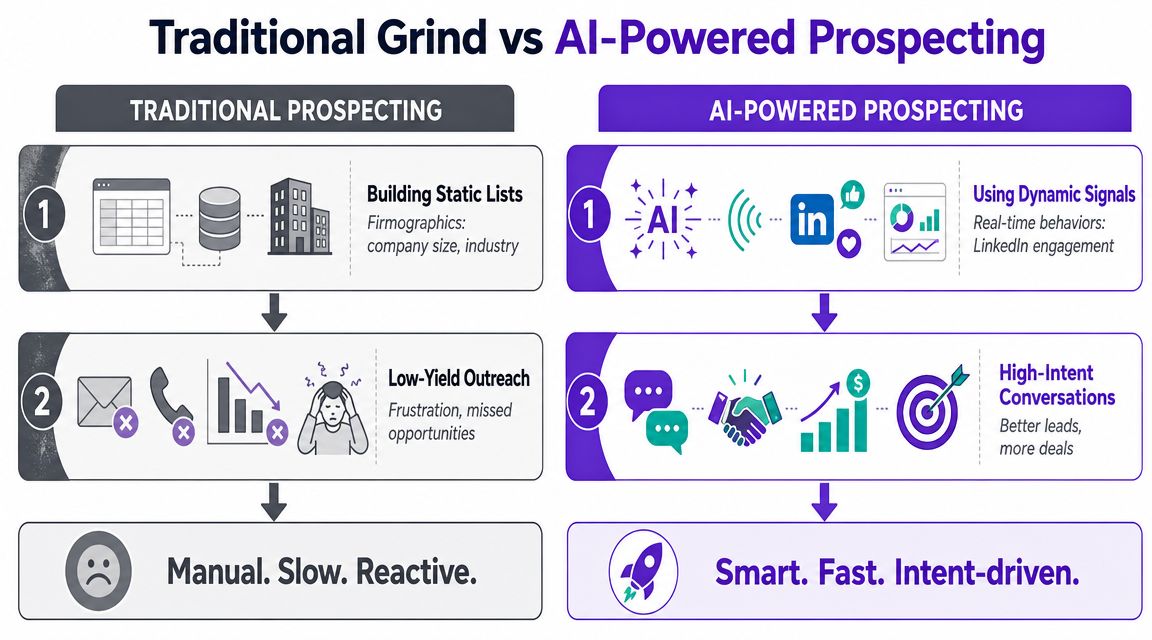
Think of AI as a scout for your team, constantly scanning platforms like LinkedIn for very specific behaviors. It turns hundreds of hours of manual, mind-numbing scrolling into a clean, curated feed of actionable opportunities. You stop guessing who might be interested and start knowing who is interested, right now.
The data backs this up. Studies show that sales teams using AI for prospecting can boost their leads by over 50% while cutting costs by as much as 60%.
The goal is to stop interrupting strangers and start joining conversations already in progress. AI gives you the context to enter that conversation at the perfect moment, armed with relevance.
By engaging prospects who have already raised their hand, you can realistically expect 2-3x higher positive reply rates and book more qualified meetings. To get started, see our breakdown of the best AI prospecting tools for sales teams. This is how you finally trade volume for precision.
Crafting AI-Assisted Messages That Don’t Sound Like a Robot Wrote Them
So you’ve found a high-intent lead. The perfect moment. What do you say? This is exactly where reps fumble the ball. They either blast a generic template that gets instantly deleted or they overthink it for 20 minutes and the moment passes.
The mistake is thinking of AI as a robot that writes for you. It's not. Treat it like a creative partner, a junior researcher who can spot an opening and draft a first line. Your rep's job is to add the human touch.

Never let AI write the entire message on autopilot. That’s how you end up with embarrassing mistakes, like congratulating someone on a promotion that happened three months ago. The real move is to use AI to generate a hyper-relevant first draft—just the opener—that references the specific buying signal you just caught.
The best AI-assisted outreach is a mix of machine speed and human instinct. AI finds the opening. The rep lands the punch.
This isn’t about scaling spam; it's about scaling relevance. You're not interrupting their day. You're joining a conversation they literally just started.
Prompts for AI-Powered Openers
Here’s how to tell your AI what to do. The key is extreme specificity.
Prompt 1 (For a LinkedIn Comment): "Write a short, casual, one-sentence opener for a LinkedIn message to a VP of Marketing. Reference their recent comment on [Expert's Name]'s post about 'customer retention strategies' and connect it to our solution for reducing churn. Start with 'Saw your comment...'"
Prompt 2 (For a Competitor Mention): "Generate a brief, insightful email opener. The prospect, a Head of Sales at [Company Name], just asked about [Competitor]'s pricing in a public forum. I want to acknowledge their research and gently position us as a smart alternative."
This works because the message is timely and shows you’ve done more than just scrape their title. For more ideas on structuring the rest of your message, you can adapt the frameworks in our guide to writing a great cold email template with these AI-powered hooks.
Measuring the Success of Your AI Sales Engine
You’ve flipped the switch on your new AI tools. The dashboards are lit up, and the outreach is automated. So, you’re done, right? Not even close. The most common mistake is treating AI as a "set it and forget it" machine. The real work begins now: figuring out if any of this is actually moving the needle.
Outreach volume is a vanity metric. The numbers that tell the real story are the ones tied to engagement and revenue. Are you getting more positive replies? Are you booking meetings with the right people? Is your sales cycle shrinking? Those are the vital signs of a healthy sales engine.
Beyond Lead Gen to Accurate Forecasting
One of the biggest shifts you’ll see with AI isn't just more leads—it's smarter forecasting. AI can analyze your pipeline, identify which deals are progressing, and spot risks you’d normally miss until it’s too late. Instead of relying on gut feelings, AI digs into deal progression, engagement signals, and lead scores to predict what’s likely to close and when. We’ve seen great strategies for this from the team at Improvado.
AI doesn't just speed up forecasting; it changes it from a manual spreadsheet exercise into a living system that updates as the buyer moves.
This gives you a much tighter grip on your pipeline. You can see which deals are real, which are stalling, and where your reps need to focus their time.
Creating a Self-Improving System
The ultimate goal here isn't just automation; it's to build a system that gets smarter on its own. Every meeting that gets accepted, every deal that closes, and even every prospect who says "not interested"—it all feeds back into the model. The AI starts to learn the specific nuances of what makes a great lead for your business. This constant feedback loop is how you continuously refine how to qualify your sales leads right from the start.
Frequently Asked Questions About Using AI in Sales
Got a few questions still bouncing around your head? Good. Let's clear up the most common concerns I hear from sales leaders before they bring AI into their process.
1. Will AI replace my sales team?
No. Anyone telling you AI is coming for your reps' jobs fundamentally misunderstands modern B2B sales. The point of sales AI isn't replacement; it's augmentation. It’s about automating the most tedious, soul-draining parts of the job so your reps can stop prospecting like it’s 2016 and start focusing on what they’re actually good at: building relationships and closing deals.
2. Is this even compliant with LinkedIn?
Yes, but only if you use the right tools. Reputable AI platforms are built to be fully compliant with LinkedIn’s terms of service. They are not automating connection requests or sending spammy DMs. Compliant AI tools simply monitor publicly available information to identify buying intent. It's high-powered research, not a black-hat automation scheme.
3. What kind of technical skills do we need?
Almost none. Modern sales AI platforms are built for salespeople, not data scientists. A good system can be set up in about five minutes. You tell it your ideal customer profile, list a few keywords, and identify your top competitors. The platform does the rest.
4. How do I actually measure the ROI?
To prove the return on investment, track three things:
Time Saved: Calculate the raw hours your reps get back by eliminating manual prospecting.
Engagement Lift: Look at the increase in positive reply rates and meetings booked from AI-surfaced leads.
Pipeline Velocity: Measure the impact on your sales cycle length and win rates. Warm, intent-driven leads close faster.
5. How is this different from LinkedIn Sales Navigator?
Sales Navigator is great for finding people based on static filters (firmographics like company size, industry, title). AI sales tools find people based on dynamic behavior (what they're doing right now). They work best together: use Sales Navigator to define your target accounts, and use AI to know when to reach out to them.
6. What's the biggest mistake people make when starting with sales AI?
Treating it like a magic button. AI is a tool, not a strategy. The biggest mistake is not having a clear process for how your reps will engage with the signals the AI finds. You need a playbook for turning an AI-generated signal into a human-led conversation.
7. How much does a good AI sales tool cost?
Prices vary, but think of it in terms of ROI. If a tool costs a few hundred dollars per month but saves each rep 10+ hours of manual prospecting and doubles their meeting booking rate, it pays for itself almost instantly. It's often cheaper than a single bad hire.
8. Can AI help with personalizing outreach at scale?
Yes, but with a major caveat. AI is fantastic for generating hyper-relevant openers based on buying signals. It should not be used to write entire emails on autopilot. Use AI for the hook, and let your rep write the rest of the message. That's the sweet spot between efficiency and authenticity.
9. What are the best buying signals to track?
Start simple. Track comments on posts from your competitors, industry influencers, and posts using your core keywords. Also, track when target accounts post jobs that are relevant to the problem you solve (e.g., a company hiring a "Head of Cybersecurity" is a great signal for a security software company).
10. How quickly can we expect to see results?
Unlike long-term SEO or content strategies, the impact of signal-based AI is felt almost immediately. Once you're set up, you'll start getting actionable signals within hours. You should see an increase in positive reply rates and meetings booked within the first few weeks, and a measurable impact on pipeline within the first quarter.
Ready to stop chasing cold leads and start closing warm conversations? RoverLead AI turns LinkedIn engagement into a daily feed of high-intent leads, so your team always knows who to talk to and when. Start your journey to smarter prospecting today.