10 Social Media Listening Tools for Real B2B Leads in 2026

Most advice about social media listening tools is stuck in brand-monitoring land. Track mentions. Watch sentiment. Build a dashboard nobody opens after week three. Fine for PR. Not enough for pipeline.
B2B teams need something more useful. They need to know who's showing buying intent, where that intent shows up, and whether a tool helps a rep act on it before the moment goes cold. That's the fundamental split in this category. Some platforms are built to help large teams understand markets. Others help sellers find people who are subtly raising their hands in public.
That shift matters because social listening isn't a niche practice anymore. By 2025, 62% of participating marketers used social listening tools, according to Coursera's summary of a Hootsuite survey, which tells you this has moved well beyond specialist software and into standard marketing operations (Coursera on social listening adoption). The category itself is also still expanding, with market projections showing double-digit growth through the early 2030s, depending on the research model used (Mordor Intelligence market outlook).
The problem is simple. “Popular” doesn't mean “right for your workflow.” If you want B2B leads, many broad listening platforms give you intelligence but not action. Useful, yes. Sales-ready, often no.
Table of Contents
1. RoverLead AI

Most social media listening tools tell you what the market is talking about. RoverLead AI is built for a narrower and more useful job. It turns LinkedIn behavior into leads you can work.
That's the distinction. Instead of centering on dashboards, RoverLead AI watches real engagement signals on LinkedIn across your niche, competitors, and relevant creators. Comments, content interactions, and demo or pricing conversations are the kind of signals that matter here because they hint at active evaluation, not passive awareness.
Why it stands out for pipeline
Setup is intentionally short. You define your ICP, keywords, competitors, and expert accounts, then the system starts surfacing matched prospects with context and an AI-written opener. For a B2B seller, that context is the whole game. A rep who knows why someone is relevant writes better outreach than a rep staring at a static list export.
For teams trying to use LinkedIn as a serious prospecting channel, RoverLead AI feels closer to autonomous signal hunting than classic listening. If you want a practical framework for that motion, this guide on using AI in sales is worth a read.
Practical rule: If your reps still build prospect lists first and search for context second, you've got the workflow backward.
Where it fits and where it does not
RoverLead AI is best for SDR teams, founders, agencies, and sales leaders who sell through LinkedIn conversations. It helps when your buyers leave a visible trail of engagement and your team is willing to act quickly when signals appear.
A few trade-offs are real. It depends on LinkedIn activity, so it won't catch people who never engage publicly. It's also an earlier-stage product with founding-style access rather than the polished procurement machinery of enterprise software. Some teams will love that. Others will want a more mature buying process and broader channel coverage.
Still, if your main question is “which social media listening tool gets me closer to a meeting,” RoverLead AI is the one on this list that is pointed directly at that outcome.
2. Brandwatch
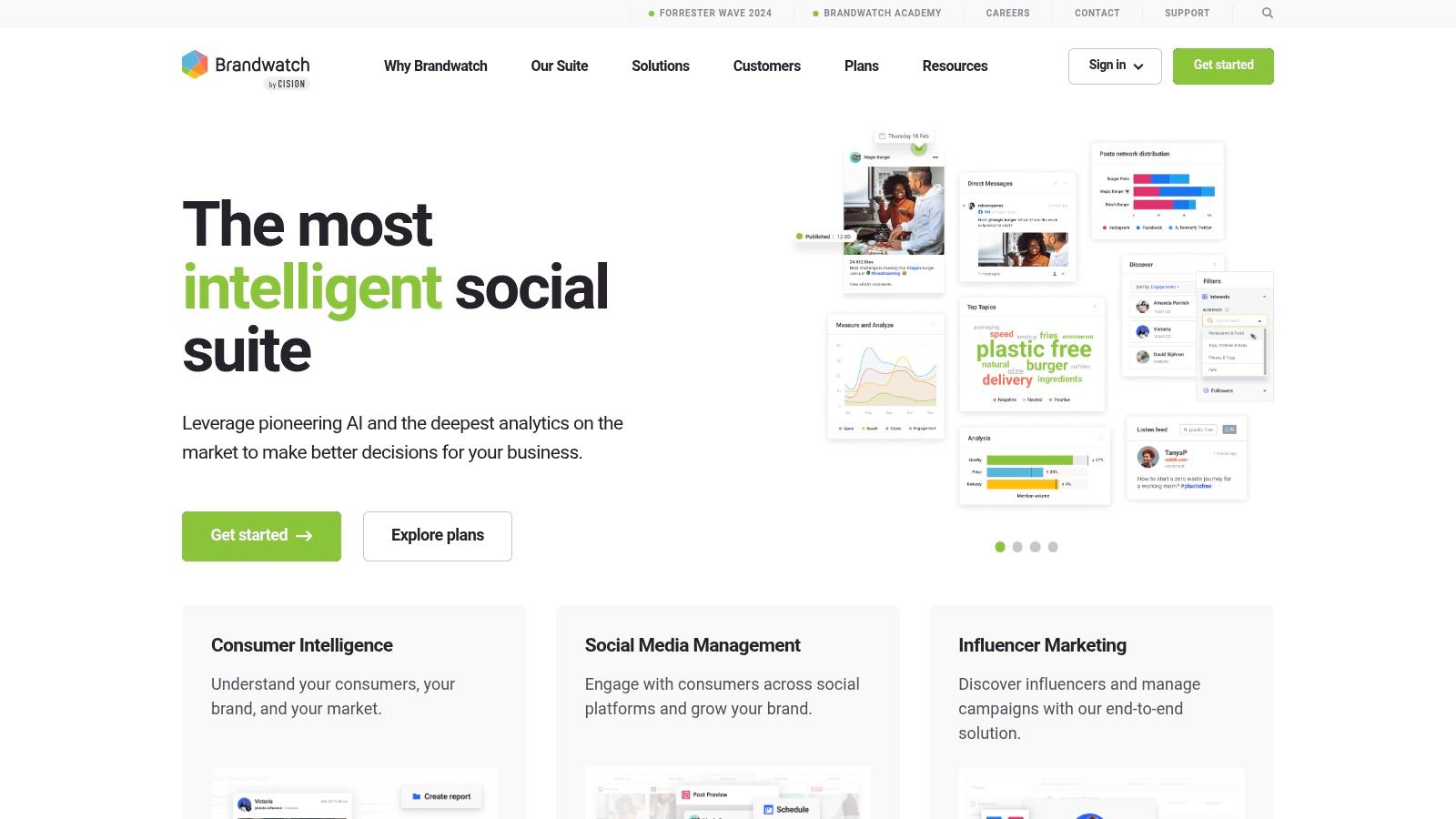
Brandwatch is what you buy when “we need better visibility” really means “we need a research function.” It's a serious platform for consumer intelligence, competitive tracking, audience analysis, and executive reporting. If your team asks complex questions and expects defensible answers, Brandwatch belongs on the shortlist.
It's not a lightweight tool. That's both the appeal and the headache.
Best use case
Brandwatch works well for large teams that need flexible queries, historical analysis, and richer classification than a basic mention tracker can handle. It's especially useful when marketing, comms, and strategy teams all need the same source of truth. If your work leans into category mapping and audience insight, it pairs well with broader thinking around B2B demand generation.
A foundational shift in this market was the move to real-time, multi-platform monitoring. Modern platforms can crawl social networks, forums, blogs, and news sources, then apply sentiment analysis and keyword tracking. In practice, that means they can process millions of social messages within minutes, which is why they became core infrastructure rather than manual research tools (Ignite Visibility on modern listening platforms).
Brandwatch is powerful, but it's not where I'd start if the real need is “help reps find warm buyers this week.”
The trade-off is predictable. Quote-based pricing, a deeper setup curve, and enough feature depth to confuse teams that just wanted alerts and a weekly report. Great platform. Wrong fit for plenty of companies.
Find Brandwatch at Brandwatch.
3. Talkwalker
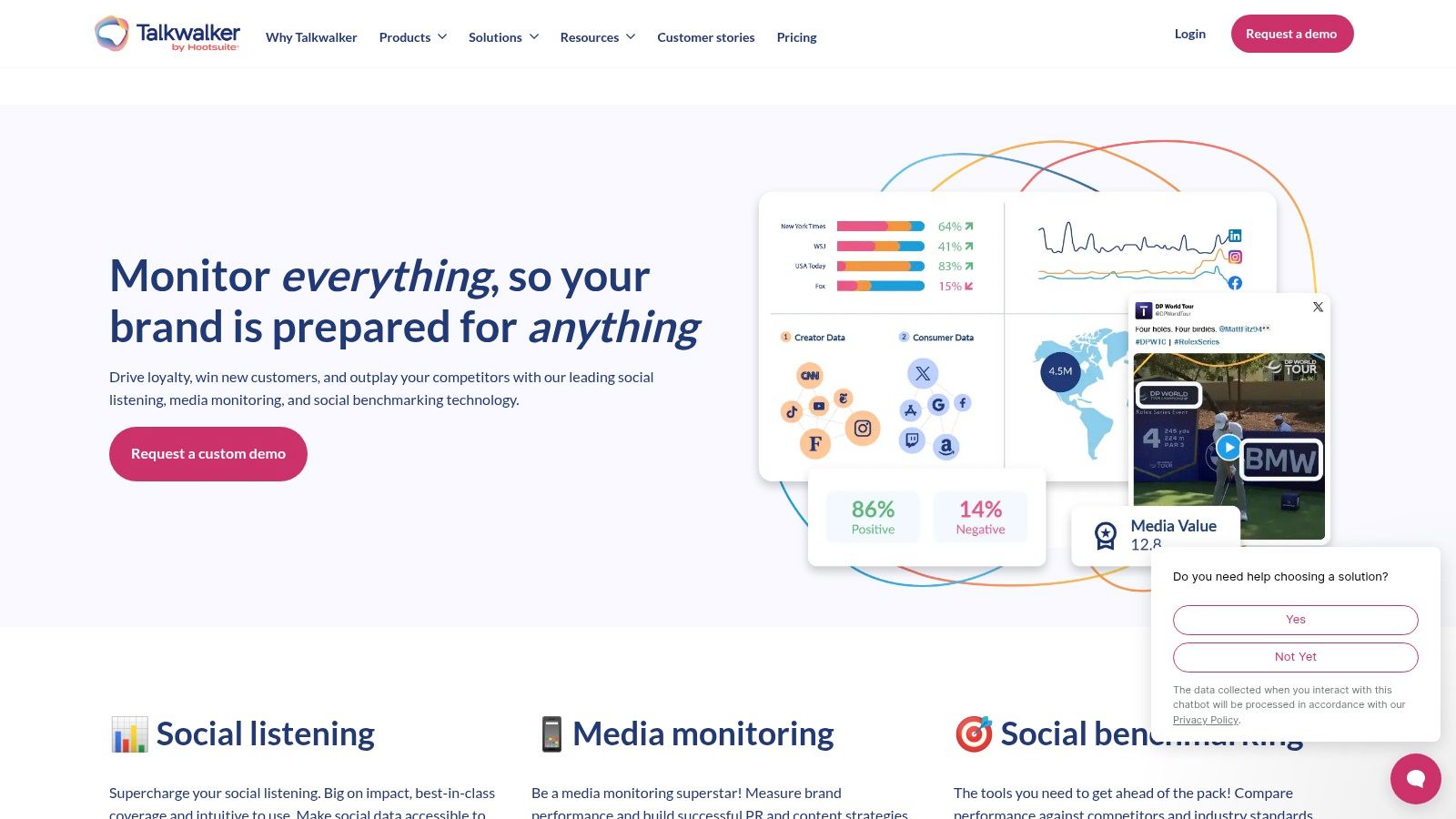
Talkwalker earns attention for one reason many tools still underdeliver on. It handles more than text. If your brand or competitor shows up in images, videos, podcasts, or other media formats, Talkwalker starts looking smarter than text-heavy platforms fast.
That makes it useful for early-signal detection, especially when a spike starts outside neat keyword mentions.
Where it earns its keep
The visual and audio recognition angle is the headline. Logo detection in images and video, plus speech and podcast analysis, gives Talkwalker a broader field of view than tools that mostly parse captions and written mentions. For brand teams, that's valuable. For B2B teams, it's more situational but still relevant when competitor chatter spreads through creators and events.
Its AI assistant also helps non-analysts get quicker summaries from complex data. That matters in enterprise settings where not every stakeholder wants to learn advanced query design just to understand a trend line.
The downside is simple. Talkwalker can be more platform than a small or mid-market team needs. If your day-to-day motion is seller-led prospecting on LinkedIn, this is a lot of machinery to buy just to end up exporting insights into another workflow.
Still, for crisis monitoring, multimedia detection, and broad listening depth, Talkwalker is one of the stronger enterprise options.
See the platform at Talkwalker.
4. Meltwater

Meltwater sits in that useful middle ground between social listening and media intelligence. If your team cares about news coverage, forums, social channels, and executive-ready reporting in one place, Meltwater makes sense.
For comms-heavy organizations, that unified workflow is often the selling point.
Best for teams already living in PR and comms
Meltwater is strong when PR, marketing, and leadership all need reporting from the same system. You can monitor across channels, watch sentiment and share-of-voice trends, and push outputs into broader reporting workflows. It's good at helping teams package insight, not just collect it.
For B2B sales use cases, the catch is that Meltwater tends to sit one step removed from direct prospecting action. You can absolutely uncover competitor chatter, pain points, and themes worth turning into outreach. But the platform itself is more about intelligence and monitoring than lead activation.
That's not a flaw. It's a category truth. Many social media listening tools are built to inform strategy, not hand reps a ready-made conversation starter.
A buying team that wants one platform for earned media and social listening should look closely at Meltwater. A sales team that wants “who should I message today?” probably shouldn't start here.
Visit Meltwater.
5. Sprout Social
Sprout Social is the practical choice for teams that already run publishing, engagement, and reporting inside Sprout and want listening without bolting on a separate enterprise platform. That convenience matters more than vendors like to admit. Software that fits your existing workflow usually beats “best in class” software nobody adopts.
The listening capability comes as an add-on, which is both good and annoying. Good because you only pay for it if you need it. Annoying because costs can creep once more users get involved.
Good operational fit for existing Sprout teams
Sprout's strength is operational handoff. A team can spot a topic, route it into engagement workflows, and keep publishing and inbox work in the same ecosystem. That's efficient for social managers and community teams.
For B2B revenue teams, Sprout can support listening-driven insight, but it isn't built like a seller-first signal engine. It helps you understand trends and mentions across networks. It doesn't naturally specialize in converting those signals into prospecting opportunities the way a more focused tool does.
If your social team owns the workflow, Sprout is a sensible buy. If your sales team owns the outcome, check whether “sensible” is enough.
Per-seat costs can also become the silent budget leak. Not dramatic at first. Very dramatic later.
You can explore it at Sprout Social.
6. Sprinklr
Sprinklr is what happens when a listening tool grows up inside a very large enterprise environment. Governance, security, routing, shared workflows, broader CX integration. It's designed for organizations with real complexity, not for a five-person team trying to find leads faster.
That's the right lens for evaluating it.
Built for complexity
The listening and insights capability sits inside a wider customer experience stack. That gives Sprinklr a clear advantage if your service, social, publishing, and advertising motions already need to connect. Large organizations often care less about “best standalone listener” and more about “least painful way to unify teams.”
Sprinklr can absolutely support advanced listening programs. It's strong for share-of-voice views, sentiment tracking, and enterprise reporting. But the implementation weight is real. This isn't a buy-it-on-Friday, use-it-on-Monday product.
For B2B teams focused on intent signals, Sprinklr may be too broad unless it already fits your stack. It's a platform for coordination, not just discovery. If your actual need is lighter and more direct, you'll feel the extra weight immediately.
See Sprinklr.
7. NetBase Quid
NetBase Quid is less about simple monitoring and more about making sense of messy markets. If your team needs narrative discovery, topic clustering, and strategic mapping across social and broader intelligence sources, it's a compelling option.
This is analyst-friendly software. That's a compliment and a warning.
Strong when strategy matters more than speed
The best use case is not “tell me every brand mention.” It's “show me how conversations cluster, where narratives are shifting, and what patterns matter across a category.” Product marketing, strategy, and competitive intelligence teams usually get more from NetBase Quid than frontline reps do.
Its strength is turning unstructured chatter into something closer to a market map. That's useful for GTM planning, positioning work, and identifying emerging themes before they harden into market consensus.
The trade-off is access and usability. Quote-based pricing, onboarding needs, and a learning curve mean casual users won't get full value quickly. If you've got analysts, that's fine. If you've got overstretched generalists, maybe not.
NetBase Quid is smart software for strategic teams. It's less compelling if your benchmark is immediate lead generation.
Find it at Quid.
8. Brand24
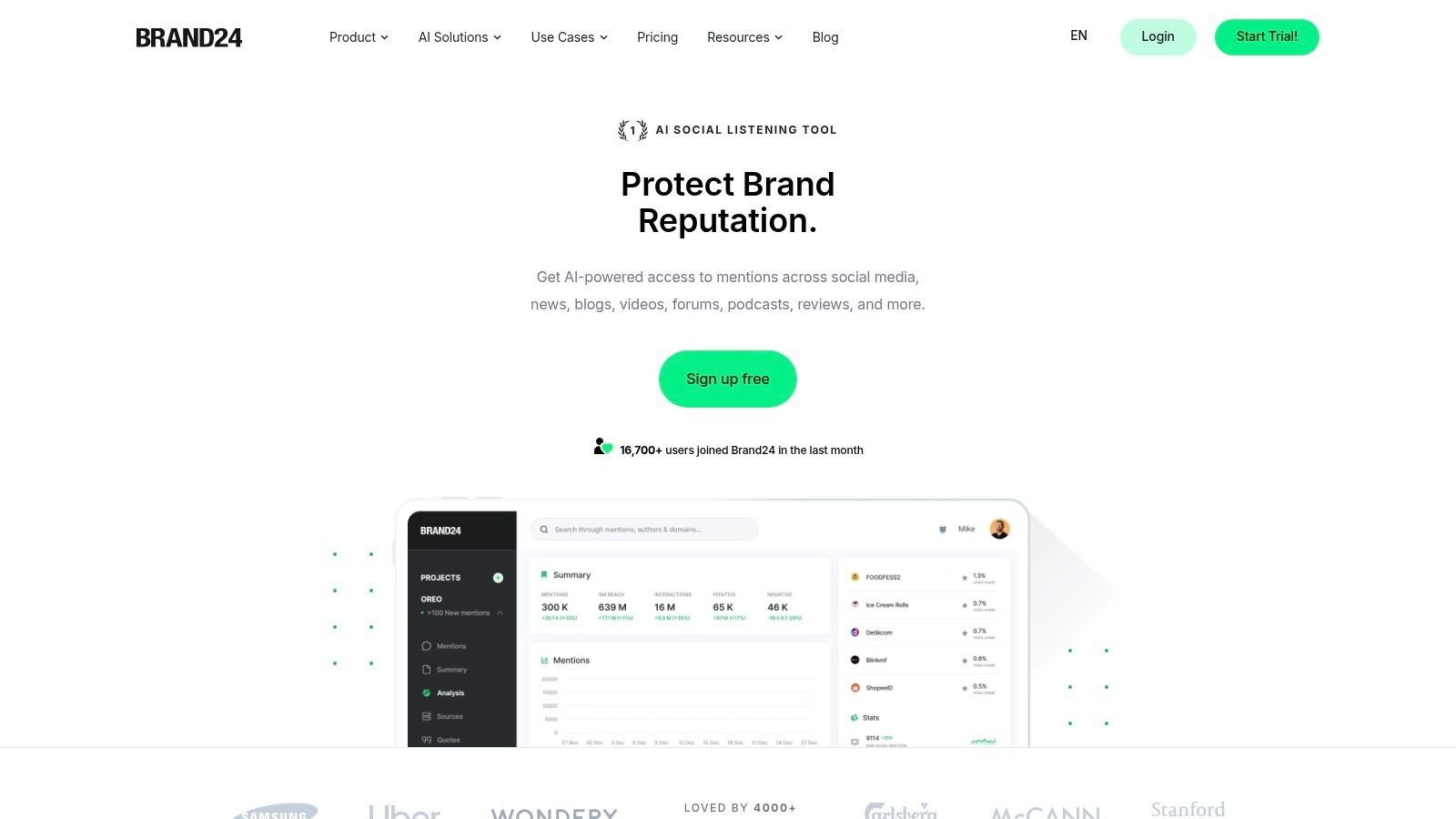
Brand24 is one of the easier tools to recommend to lean teams because it doesn't pretend setup has to be painful. You can get running quickly, track mentions across multiple channels, and put alerts in front of people who might put them to use.
That matters more than feature theater.
A practical option for lean teams
Brand24 works well for SMB and mid-market teams that need fast alerts, straightforward reporting, and enough coverage to keep tabs on brand, competitor, or topic conversations without enterprise overhead. It's especially useful when the team wants self-serve pricing and a lower-friction start.
For B2B lead generation, Brand24 can support an intent workflow if you're disciplined. Track competitor mentions, pain-point terms, and relevant conversations, then route those findings into outreach. If that's the direction you're heading, it helps to understand what high-intent leads look like before you start building keyword sets.
Best part: It's accessible enough that smaller teams often use it consistently.
Watch for this: It's not the deepest option for advanced AI modeling or heavy historical research.
Good fit: Marketing teams that want practical monitoring without needing a dedicated analyst.
Brand24 is good software for teams that need to act this week, not build a command center by quarter-end.
You can try it at Brand24.
9. Awario
Awario has a very straightforward appeal. It gives startups, solo operators, and smaller teams a way to monitor keywords and topics without dragging them into enterprise software territory.
Sometimes that's exactly the right answer.
Where it works best
Awario is useful when budget matters, setup time matters, and your use case is still clear enough to run on keywords, Boolean logic, and alerts. Founders and small marketing teams can use it for competitor tracking, basic brand monitoring, and industry topic watching without much friction.
Its limitations are the ones you'd expect. You won't get the same analytical depth, governance, or executive-grade reporting found in more expensive platforms. Heavy usage can also push you toward higher tiers over time.
Still, a lot of teams don't need the full orchestra. They need something reliable that catches relevant chatter and lets them export it. Awario does that job well enough to stay in the conversation.
See Awario.
10. YouScan
YouScan is the specialist on this list. If visual mentions matter, it becomes very interesting very fast. If they don't, it may feel like buying a very good wrench for a problem that needs a screwdriver.
That's not an insult. Specialization is useful when the problem is real.
A specialist, not a full replacement
YouScan is strongest when brands appear in user-generated visuals without obvious text mentions. Logo recognition, OCR, and visual monitoring can catch things general text-first platforms miss. For consumer brands, events, sponsorships, and creator-driven content, that can be a meaningful blind spot to close.
In B2B, the need is usually narrower. If your category relies heavily on webinar screenshots, conference photos, product visuals, or creator content, YouScan can add value. If not, it's usually better as a complement than a centerpiece.
The main caution is platform overlap. YouScan is great at its specialty, but many teams still need a broader listener for text, forums, and strategic analysis. So evaluate it as part of a stack, not automatically as the whole stack.
Visit YouScan.
Top 10 Social Listening Tools Feature Comparison
Product | Core features ✨ | Quality / Results ★ | Target audience 👥 | Value & Price 💰 |
|---|---|---|---|---|
RoverLead AI 🏆 | Behavioral intent tracking, Signal Agents, AI openers, 5‑min ICP setup | ★★★★☆, 2–3× reply lift; 30–50% more meetings | B2B sales leaders, SDR/BDR, founders, GTM teams | 💰 Founding locked lifetime rate, priority support; gated access |
Brandwatch – Consumer Research | 100M+ sources, AI Iris, image/logo analysis, historical archives | ★★★★★, enterprise decision‑grade insights | Market researchers, enterprise PR & strategy teams | 💰 Quote‑based (enterprise) |
Talkwalker – Social Listening | Visual & audio detection, logo in video, Yeti AI summaries, broad coverage | ★★★★★, best‑in‑class multimedia detection | Brand/comms teams, crisis monitoring, agencies | 💰 Quote (enterprise) |
Meltwater – Social Listening | Cross‑channel monitoring, SOV, sentiment, API & modular suites | ★★★★☆, PR + social workflows, exec reporting | PR, comms, mid‑market & enterprise teams | 💰 Quote/modular pricing |
Sprout Social – Listening (add‑on) | Topic monitoring, integrated publishing & Smart Inbox, role controls | ★★★★, easy operational handoff | Social media teams wanting unified publishing + listening | 💰 Add‑on paid; per‑seat costs |
Sprinklr – Insights Suite | Enterprise listening with AI enrichment, KPI/CX integrations | ★★★★★, governance & scale for large orgs | Large enterprises needing CX governance & security | 💰 Quote‑based enterprise pricing |
NetBase Quid (Quid Monitor) | NLP clustering, topic maps, market & narrative discovery | ★★★★☆, strategic trend & category mapping | Product/GTM strategy, market intelligence teams | 💰 Quote; onboarding typical |
Brand24 | Real‑time alerts, sentiment, cross‑channel (incl. TikTok/YouTube), exports | ★★★★, fast setup, practical alerts | SMBs, growth teams, small agencies | 💰 Transparent plans; SMB‑friendly |
Awario | Boolean search, unlimited keywords per topic, CSV/PDF reports | ★★★, budget monitoring & alerts | Founders, small sales/marketing teams | 💰 Low‑cost tiers; good entry value |
YouScan – Visual Social Listening | Logo/object detection, OCR, visual UGC tracking | ★★★★☆, excels at untagged visual mentions | Brands focused on visual UGC & image tracking | 💰 Quote‑based; visual modules on higher plans |
Final Thoughts
The best social media listening tools are not all solving the same problem. That's where most buying advice falls apart. It compares dashboards as if every team needs the same thing. They don't.
If your mandate is brand health, market research, crisis monitoring, or executive reporting, broad platforms like Brandwatch, Talkwalker, Meltwater, Sprinklr, and NetBase Quid make sense. They're built to collect signals across channels and turn them into strategic understanding. For the right team, that's valuable. For the wrong team, it's expensive wallpaper.
If your team is lean, Brand24 and Awario are easier to justify. They're practical, faster to adopt, and less likely to require a dedicated analyst just to stay useful. Sprout Social sits in a different lane. It's appealing when your social team already lives there and wants listening stitched into publishing and engagement workflows.
The sharper question for B2B leaders is this: do you want intelligence, or do you want pipeline?
Those aren't the same purchase. A broad listening suite can tell you what buyers are discussing. It usually won't hand your reps a clean feed of people who are active, relevant, and primed for a timely message. That gap is why so many companies end up with good insights and mediocre action.
For sales-led teams, the strongest option on this list is RoverLead AI because it narrows the job correctly. Instead of trying to be an everything platform, it focuses on identifying high-intent behavior on LinkedIn and turning that behavior into outreach opportunities with context attached. That's much closer to revenue work than conventional social listening.
There's also a bigger category trend underneath all this. Social listening has matured from simple keyword monitoring into real-time, multi-platform analysis across social sites, forums, blogs, and news, with sentiment and trend detection layered on top. That evolution is why enterprise demand keeps growing and why the market is projected to expand at a double-digit pace through the early 2030s, as noted earlier. The tooling is getting better. Buyers just need to get more honest about the use case.
My blunt advice is simple. Don't buy social media listening tools because your competitors have one. Buy the tool that matches who needs to act on the signal. If analysts need it, buy analysis software. If reps need it, buy something that gets them closer to a conversation.
If your team cares more about warm conversations than pretty dashboards, RoverLead AI is the one to look at. It turns LinkedIn engagement into daily, high-intent leads matched to your ICP, with context and AI-written openers baked in, so reps can spend less time digging and more time starting relevant conversations.