High Intent Leads: Find Buyers, Not Just Browsers
Your team has activity. The CRM is busy. Sales Navigator lists are stacked. Sequences are running. Yet the calendar keeps filling with calls that feel like polite dead ends.
That usually means the pipeline isn't full of opportunity. It's full of people who were easy to find.
A lot of B2B teams still confuse fit with timing. Someone can match your ICP perfectly and still have zero reason to talk to you this quarter. Meanwhile, a buyer who just engaged with a competitor's pricing discussion on LinkedIn might be far closer to revenue than the “perfect” account sitting on a static list. That's the whole game with high intent leads. You're not looking for names. You're looking for evidence.
Table of Contents
Your Sales Pipeline Is Full of Lies
A stuffed pipeline can hide a lazy targeting model. Plenty of teams call it momentum when what they really have is volume. More contacts, more tasks, more “touches,” more deals parked in discovery with no pulse.
The old playbook says if reps are busy, the machine is working. It isn't. Busy reps can still be spending their day on people who downloaded something vague six weeks ago, accepted a connection request out of politeness, or fit an account list that looked good in a slide deck.
A 2025 industry round-up on lead generation and intent data says 72% of marketers plan to adopt intent data, and the same source says intent-driven targeting can produce 40% shorter sales cycles and 3x more qualified opportunities. That shift matters because teams are tired of measuring motion instead of progress.
Practical rule: A pipeline full of names is not a pipeline full of buyers.
The better question isn't “How many leads did we add?” It's “Which accounts are showing signs they're in market?” That's the difference between a rep who looks productive and a rep who creates pipeline with teeth.
If your team still builds outreach around static lists first and behavior second, it's worth rethinking the shape of your B2B lead generation funnel. Fit still matters. But fit without timing is just a well-organized guessing game.
The vanity metric trap
Three things usually inflate fake pipeline:
ICP-only targeting that assumes company profile equals buyer readiness
Content vanity signals like broad downloads or light engagement with no follow-up behavior
Slow follow-up that treats a warm signal like it'll still be warm next week
The hard truth is simple. Revenue teams don't need more leads. They need fewer bad ones and faster action on the right ones.
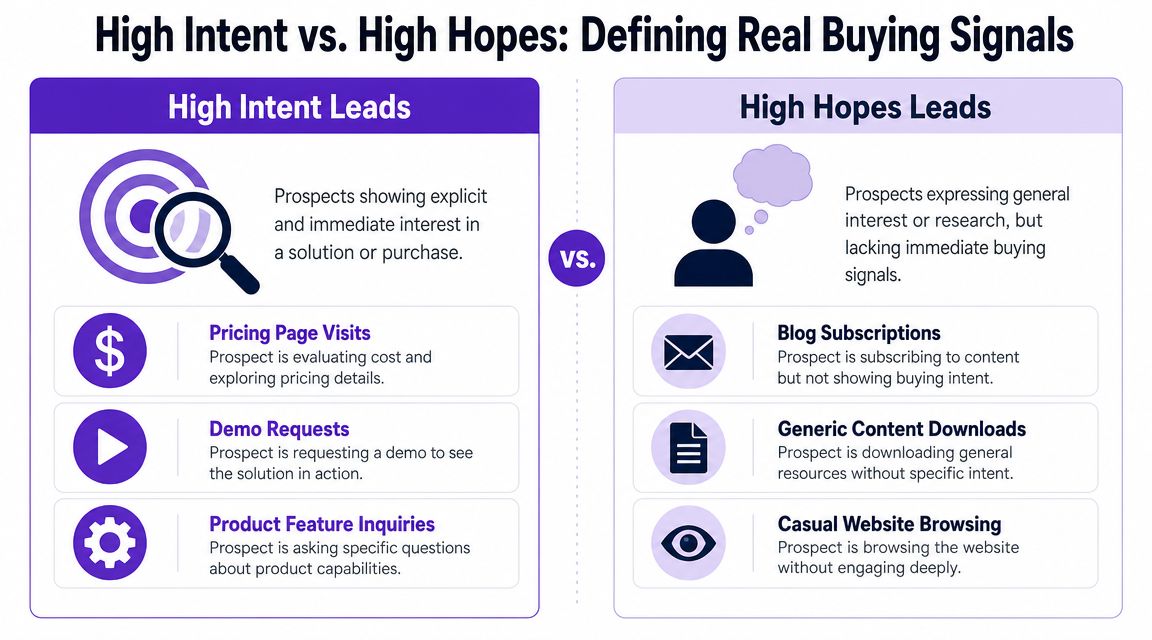
High Intent vs High Hopes Defining Real Buying Signals
Often, teams don't have a lead problem. They have a signal interpretation problem.
A high-hope lead looks good in a dashboard. A high-intent lead gives you a real reason to reach out now. That difference gets missed all the time, especially on LinkedIn, where people mistake general activity for commercial interest.
What makes a lead high intent
High intent is usually a mix of behavior, recency, and context.
Behavior means the buyer did something meaningful. Recency means they did it recently enough to matter. Context means the action makes sense inside your sales motion. A generic website visit might be nothing. A comment on a competitor's LinkedIn post asking about implementation is a different animal.
There's also a channel-quality angle that too many teams ignore. A 2025 Databox lead generation roundup says SEO accounts for 35% of the most valuable leads and referrals 30%. That lines up with what sales teams see on the ground. Buyers who actively seek information tend to be more valuable than people interrupted into a conversation they didn't ask for.
High Hopes vs High Intent Leads
Attribute | Low-Intent Lead ("High Hopes") | High-Intent Lead ("Buyer") |
|---|---|---|
Core trait | Fits the ICP on paper | Shows active buying behavior |
Timing | Unclear or distant | Feels current and relevant |
Example signal | Blog subscription or generic content download | Demo request, pricing discussion, repeated product-interest behavior |
LinkedIn clue | Liked a broad thought-leadership post | Commented on a competitor topic, engaged around pricing, integrations, rollout, or switching |
Sales response | Nurture, observe, qualify gently | Prioritize, personalize, act quickly |
Risk | Burns rep time with little movement | Can still be noisy, but worth immediate review |
A lead isn't “high intent” because marketing labeled it MQL. It's high intent when the buyer's actions make a sales conversation timely.
That's why “high intent leads” should be treated less like a lead source and more like a decision layer. The label only matters if it changes who gets worked first.
Decoding Intent From Clicks to Customers
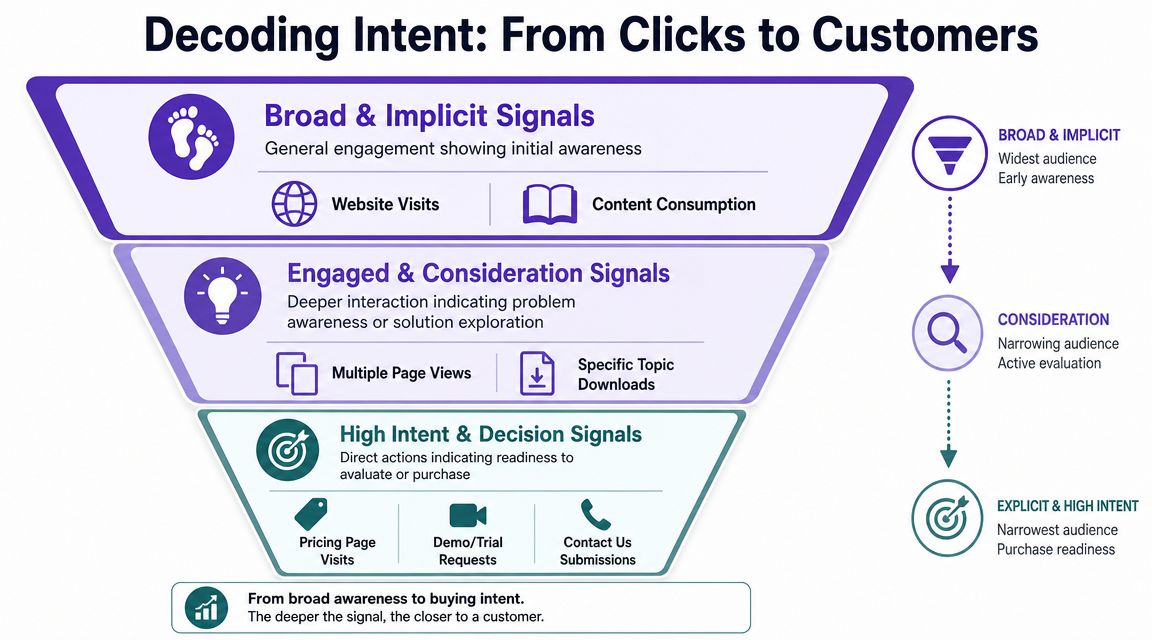
Intent isn't binary. It stacks.
The mistake is treating every signal as equally meaningful, or worse, treating a single signal as proof. One buyer visits your site once. Another follows your category, engages with a competitor thread, checks your profile, and returns to your product page. Those are not the same lead. One is curious. One is assembling a shortlist.
A hierarchy of signals
Think of buyer signals in layers.
Broad and implicit
Someone follows a relevant creator, reacts to a category post, or browses educational content. Useful, but weak on its own.Engaged and directional
They revisit a topic, join a sharper discussion, or interact around a pain point tied to your offer. Better. Still not enough by itself.Decision-adjacent They ask about pricing, compare vendors, discuss integrations, request a demo, or repeatedly engage with problem-to-solution content. At this stage, outreach starts making sense.
A lot of LinkedIn prospecting fails because reps stop at layer one. They treat surface engagement like a buying signal instead of a clue that needs corroboration.
Why LinkedIn signals punch above their weight
LinkedIn can be more revealing than a website because the buyer often exposes intent in public language. Comments, follows, profile changes, and topic engagement all give you context a pageview never will.
A vendor-neutral overview of high-intent lead identification notes that the strongest intent signals are context-specific and often combined. It also points out an underappreciated nuance: a social comment or competitor follow on LinkedIn can matter more in an outbound motion than a generic website visit.
That's the part many teams miss. Intent is not universal. It depends on motion.
If your motion is LinkedIn-led outbound, useful signals often include:
Competitor engagement such as commenting on their positioning or offer
Role change or new responsibility that opens a fresh problem window
Topic clustering where one prospect keeps appearing around the same pain point
Public buying language like “pricing,” “tooling,” “process,” “integration,” or “recommendation”
If you need a sharper qualification model for these signals, a practical sales lead qualification approach should weigh source, recency, and commercial relevance together. Single events create false positives. Patterns create pipeline.
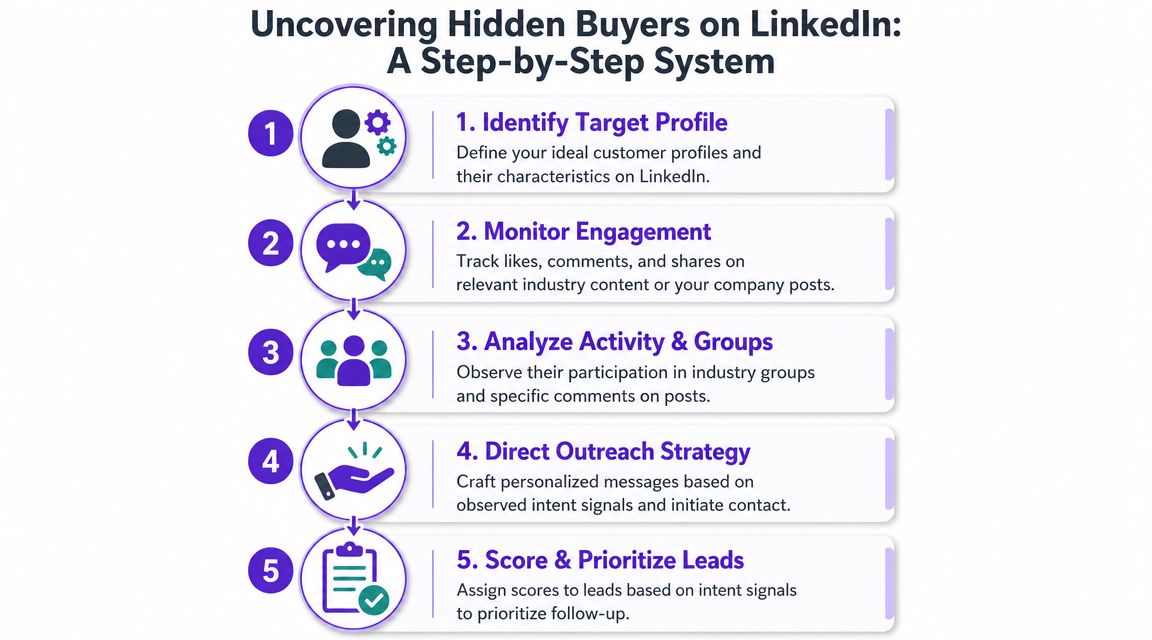
Your System for Uncovering Hidden Buyers on LinkedIn
You do not need a giant RevOps project to get started. You need a repeatable signal collection habit, a scoring model, and a routing process that sales will use.
Start manual before you automate
Start with a narrow slice of the market. Pick your ICP, list the competitors buyers mention most, identify category keywords, and watch a small set of creators your buyers interact with.
Then work through this routine:
Track the right people
Use LinkedIn Sales Navigator to monitor target accounts, job changes, and relevant decision-makers.Watch the right conversations
Focus on comments and discussions around pricing, alternatives, implementation pain, headcount growth, or process changes. Likes are weak. Comments are better. Repeated comments are where things get interesting.Capture context immediately
Don't save “John liked a post.” Save “VP Sales at target account commented on competitor post about outbound tooling and asked about ramp time.”Apply ICP fit after the signal Teams often invert the logic at this stage. Signal first. Then check company, role, geography, and account quality.
For teams that want software support, tools can automate pieces of this workflow. LinkedIn Sales Navigator helps with monitoring. CRM workflows help with routing. RoverLead AI is one option built around turning LinkedIn engagement into ICP-matched intent signals with context for outreach.
Score signals like a revenue team not a content team
A weighted model beats a one-trigger model every time.
A practical guide to high-intent lead scoring recommends examples like demo requests at +50 points and pricing page visits at +30 points, with many teams using a 60 to 80 point threshold for sales handoff. The same guidance says Tier 1 signals should trigger outreach within 48 hours.
That scoring logic matters because not all activity is equally close to revenue.
Here's a simple LinkedIn-friendly version:
Signal type | Example | How to treat it |
|---|---|---|
Strong | Demo request, explicit pricing question, competitor comparison | Route fast to sales |
Medium | Repeated topic comments, integration interest, profile activity tied to problem awareness | Monitor and combine with fit |
Light | Post like, broad content engagement, passive follow | Keep in nurture unless reinforced |
The best scoring model asks one blunt question: “How close is this behavior to a buying decision?”
Don't make the model too clever. If reps can't understand it, they won't trust it. If marketing can't explain why a lead crossed the threshold, handoff quality collapses and everyone goes back to arguing over lead stages like it's a hobby.
Dont Just Find Leads Start Conversations
Finding high intent leads is only half the job. The other half is not ruining the moment with robotic outreach.

The worst message you can send is the one that makes the buyer feel watched instead of understood. “I saw you liked a post” is technically personalized and practically useless. It sounds like surveillance with punctuation.
Outreach that uses context without sounding creepy
Good outreach translates the signal into a relevant business reason to talk.
Try this instead:
Weak version
“Saw you engaged with a post about sales tools.”Better version
“Looks like your team may be evaluating ways to improve outbound workflow. We help sales teams tighten follow-up around active buyer signals.”Even better version
“You seem to be digging into outbound process and tooling. Curious if this is tied to a bigger team push, new hiring, or just cleanup work.”
That last version works because it uses context without pretending you know more than you do.
Buyers respond to relevance, not to proof that you monitored every click.
A practical opener should do three things:
Reflect the signal without naming every detail
Offer a useful angle tied to the buyer's likely problem
Invite correction so the buyer can tell you what's going on
If your reps need help with message structure, this set of conversation starters for sales outreach is the kind of resource worth keeping close.
Speed decides whether intent becomes pipeline
Teams frequently lose warm signals in operational sludge. Someone notices intent. Someone else exports data. A rep gets it tomorrow. By then the buyer has moved on, booked with a competitor, or forgotten why they cared.
An Upcell guide on high-intent lead capture says that if enrichment and routing take longer than five minutes, the signal is often wasted. The same guidance recommends pairing first-party behavior with rapid ICP filtering and CRM routing so sales can act while the buyer is still in an active window.
That means your process should look something like this:
Alert instantly into Slack or CRM
Enrich fast with role, account, and fit details
Assign ownership before the signal cools off
Trigger outreach while the context is still fresh
A short explainer on this approach is worth a watch:
Fast doesn't mean aggressive. It means prepared. The goal isn't to pounce. It's to show up while the buyer's attention is still pointed at the problem.
FAQ Your High Intent Lead Questions Answered
A lot of teams like the idea of high intent leads right up until they have to operationalize them. Fair enough. This only works if the system is simple enough to run every week.
Question | Answer |
|---|---|
What is a high intent lead in plain English? | It's a prospect showing recent behavior that suggests active evaluation, not just casual awareness. |
Are high intent leads only inbound leads? | No. They can appear in inbound or outbound motions. LinkedIn behavior often creates outbound opportunities that feel warm because the timing is real. |
Can I do this without expensive tools? | Yes. You can start manually with LinkedIn, Sales Navigator, a spreadsheet, and a clear scoring model. Tools help with scale, not with judgment. |
What's the biggest mistake teams make? | Treating single signals as proof. One action can mislead you. A pattern of behavior is much stronger. |
Should firmographic fit still matter? | Yes. Intent without fit creates noise. Fit without intent creates stale lists. You need both. |
Are website visits enough to qualify someone? | Usually not by themselves. They become more useful when paired with repeat behavior, sharper content interest, or LinkedIn context. |
How fast should sales follow up? | Fast enough that the buyer still remembers the problem they were exploring. If your process drags, the signal loses value. |
How do I use LinkedIn signals without sounding creepy? | Speak to the business topic, not the surveillance detail. Reference the likely problem, not every action you observed. |
Does this replace ABM? | No. It makes ABM smarter. Instead of treating every target account the same, you prioritize accounts showing live buying behavior. |
Where should I start this week? | Pick one ICP, define a handful of strong signals, build a lightweight scorecard, and route the hottest signals to one rep or pod first. |
A final note. High intent doesn't mean guaranteed deal. It means the odds of a useful conversation are better because the timing is better. That sounds obvious, yet a shocking amount of B2B prospecting still ignores it.
If your team wants a simpler way to turn LinkedIn activity into workable sales opportunities, RoverLead AI helps surface ICP-matched buyer signals from social engagement so reps can prioritize timely outreach instead of grinding through static lead lists.