10 Best Sales Intelligence Tools to Use in 2026

Your AE opens the day with LinkedIn, a data vendor, an intent dashboard, email sequencing, and a CRM full of half-complete records. By lunch, they still have not answered the only question that matters. Who should I contact right now, and why?
That is the primary problem with sales intelligence. Teams buy categories they do not need, stack overlapping tools, and end up with more tabs than usable signal. A static data provider can look great in a demo and still collect dust if the rep has to leave their core workflow to get value. Tools that fit the sales motion and surface timely signals inside the rep's normal routine usually win adoption. Tools built around behavior, timing, and workflow fit often beat bigger databases with longer feature lists.
The market keeps expanding, which is why choosing by vendor brand alone is a bad buying strategy. Grand View Research estimates the category is growing quickly, which tracks with what buyers already feel in practice: sales intelligence is no longer one bucket. It now spans contact data, enrichment, account intent, social selling, and workflow automation. The result is more choice, but also more confusion.
So use a simpler filter. Start with the job-to-be-done.
Some teams need accurate contact data and broad coverage. Some need buying signals to prioritize accounts already showing intent. Others need a social-selling workflow that turns LinkedIn activity into warm outreach. Those are different problems, and they call for different tools. That is also why traditional database-first platforms should be evaluated differently from behavior-based prospecting products like RoverLead AI, which focus less on storing names and more on helping reps act on live signals. If your team is already reworking prospecting around automation and signal-based outreach, this guide on how to use AI in sales is a useful companion.
This list groups the tools by the job they do best, then calls out where each one fits, where it falls short, and which sales motion it supports.
Table of Contents
1. RoverLead AI
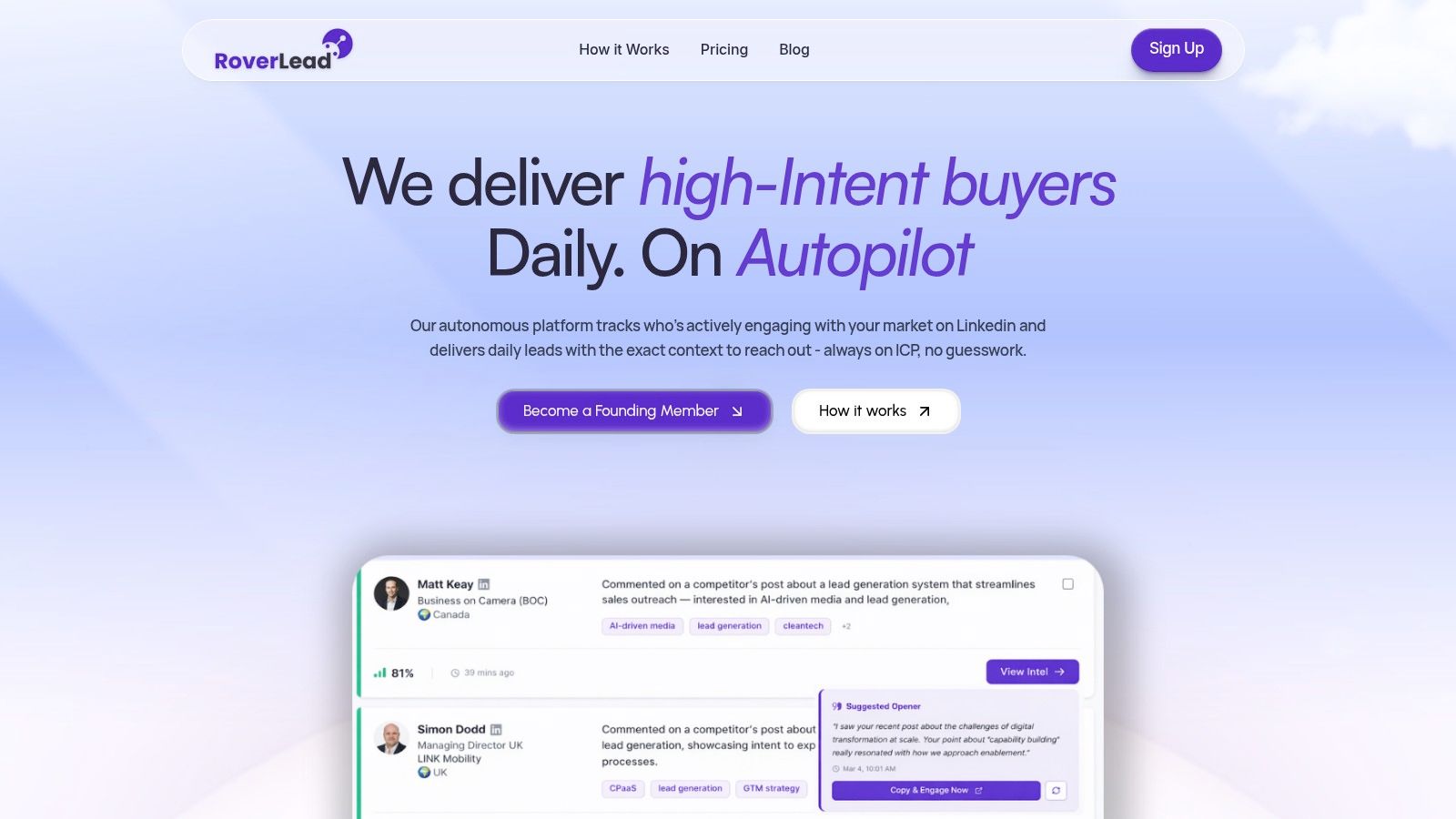
RoverLead AI is the most interesting option on this list if your pipeline lives on LinkedIn and you're tired of pretending static lead lists are “intent data.” It doesn't start with a database pull. It starts with observed behavior inside your niche.
Best for LinkedIn-first warm prospecting
After setup, RoverLead monitors LinkedIn-native signals like comments, content engagement, pricing or demo discussions, and interactions around relevant creators or competitors. Instead of handing reps a pile of titles and company names, it delivers a daily feed of people showing actual activity plus the post context and an AI-written opener. That's a different operating model.
One of the biggest gaps in most sales intelligence tools content is the difference between generic intent and social signals. Recent coverage has started separating contact intelligence, warm-signal intelligence, and conversation intelligence, while also noting that many guides still under-explain how to use LinkedIn-heavy signals like comments, creator interactions, competitor engagement, or pricing discussions in real outbound motions (Avoma's breakdown of signal types in sales intelligence).
Practical rule: If your reps already spend serious time on LinkedIn, a tool that turns social activity into prioritized outreach is usually more valuable than one more static list provider.
RoverLead says customers report stronger reply rates, more meetings, and less research time. I'd treat that the right way. Not as magic, but as what usually happens when timing and context stop being guesswork.
Where it wins and where it does not
What works:
Behavior over firmographics: It finds people doing something now, not just matching a title filter.
Fast setup: Define ICP, keywords, competitors, and influencers, then let the system learn from rep actions.
Contextual outreach: Reps don't need to reverse-engineer why a lead matters.
What doesn't:
It depends on platform activity: If your market barely uses LinkedIn, the signal pool will be thinner.
It's not your entire stack: You may still want email, CRM enrichment, or broader account intelligence elsewhere.
If you're building a social selling motion, it pairs well with a practical AI workflow like the one covered in this guide to using AI in sales. You can check the platform at RoverLead AI.
2. ZoomInfo SalesOS
A VP of Sales asks for "better prospecting data," buys ZoomInfo, and six weeks later the reps are still pulling giant lists and arguing about who owns follow-up. That outcome is common because ZoomInfo is a system for teams that already know how they prospect, route, enrich, and measure. It gives you scale and structure. It does not supply judgment.
Best for enterprise data depth
ZoomInfo fits best in a traditional data-first motion. If the job is to map accounts, find the right contacts, enrich records, and push clean data into the rest of the stack, it does that well. US coverage is usually the draw. Org charts, technographics, territory planning, and enrichment workflows are the reason larger teams keep it in the budget.
That also explains the trade-off against tools built around behavior signals. A static provider helps answer who fits the ICP. A behavior-based platform like RoverLead AI is built to answer who is showing signs worth acting on now. Those are different jobs. Teams that confuse them usually overspend on one and still need the other.
The practical buying test is simple. Buy ZoomInfo if rev ops is already in the room, routing rules exist, and reps are expected to work defined account lists with discipline. Skip it if you want a low-cost tool that reps can self-serve without much process support.
Where it tends to earn its keep:
Structured outbound: Good for account selection, territory carving, and list building at scale.
CRM enrichment: Useful when bad records create handoff problems between marketing, SDRs, and AEs.
Enterprise workflows: Strong fit for teams that need governance, admin controls, and broader GTM stack integration.
Where teams get frustrated:
Price creep: Add-ons, credits, and packaging decisions can turn a big contract into a bigger one.
Rep adoption: A large database does not fix weak messaging or poor list strategy.
Timing gaps: It is stronger at identifying who to contact than explaining why now.
That last point matters. If your sales motion depends on account coverage and database depth, ZoomInfo is a serious option. If your motion depends on catching buying signals, social activity, or in-market behavior before competitors do, a traditional provider can feel blunt. Learn more at ZoomInfo SalesOS.
3. Apollo.io
Apollo.io is the classic “good enough in a lot of places” tool, and that's not an insult. For lean outbound teams, that can be exactly the right answer. You get contact data, sequencing, calling, and enrichment without building a Frankenstack on day one.
Best for lean outbound teams
Apollo tends to work best when speed matters more than perfection. Solo sellers, startups, and small SDR teams like it because they can sign up, pull lists, launch sequences, and start learning fast. That time-to-value matters more than many vendors admit.
The broader market trend supports that kind of adoption. Precedence Research estimates the global sales intelligence market at USD 3.31 billion in 2024 and projects it to surpass USD 9.02 billion by 2034, with Asia Pacific expected to be the fastest-growing region at 15.2% CAGR. The practical takeaway is simple. Lighter-weight tools are entering more teams earlier, and not every company wants an enterprise rollout before the first outbound campaign.
Apollo's real strengths are convenience and consolidation:
All-in-one workflow: Data, email, dialer, and sequencing in one app.
Accessible buying experience: Easier to trial than quote-heavy enterprise vendors.
Good for ramping: New reps can get productive quickly.
The trade-off is that flexibility and lower entry cost can come with uneven data quality depending on your ICP, plus credit and feature limits that matter once usage climbs. If your motion is straightforward outbound and you care about speed, Apollo is usually worth a look at Apollo.io.
4. LinkedIn Sales Navigator
Sales Navigator is the tool almost everyone has tried, underused, or both. It remains the default choice for LinkedIn-led prospecting because nobody else has LinkedIn's native graph. That alone keeps it relevant.
Best for native LinkedIn research
What Sales Navigator does well is obvious. Search filters are strong, lead and account lists are easy to build, and alerts around job changes, posts, and engagement give reps a decent excuse to stop sending messages that read like they were written in a bunker. For LinkedIn-first teams, that social context is often more useful than another spreadsheet of titles.
The catch is that Sales Navigator is often a research environment, not a decision engine. It helps reps find and track people, but reps still have to do a lot of manual interpretation. If your team is still pulling lists and then guessing who matters first, the workflow starts to drag.
A better use of Sales Navigator is as a foundation for relationship-based outreach:
Use it for: ICP filtering, account tracking, warm paths, and visible social context.
Don't expect it to be: A complete contact database or a true multi-channel intent platform.
If you're building a LinkedIn-led motion, the difference between basic search and usable prospecting process matters a lot. This practical guide to B2B sales prospecting on LinkedIn gets into that side of the work. Product details are at LinkedIn Sales Navigator.
5. 6sense Revenue AI for Sales
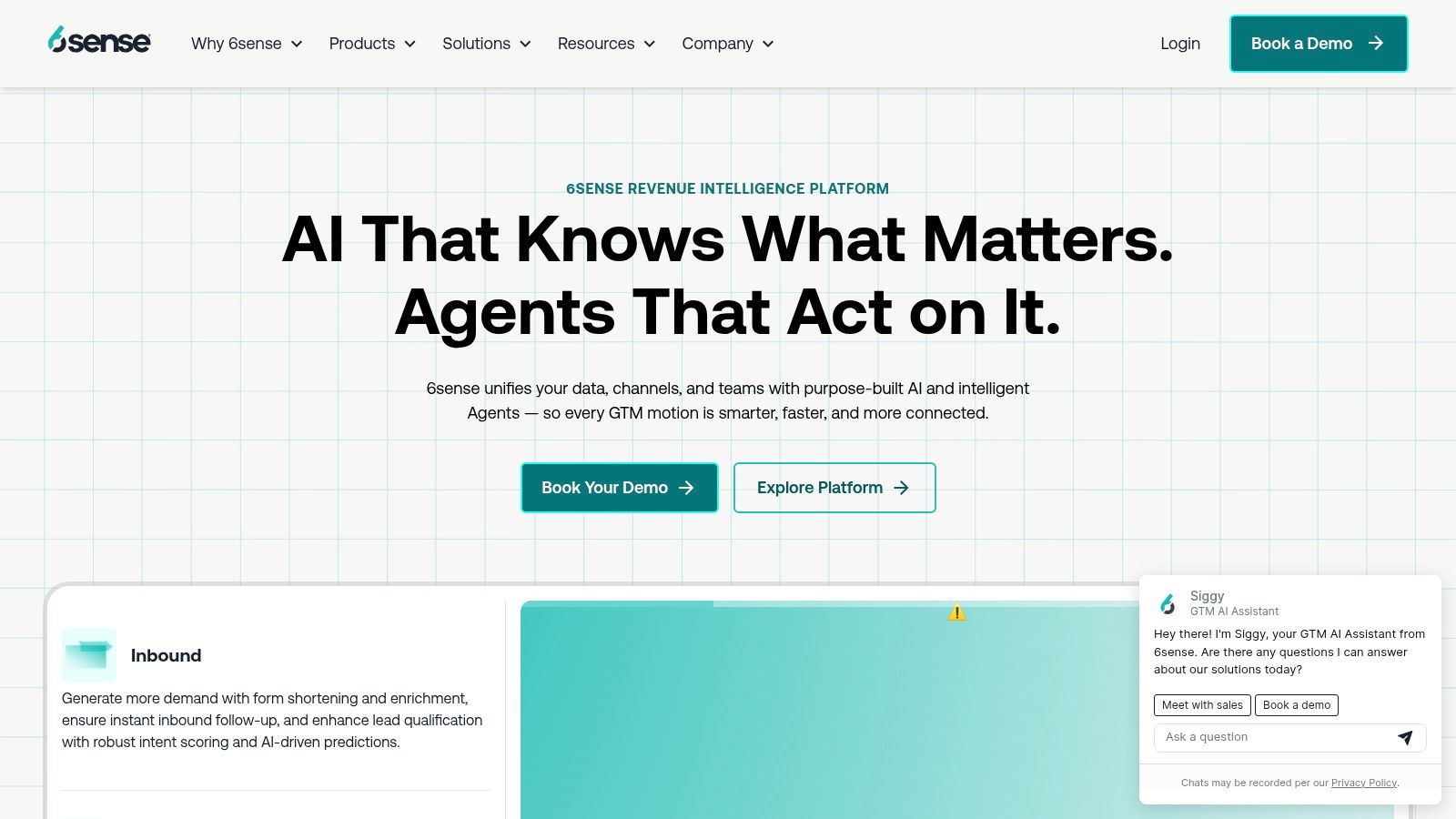
6sense is what you buy when account prioritization matters more than raw lead volume. It's built for teams running ABM or ABX motions where sales and marketing need to agree on which accounts are heating up and when.
Best for account prioritization in ABM motions
This is not a lightweight tool. 6sense works best when you already have reasonable CRM hygiene, marketing alignment, and someone who can own the operational side. When those conditions are in place, it can help teams move beyond broad TAM targeting into better account selection and sequencing.
The bigger category shift helps explain why tools like 6sense have grown in importance. Mordor Intelligence estimates cloud deployment will hold 82.05% share in 2025 and hybrid deployment is the fastest-growing architecture at 17.95% CAGR through 2031. That reflects how central SaaS-based prospecting, enrichment, and signal workflows have become in the sales stack, especially for distributed GTM teams.
Where 6sense shines:
Account-level prioritization: Useful for ranked lists of likely in-market accounts.
Sales and marketing alignment: Especially strong in coordinated ABM workflows.
Journey context: Helps teams think in buying groups, not just isolated leads.
Where it gets painful:
Implementation overhead: This isn't plug-and-play.
Budget reality: It usually fits mid-market and enterprise buying motions.
For teams comparing ABM-oriented stacks, this roundup of account-based marketing tools is a useful complement. Product info lives at 6sense Revenue AI for Sales.
6. Demandbase One Sales Intelligence Cloud
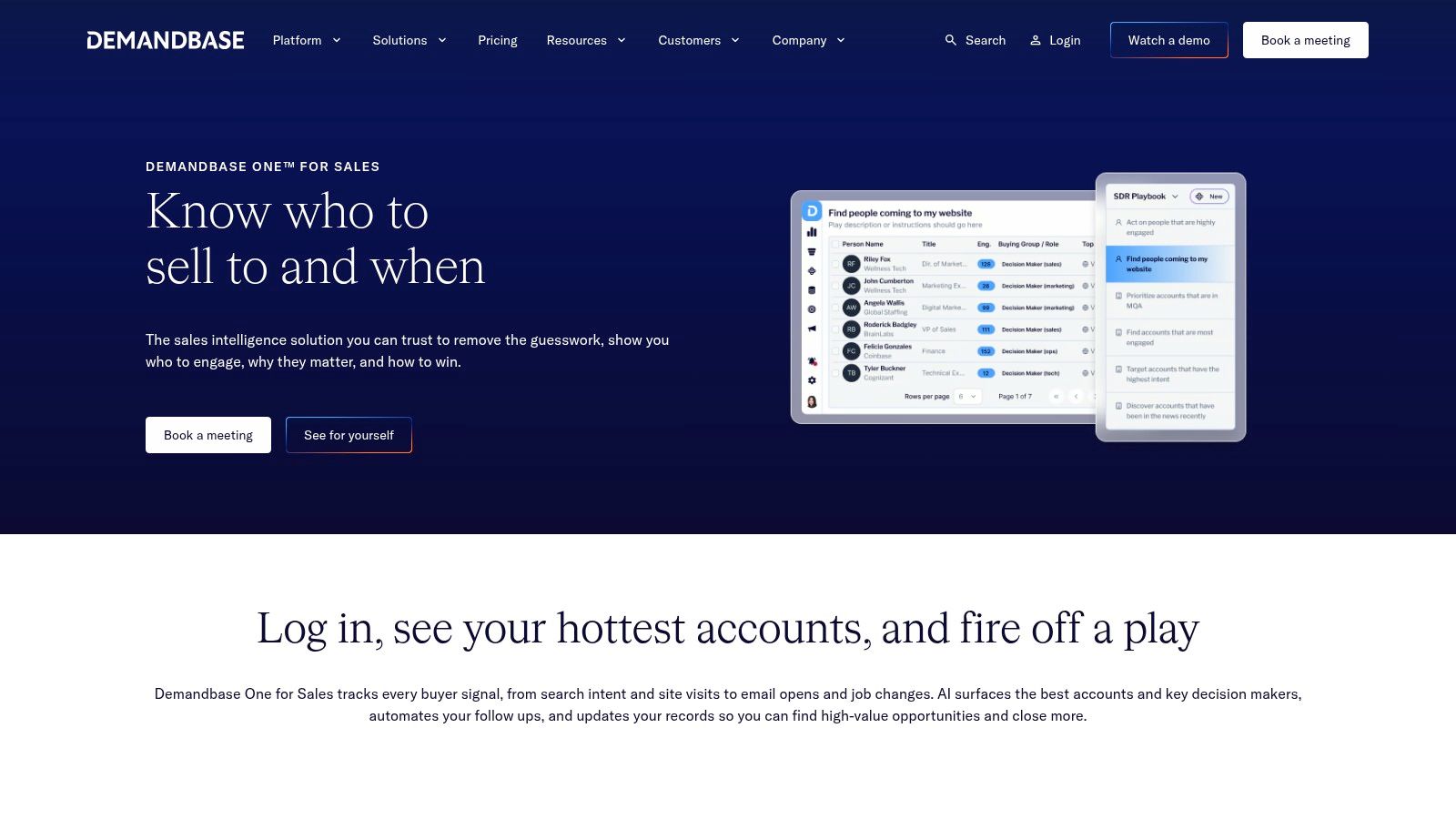
Demandbase One Sales Intelligence Cloud makes the most sense when your company already thinks in accounts, campaigns, and coordinated GTM plays. If marketing is deep in Demandbase and sales is not, that gap usually gets noticed fast.
Best for teams already running Demandbase
Demandbase blends firmographics, technographics, and account-level signals into a sales workflow that's much more useful in an ABM environment than in a simple volume outbound motion. The strength here isn't novelty. It's alignment. Sales gets context that fits the same account strategy marketing is using.
That shared context delivers core value:
Account-centric view: Better for named-account programs than generic outbound list building.
Stack fit: Stronger when paired with Demandbase's broader marketing modules.
Workflow continuity: Less vendor stitching for enterprises already invested in the ecosystem.
The downside is equally clear. If you're not already running a Demandbase-style motion, this can feel like wearing ski boots to the grocery store. Technically possible. Completely unnecessary.
For enterprise ABM teams, though, Demandbase remains one of the more credible sales intelligence tools because it supports the whole account story, not just the lead list. Explore it at Demandbase One Sales Intelligence Cloud.
7. Bombora Company Surge
Bombora is not your contact database. It's your timing layer. Teams use it to spot which companies are researching topics related to what they sell, then route or prioritize those accounts accordingly.
Best for adding company-level intent
That distinction matters because many buyers expect intent data to hand them ready-to-call people. Bombora doesn't really work that way. It gives you company-level signals that become useful only when your downstream routing, messaging, and contact selection are solid.
Used well, Bombora is valuable for:
Prioritizing accounts: Especially when territory lists are broad.
Topic-based routing: Helpful when different teams cover different problems or products.
Layering into other systems: It often works best as an ingredient, not the whole meal.
Intent without operational follow-through is just an expensive way to make a spreadsheet feel smarter.
The usual mistake is picking too many vague topics, then wondering why the output feels noisy. Good intent programs need sharp topic selection and clear action paths. If your team can do that, Bombora is a strong add-on in an ABM or outbound stack. Check the platform at Bombora Company Surge.
8. Clearbit by HubSpot
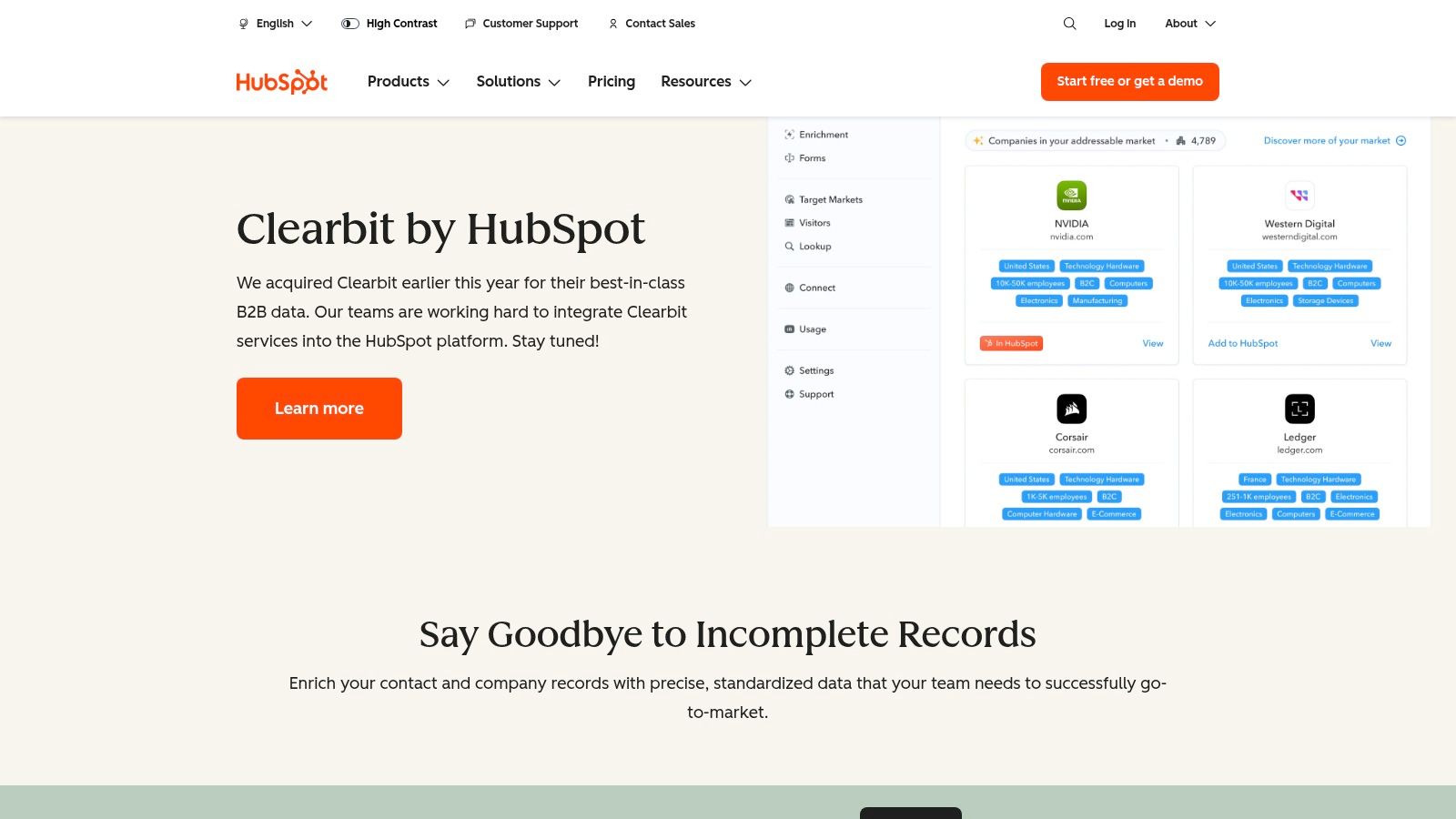
Clearbit by HubSpot is one of those choices that gets better the less you enjoy duct-taping vendors together. If your CRM is HubSpot and you want enrichment plus visitor intelligence inside the same house, the appeal is obvious.
Best for HubSpot-centric enrichment
This is a workflow decision as much as a data decision. Clearbit's strength is native fit. Records enrich inside HubSpot, routing is simpler, and reporting stays closer to the system your team already uses. For RevOps teams that value fewer moving parts, that's not a small thing.
It's especially practical for:
HubSpot shops: Native governance and cleaner admin experience.
Inbound-heavy teams: Visitor identification and segmentation inside the CRM.
Simplification projects: Reducing extra point solutions.
The main warning is simple. If you're not already committed to HubSpot, the value drops. A native feature is only “native” if you live in that platform every day.
Clearbit by HubSpot makes sense for teams that want embedded enrichment, not another separate destination reps forget to open. Product details are at Clearbit by HubSpot.
9. Cognism
Cognism is usually on the shortlist when teams need global coverage with a stronger compliance posture, especially across EMEA. It's a practical choice for companies that can't treat compliance like a footnote.
Best for compliance-conscious global prospecting
The value proposition here is less glamorous than “AI everything,” but often more important. If your team sells across regions with stricter data expectations, sourcing and compliance workflows matter. A lot. Reps may not cheer for that in Slack, but legal certainly will.
Cognism is a good fit when:
EMEA matters: Global teams often want coverage beyond a US-first database.
Compliance matters: Screening and governance features are part of the buying case.
You still need integrations: It plugs into common CRM and engagement workflows.
The trade-off is that global breadth can still vary by industry and geography, and some teams may find US depth less compelling than the biggest US-centric platforms. So this isn't automatically the “best database.” It's the best fit when compliance and regional mix shape the motion.
If your market spans the US and Europe, Cognism is one of the more sensible data-first sales intelligence tools to evaluate at Cognism.
10. SalesIntel

A rep needs a mobile number for a VP at a target account. The sequence is queued, the call block starts in 20 minutes, and nobody wants to waste the hour chasing bad records. SalesIntel earns consideration in exactly that kind of workflow.
Best for verified US contact workflows
This is a data-first tool for teams that care about contact accuracy more than flashy positioning. If your sales motion still depends on direct outreach, especially calling into US accounts, verified records matter. A lot of platforms promise scale. Fewer make their case around human-checked contact data and research support.
That focus gives SalesIntel a clear job-to-be-done in this list. It is not trying to be a behavior-driven prospecting engine like RoverLead AI, and it is not trying to be your full ABM command center. It fits teams that already know who they want to reach and need cleaner contact data to reach them reliably.
SalesIntel makes the most sense when:
US coverage drives the pipeline: Especially for SDR teams running phone-heavy outbound.
You need help filling data gaps: Research-on-demand is useful when your ICP gets narrow or account lists get messy.
You want some signal data without buying a larger platform: Enough context to prioritize, without rebuilding your stack around intent.
The trade-off is straightforward. If your motion depends on global coverage, social selling, or real-time behavior signals, this will feel narrower than newer prospecting platforms. But narrower is not always worse. For teams measured on connects, conversations, and data accuracy inside a defined US market, that narrower focus can be the point.
You can review it at SalesIntel.
Top 10 Sales Intelligence Tools, Feature Comparison
Product | Core capability | Performance & UX (★) | Pricing & value (💰) | Target audience (👥) | Unique selling point (✨) |
|---|---|---|---|---|---|
RoverLead AI 🏆 | Behavioral LinkedIn intent via Signal Agents; AI-written openers; daily contextual feed | ★★★★☆, 2–3x replies; 30–50% more meetings; ~60% less research | 💰 Founding-only locked lifetime; limited spots | 👥 B2B sales leaders, SDR/BDRs, founders, GTM marketers, agencies | ✨ Real-time LinkedIn behavior -> action-ready leads; 5‑min setup |
ZoomInfo SalesOS | Large US contact DB, direct dials, org charts, intent & WebSights | ★★★★☆, enterprise depth, rich contact coverage | 💰 Quote/enterprise; add-on fees common | 👥 Enterprise sales teams needing US depth | ✨ Best-in-class direct-dial + account depth |
Apollo.io | Contact data + multi-channel sequences, dialer, deliverability tools | ★★★☆☆, fast time-to-value for SMBs | 💰 Transparent tiers; credit overages possible | 👥 SMBs, solo sellers, small outbound teams | ✨ All-in-one affordable outbound stack with deliverability |
LinkedIn Sales Navigator | Advanced LinkedIn search, lead/account alerts, InMail, CRM sync | ★★★★☆, native social context for LinkedIn-led motions | 💰 Seat-based subscriptions; ROI depends on usage | 👥 Social sellers, account execs, teams running LinkedIn-first outreach | ✨ Direct access to LinkedIn member & company graph |
6sense Revenue AI for Sales | Predictive AI, intent, buying-group & journey-stage insights | ★★★★☆, powerful ABM prioritization; longer TTV | 💰 Quote-only, enterprise-level | 👥 Mid-market & enterprise ABM/sales+marketing teams | ✨ Predictive timing + buying-group visibility |
Demandbase One – Sales Intelligence Cloud | Account signals, intent, technographics; ABM alignment with marketing | ★★★★☆, strong ABM integrations | 💰 Quote-based; best value with Demandbase stack | 👥 ABM teams, sales+marketing aligned orgs | ✨ Deep martech & ABM workflow integration |
Bombora Company Surge | Company-level surge scores by topic from large data co-op | ★★★☆☆, standard third-party intent baseline | 💰 Quote-based; varies by delivery | 👥 ABM/ops teams prioritizing account timing | ✨ Co-op intent taxonomy & broad integrations |
Clearbit by HubSpot | Firmographic/technographic enrichment & visitor ID inside HubSpot | ★★★☆☆, seamless for HubSpot users | 💰 Priced via HubSpot plans/credits | 👥 HubSpot-centric sales & marketing teams | ✨ Native HubSpot enrichment & Reveal-style visitor intelligence |
Cognism | Global contact data with compliance tooling, mobile & direct-dial coverage | ★★★☆☆, strong compliance posture for EMEA+US | 💰 Quote-based; mid-high | 👥 Teams selling in EMEA & US needing compliance | ✨ GDPR/CCPA tooling + mobile/direct-dial focus |
SalesIntel | Human-verified US contacts, re-verification, Research-on-Demand | ★★★★☆, high reported US accuracy; good connect rates | 💰 Quote-based; competitive for verified data | 👥 US-focused teams prioritizing verified contacts & phone connect | ✨ Human verification + on-demand research services |
Final Thoughts
Monday morning. The team has three tabs open, a fresh batch of leads, and the same old problem. Reps still do not know who is worth contacting now, who just fits the ICP on paper, and who is only going to pad activity numbers without producing pipeline.
That is the core buying decision with sales intelligence tools. Pick the tool for the job you need done.
This category breaks cleanly into three buckets. Data tools help reps find the right people and keep records usable. Intent tools help teams time outreach around real buying activity. Social selling tools help sellers work conversations, relationships, and warm paths that never show up in a static list. Put all three in one evaluation spreadsheet and everything starts to look similar. In practice, they solve very different problems.
Teams that need coverage, enrichment, and list building should start with the classic data providers, including ZoomInfo, Cognism, SalesIntel, Apollo, and Clearbit. Teams running account-based motions should look harder at 6sense, Demandbase, and Bombora, because prioritization matters more than raw volume in those environments. Teams that prospect through LinkedIn need to be honest about workflow. Sales Navigator is useful for visibility, but it still leaves reps doing a lot of manual filtering, note-taking, and follow-up work.
The bigger shift is simple. Static databases tell you who matches your market. Behavior-based platforms tell you who is showing signs of interest right now.
That difference changes rep behavior. A database-first workflow usually produces bigger lists, more low-context outreach, and a lot of activity that looks busy in Salesforce. A behavior-first workflow narrows the field and gives the rep a reason to reach out today. For many teams, that is the difference between prospecting that gets tolerated and prospecting that consistently creates meetings.
There is no universal winner here. A high-volume outbound team with strong ops support may get more value from data depth and routing controls. A strategic AE team selling into named accounts may care more about timing signals and buying-group visibility. Founder-led sales teams and relationship-driven reps often need social context first, then contact data second.
My recommendation is blunt. Do not buy the platform with the longest feature checklist. Buy the one that fits your sales motion, your rep workflow, and your tolerance for operational overhead. If reps have to leave their normal flow of work to make the tool useful, adoption drops fast. If the tool gives them a clear next step, they keep using it.
Good sales intelligence does not give the team more names. It cuts bad bets.
If your team lives on LinkedIn and wants intent signals tied to actual engagement, RoverLead AI deserves a close look. It turns buyer activity into contextual leads matched to your ICP, which cuts list-pulling time and gives reps a better reason to start the conversation.