B2B Lead Generation Funnel: A Modern Playbook for 2026
Your team is working hard. The dashboards look active. SDRs are sending messages, marketing is generating form fills, and LinkedIn posts get a respectable trickle of likes.
Yet the calendar stays weirdly empty.
That's the usual sign that your B2B lead generation funnel isn't broken at the top. It's leaking in the middle. You're creating activity, not movement. And those are not the same thing.
Most funnels still treat lead gen like a sorting exercise. Capture names. score downloads. hand off “engaged” leads. hope sales can force the rest. That worked better when buyers tolerated interruption and static list-based outreach. Now it's a slower, noisier game. One reason is simple: the majority of visitors to your site are not ready to buy, and a widely cited industry roundup notes that 96% of website visitors aren't ready to buy on their first visit, while 80% of new leads never translate into sales according to Sopro's lead generation statistics roundup.
A modern funnel has to do more than collect attention. It has to detect intent, nurture timing, and tell sales who is moving.
Here's a useful overview before we get tactical:
Table of Contents
Your Funnel Is Leaking and Everyone Knows It
Sales leaders usually notice the leak long before anyone says it out loud. Reps are busy, reply quality is poor, “qualified” leads don't convert, and pipeline reviews start sounding like group therapy with screenshots.
The problem usually isn't effort. It's that the funnel rewards the wrong behavior. Teams celebrate top-of-funnel motion because it's easy to count. More leads. more clicks. more downloads. Meanwhile, the people who are important are sending quieter signals, and nobody is watching closely enough.
Most funnel problems aren't top-of-funnel volume problems. They're prioritization problems dressed up as volume problems.
That's why a useful B2B lead generation funnel isn't passive. It's an active hunting ground. You don't just map stages and wait. You identify who is moving between stages, what they're reacting to, and whether their behavior suggests real buying momentum.
A healthy funnel does three things well:
Separates curiosity from intent so sales doesn't chase every hand raise.
Maintains context across touches so a prospect doesn't feel like they're restarting the conversation each time.
Creates timing advantages by telling reps when interest becomes commercially relevant.
If your team still treats every MQL like a gift from heaven, expect disappointment. Some leads are just bored. Some are researching. Some are students. Some are competitors. And some are buyers. The job is to know the difference early.
Deconstructing the Modern B2B Lead Funnel
A modern B2B lead generation funnel isn't a neat triangle on a slide. It's closer to a sequence of gates in a business relationship. Buyers don't move in perfect order, and they rarely announce their intentions politely.
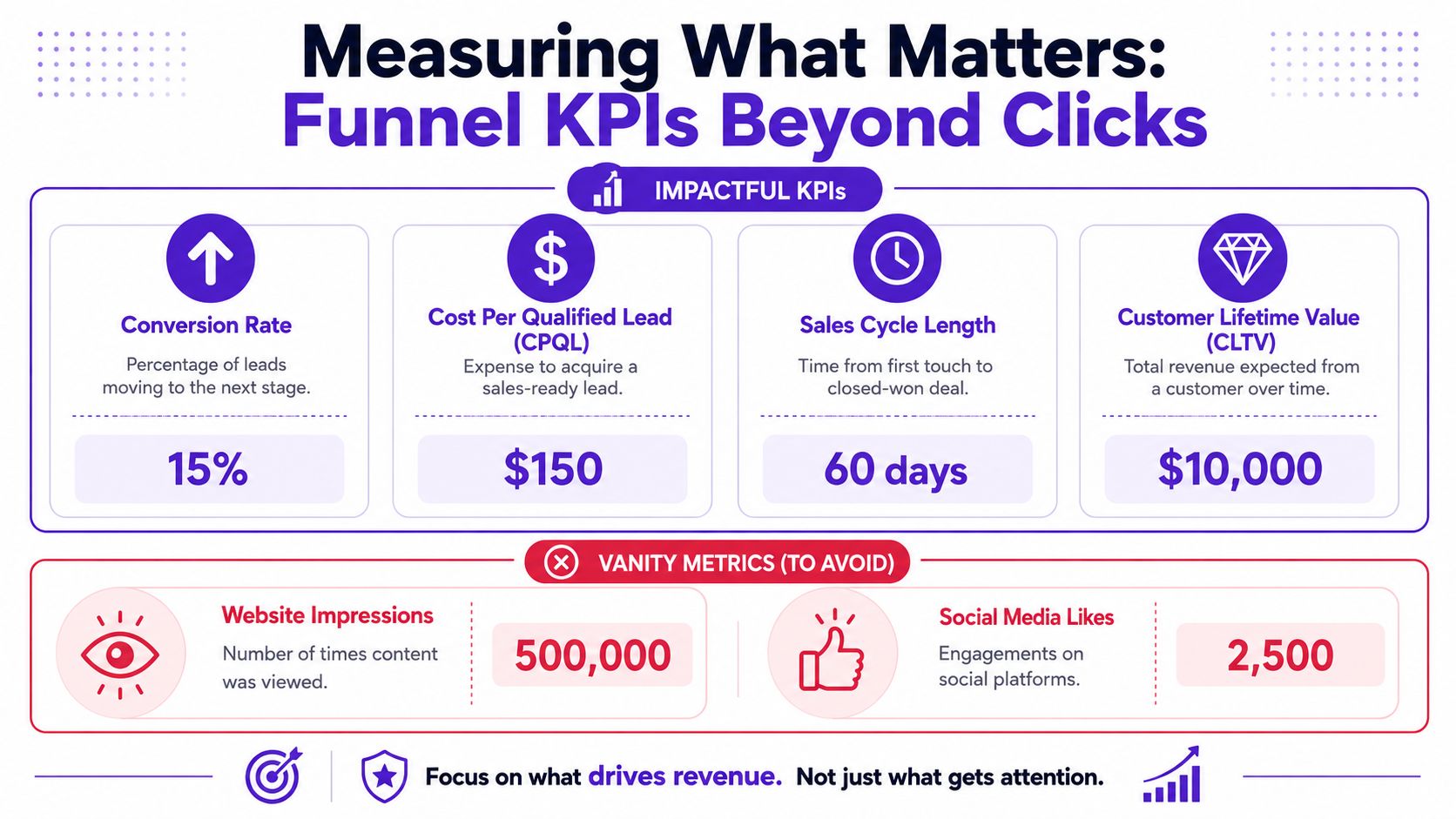
If you want a broader view of how awareness turns into pipeline, this explanation of B2B demand generation is worth pairing with the funnel model.
The funnel is a set of gates, not a slide
Awareness is when the buyer notices a problem, or notices your take on it. They may not know your company yet. They may not even know they'll buy this quarter. At this stage, educational content, category commentary, and smart distribution matter more than hard selling.
Interest begins when they choose to spend more time. They read another post, watch a webinar, visit your site, or follow your team on LinkedIn. This is still soft. It means “tell me more,” not “send pricing.”
Consideration is where things get serious. The buyer starts comparing approaches, gathering proof, and evaluating fit. Generic nurture often fails here because the buyer's questions become specific. Industry fit. onboarding. integrations. risk. proof.
Intent is the stage many teams miss because they confuse it with engagement. Intent looks like pricing conversations, vendor comparison behavior, repeat visits to bottom-funnel pages, or visible interaction with competitor and niche content. Sales should lean in here.
Conversion is the formal hand raise. Demo booked. meeting requested. contact sales. The trap here is assuming conversion starts the selling process. In reality, the sale began much earlier when intent became visible.
Why retention belongs in the funnel
Too many teams stop thinking once the deal closes. That's shortsighted.
Retention matters because customers create the strongest downstream funnel inputs. They refer peers, expand usage, validate your claims, and give sales the language that resonates in the market. A funnel that ignores retention also ignores the source of its best proof.
Practical rule: If a stage doesn't change what sales or marketing does next, it's not a useful stage. It's just decorative funnel theater.
The best practitioners keep the model simple enough to act on. Awareness, Interest, Consideration, Intent, Conversion, Retention. Six stages. Clear buyer mindset. Clear next move. No corporate origami.
Winning Plays for Every Funnel Stage
The old playbook still hangs around because it feels efficient. Pull a list. filter by job title. send a sequence. repeat until morale improves. It's tidy, measurable, and often painfully irrelevant.
That's why LinkedIn now sits at the center of many modern funnels. A 2026 industry roundup reports that 80% of all B2B leads generated through social media come from LinkedIn, and 94% of B2B marketers use the platform for lead generation efforts, according to Reach Marketing's B2B lead generation statistics and trends.
Old funnel behavior versus modern funnel behavior
Funnel Stage | The Old Way (Static & Cold) | The New Way (Dynamic & Warm) |
|---|---|---|
Awareness | Buy lists and blast generic intros | Publish useful expertise and engage where buyers already pay attention |
Interest | Gate basic content and call every downloader | Watch who returns, comments, follows, and engages with relevant topics |
Consideration | Push canned nurture sequences | Tailor outreach to the pain points and proof the buyer is already exploring |
Intent | Wait for a form fill | Track signals like pricing discussion, competitor engagement, and repeated bottom-funnel behavior |
Conversion | Treat meetings as the finish line | Carry context into the call so the buyer doesn't have to re-explain their problem |
Retention | Hand account off and move on | Feed customer language, objections, and use cases back into targeting and messaging |
What to do at each stage
At Awareness, stop trying to sound polished and start trying to sound useful. Strong LinkedIn content, founder commentary, webinar clips, and direct interaction with niche creators tend to outperform bland “thought leadership” that says nothing and offends no one.
At Interest, don't assume every click means buying interest. A prospect who engages with a problem-specific discussion several times is often more valuable than someone who grabbed a generic ebook once.
At Consideration, sales should stop operating blind. At this point, behavioral context matters. If someone is engaging around integration concerns or change-management topics, your outreach should reflect that. Not your quarterly campaign theme.
For Intent, teams need a qualification framework grounded in behavior. Resources on how to qualify sales leads prove useful, as qualification gets sharper when the rep understands both account fit and live intent signals.
One option in this category is RoverLead AI, which monitors LinkedIn engagement signals tied to your ICP, competitors, keywords, and relevant creators so reps can prioritize conversations based on live behavior rather than static lists.
Use these practical plays:
For awareness and interest: Comment where your market already gathers. Don't just post and vanish.
For consideration: Build outreach around observed questions, not guessed pain points.
For intent: Prioritize people showing specific commercial behavior, especially repeated engagement around pricing, alternatives, or implementation.
For conversion: Bring a point of view to the meeting. Buyers don't need another calendar invite with no context.
If your funnel depends on strangers caring about your sequence before you've shown relevance, that isn't a funnel. It's wishful automation.
Measuring What Matters Funnel KPIs Beyond Clicks
Monday pipeline review. Marketing brings a slide full of impressions, CTR, and webinar signups. Sales asks a rude but fair question: which accounts are moving?
That question should run the dashboard.
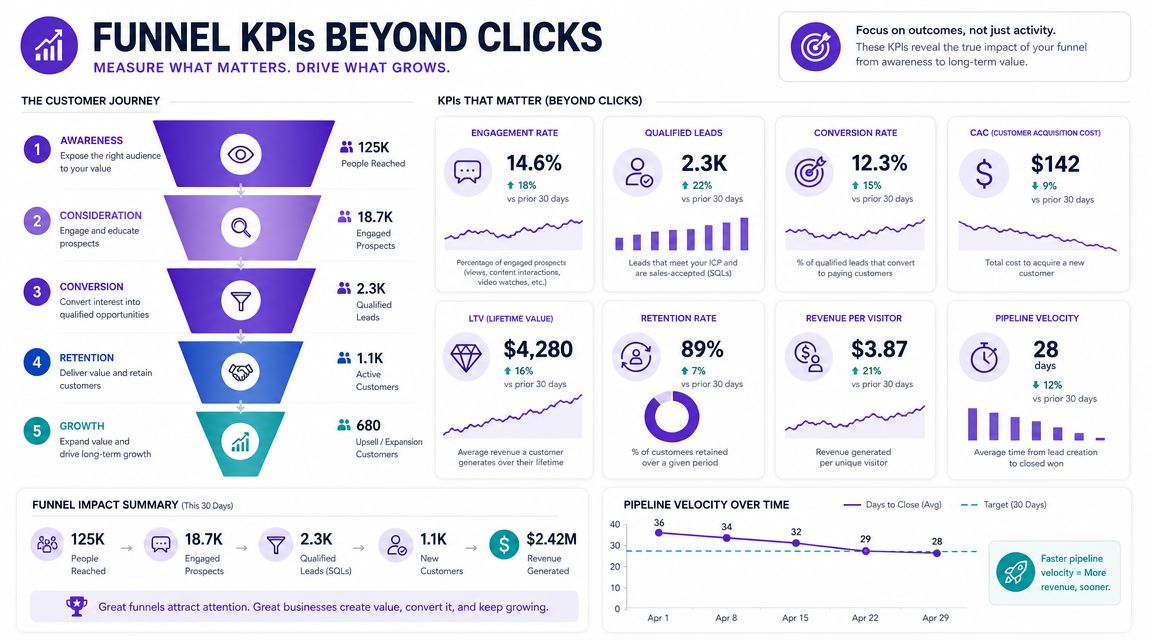
A B2B funnel is not a museum exhibit. It is a hunting ground. The point is not to admire stage counts. The point is to spot movement early, especially the movement buyers show before they ever fill out a form. That is why clicks sit low on the list. They show activity. They rarely show buying motion.
The numbers that deserve attention
Track KPIs that help the team choose who to contact, what to say, and which accounts deserve real effort.
Lead-to-opportunity rate: This shows whether top-of-funnel activity turns into pipeline someone would defend in forecast.
Stage velocity: Slow progression usually points to weak routing, muddy messaging, or reps chasing people with curiosity instead of intent.
SQL-to-deal rate: A clean read on whether qualification is producing sales conversations with teeth.
Close-won rate: Useful for spotting disconnects between what got scored highly and what buyers purchase.
Sales cycle length: Long cycles are not always bad. Enterprise deals take time. But if the wrong accounts clog the middle, cycle length gets bloated for reasons your team can fix.
Those are outcome metrics. Pair them with signal metrics.
For example, track how often an account shows repeat high-intent behavior across the same topic cluster. Pricing page revisits, competitor comparisons, implementation content, and sustained LinkedIn engagement from multiple stakeholders deserve more attention than a single ebook download from a student account. If your ideal customer profile in business is loose, even good KPI reporting turns into guesswork.
Where predictive scoring helps
Predictive scoring earns its keep when it sharpens rep judgment. If it becomes a mysterious number nobody can explain, it will get ignored by the third forecast call.
DemandZEN argues in its guide to scalable B2B lead generation funnels that predictive lead scoring can improve lead-to-sale conversion rates by up to 30%. Fair enough. The underlying value is simpler. Good scoring helps teams stop treating every hand-raiser like the same opportunity.
Use scoring inputs that map to buying motion:
Fit signals: Industry, company size, role, and use case match
Behavioral signals: Repeat visits, event attendance, response quality, and topic-specific engagement
Commercial signals: Pricing research, competitor evaluation, procurement questions, and buying committee activity
Network signals: Who at the account is active on LinkedIn, what they engage with, and whether that engagement is spreading across the team
That last category gets missed all the time. Modern funnels leak because teams measure the form fill and miss the trail. Buyers often reveal stage progression in public before they reveal it to your CRM.
The right KPI changes who gets a call this week, which account gets another pass, and what message a rep leads with.
If a metric cannot improve prioritization, resourcing, or messaging, it belongs in a reporting deck. Not in the operating system for your funnel.
Why Your B2B Funnel Is Quietly Failing
The dangerous funnels aren't the ones that collapse visibly. They're the ones that keep producing just enough activity to avoid scrutiny.
The leaky middle is usually self-inflicted
Many teams still score passive engagement as if it were demand. Someone downloaded a checklist. someone clicked a webinar reminder. someone liked a post about “AI trends.” Fine. That's attention. It is not intent.
This is one reason the middle of the funnel stalls. As noted in Markletic's analysis of why B2B lead gen funnels stall at the middle, funnels often break because teams score passive engagement instead of verified intent signals, and the fix is to measure handoff quality and intent strength rather than just MQL volume.
The second leak is targeting. If your team still hasn't tightened its ideal customer profile, every downstream metric gets noisier. You can't rescue a bad-fit lead with clever copy and a follow-up task.
What to fix first
Start with these:
Redefine lead quality: Sales and marketing need one shared definition of what deserves human follow-up.
Disqualify faster: Not every engaged contact belongs in the funnel. Some should be routed to nurture, some should be removed.
Improve handoff context: Sales should know what the prospect engaged with, why they were flagged, and what changed.
Audit middle-funnel content: If every asset sounds like top-of-funnel education, buyers in active evaluation won't find what they need.
Stop worshipping MQL volume: More names with weaker intent just means more expensive confusion.
Quiet failure is still failure. The funnel doesn't care how busy your team feels.
Your B2B Funnel Questions Answered
Below are the questions sales leaders usually ask once they stop pretending more volume will fix everything.
Question | Answer |
|---|---|
What is a B2B lead generation funnel? | It's the system that moves a business buyer from first awareness to sales conversation and, ideally, into customer expansion. The useful version tracks movement and intent, not just lead capture. |
How is a B2B funnel different from a B2C funnel? | B2B deals usually involve more stakeholders, more scrutiny, more proof, and longer consideration. Buyers need context and confidence, not impulse triggers. |
What should a small team focus on first? | Tighten ICP, define qualification rules, and choose one or two channels you can run well. A messy multichannel motion is still messy. |
Is LinkedIn really that important? | For many B2B teams, yes. It's where buyers, sellers, creators, and competitors all leave visible signals. That makes it useful not just for reach, but for timing. |
What content works best at the top of the funnel? | Useful, opinionated content tied to real buyer problems. Educational posts, webinar clips, practical breakdowns, and direct commentary usually outperform vague brand content. |
What matters most in the middle of the funnel? | Signal quality. Repeated engagement with relevant topics, proof-seeking behavior, and commercial curiosity matter more than light content consumption. |
Should marketing own the funnel or sales? | Neither should own it alone. Marketing shapes demand and captures signals. Sales validates intent and converts it. Shared definitions matter more than departmental borders. |
How much automation is too much? | The moment automation strips away relevance. Automate routing, scoring, reminders, and data capture. Don't automate generic outreach and call it personalization. |
How long before a new funnel setup shows results? | You'll see operational signals before revenue signals. Better targeting, clearer handoffs, and stronger conversations appear first. Closed deals take longer because B2B buying takes time. |
What should I review every month? | Lead-to-opportunity movement, stage velocity, disqualification reasons, SQL quality, message relevance, and which touches consistently appear before conversion. |
A solid B2B lead generation funnel doesn't need to be flashy. It needs to be honest. Honest about who fits, who doesn't, and who is progressing.
If your team wants a cleaner way to find in-market buyers on LinkedIn, RoverLead AI helps turn visible engagement into prioritized prospecting signals so reps can focus on conversations with context instead of cold list guessing.