What Does ICP Stand for in Business? a Practical Guide
ICP stands for Ideal Customer Profile. In business, it means a detailed description of the company most likely to buy, stay a customer, and expand over time, not the individual person inside that company.
When the question of what ICP stands for in business comes up, you're probably already feeling the pain of not having one. Your team is working hard, sending messages, pulling lists, tweaking subject lines, and somehow still ending the week with more activity than meetings. That's not a hustle problem. It's a targeting problem.
A bad list makes good reps look average. A sharp ICP makes average outreach look smart. That's the difference.
Table of Contents
The Real Reason Your Sales Outreach Is Falling Flat
Monday, your SDR pulls a list. Tuesday, they send connection requests. Wednesday, they test a new opener. Thursday, they ask marketing for better copy. Friday, the calendar still looks like a ghost town.
I've seen this movie too many times.
The team blames the channel, the script, the market, the algorithm, Mercury in retrograde, whatever's handy. But the issue is simpler. They're prospecting anyone who looks vaguely plausible instead of companies that are a true fit.
Activity isn't the same as traction
You can send polished outreach to the wrong accounts all day and get nowhere. In fact, that happens constantly. Reps grab broad titles, broad industries, broad geographies, then wonder why nobody replies with urgency.
A lot of teams try to patch this with better messaging. Sure, messaging matters. A solid cold email template for outbound prospecting helps. But no template can rescue a message sent to the wrong company.
Busy reps don't always create pipeline. Focused reps do.
What actually changes results
When a team knows exactly which companies deserve attention, everything gets easier. Lists get smaller. Messages get sharper. Qualification gets faster. Reps stop wasting half the day chasing accounts that were never going to buy in the first place.
That's what an ICP does. It gives sales a filter, not a slogan.
So What Is an Ideal Customer Profile Anyway
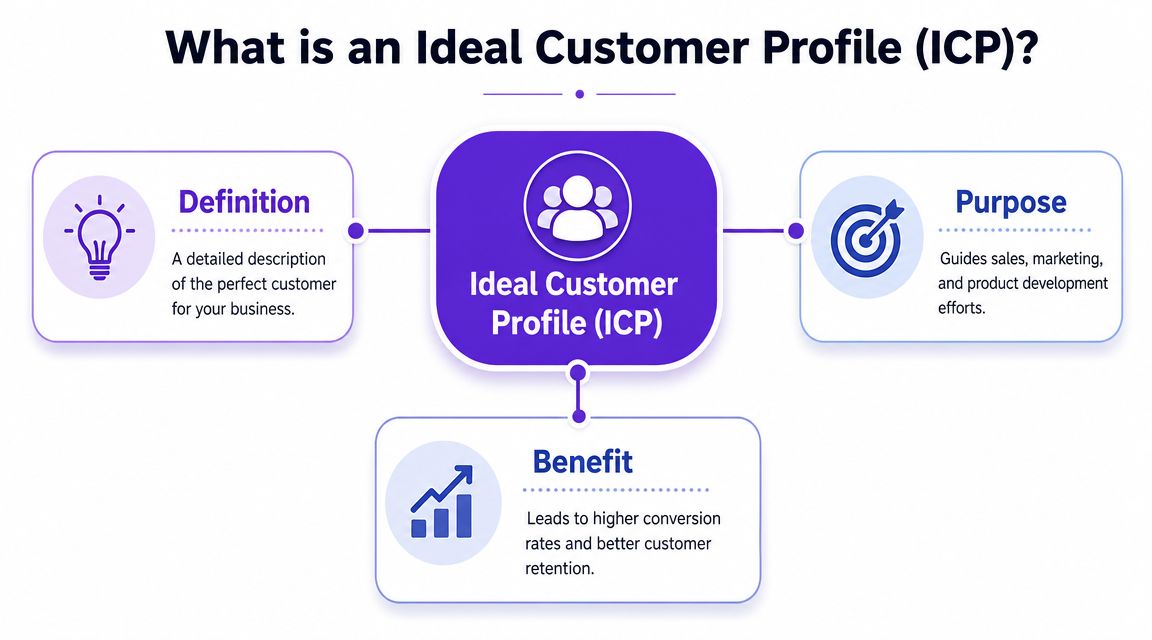
An Ideal Customer Profile, or ICP, is the definition of the company you're best positioned to sell to. Not the company you'd like to brag about landing. The company that is the best fit.
An ICP describes the kind of business most likely to buy, stay, and expand with you.
That's the part people leave out. A real ICP isn't just about who can sign a contract. It's about who becomes a good customer after the contract is signed.
What belongs in an ICP
According to Gong's explanation of ICP in sales, an ICP is used to define the type of company most likely to buy, stay a customer, and expand over time. In B2B sales, teams build ICPs from signals like company size, industry, revenue, geography, and behavior, and many use their top 20% of customers by revenue, retention, and expansion as the starting point.
That's practical advice, not theory.
An ICP should answer questions like these:
Company fit: What kind of business gets obvious value from your offer?
Operational fit: Do they have the structure, urgency, and budget reality to buy?
Growth fit: Are they likely to stick around and grow with you?
What an ICP is not
Here, teams get sloppy.
An ICP is not a job title. It's not "VP of Sales at a SaaS company." That's a person. Helpful, yes. But still a person.
An ICP is the account-level profile. It tells you which building to walk into. The buyer persona tells you which office door to knock on.
ICP vs Buyer Persona The Ultimate Showdown
Sales and marketing teams mix these up all the time, and then they wonder why targeting gets messy.
Here's the clean version. The ICP is the company. The buyer persona is the individual inside that company. If you want a sticky analogy, the ICP is the car, the persona is the driver.
ICP vs Buyer Persona What's the Difference?
Criterion | Ideal Customer Profile (ICP) | Buyer Persona |
|---|---|---|
Focus | The company you should target | The person you should speak to |
Scope | Account-level | Contact-level |
Core question | "Which businesses fit us?" | "Who inside that business cares?" |
Typical inputs | Industry, company size, revenue, geography, behavior | Role, goals, objections, priorities, buying style |
Main sales use | Account selection and prioritization | Messaging and conversation strategy |
Main mistake | Making it too broad | Making it too fictional |
Why you need both
If you only use personas, reps can find the right title at the wrong company. That's a waste of effort dressed up as personalization.
If you only use ICPs, reps can identify the right account and still message the wrong person with the wrong angle.
The ICP gets you into the right market. The persona helps you sound relevant once you're there.
Good sales teams use both. They choose the right accounts first, then tailor the outreach to the people who influence the deal.
The Anatomy of a Killer ICP
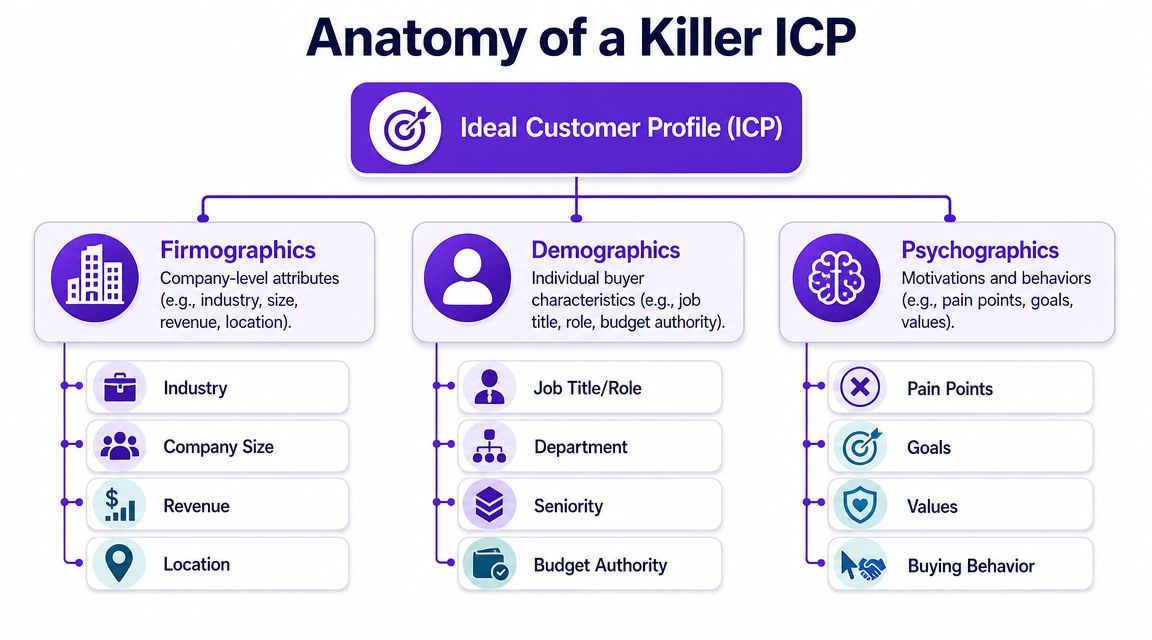
A useful ICP isn't a flat spreadsheet with three filters and a prayer. It's layered. You need enough detail to spot fit fast, and enough nuance to avoid junk leads that look good on paper.
Firmographics give you the outer frame
This is the obvious stuff. Industry. Company size. Revenue band. Geography.
You need it, but don't stop there. Firmographics are the cover of the book, not the story.
A company can match your size and industry filters and still be a terrible fit because the timing is wrong, the process is wrong, or the pain isn't real.
Technographics expose fit faster
Technographics tell you what tools and systems a company already uses. That matters because existing software often reveals buying readiness.
A company using a patchwork of tools may need consolidation. A company using a competitor may have replacement potential. A company with no relevant stack at all might need more education than your sales cycle can tolerate.
At this point, reps get more precise. You're no longer saying, "They look like our kind of account." You're saying, "Their setup suggests they'll understand the problem quickly."
Behavioral signals are where modern prospecting gets interesting
This is the layer many teams overlook, and it's the one that makes an ICP genuinely useful in day-to-day outbound.
Watch for signs like:
Hiring activity: Open roles can hint at growth, process change, or a new priority.
Content behavior: If people at the company engage with relevant industry topics, that's signal.
Market movement: Funding, expansion, leadership changes, and new initiatives often create urgency.
A static ICP tells you who fits. A dynamic ICP tells you when to reach out.
That's the practical leap businesses need to make. Your ICP shouldn't sit in a deck. It should shape who you target and when you target them.
How to Build Your ICP in 5 Simple Steps
Organizations often overcomplicate this. They hold workshops, make giant slides, debate wording, then produce a document nobody uses. Don't do that. Build an ICP from customer truth, not committee theater.
Start with the asset below if you want a visual before you roll up your sleeves.
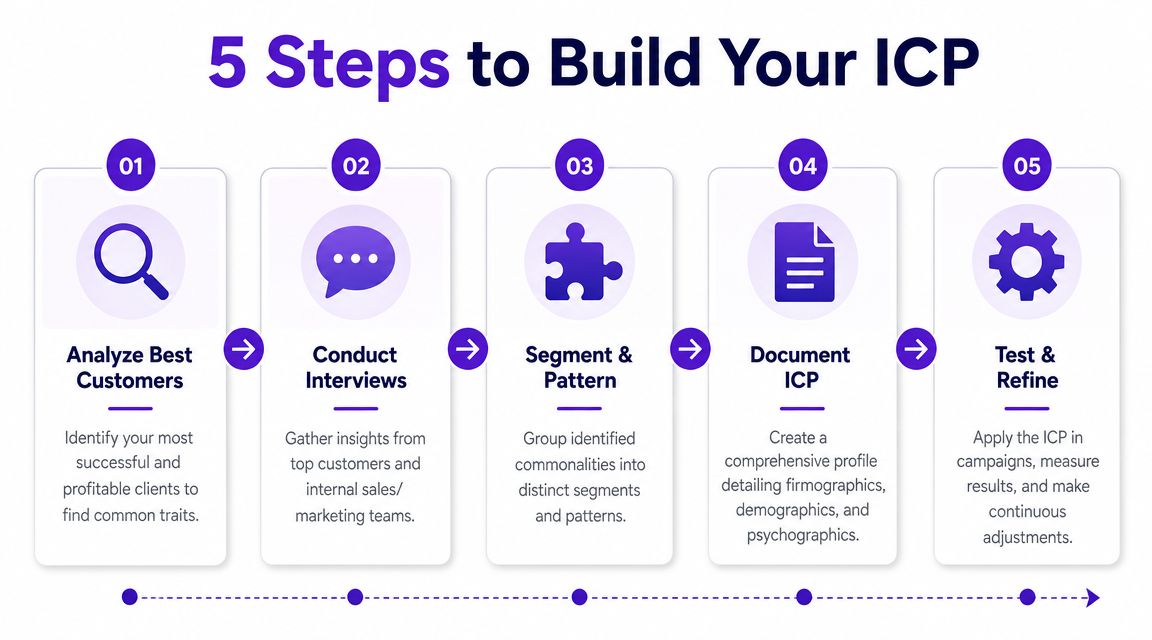
Step 1 and Step 2
Audit your best customers
Don't start from assumptions. Start from accounts that already prove the model works. Pull the customers who buy, stay, and expand. That's your clue set.Talk to the people closest to the truth
Interview customers. Talk to sales. Talk to customer success. Ask why deals closed, why they stalled, and why some accounts became strong long-term customers while others didn't.
A tighter process for qualifying sales leads the right way helps here, because qualification criteria often expose the difference between surface-level fit and real fit.
Step 3 and Step 4
Find the patterns that repeat
Look for overlap in business model, urgency, buying trigger, operational maturity, and post-sale success. If your best customers share traits, that's not coincidence. That's the blueprint.Write the ICP like a working document
Keep it simple enough that reps will use it. Include:Firmographic basics: Industry, size, geography, revenue reality
Environmental clues: Team structure, tech stack, buying motion
Behavioral indicators: The signals that suggest active need
Before you finalize anything, this walkthrough is worth a watch:
Step 5
Treat it like a living profile, not a stone tablet
A common pitfall is that teams build an ICP once and then worship it forever.
According to Apollo's take on ICP meaning in sales, a stronger ICP is a living profile built from real customer outcomes, including retention and expansion, not just acquisition. That same view argues your ICP should reflect both net-new fit and expansion fit, while win/loss analysis helps you define who becomes a high-value customer.
Practical rule: If your ICP only describes who can buy, it's unfinished. It should also describe who succeeds after buying.
Common ICP Pitfalls That Sabotage Your Sales
Bad ICP work doesn't fail loudly. It fails with full calendars, weak pipeline, and reps insisting they're "working a lot."

The Ocean Strategy
This is the classic mistake. "We can sell to any B2B company." No, you can't. That's not a market. That's laziness wearing optimism.
When the ICP is too broad, reps chase volume instead of fit. Messaging gets generic because it has to. Nobody sounds sharp when they're trying to talk to everyone.
The Stone Tablet
Some teams do define an ICP, then never touch it again. New market conditions show up. Product direction changes. Customer behavior shifts. The document stays frozen.
That's how outdated targeting survives for months while leadership keeps asking why pipeline quality slipped.
The Aspirational Mirage
This one is sneaky. The team builds an ICP around logos they wish they had, not customers who buy and succeed.
The fix is brutally simple:
Use evidence, not ego: Build from real customers, not fantasy accounts.
Tighten the filter: If too many accounts qualify, the profile is too loose.
Review it regularly: Sales reality changes. Your ICP should keep up.
Putting Your ICP to Work on LinkedIn
At this point, strategy stops being pretty and starts being useful.
A strong ICP should shape how you search, who you save, what you monitor, and when you reach out on LinkedIn. If all you do is plug in company size and industry inside Sales Navigator, you're still working with a half-built machine.
Start with fit, then layer timing
First, use your ICP to narrow the field. That means filtering for the kinds of companies that match your account criteria.
Then add timing. That's the missing piece.
A company might match your ICP perfectly and still be a bad prospect today. Another might match your ICP and be showing clear signs of active interest right now through leadership posts, team changes, public conversations, or engagement around a problem your product solves.
What reps should actually look for
Use your ICP as the base, then watch for intent clues such as:
Relevant posting behavior: Leaders discussing a challenge tied to your category
Engagement patterns: Employees interacting with competitor or niche content
Operational signals: Hiring, expansion, restructuring, or new initiatives
Those signals make outreach feel less like interruption and more like timing.
If your reps struggle with the first message after spotting those signals, sharpen that part of the workflow too. Strong LinkedIn conversation starters for sales outreach matter because timing without relevance still falls flat.
The best LinkedIn prospecting doesn't begin with a list. It begins with fit plus intent.
Frequently Asked Questions About ICPs
1. Can a company have more than one ICP
Yes. Many companies serve more than one distinct type of account. If the sales motion, pain points, or expansion potential differ meaningfully, separate them.
2. How often should you update an ICP
Update it whenever customer reality changes enough to affect targeting. If wins shift, retention changes, or the product moves upmarket or downmarket, revisit it.
3. Is an ICP only for sales teams
No. Sales, marketing, customer success, and product all benefit from the same definition of a best-fit account.
4. What's the difference between an ICP and a target market
A target market is broader. An ICP is the tighter slice inside that market that deserves focused effort.
5. What's the difference between an ICP and TAM
TAM is your total addressable market. Your ICP is the portion of that market you should care about most right now.
6. Can startups build an ICP without much customer data
Yes. Start with founder-led sales conversations, early wins, and pattern spotting. It won't be perfect, but it beats guessing blindly.
7. Should an ICP include negative fit
Absolutely. A negative ICP helps reps rule out bad-fit accounts quickly. That's often just as valuable as identifying good-fit ones.
8. Who should own the ICP internally
Sales usually feels the pain first, but ownership should be shared. Revenue teams break things when marketing, sales, and success all work from different definitions.
9. Should behavior be part of an ICP
Yes. Firmographics alone are too static. Behavioral cues help teams spot when a good-fit account is in motion.
10. What's the simplest test for whether your ICP is useful
Give it to a rep and see if they can use it to say both "yes" and "no" quickly. If everyone still qualifies, the ICP isn't sharp enough.
RoverLead AI helps B2B teams turn a static ICP into live prospecting. Instead of relying on cold list pulls alone, it tracks LinkedIn engagement and buying signals to surface high-intent accounts that match your ICP, complete with context for outreach. If you want fewer random leads and more timely conversations, take a look at RoverLead AI.