The Perfect Email Introduction Response: A Witty Guide
That familiar subject line lands in your inbox. “Intro: Alex meet Jordan.” You open it and feel two things at once: mild annoyance and a flicker of opportunity. That reaction is normal.
Often, the email introduction response gets botched right here. They fire back “Thanks for the intro!” add a vague “happy to connect,” and then wonder why nothing happens. The intro dies in a thread graveyard with every other polite, useless email.
That's sloppy. A warm introduction is one of the few moments in modern outreach where attention is already pre-sold. One industry benchmark notes average cold-email reply rates are around 3.43%, with many campaigns struggling to break 1%. In plain English, random outbound is getting crushed. Introductions still cut through.
Table of Contents
That Awkward Intro Email Just Hit Your Inbox Now What
The bad version goes like this. Your former colleague introduces you to someone “you two should know each other.” You reply late, write nothing useful, and force the other person to do all the work. Nobody wants to be the adult in a thread where everyone is pretending momentum exists.
The better move is to treat the intro like a live deal. Not a huge deal, not a wedding toast, but a real chance to move something forward while trust is still warm. The introducer has lent you credibility. Don't waste it with a social shrug.

Why this moment matters
A warm intro is valuable because it skips the hardest part of outreach: getting noticed without looking like a pest. That's why smart sellers obsess over relevance and timing, not just volume. If you need help finding cleaner openers for business conversations, this roundup of conversation starters for sales outreach is worth a look.
A warm intro isn't permission to ramble. It's permission to be relevant faster.
What most people get wrong
They confuse politeness with effectiveness.
You should be polite. You should also be clear, brief, and useful. The intro email itself is not the finish line. It's the handoff. If your reply doesn't make the next step obvious, you've turned a warm lead into admin work.
The Three-Question Triage Before You Reply
Don't type yet. Read the thread and make a decision first. A strong email introduction response starts with triage, not enthusiasm.
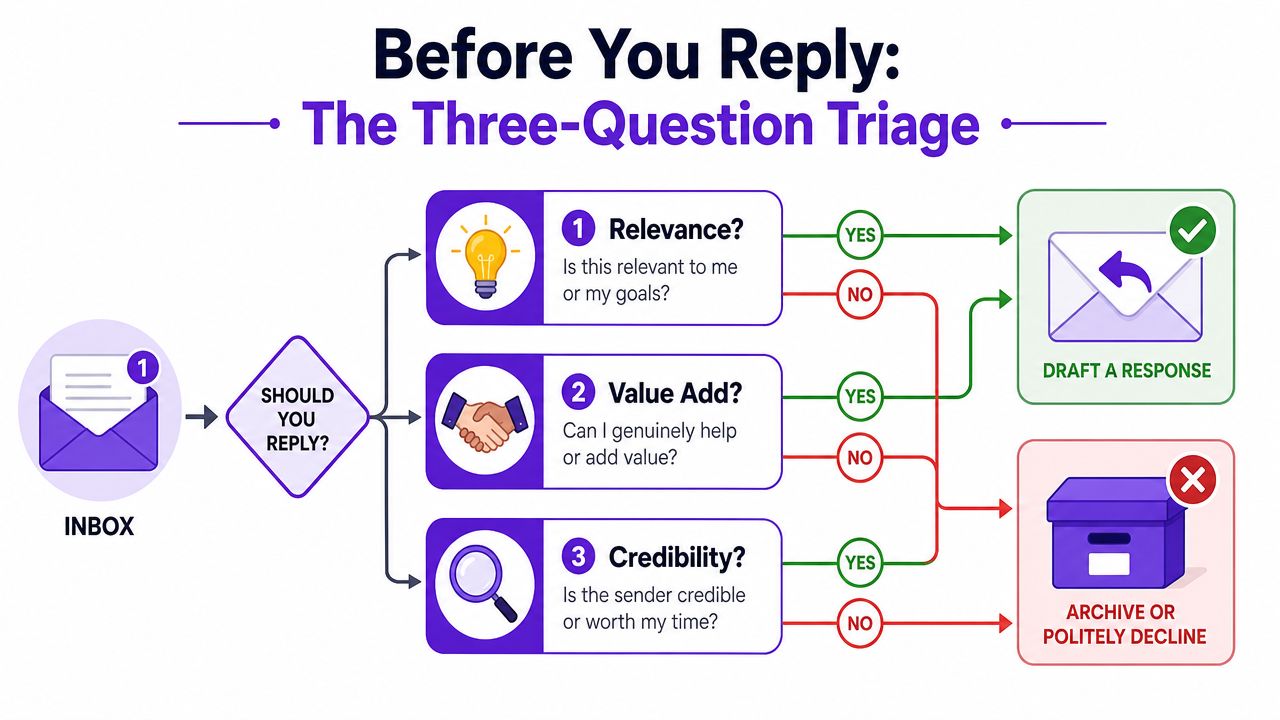
Question one: Is this relevant right now
Not “could this someday maybe matter.” Right now.
If the intro matches your role, priorities, pipeline, hiring needs, partnerships, or current problem set, reply. If it's random, forced, or obviously off-base, don't reward bad routing with fake interest. One etiquette guide explicitly notes that some sales-pitch introductions won't be a good fit and that the recipient should decide how important the introduction is before responding, as discussed in this email introduction etiquette guide.
Question two: What do I owe the introducer
Not all intros are equal. If a trusted customer, investor, close peer, or key partner made the intro, your response should reflect that relationship.
That doesn't mean you owe everyone a meeting. It means you owe the introducer professionalism. If it's a bad fit, decline cleanly and, when appropriate, redirect them to a better contact.
Question three: What outcome do I want
There are only a few sensible answers:
Take a meeting
Ask one clarifying question
Redirect to someone else
Decline gracefully
Anything fuzzier than that produces the classic useless reply: friendly tone, zero progress.
Practical rule: decide the outcome before you write the first sentence.
Speed matters more than people admit
Momentum fades fast in intro threads. Stanford's guidance says you should aim to reply within 2 hours during business hours, ideally within 20 minutes. That's not about theatrics. It shows respect, keeps the introducer from looking silly, and prevents the thread from becoming yesterday's news.
Use double opt-in when you're making or extending intros
If you're the person carrying the thread forward, use a double opt-in mindset. Confirm interest with both sides separately when needed. Don't shove two people into a forced conversation and call it networking. Adults hate surprise homework.
Nailing the Subject Line and First Sentence
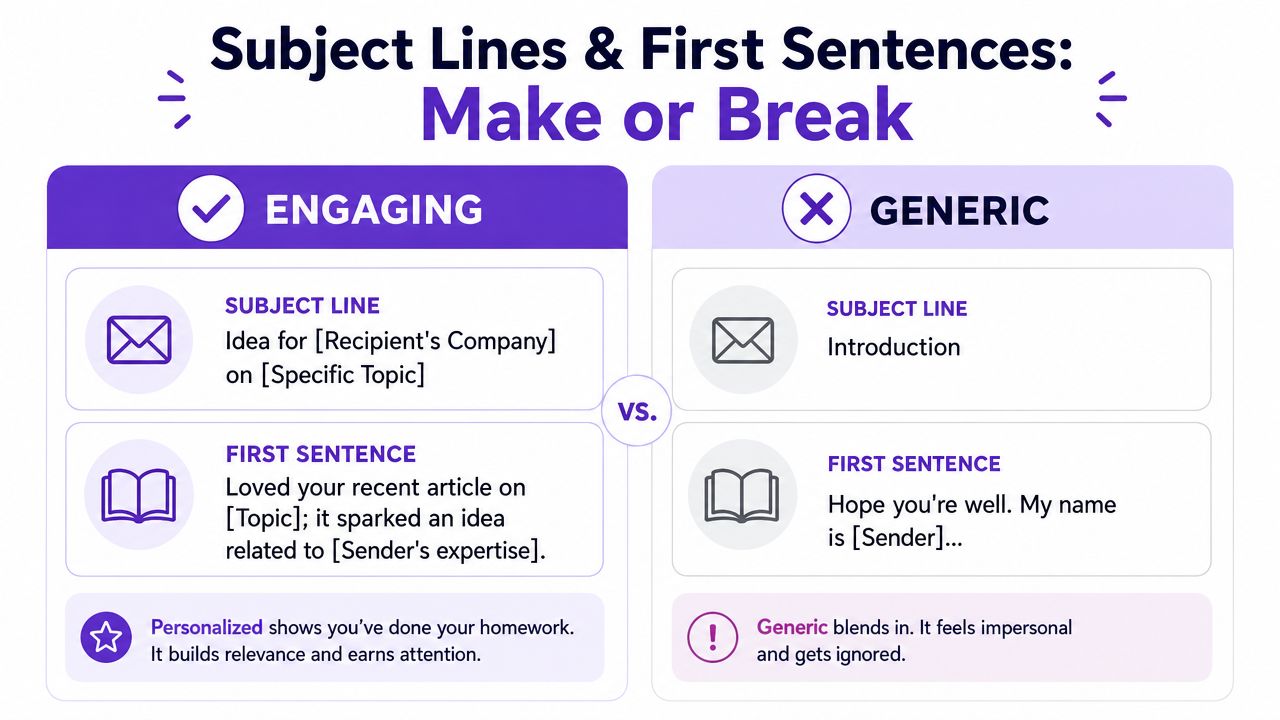
Your subject line and first sentence do almost all the emotional work. They tell the recipient whether this thread is headed toward a useful conversation or another swamp of empty pleasantries.
Good, better, best subject lines
Good
Re: Intro from Sam
Clear. Not exciting, but serviceable.
Better
Re: Sam's intro, Alex <> Jordan
Now everyone knows what thread they're in and who matters.
Best
Re: Jordan + Alex, customer onboarding question
This adds context without turning the subject line into a suitcase that won't close.
One useful Stanford rule: put the more important person's name first in the subject line, as covered in the earlier Stanford guidance.
A quick visual breakdown helps:
The first sentence should match your intent
There's a real split in advice here. Etiquette-first replies open with gratitude. Sales-minded replies often lead with relevance. One analysis makes that point directly in its discussion of opening lines for introduction emails.
Here's my take.
If the intro is relationship-driven, lead with thanks. If the intro is commercial and time-sensitive, lead with relevance.
Examples:
Gratitude-first: Thanks, Sam. Jordan, glad to connect.
Recipient-first: Jordan, saw your team is rolling out a new partner program. Good timing on this intro.
Both can work. The wrong one sounds tone-deaf.
Don't write a first sentence that says nothing
Skip these:
Hope you're well
My name is
Just wanted to reach out
Happy to connect
Those phrases are the beige wallpaper of business email. Nobody remembers them because they signal nothing.
The first sentence should answer one of two questions immediately: why this person, or why now?
Structuring Your Reply for Maximum Impact
Long intro replies are self-indulgent. The recipient doesn't need your memoir. They need context, relevance, and an easy next step.
The three-block format
Independent guidance converges on a tight structure for intro emails: context opener, brief value statement, single CTA. It also recommends 80 to 120 words, short sentences, and one clear ask, as outlined in this introduction email guide.
Use that like a hard ceiling, not a suggestion.
Acknowledge and orient
Thank the introducer briefly. Confirm who you are in the thread.Bridge to relevance
Give one or two sentences on why the conversation makes sense for the other person.Make one easy ask
Offer a single next action. One. Not three.
Email Response Structure by Goal
Scenario | Value Statement Focus | Effective CTA |
|---|---|---|
B2B sales inquiry | A specific problem you can help solve or a relevant trigger behind the intro | Would a short call next week be useful to compare approaches? |
Networking request | Shared context, mutual interests, or overlap in operator experience | Open to a quick intro call sometime next week? |
Mentorship ask | Why their perspective is specifically relevant and what guidance you're seeking | Would you be open to one question by email or a brief chat? |
What a strong body sounds like
Short. Specific. Calm.
“Thanks, Priya, for the intro. Taylor, good to meet you. Priya mentioned your team is revisiting outbound messaging for enterprise accounts. I work with sales leaders on tightening reply quality and reducing wasted outreach. If useful, happy to trade notes on what's working and what's not. Open to a short call next week?”
That's enough. No brochure. No chest-thumping. No twelve-link signature trying to win a design award.
The Follow-Up Cadence That Actually Works
Many send one reply, hear nothing, and vanish. That's amateur behavior.
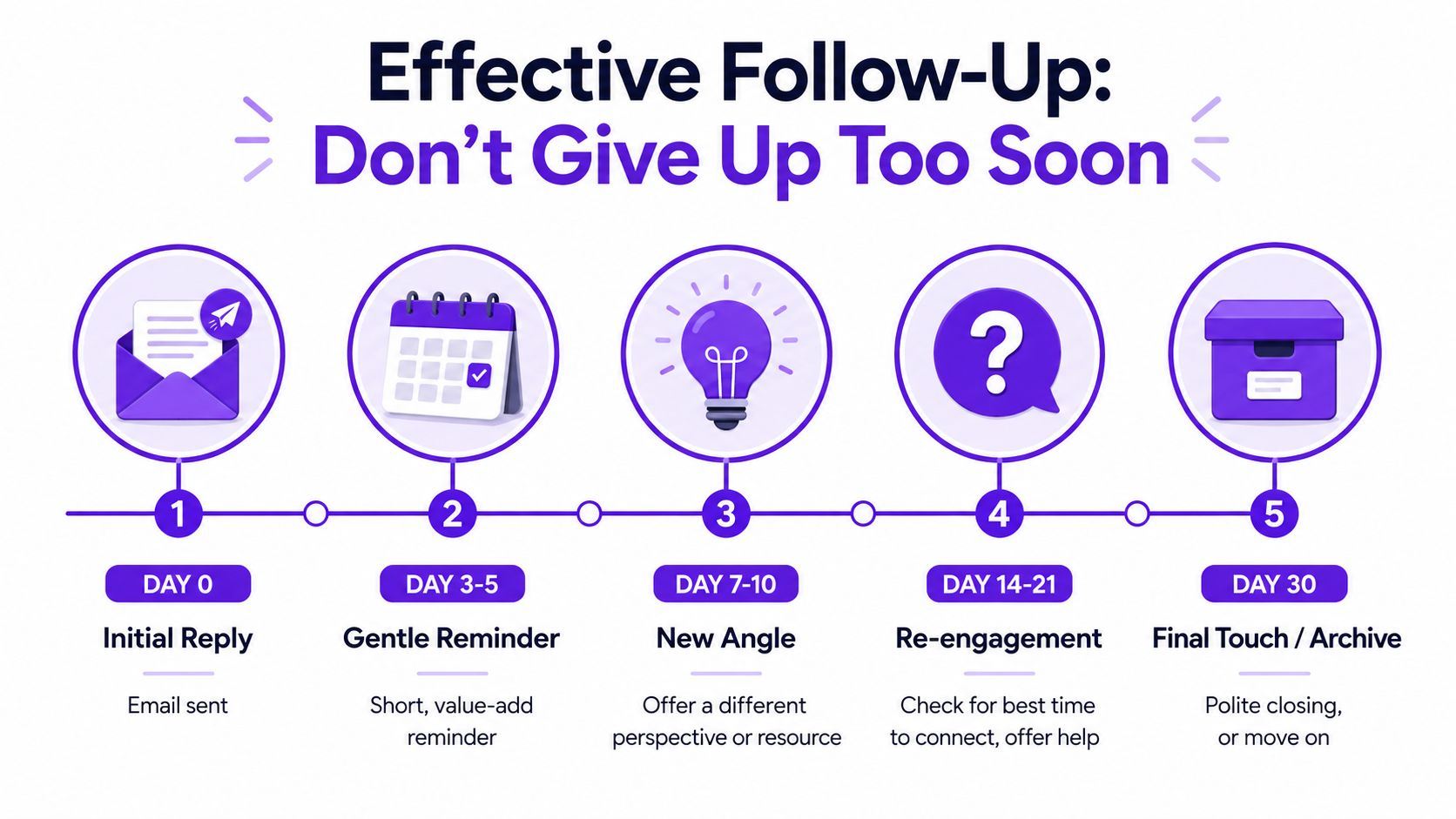
A lot of replies come after the first touch. One benchmark says 42% of replies come from follow-ups, with effective campaigns often using 4 to 7 touchpoints. That doesn't mean you should stalk people through their inbox. It means silence after one message tells you almost nothing.
A sane follow-up rhythm
First follow-up
Keep it short. Reference the original thread and restate the easy next step.Second follow-up
Add a new angle. Share a fresh reason the conversation could matter.Third follow-up
Lower the friction. Offer a simple yes-or-no path or suggest email instead of a meeting.Final touch
Close the loop politely. Leave the door open without sounding wounded.
Never send “just checking in”
That phrase is lazy. Add context every time.
You can also use tracking data carefully to avoid guessing. If your team uses read tracking, this guide on how to see if an email was read can help you separate bad timing from no interest.
Persistence works when each follow-up earns its place.
Templates You Can Steal and Adapt
Templates are dangerous in the hands of lazy people and wonderful in the hands of disciplined people. Use these as structure, not as a substitute for thought.
If you want a broader library for outbound ideas, this collection of a cold email template examples is useful. For intro replies, though, the standard is higher. You already have trust in the room. Don't squander it with robotic filler.
Template for a B2B sales intro
Subject: Re: [Introducer Name] intro, [Your Name] <> [Recipient Name]
Hi [Recipient First Name], Thanks, [Introducer First Name], for connecting us.
[Recipient First Name], [specific context on their company, team, initiative, or timing]. I work with [role/team type] on [specific problem area], and [introducer or trigger] made me think a quick conversation could be useful.
If it helps, I'm happy to share a few ideas specific to [their stated priority]. Open to a short call next week?
Best, [Your Name]
Why it works:
It respects the thread by acknowledging the introducer without overdoing it.
It earns relevance with a specific context line.
It uses one CTA instead of offering a menu nobody asked for.
Template for a networking or partnership intro
Subject: Re: Intro from [Introducer Name]
Hi [Recipient First Name], Appreciate the intro, [Introducer First Name].
Good to meet you. [Introducer First Name] mentioned your work around [topic]. There seems to be solid overlap with my work in [area], especially around [shared interest or business priority].
Would you be open to a brief call sometime next week to compare notes and see if there's a fit to stay in touch?
Thanks, [Your Name]
Why it works:
It sounds human instead of sounding like a pitch deck escaped into Gmail.
It leaves room for the relationship to develop without forcing an agenda.
It stays brief so the other person can decide quickly.
Frequently Asked Questions About Intro Emails
Edge cases are where people melt down. Here's the practical version.
Email Introduction FAQ
Question | Answer |
|---|---|
Should I reply all to an intro email? | Yes, at first. Keep the introducer in the first response so context stays intact. Move them to BCC only after the handoff is clear. |
How fast should I respond? | Same business day is the baseline. Faster is better when the intro matters. |
What if I'm not interested? | Decline politely, thank the introducer, and close the loop cleanly. Don't ghost a warm intro unless the thread is obviously abusive or irrelevant. |
What if I'm interested but not the right person? | Redirect with a name if you can. That's more helpful than a vague “someone on my team handles this.” |
Should I thank the introducer privately too? | If the relationship matters, yes. A quick separate note is good manners and good network hygiene. |
How long should my reply be? | Short enough to read on a phone without scrolling forever. Tight beats impressive. |
Should I include a calendar link? | Only if it matches the tone and seniority of the thread. For many intros, asking if they're open to a short call feels less presumptuous. |
What if the intro feels like a disguised sales ambush? | Stay professional. You can decline, ask for context, or redirect. You don't owe a meeting to every “thought this would be valuable” email. |
Should I attach anything? | Usually no. Attachments add friction. Earn the conversation first. |
What if nobody replies after my response? | Follow up a few times with actual substance. Then close the loop and move on without drama. |
A final opinion, since too many guides dance around it: the best email introduction response is not the nicest one. It's the one that makes the next action obvious while protecting your time, your reputation, and the introducer's trust.
If your team wants more than polite replies and would rather turn timely signals into better conversations, RoverLead AI is worth a look. It helps sales teams find high-intent prospects based on real LinkedIn behavior, so your outreach starts with context instead of guesswork. That means fewer generic intros, better timing, and a lot less time wasted writing emails nobody should've sent in the first place.