B2B Lead Generation Definition: What Really Works in 2026

Your reps are working. Your dashboards are full of activity. The CRM shows emails, calls, connection requests, webinar signups, and a heroic amount of follow-up tasks.
And yet your calendar looks like a ghost town.
That gap has a name, even if it's rarely acknowledged out loud. Your pipeline is broken because your definition of a lead is broken. If your team treats every contact like an opportunity, they'll stay busy forever and still miss quota with impressive consistency.
That's why the B2B lead generation definition matters in 2026. Not as a textbook term. As a diagnostic tool. If your definition is sloppy, your targeting is sloppy, your handoffs are sloppy, and your forecasts are fiction.
Table of Contents
Your Team Is Busy But Your Calendar Is Empty
You've seen this movie before.
An SDR sends a few hundred emails, likes a pile of LinkedIn posts, adds fresh accounts to a spreadsheet, and proudly reports “great activity.” Marketing sends over a batch of so-called leads because they downloaded something six weeks ago. Sales says the leads are junk. Marketing says sales didn't follow up fast enough. Everyone is technically doing their job, and nobody is producing meetings.
That isn't a hustle problem. It's a definition problem.
A lot of teams still act like lead generation means collecting names. That worked when static lists, vague personas, and brute-force outreach could still muscle a few deals through. Now buyers leave behavioral clues everywhere, and the teams that ignore those clues end up chasing people who were never going to buy.
Practical rule: If a “lead” only means “a person we can contact,” your pipeline will clog with noise.
The question isn't how many leads you have. It's whether your team can tell the difference between a random contact, a curious visitor, and a buyer who's leaning in right now. That distinction is where revenue starts.
What B2B Lead Generation Actually Is And Is Not
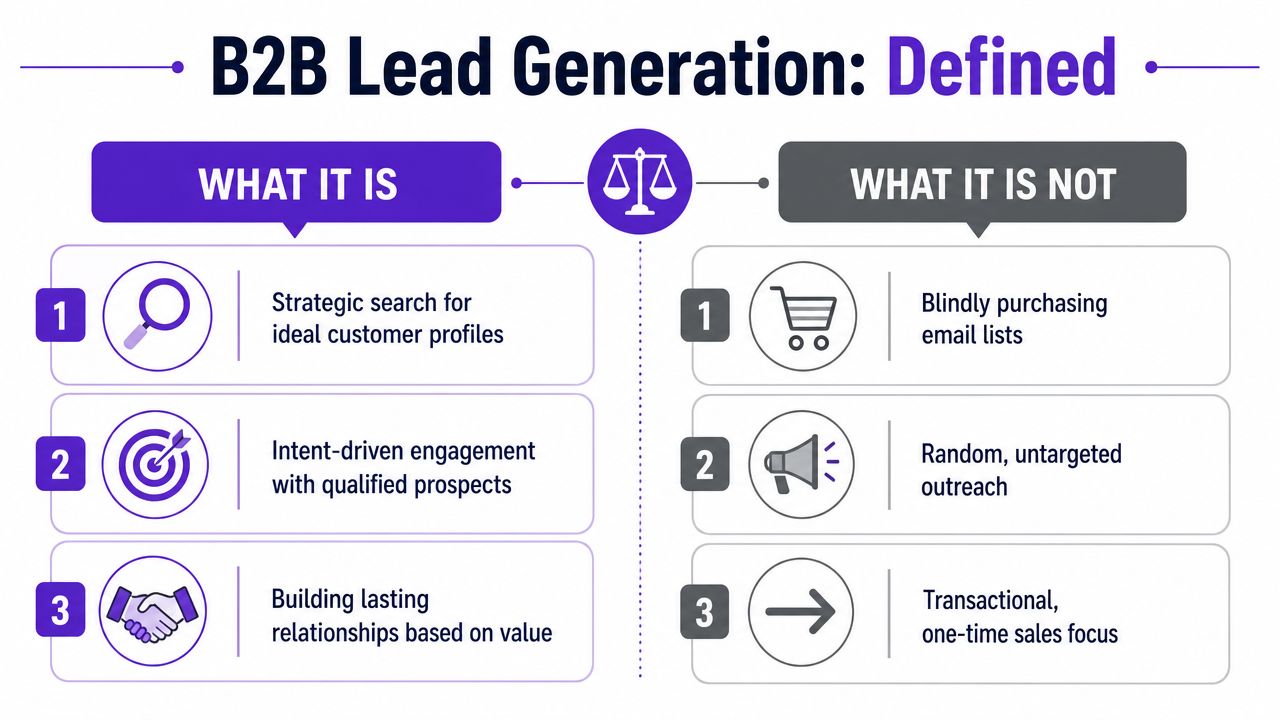
B2B lead generation is the process of identifying businesses that could buy from you, attracting them, and qualifying them so they can move into the sales pipeline. SAP's framework makes the point cleanly: marketing-qualified leads engage with marketing, while sales-qualified leads show stronger purchase intent, such as requesting a demo or contacting sales directly, as outlined in SAP's explanation of B2B lead generation.
That means lead gen is not a list-building contest. It is a system for finding fit and intent.
What counts as real lead generation
The cleanest definition I've seen is this: effective B2B lead generation combines firmographic filters like industry and company size with behavioral signals like website visits or demo requests to identify both fit and intent. That's what turns a database into a pipeline, as explained in this guide to B2B lead generation fundamentals.
Think of old-school lead gen as handing out flyers on a random street corner. Modern lead gen is talking to the people already staring into your shop window.
Here's the difference:
It is strategic targeting. You define the kind of company and buyer role that can win with your product.
It is signal-based qualification. You pay attention to actions that suggest timing, curiosity, or urgency.
It is pipeline design. You build a path from first touch to sales conversation, not just a pile of contacts.
For a related view, this distinction gets even sharper when you compare lead gen with B2B demand generation.
What teams still get wrong
Most bad lead gen falls into three buckets:
Bought lists posing as strategy. A list gives you names. It does not give you relevance.
Untargeted outreach. If the message could go to anyone, it will resonate with no one.
Volume worship. More contacts rarely fixes poor timing or poor fit.
A contact becomes a lead when context enters the room.
If your current process rewards quantity before qualification, you don't have a lead generation engine. You have a spreadsheet addiction.
Decoding The Lead Alphabet Soup MQL SQL And ICP
A lot of pipeline arguments happen because teams throw around acronyms like everyone agreed on the definitions. They didn't.
If sales and marketing use different meanings for ICP, MQL, and SQL, your handoff will be a mess no matter how nice your CRM looks.
The foundation is ICP
ICP means Ideal Customer Profile. This is the company profile that best matches your solution, buying motion, and value proposition. It usually includes industry, company size, geography, revenue range, and decision-maker role.
If your ICP is fuzzy, everything downstream gets worse. Your content attracts the wrong crowd. Your SDRs chase accounts that stall. Your AE pipeline fills with “nice conversations” that never become real deals.
If your team needs a clearer starting point, read this breakdown of what ICP means in business.
MQL vs SQL At a Glance
SAP draws a useful line here: MQLs have engaged with marketing, while SQLs have shown stronger purchase intent, such as requesting a demo or contacting sales directly. That distinction keeps sales focused on people who are ready for a conversation.
Criteria | Marketing Qualified Lead (MQL) | Sales Qualified Lead (SQL) |
|---|---|---|
Definition | A lead that has engaged with marketing and shown early interest | A lead that has shown stronger purchase intent |
Typical behavior | Webinar signup, content download, repeat site visit | Demo request, direct contact with sales, clear buying inquiry |
Primary signal | Engagement | Intent |
Typical owner | Marketing, then SDR or nurture workflow | Sales |
Best next step | Nurture, educate, qualify further | Fast follow-up and discovery |
A common mistake is sending MQLs to sales too early, then acting surprised when reps ignore them. Sales doesn't need more names. Sales needs people with context, fit, and timing.
How the journey should work
A healthy flow looks like this:
Start with ICP fit. Wrong company, wrong lead. End of discussion.
Watch for engagement. Marketing interactions can signal curiosity.
Separate curiosity from intent. Not every download deserves a sales call.
Promote only when behavior changes. Demo requests, direct outreach, or repeated high-intent actions matter.
Handoff with context. Sales should know what happened, not just who the person is.
Sales and marketing don't need perfect harmony. They need shared definitions and fast response.
Once that's in place, pipeline reviews get less theatrical and a lot more useful.
The Modern B2B Lead Generation Playbook
Your reps are busy, marketing is shipping campaigns, and the CRM keeps gaining names. The pipeline still feels thin. That usually means the problem is not effort. It is definition.
If you define lead generation as collecting contacts, you get static lists, inflated activity, and a calendar full of hope. If you define it as finding buying motion early enough to act on it, your pipeline gets a lot less mysterious. That is the modern playbook.

Channel choice should follow signal quality
B2B teams waste time asking which channel is best. Ask which channel shows intent soon enough for your team to do something useful.
According to Snov.io's lead generation statistics, LinkedIn drives 80% of B2B prospects from social media, email is the top-performing channel for 32% of marketers, the average MQL-to-SQL conversion rate is 16%, average cost per lead is $391.80, and landing pages convert at 6.6% on average across industries, with 3.8% in SaaS and 12.3% in events and entertainment.
Those numbers matter because they force better decisions. LinkedIn earns attention when buyer behavior is visible. Email earns a spot when timing and message quality are tight. Landing pages should filter and qualify, not just collect form fills.
Here is the 2026 read on the field:
LinkedIn is a live signal feed. Comments, profile views, post engagement, job changes, and content interaction give sales teams context before outreach.
Email still pulls weight. It works when tied to a trigger, a pain point, or a recent action. Generic sequences belong in the trash.
SEO and content should capture active demand. Go after problem-aware searches with commercial intent. Leave fluffy traffic goals to teams that enjoy bad attribution meetings.
Paid channels work when they speed up discovery. They fail when used to force interest that does not exist.
What to keep and what to kill
Keep anything that helps your team spot change. Kill anything built on stale assumptions.
Keep search-driven content that targets buyers who are already trying to solve a problem.
Keep follow-up email for progression after a real interaction, not as a cold substitute for relevance.
Keep social outreach based on visible behavior, shared context, and timing.
Kill static list obsession. A clean-looking spreadsheet is not demand.
Kill spray-and-pray messaging. Volume does not fix weak targeting.
Kill channel silos. The best programs connect signals across web, email, social, and CRM activity.
This is also why modern tools are replacing old list-first workflows. Static databases age fast. Intent signals do not. Platforms such as RoverLead AI fit the shift because they help teams work from fresh behavior, not expired assumptions.
If qualification breaks after lead capture, fix that next. A practical framework for how to qualify sales leads will save your reps from wasting good hours on bad names.
If your team needs a quick reset on the basics before rebuilding the system, this short video is a useful refresher.
Good lead gen in 2026 is not about adding more channels. It is about choosing the few that expose real buying motion, then acting before your competitor does.
Putting It All Together From Lead To Meeting
A working pipeline needs a sequence. Not a vague idea. Not a Miro board. A sequence.
The strongest teams run lead generation as a chain of decisions. Each step answers a different question: Who fits? Who's active? Who's worth a rep's time? Who needs nurture instead of pressure?
A practical five-step model
Identify intent signals Start with behavior, not just account lists. Look for actions that suggest real interest: repeated visits, webinar attendance, direct inquiries, pricing-page behavior, demo requests, or visible engagement in the places your buyers spend time.
Capture and enrich
Once someone signals interest, give your team enough context to act. That includes company details, role, source, previous interactions, and whatever else helps a rep avoid sounding clueless.Qualify and score
Not every active contact deserves equal attention. Prioritize by fit, stage, and depth of engagement. If someone fits your ICP but shows weak interest, nurture them. If they show urgency and fit, move fast.
For teams refining this stage, this guide on how to qualify sales leads is worth keeping close.
Where most teams fumble the handoff
Such scenarios lead to pipeline leaks. Marketing captures a lead. Sales gets a name. Nobody gets the story.
A stronger handoff model requires scoring criteria, clear ownership, and metrics that tell you whether the machine is working. Salesforce recommends defining scoring criteria and tracking conversion rate, CPL, and ROI, plus testing forms and CTAs to improve capture friction and response timing, as summarized in Zendesk's guide to B2B lead generation.
Here's the practical version:
Define what triggers sales follow-up. Don't leave this to rep mood.
Include behavior in the record. “Requested a demo” is useful. “Lead from website” is not.
Set response rules. High-intent leads should not sit in a queue while someone updates Salesforce fields.
Keep nurture alive. A lead that isn't ready now is not dead. It's just not ready now.
Fast response matters, but relevant response matters more.
The final step is simple. Engage with context, then either book the meeting or return the lead to nurture with a reason attached. That loop is what turns lead generation from random effort into a system your team can trust.
Your B2B Lead Generation Questions Answered
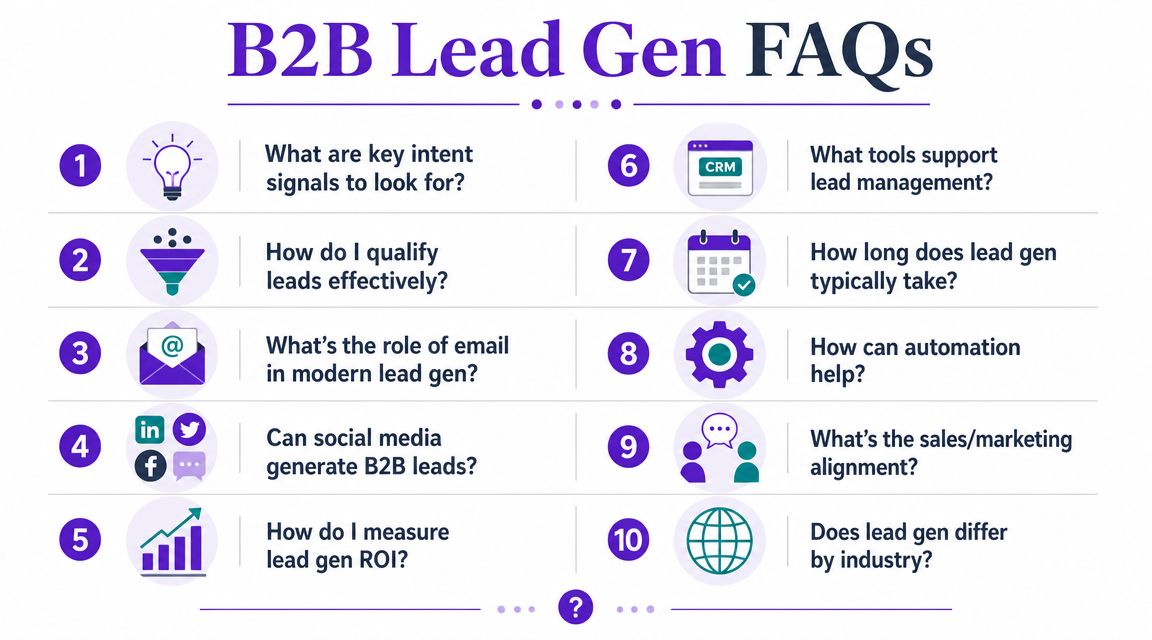
1. What's the simplest B2B lead generation definition?
B2B lead generation is the system you use to spot the right accounts, catch buying signals, and turn that interest into qualified conversations for sales.
That definition matters because it shows you where the pipeline is broken. If you have traffic but no replies, your message is off. If you have replies but no meetings, your qualification is weak. If you have names but no intent, you are still running the old playbook of list-building instead of buyer detection.
2. What's the difference between lead gen and demand gen?
Demand gen creates interest before a buyer raises a hand. Lead gen turns that interest into identified people and accounts your team can work.
One fills the top of the funnel. The other decides whether sales gets a real shot or another contact record that goes nowhere.
3. How much should I budget for B2B lead generation?
Budget after you understand your math. Start with customer value, sales capacity, close rate, and time to revenue.
If your team takes two weeks to follow up or chases accounts outside your ICP, a bigger budget will not save you. It will just help you waste money faster.
4. What metrics matter most?
Track the numbers tied to pipeline movement. Start with lead-to-meeting rate, meeting-to-opportunity rate, cost per qualified lead, and speed to follow-up.
Add channel-level quality once the basics are clean. If a metric does not help you change targeting, outreach, staffing, or spend, ignore it.
5. What's a good MQL-to-SQL conversion rate?
Use industry averages as a rough gut check, nothing more. A healthy conversion rate depends on how tightly your ICP is defined, how serious the buying signal is, and whether marketing and sales use the same qualification rules.
If your number is low, do not rush to blame lead volume. Check the handoff first. Bad scoring and lazy routing wreck conversion faster than weak demand.
6. Which social platform matters most for B2B?
LinkedIn still carries the most weight for B2B prospecting because buyer context lives there. Job changes, hiring activity, content engagement, and category conversations all show up in public.
Treat it like a live intent feed, not a digital business card. That is the difference between old-school prospecting and modern lead generation.
7. Is cold email dead?
Cold email still works. List spam does not.
The inbox is less forgiving now, and that is a good thing. Relevant outreach tied to timing, role, and a clear problem still gets replies. Generic sequences sent to stale data belong in the trash folder.
8. Should SDRs report to Sales or Marketing?
Put SDRs under the leader who owns pipeline creation and can fix problems fast. In an early-stage company, that is usually Sales. Speed matters more than org-chart symmetry.
In a larger team, reporting lines matter less than shared definitions, shared targets, and tight feedback loops. If marketing celebrates form fills while sales complains about junk, the reporting structure is not the actual problem.
9. How long does lead generation take to show results?
That depends on the channel, the sales cycle, and how strong your signal quality is. Paid campaigns can produce conversations quickly. Content and SEO take longer but compound over time.
Watch for early proof. Are the right accounts engaging? Are replies coming from buyers with a reason to talk? If attention shows up but meetings do not, fix messaging and qualification before you scrap the whole program.
10. Can AI replace my SDR team?
AI can replace manual research, list cleaning, account prioritization, and the first draft of outreach. Good. Reps should not spend their day copying job titles into spreadsheets.
It does not replace judgment. It does not replace timing. It does not replace a smart rep hearing hesitation on a call and changing the angle on the spot.
The best use of AI in lead gen is removing low-value work so your team can spend more time in real sales conversations.
If your team is still buying static lists and hoping volume saves the quarter, you are using a 2019 fix for a 2026 problem. RoverLead AI is built for the newer model. It helps B2B teams turn LinkedIn engagement into daily, high-intent prospects matched to your ICP, with context and AI-written openers that make outreach timely instead of random.