B2B SaaS Companies: The Ultimate Sales Guide for 2026
You pulled a clean list of B2B SaaS companies. You wrote the sequence. You personalized the first line. You sent the LinkedIn requests. Then nothing happened except a few polite ignores and one reply that basically said, “not a priority.”
That's not a messaging problem. It's a timing problem dressed up as a copy problem.
Sales teams often prospect B2B SaaS companies like it's a spreadsheet exercise. They sort by headcount, funding, industry, maybe job title, then act shocked when cautious buyers don't jump into demos. In this market, that playbook is stale. Recent market commentary notes that many SaaS firms are dealing with the fallout of chasing bad-fit customers, while mid-market buyers have become more cost-sensitive and harder to move, which makes smarter targeting essential, not optional, according to this 2024 analysis of B2B SaaS market conditions.
The reps winning right now aren't working harder. They're watching for behavior. They care less about who fit the ICP last quarter and more about who is showing signs of pain today on LinkedIn.
Table of Contents
The SaaS Sales Struggle Is Real
A rep spends half the week building a target list. SaaS founders. RevOps leaders. Heads of Growth. Nice logos, fresh funding, decent employee count. On paper, it looks sharp. In practice, it produces a graveyard of “seen” messages.
The problem is simple. Most outreach hits accounts when they're not actively solving the problem you sell. You can have a solid offer and still be irrelevant on Tuesday morning.
That hurts more in software because buyers don't just ask, “Do we want this?” They ask, “Will this integrate, get adopted, survive procurement, and still matter at renewal?” If the answer isn't obvious, they stall.
Good sales timing beats polished generic outreach every single week.
Teams selling into B2B SaaS companies need to stop worshipping static firmographics. Company size matters. Industry matters. But neither tells you whether a buyer is dealing with pain right now. LinkedIn behavior does. Comments do. Hiring patterns do. Public questions do. Product launch chatter does.
When your calendar is empty, the fix usually isn't “write a better pitch.” It's “target people who are already leaning toward the conversation.”
What Are B2B SaaS Companies Anyway
The business model in plain English
A B2B SaaS company sells software to other businesses through a subscription. Think gym membership, not one-time equipment purchase. The buyer pays monthly or annually for access, updates, support, and usually a promise that the product keeps improving.
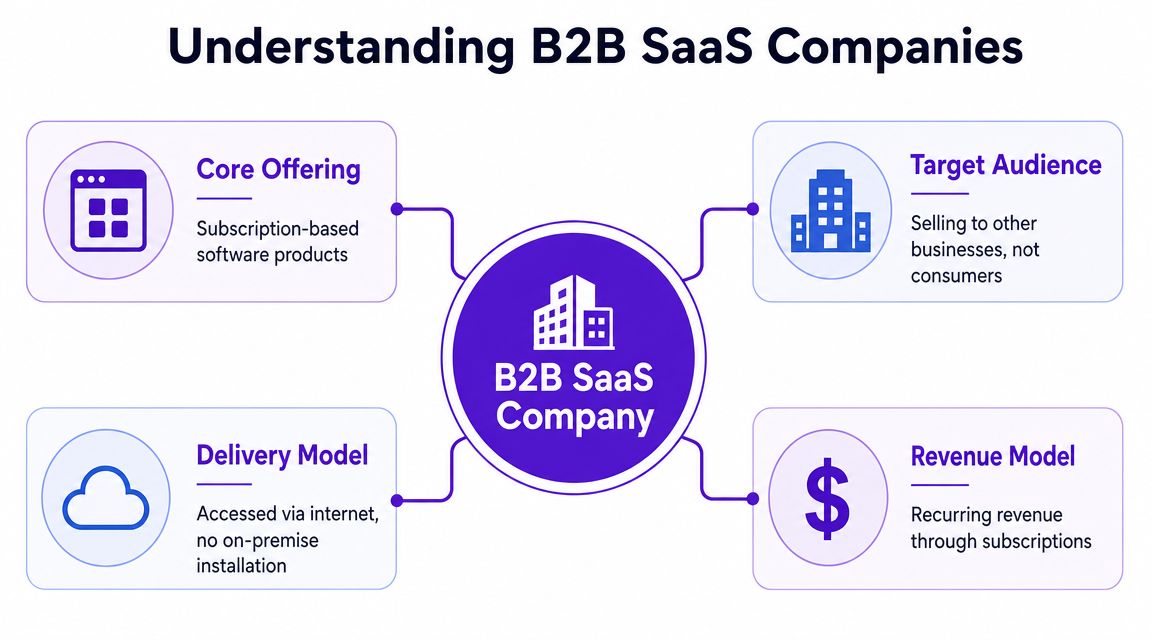
That sounds basic, but it changes everything. These companies don't win by closing a deal once. They win by keeping customers using the product long enough to renew, expand, and refer.
This isn't some tiny niche anymore. The global B2B SaaS market was estimated at $497.41 billion in 2025 and is projected to reach $4.44 trillion by 2034, with 17,000+ SaaS companies in the U.S. alone, according to this roundup of B2B SaaS market statistics.
Why recurring revenue changes how they buy
Because revenue repeats, these companies obsess over metrics that signal durability. You'll hear terms like ARR, MRR, retention, expansion, and churn. You don't need to become a finance professor. You do need to understand the logic.
If you sell into a B2B SaaS company, your buyer is usually asking four blunt questions:
Will this improve adoption? If users don't touch the product, the customer won't stay.
Will this reduce friction? Extra manual work is poison in recurring-revenue businesses.
Will this support scale? They don't want to retool every quarter.
Will this help retention or expansion? If it doesn't affect long-term account value, it's easier to cut.
Practical rule: Sell outcomes that survive beyond implementation. SaaS buyers are cautious because they live with the consequences every renewal cycle.
There's also a technical layer. B2B SaaS buyers increasingly judge tools on integration fit, customization, analytics, and SLA commitments, including expectations like 99.9% uptime, as described in this B2B SaaS glossary and buyer criteria breakdown. If your pitch ignores operational reality, expect a polite brush-off.
Not All SaaS Are Created Equal
Selling to “SaaS companies” is sloppy targeting. A startup with a founder-led sales motion behaves nothing like a mature platform with procurement, security review, and six people in the buying committee. If you lump them together, your outreach gets vague fast.
SaaS buyer segments at a glance
Segment | Key Decision-Maker | Sales Cycle | Primary Pain Point |
|---|---|---|---|
SMB SaaS | Founder, Head of Sales, first ops hire | Shorter | Speed, bandwidth, immediate ROI |
Mid-market SaaS | Department head, RevOps, finance partner | Medium | Cost sensitivity, adoption risk, migration friction |
Enterprise SaaS | VP, procurement, IT, security, operations | Longer | Integration, compliance, cross-team rollout |
That table is the part most reps skip. Then they write one message for all three segments and wonder why nobody bites.
Mid-market deserves special attention. It's the awkward middle child. Big enough to need process. Small enough to fear disruption. That means your deal doesn't die because they “don't see value.” It often dies because change feels expensive and annoying.
Horizontal versus vertical is not a small detail
The second split is horizontal SaaS versus vertical SaaS.
Horizontal tools sell across industries. Think broad workflows like CRM, collaboration, analytics, or sales engagement. Vertical tools focus on one market and go deep, such as software for healthcare operations, construction workflows, or real estate teams.
Here's my opinion. Too many sellers chase tech companies because they're familiar. Familiar is not the same as attractive.
Public analysis has argued that SaaS-to-SaaS growth has cooled while companies selling into non-tech sectors such as manufacturing, healthcare, and real estate are thriving. One cited example says 70% of Monday.com's customers are not in tech, as discussed in this SaaStr analysis on selling outside tech.
That matters because software in less digitally mature industries often becomes mission-critical faster. It solves uglier problems. Scheduling chaos. Compliance headaches. Broken handoffs. Manual reporting. Those pains are less glamorous than “AI workflow orchestration,” but they're often easier to monetize.
Use this filter when choosing where to focus:
Pick urgency over trendiness. A boring pain with budget beats a trendy problem with endless debate.
Prefer painful workflows. If a task breaks revenue, compliance, or customer delivery, buyers pay attention.
Watch competition density. Crowded software categories create comparison fatigue and pricing pressure.
The best market isn't always the loudest one. It's often the one with fewer vendors and clearer pain.
Decoding B2B SaaS Buying Signals
Static lists are lazy targeting
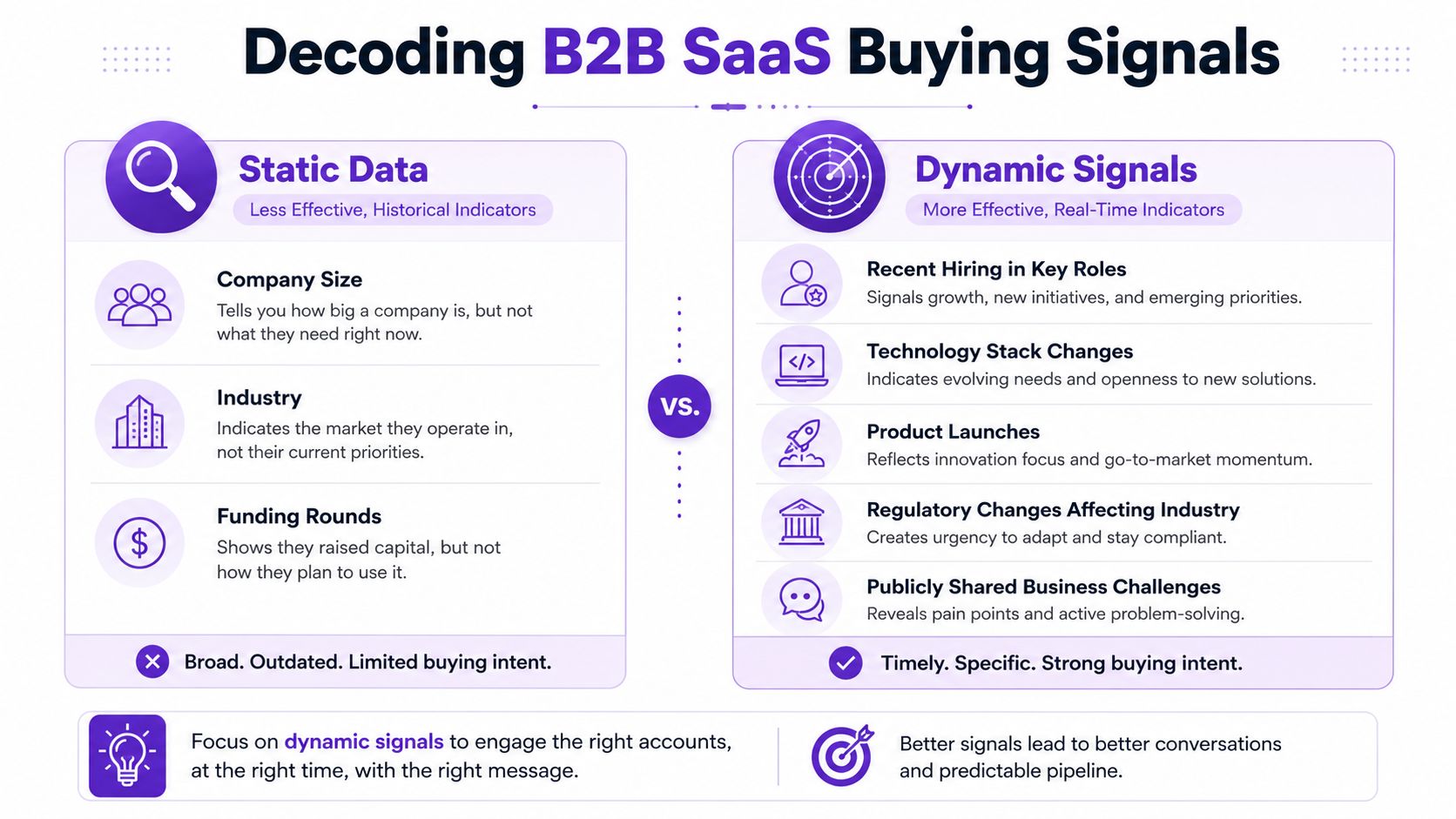
Most prospecting data tells you what a company is. It doesn't tell you what they're dealing with this week.
Headcount, funding, and category can help you narrow the field. They are not intent. Treating them like intent is how reps burn time on dead accounts and call it pipeline generation.
Because SaaS value is measured through usage and retention, these companies rely on analytics to track engagement, identify churn causes, project revenue, and understand what drives conversion and retention. That makes any sign that a team is trying to solve a workflow or data problem a strong conversation opener, as explained in this guide to B2B SaaS data analytics.
What real intent looks like on LinkedIn
Behavior beats biography. Every time.
Real buying signals usually look small from a distance. Up close, they're gold:
A public pain clue such as a VP commenting on attribution, onboarding, reporting, or churn.
A role change like hiring a first RevOps leader, enablement owner, or customer success operator.
A process change such as switching CRMs, launching a product line, or rebuilding reporting.
A pattern of engagement where multiple people from one account interact with the same topic.
If you want a sharper framework for filtering these signals into real opportunities, this guide on how to qualify sales leads is worth your time.
Don't ask, “Does this account fit?” Ask, “Did someone at this account reveal a problem they care about solving now?”
That one question saves an absurd amount of wasted outreach.
Your LinkedIn Playbook for Targeting SaaS Buyers
The best LinkedIn prospecting doesn't look like prospecting. It looks like paying attention.

Build a signal feed, not a vanity list
Start by creating a narrow watchlist. Follow competitor company pages, relevant creators, category analysts, and operators your buyers respect. Don't follow everyone. Follow the people whose posts attract the exact comments you want to mine.
Then monitor for moments that imply pain, evaluation, or change. Good examples include comments asking for alternatives, complaints about workflows, posts about hiring into a new function, and product updates that create downstream operational mess.
A practical workflow looks like this:
Choose a tight niche. Pick one buyer group, one core problem, one angle.
Track the right sources. Competitors, influencers, communities, and customers all leave clues.
Save signal patterns. Questions, frustrations, tool mentions, hiring moves, launch posts.
Respond fast. Context expires. Relevance has a shelf life.
Write from the signal. Don't lead with your product. Lead with what they just revealed.
If your team still builds giant Sales Navigator lists and calls that targeting, they're doing admin work, not selling. For a stronger process, study modern LinkedIn lead generation methods that prioritize engagement signals over static filters.
Write messages that sound like a human noticed something
The opener is where most reps ruin a good signal.
A weak message says, “We help SaaS companies improve efficiency.” That's wallpaper. Nobody remembers wallpaper.
A stronger message references the trigger. Keep it short. Keep it contextual. Keep the ask light.
Examples:
“Saw your comment about reporting lag on Alex's post. Sounds like the issue isn't data volume, it's getting answers fast enough. Is that something your team is actively fixing?”
“Noticed you're hiring your first enablement lead. That usually means the sales process has outgrown tribal knowledge. Curious if onboarding consistency is part of the brief.”
“You mentioned evaluating alternatives to your current stack. Happy to share what teams usually compare first if that's useful.”
A few rules matter more than templates:
Use the signal in line one. If the trigger isn't obvious, the message feels random.
Make one assumption, not five. Show awareness without pretending you know their entire business.
Ask low-friction questions. “Worth a quick compare?” works better than demanding a meeting.
Drop the chest-thumping. Nobody cares that you're “industry-leading” in a first message.
This walkthrough is useful if you want to see a live breakdown of social selling mechanics before your team starts winging it:
Relevance doesn't require a long message. It requires a believable reason for the message to exist.
That's the whole game on LinkedIn.
Putting It All on Autopilot with RoverLead AI
This playbook works. It also eats time for breakfast if you do it manually.
You have to monitor creators, competitors, comments, role changes, product chatter, and public pain signals. Then you still need to decide which accounts match your ICP and write an opener that doesn't sound like it came from a copy-paste dungeon.
That's where automation earns its keep. How to use AI in sales isn't about replacing reps. It's about removing the scavenger hunt so reps can spend time on conversations.
RoverLead AI is built for that exact job. It watches LinkedIn for buying signals tied to your ICP, surfaces leads with context, and drafts signal-based outreach so the team can act while the signal is still warm. That turns prospecting from a daily research slog into a focused workflow.
Frequently Asked Questions About B2B SaaS Sales
1. Who should I target first at B2B SaaS companies?
Start with the person who owns the pain, not the highest title. In SaaS, that's often a functional leader in sales, marketing, RevOps, customer success, or product operations.
2. Is funding still a good trigger?
It's a weak trigger by itself. Useful for context, yes. Reliable buying intent, no.
3. Are mid-market SaaS companies worth the effort?
Yes, but only if your offer is easy to adopt. Mid-market buyers hate long migrations and messy change.
4. Should I sell to tech companies or non-tech vertical SaaS first?
Go where pain is clearer and competition is lighter. A less fashionable niche often closes better than a crowded tech segment.
5. What matters most to SaaS buyers after the demo?
Operational fit. Integrations, rollout friction, adoption risk, and whether the tool becomes useful fast.
6. What metric gets attention fastest?
Anything tied to retention, expansion, or usage usually lands well. Top-performing B2B SaaS companies show median gross revenue retention around 90%, which implies about 10% annual gross revenue churn, according to Zylo's SaaS benchmark statistics.
7. How long should a LinkedIn opener be?
Short enough to read in one screen without scrolling. If it looks like a mini-novel, you already lost.
8. What's the biggest mistake in SaaS outreach?
Leading with your product instead of the buyer's visible problem.
9. Should I automate the first message?
You can automate support work. You should still make the message feel tied to a real signal.
10. How do I know a signal is strong enough to act on?
If the behavior suggests active evaluation, frustration, change, or problem ownership, act on it. If it's just demographic fit, keep watching.
If your team is tired of static lead lists and wants a faster way to find real buying signals on LinkedIn, RoverLead AI is worth a look. It helps you spot high-intent prospects, understand why they're relevant, and start conversations while the timing still makes sense.