Sales Engagement Platform Guide: Scaling Outreach in 2026

Your reps aren't losing deals because they forgot how to sell. They're losing momentum because their day keeps getting hijacked by work that feels like selling but isn't. Copy a note into the CRM. Set a reminder. Send a follow-up. Realize the follow-up should've gone out yesterday. Open five tabs to figure out what happened on one account. Repeat until morale starts to look like a churn metric.
That mess is why the sales engagement platform became such a big category. It gave teams a way to turn scattered outreach into a managed system. It also became big business fast. The Fact.MR sales engagement software market forecast values the category at US$9.6 billion in 2024 and projects it to reach US$35.7 billion by 2034, growing at a 14% CAGR.
Table of Contents
The Outreach Grind That Broke Sales Teams
Before sales teams adopted structured outreach systems, a lot of pipeline building looked like organized panic. Reps kept prospect lists in spreadsheets, tracked follow-ups in their inbox, and treated calendar reminders like a life support machine. A good rep could hold the whole process together for a while. A growing team couldn't.
The pain showed up in familiar ways. A rep would send a strong first email, forget the second touch, then remember the prospect only after seeing a stale CRM task. Another rep would call the right account but with the wrong context because notes lived in three places and none of them agreed. The result wasn't just wasted time. It was inconsistent execution.
Manual outreach breaks in quiet ways first. Missed follow-ups, duplicate touches, and half-finished research don't look dramatic. They just slowly drain pipeline quality.
That's the problem a sales engagement platform was built to solve. Not “send more emails.” Not “automate everything.” Its core function was to make outreach repeatable enough for a whole team, not just for the rep who color-codes their life and never sleeps.
What Is a Sales Engagement Platform Really
A sales engagement platform isn't just an email sequencer with nicer branding. It's the operating layer that runs outbound activity across channels, keeps the rep on the next best action, and ties those touches back to the rest of the sales process.
Your CRM remembers. Your SEP moves
The simplest way to think about it is this:
System | Main job |
|---|---|
CRM | Stores account, contact, and deal history |
Sales engagement platform | Executes outreach and manages follow-up actions |
Your CRM is the memory. Your SEP is the motion.
That distinction matters because reps don't close deals by admiring clean records. They close deals by contacting the right people, in the right order, without dropping the thread. Apollo describes a sales engagement platform as a system of action that orchestrates multi-channel sequences across email, phone, and social from one workspace, reducing context switching while combining prospecting, automation, and analytics in the same workflow, as explained in Apollo's overview of sales engagement solutions.
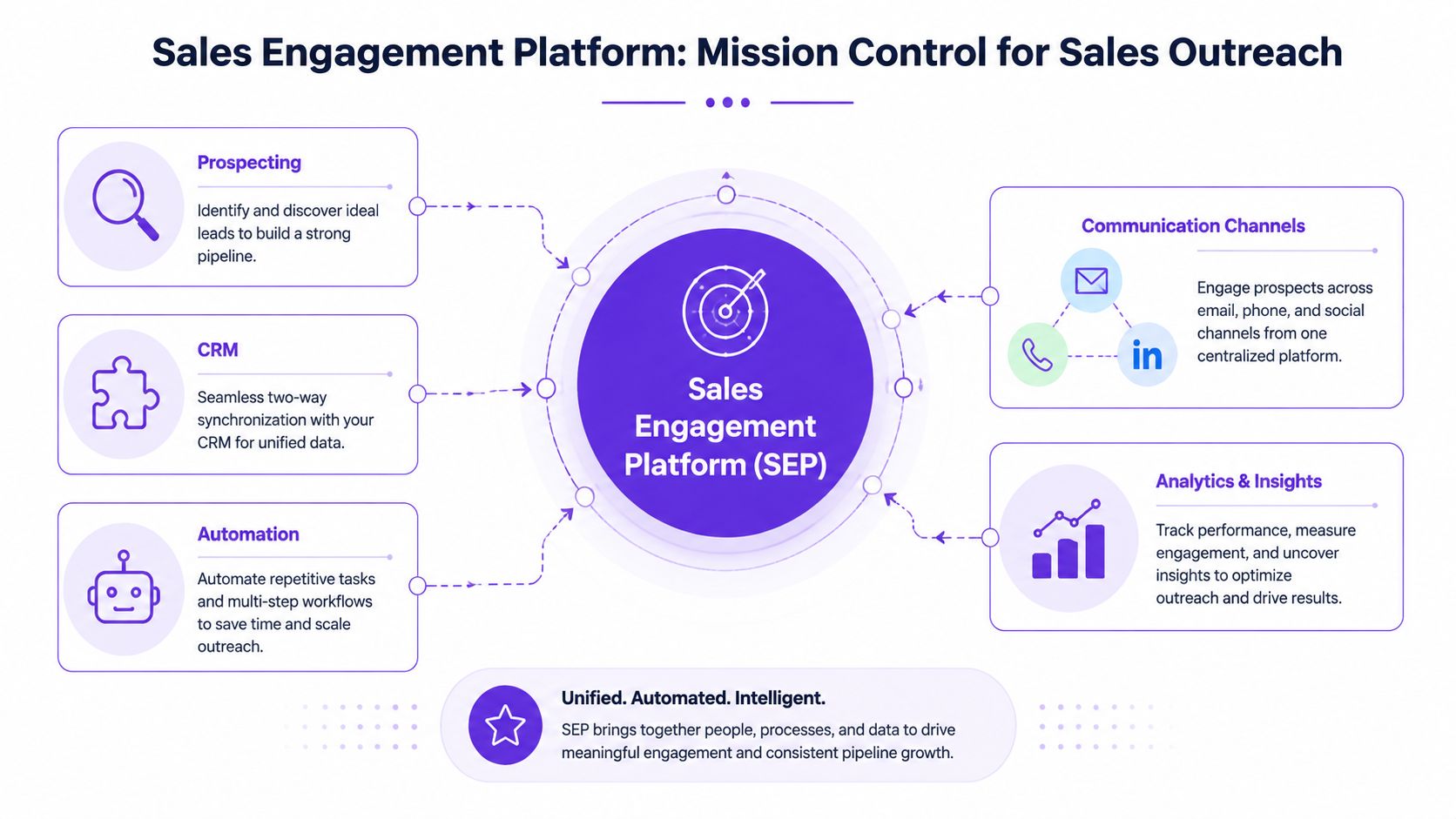
If you want the companion concept on the enablement side, this breakdown of a sales enablement platform is useful because it shows where rep readiness ends and daily execution begins.
Why that architecture matters
A decent SEP cuts down the tab juggling. A strong one changes rep behavior.
Instead of making reps decide from scratch what to do next, the platform presents a queue of actions. Email this contact. Call that stakeholder. Pause this sequence because someone replied. Update the CRM without forcing a second round of manual admin. That's the boring stuff, and the boring stuff is where selling hours disappear.
A good platform also keeps multi-channel outreach from turning into channel chaos. Email, phone, and social work better together than alone, but only if the rep can see the full history in one place and adapt based on what happened last.
Practical rule: If your reps need a separate personal system to stay on top of outreach, your SEP isn't running the process. Your reps are.
The Core Capabilities That Actually Matter
A lot of product demos sparkle. Few survive real use by an SDR team on a rough Wednesday. The capabilities that matter aren't the flashy ones. They're the ones that help reps work faster without sounding automated, and help managers spot what's broken before the quarter does.
Cadences that match how buyers respond
The first must-have is multi-channel cadence management. Not because more steps are always better, but because a single channel rarely carries the whole load. A workable cadence lets a rep mix email, calls, and social touches in a sequence that feels coordinated instead of random.
Then there's personalization at scale. Good platforms support snippets, variables, and templates, but they also leave room for the rep to add something real. The difference between useful automation and spam is usually one sentence of actual relevance.
Here's what tends to work:
Structured sequences: Reps know what happens after a no-reply, a click, or a positive response.
Flexible steps: The best teams can insert manual research or custom outreach without breaking the flow.
Role-based messaging: SDRs, AEs, and account managers shouldn't all sound like the same mildly enthusiastic robot.
Automation that still sounds human
Automation is where teams either become more effective or destroy trust. The right use case is repetitive process. The wrong use case is replacing judgment.
Use automation for task creation, follow-up scheduling, queue management, and template scaffolding. Don't use it to mass-produce fake personalization. Buyers can smell “saw your impressive work at company” from space.
The goal isn't to remove the rep from outreach. It's to remove the repetitive labor that keeps the rep from doing real outreach.
The plumbing nobody loves but everybody needs
The least glamorous capability is often the most important: CRM integration. If contact data, activity history, and reply states don't sync cleanly, the platform creates more work than it removes. Reps stop trusting the system. Managers start exporting CSVs. Everyone loses a little dignity.
The same goes for analytics. Vanity reporting won't help. Managers need enough visibility to compare messaging, channels, and sequence performance in a way that leads to action. This guide to sales automation tools is useful context because it shows how automation creates value only when it's tied to workflow, not just volume.
Common SEP Workflows and Use Cases
Theory is nice. Tuesday morning is where software gets judged.
Mixmax reports that teams using SEPs see a 15% increase in meetings booked and a 27% higher reply rate, while reps can process up to 50 leads per hour, which it presents as a 10x improvement over manual methods, in its roundup of sales engagement platform outcomes.
The everyday SDR cadence
A common SDR workflow starts with a fresh contact entering a sequence. The rep gets a first-touch email out, then the platform schedules the next steps instead of relying on memory and optimism.
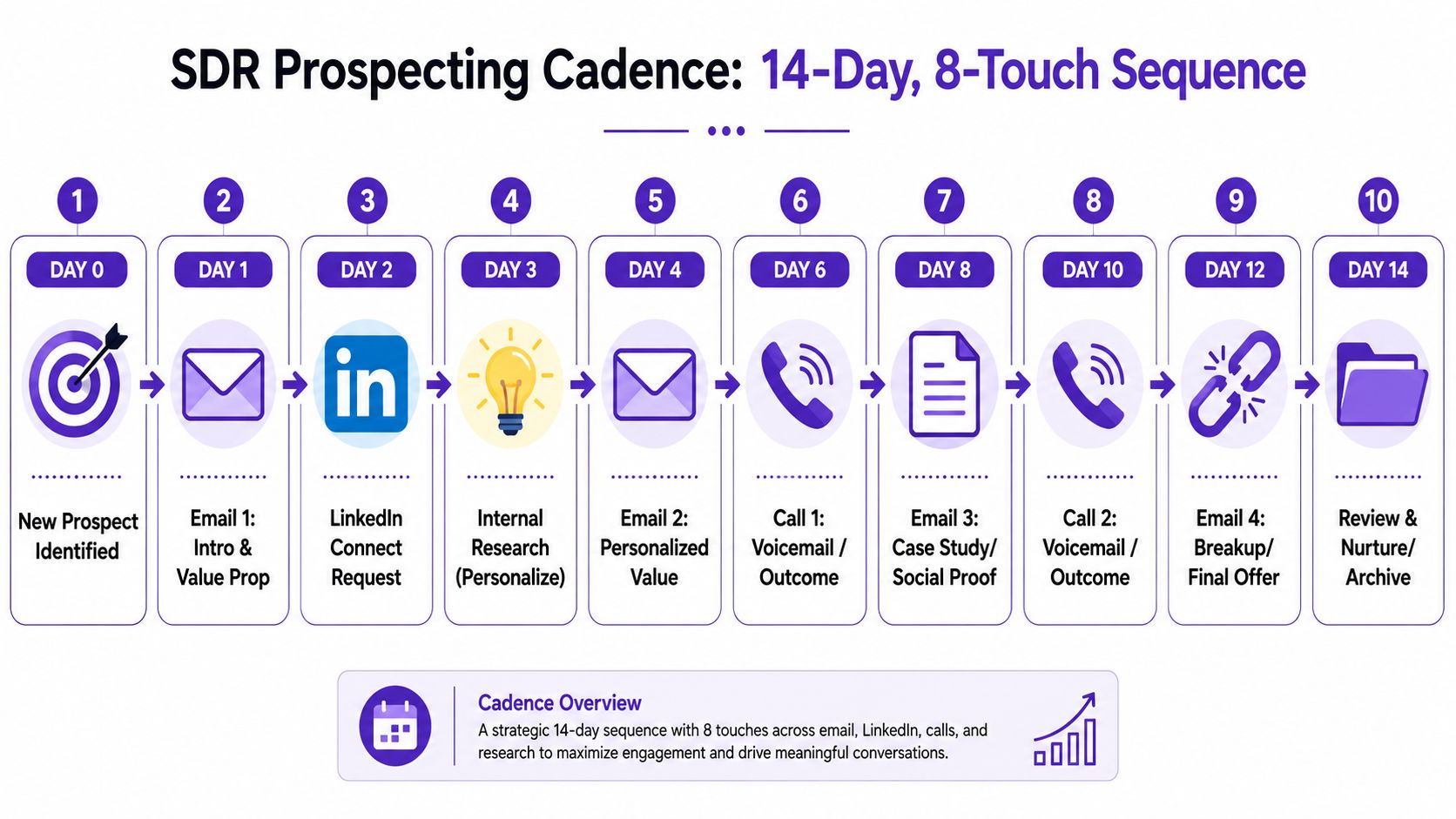
That sequence usually mixes automated and manual steps. The rep may send the first email from a template, then pause to review LinkedIn activity, add a call task, and tailor a later message based on what they found. The SEP keeps the cadence intact while still allowing judgment.
A quick walkthrough helps:
Early touches: Intro email, LinkedIn connect, and basic qualification.
Middle touches: A call task, a more personalized follow-up, and a relevance check.
End-of-sequence actions: Either route the contact to nurture, recycle later, or hand off if the account shows traction.
This video shows the kind of cadence logic teams often use in practice:
The account-based version
The workflow changes when the target is a strategic account instead of a single lead. Now the SEP coordinates outreach across several stakeholders. One person gets the value message. Another gets the technical angle. A third gets a softer introduction after someone else engages.
That's where the platform earns its keep. Without one, reps collide with each other, duplicate messages go out, and the account experiences your team as a swarm instead of a company.
How to Choose a Platform and Avoid Common Pitfalls
Buying a sales engagement platform is easy. Picking one your team will use is the hard part.
The first trap is feature shopping. Buyers get dazzled by AI copy buttons, shiny dashboards, and every possible workflow branch, then discover the daily rep experience feels clunky. If building a basic sequence requires a training montage, adoption will suffer.
The mistakes buyers make first
The common mistakes are usually operational, not technical:
Feature overload: Teams buy a giant platform when they only needed strong sequencing and CRM sync.
Weak integration review: The demo connects beautifully. The actual sync turns into cleanup duty for reps.
Ignoring adoption: Managers assume reps will change habits because the new tool exists. They won't.
Shallow reporting: Leadership wants coaching insight but gets a pile of activity data with no story.
Support blind spots: Implementation help matters more than most buyers admit before signature day.

A practical shortlist checklist
When comparing tools, ask questions that force a real answer:
What to evaluate | What to ask |
|---|---|
CRM compatibility | Does activity sync cleanly both ways, or will reps need manual fixes? |
Sequence builder | Can a manager create and edit workflows without calling RevOps for help? |
Channel support | Does it support the channels your team actually uses, not just email? |
Rep workflow | Can a rep work from one queue, or will they bounce between tools all day? |
Analytics quality | Can managers identify what message, step, or channel changed outcomes? |
Onboarding | What does rollout look like for a real team, not the best-case demo team? |
A platform that's slightly less powerful and far more usable usually wins. Reps don't adopt software because it's impressive. They adopt it because it saves them time today.
The Next Evolution From Engagement to Intent
Sales engagement platforms solved the scale problem. They did not solve the relevance problem.
That's why I think of SEPs as Outreach 2.0. They took outbound from manual chaos to organized execution. That was a big leap. But sequence-based selling still starts with a basic assumption: build a list first, then try to force timing later.
Why Outreach 2.0 stops short
That model works, up to a point. Then the market gets noisy. Every team has templates. Every team has cadences. Every inbox is full of “personalized” messages written from the same playbook.
The next step is intent-led prospecting. Instead of asking, “Who fits our ICP?” smart teams ask, “Who fits our ICP and is showing signs of interest right now?” That's a different motion. Timing becomes part of targeting, not a guess layered on top.
This is why interest in high-intent leads has grown. Teams want signals that help them prioritize relevance over raw activity count.
Sales Engagement Platform vs. Autonomous Prospecting Platform
Attribute | Traditional Sales Engagement Platform | Autonomous Prospecting Platform (e.g., RoverLead AI) |
|---|---|---|
Primary job | Execute outreach sequences | Surface prospects showing live intent and suggest timely outreach |
Starting point | Static lists, imported contacts, CRM records | Behavior signals, engagement activity, live market context |
Best use | Structured follow-up and team-wide process consistency | Finding who is worth contacting now |
Rep workflow | Work the queue efficiently | Prioritize the queue more intelligently |
Personalization model | Templates plus manual edits | Context built from current behavior and signal-based triggers |
Main strength | Scale and process control | Relevance and timing |
Main weakness | Can create more noise if targeting is weak | Depends on signal quality and clear ICP definition |
An SEP is still useful. For many teams, it's mandatory. But on its own, it's incomplete. Execution without intent just helps you scale your guesswork faster.
Your Sales Engagement Platform Questions Answered
1. Is a sales engagement platform the same as a CRM
No. A CRM stores records. A sales engagement platform drives outbound actions and follow-up.
2. Does every sales team need one
Not every team, but most outbound teams benefit from one once manual follow-up starts slipping or rep activity becomes hard to manage consistently.
3. What channels should it support
At minimum, the channels your reps use to start and continue conversations. Email alone usually isn't enough for modern outbound.
4. Will automation make outreach sound robotic
It can if you automate the wrong parts. Automate process and task flow. Keep judgment and real context in the message.
5. What matters more, features or usability
Usability. A rep-friendly tool with strong basics usually outperforms a bloated platform nobody likes opening.
6. How important is CRM integration
Very. If data sync is messy, the platform creates admin work and trust drops fast.
7. Should SDRs and AEs use the same platform
Often yes, but not always in the same way. SDRs usually need high-volume queue discipline. AEs often need account coordination and stakeholder visibility.
8. What's the biggest implementation mistake
Rolling it out as software instead of as a workflow change. Teams need operating rules, not just logins.
9. Can a sales engagement platform replace prospecting research
Not fully. It can reduce manual work, but reps still need context. The better question is whether your stack helps reps spend more time on useful research and less on scavenger hunts.
10. What should I look for in 2026
Look for a platform that doesn't just help you send more. Look for a setup that helps your team contact better-fit buyers at better moments, with fewer wasted touches.
If your team has already nailed Outreach 2.0 and wants the next step, RoverLead AI is worth a look. It helps B2B teams move from static lists to live LinkedIn intent, so reps can spot high-fit prospects when they're showing interest, not weeks later after another stale list pull.