Intent Based Marketing: Stop Guessing Who Wants to Buy

Your SDRs built the list. Marketing polished the messaging. Sales launched the sequence. Then nothing happened except a few opens, a couple of polite no-thanks, and one reply that said, “Why are you emailing me?”
That's the problem with most outbound. It looks organized on the inside and random on the buyer's side. Teams still target people based on title, company size, and a neat-looking ICP slide, then wonder why the market responds with a shrug.
Intent based marketing fixes the part many marketing departments keep guessing at. It shifts focus from who a prospect is to what they're doing right now. That sounds obvious, but it changes everything. You stop treating every VP at a mid-market SaaS company like they woke up today desperate for your product. You look for behavior that suggests an active problem, active research, or active evaluation.
Done well, intent based marketing doesn't make sales easier because buyers suddenly become generous. It makes sales more relevant because your team enters deals that are already moving.
Table of Contents
Your Sales Team Is Working Hard Not Smart
A lot of sales teams confuse activity with progress. Reps spend hours pulling lists, enriching contacts, checking job changes, and building sequences for accounts that look right on paper. Then they send the same broad message to people who may not be thinking about the problem at all.
That's not a sales process. That's expensive optimism.
The better move is to prioritize behavior. If an account is researching your category, revisiting relevant content, or showing visible interest in the problem you solve, the conversation starts warmer. Foundry reports that intent-based ads were 2.5x more efficient than control-group campaigns and delivered a 220% higher click-through rate in its ABM and intent data benchmark. The point isn't just ad performance. The point is that real-time behavior beats static targeting.
Stop asking, “Does this company fit our ICP?” first. Ask, “Did they do anything that suggests they care right now?”
If your team is still running outbound from static lists alone, fix that before you hire another SDR. Better prioritization usually produces greater results than more headcount. If you're tightening handoffs and rep workflows, this guide on sales process optimization is a useful companion.
So What Is Intent Based Marketing Really
A rep opens Salesforce on Monday morning and sees 200 “good fit” accounts. Same firmographic filters. Same generic sequence. Same bad odds.
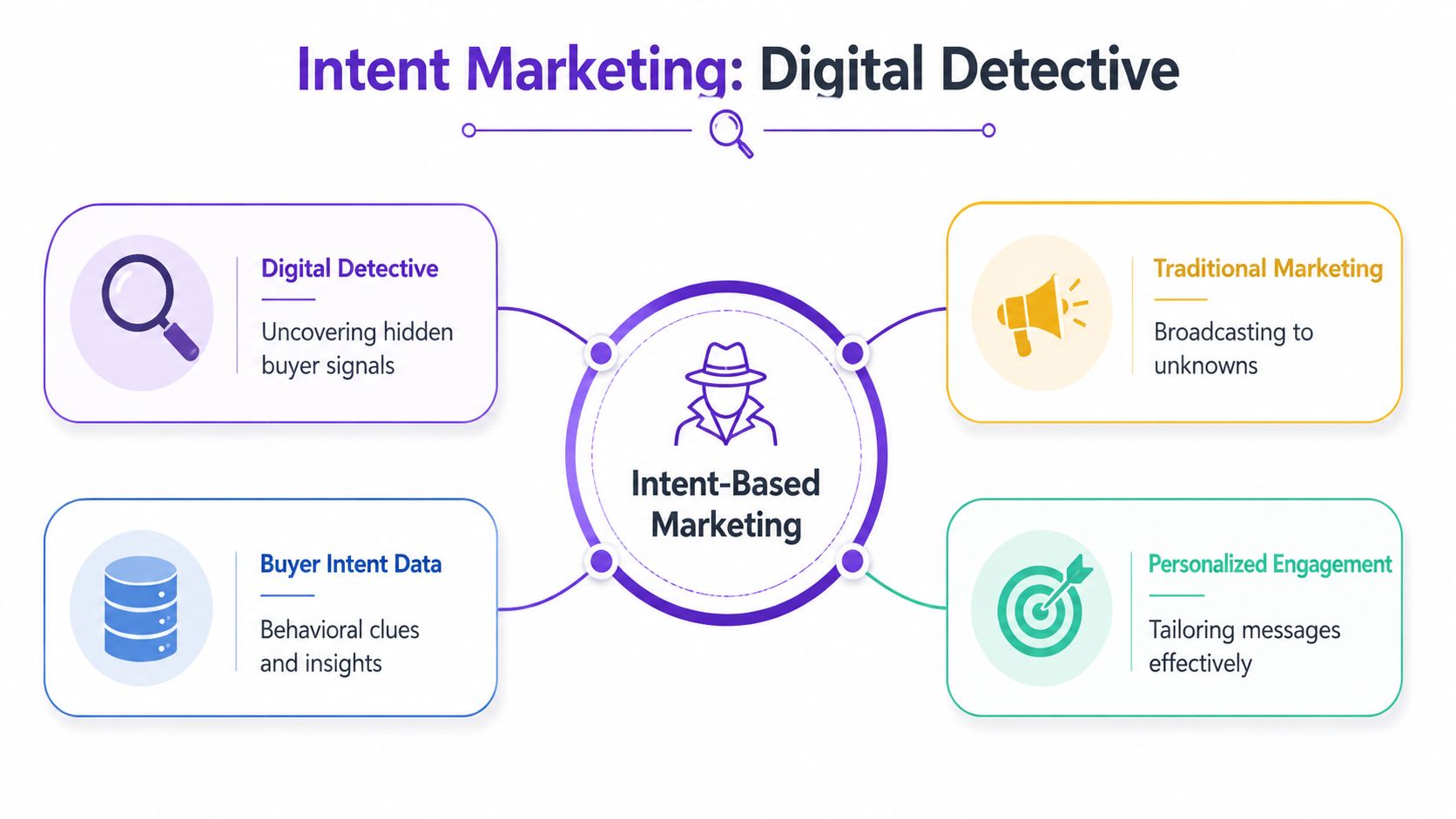
Intent based marketing fixes the prioritization problem. It uses observed behavior to decide which accounts deserve attention now, what they likely care about, and how specific your outreach should be. The point is not more data. The point is better timing.
What counts as intent
Intent is not one click, one page view, or one person liking a post. It is a useful pattern that suggests buying interest is forming or active. Good teams judge signals by three things. How recent they are, how specific they are to the problem you solve, and whether a rep can put them to use.
That can include:
Owned behavior such as repeat visits to pricing or product pages, demo requests, webinar attendance, or replies to outbound
Research behavior outside your channels such as category reading or competitor topic consumption
Public social behavior such as LinkedIn comments, post engagement, or visible discussion around the pain point your product addresses
Many teams get lost here. They buy a giant third-party feed, score a bunch of accounts, and call it intent. Then reps stare at an account-level surge with no clear contact, no clear trigger, and no message angle. Useful in theory. Slippery in practice.
The more actionable view is simpler. Intent based marketing is the discipline of ranking signals by how fast your team can use them. A prospect commenting on a relevant LinkedIn post this morning is often more useful than an anonymous topic spike from last week. One gives a rep context for outreach. The other gives marketing a hint to watch.
Why teams care
Used well, intent based marketing helps sales teams stop treating every ICP account like it is equally ready. It tightens focus, improves message relevance, and cuts wasted sequences. Used poorly, it creates a lot of dashboard theater and very little pipeline.
That is why the output matters more than the definition. The job is to turn behavior into priority, context, and action. If you want the practical version of what sales can do with those signals, this guide to high-intent leads is a useful follow-on.
The Three Flavors of Intent Data
Not all intent data deserves equal trust. Some signals are close to the buyer and easy to act on. Some are broad and useful for pattern spotting. Some look exciting in a dashboard and turn into mush the moment a rep tries to use them.
The practical view is simpler than most vendor slides. You have three useful buckets: first-party, third-party, and social.
Comparison of Intent Data Types
Data Type | What It Is | Pros | Cons |
|---|---|---|---|
First-party | Behavior on your own properties such as website visits, form fills, webinar attendance, or CRM activity | High relevance, clear context, easier to tie to your funnel | Limited to people already touching your brand |
Third-party | Research activity observed outside your properties through publisher and partner networks | Earlier visibility into category research, broad market coverage | Often account-level, often delayed, often noisy |
Social | Public engagement on platforms like LinkedIn such as comments, topic engagement, and interactions with creators or competitors | Timely, visible, rich context for outreach, easier for reps to act on | Can be messy without good filtering, not every social interaction means budget |
Third-party data matters because it expands your field of view. Major vendors collect co-op intent data from 4,000+ high-traffic B2B research websites and domains, according to Cognism's category overview cited in this Demandbase-related background. That scale is useful for spotting early research across the web.
But scale is also the trap.
What each type is good for
First-party data is your best source for strong buying context. If someone keeps hitting product pages or conversion paths, that usually deserves attention.
Third-party data is useful for account prioritization and early-stage pattern detection. It is less useful when reps need a precise opener tomorrow morning.
Social intent data is often the most actionable because it's immediate and public. A prospect commenting on a competitor's post or engaging with content about a painful workflow is easier to work with than a vague “topic surge.”
The broadest data source is not automatically the best one. Reps need signals they can turn into conversations, not just colored scores in a dashboard.
The strongest programs blend all three. First-party shows direct engagement, third-party shows market movement, and social often tells you where urgency is surfacing in plain sight.
A Practical B2B Implementation Guide
Monday morning. Sales has a list of "high-intent" accounts. Half came from a topic surge, a few hit the pricing page once, and one prospect liked a LinkedIn post about a painful workflow your product fixes. Guess which one a good rep should call first.
That's the implementation problem in plain English. Intent only helps if the signal leads to a clear next action.
Pick action triggers before you pick software
Teams get into trouble when they buy a big intent feed first and figure out operations later. The result is predictable. Marketing sees coverage. Sales sees homework.
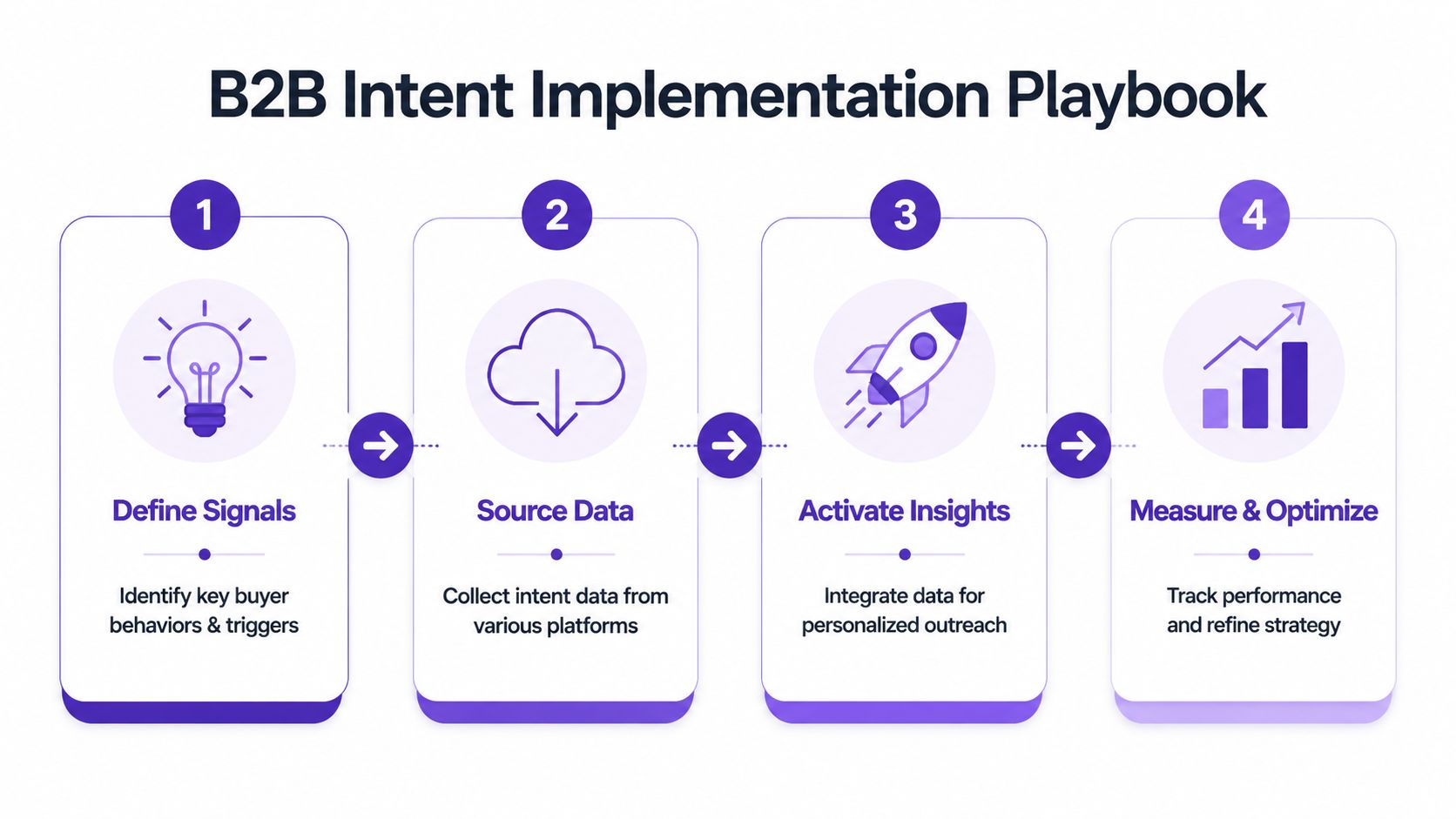
Start with the moments that should trigger human follow-up. Default gives a practical example in its guide to B2B intent data: a rule like “3 high-intent actions in 7 days” is simple enough for sales to trust and specific enough for ops to build.
A workable trigger set usually includes:
Repeat visits to high-stakes pages
Product, pricing, integrations, security, competitor comparisons, and implementation pages usually beat generic blog traffic.Evaluation-stage content engagement
Demo-related webinars, ROI content, migration guides, and technical docs say more than top-of-funnel downloads.Signal stacking across channels
A known account visiting your site after a rep sees relevant LinkedIn engagement is far more useful than a standalone third-party spike.
That last point matters more than many teams admit. Broad third-party data can help with account selection, but high-immediacy social signals often give reps the better opener because the context is fresh and public.
Build thresholds sales can explain in one sentence
Do not score every click. That's how teams end up labeling an account "hot" because someone opened two newsletters and skimmed a blog post.
Use a small number of signals. Weight them by buying intent, not by ease of collection.
A simple model might look like this:
Cold for one-off or low-context activity
In-market for repeated category research or light site return visits
Engaged for multiple meaningful actions tied to evaluation
Ready for outreach for clustered actions in a short window, especially when first-party activity lines up with social context
If a rep cannot explain why the account was flagged without opening three tabs, the model is too complicated.
If you need a cleaner handoff between signal capture and rep action, this guide on how to qualify sales leads is a useful filter.
Route fast. Then write like a person.
Intent decays quickly. A signal that looked promising on Tuesday can be useless by Friday, especially when it came from public social activity that has already moved on.
Route the account to a named owner fast, with the reason attached. Not a score. A reason.
Good outreach mirrors the signal without sounding creepy. “You seem interested in solutions like ours” is lazy. “Saw your team discussing onboarding bottlenecks and noticed a spike in visits to our integration docs” gives the rep something real to work with.
A practical message structure:
Observed context tied to a live problem
Reason this matters to the account or role
Low-friction next step that fits buyer stage
That is what separates intent programs that create pipeline from the ones that create dashboards and internal meetings.
Measuring ROI Beyond Clicks and Opens
Intent based marketing should make the funnel move better, not just make dashboards look busy. If your reporting still revolves around opens and clicks, you're measuring motion, not impact.
The main question is simple. Do intent-qualified accounts move through the funnel faster and convert better than accounts sourced through generic targeting?
What to measure instead
Focus on metrics sales cares about:
Meeting quality by signal source. Which signals produce conversations that continue past the first call?
Pipeline velocity for intent-qualified accounts. Do those accounts move faster from first touch to opportunity?
Stage conversion after qualification. Are intent-routed accounts more likely to progress?
Positive reply rate on rep outreach informed by real context
Closed-won patterns by signal cluster over time
A lot of teams get uncomfortable because they want intent to be judged like a campaign channel. It isn't one. It's a prioritization layer across outbound, ads, email, and sales follow-up.
A healthy program compares outcomes by signal quality, not just by volume. If social signals create better meetings and first-party signals create better late-stage conversion, that's useful. If a giant third-party topic feed keeps surfacing accounts that never reply, that's useful too. It tells you what to stop trusting.
The Rise of Social Intent Prospecting Tools
Traditional intent data often lives in the dark funnel. It's aggregated, account-level, and occasionally late by the time it reaches a rep. Useful, yes. Easy to act on, not always.
Social intent is different because the signal is public and immediate.
Why social signals feel different
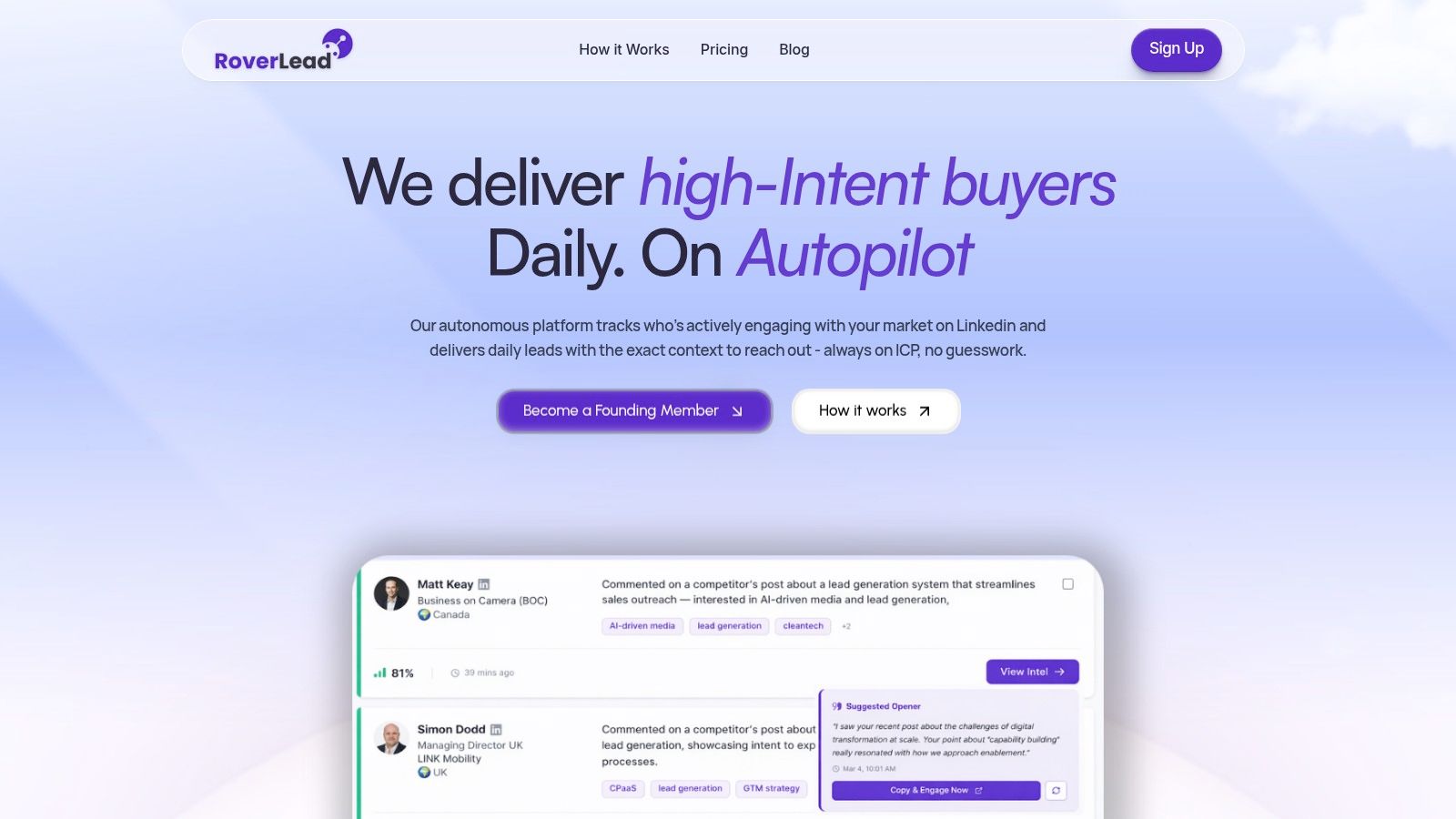
When someone comments on a post about a painful workflow, engages with a competitor's content, or joins a visible discussion around pricing, implementation, or category trade-offs, reps have something concrete to work with. It's not just “this account is surging.” It's “this person is raising their hand in public.”
That matters because modern intent models work best when they prioritize explicit behaviors and stage-based segmentation, as noted in N.Rich's implementation guide. Social engagement often carries that same explicit quality, with the added benefit of immediacy.
Where tools fit
Newer tooling has become practical. Instead of forcing SDRs to babysit Sales Navigator and manually monitor posts, tools can watch for relevant engagement patterns and surface likely opportunities.
One example is RoverLead AI, which tracks LinkedIn engagement tied to your ICP, competitors, keywords, and niche topics so reps can work from behavior-driven lead feeds instead of static list pulls.
The shift is less about replacing first-party or third-party data and more about improving actionability. Social signals tend to answer the rep's favorite question: “Why this person, why now?”
This short demo shows the workflow in motion.
Common Pitfalls and How to Dodge Them
The funny thing about intent based marketing is that teams usually fail with too much enthusiasm, not too little. They collect every possible signal, create a giant score, and congratulate themselves for becoming “data-driven” while reps ignore the alerts.

Three ways teams blow it
They confuse curiosity with intent
Only B2B points out a problem too many guides skip: teams need evidence-based scoring rules to separate real buying intent from generic curiosity in its analysis of intent-based marketing. A prospect can read a thought-leadership article and still be nowhere near a purchase.They react too slowly
Good signal, slow follow-up. Sales gets the alert after the window has cooled off, or the account sits in a queue because routing is fuzzy.They send generic outreach anyway
This one hurts the most. The team finally gets context, then wastes it with a template that could have gone to anyone.
A weak signal used quickly can beat a strong signal used late.
The dodge is straightforward. Track fewer signals. Weight repeated actions higher than one-off activity. Set response rules. Give reps context they can use in a sentence or two.
Intent Based Marketing FAQ
Is intent based marketing just lead scoring with a new name
No. Lead scoring usually focuses on activity inside your own funnel. Intent based marketing includes behavior beyond your owned channels and uses that context to drive timing, routing, and messaging.
Does it only work for enterprise teams
No. Smaller teams often benefit more because they can't afford random outreach. A tighter signal model helps them spend limited rep time where it counts.
Should sales or marketing own it
Both. Marketing usually manages data and segmentation. Sales owns fast follow-up and message quality. If one side treats it like the other team's project, it stalls.
What's the best first signal to start with
Start with first-party actions that clearly suggest evaluation. Repeated product-page visits, demo-related behavior, and high-value content tied to the problem are practical places to begin.
Is third-party intent data enough on its own
Usually not. It's useful for coverage and prioritization, but by itself it can be too broad for frontline outreach.
Why are social signals getting more attention
Because they're timely and easier to interpret. Public engagement often gives reps immediate context for why a buyer might care now.
How fast should reps act on an intent signal
Fast enough that the behavior still feels current. If your process turns fresh signals into next week's task list, you're wasting the advantage.
How do you avoid creeping buyers out
Use the context to be relevant, not invasive. Talk about the problem space, use case, or business issue. Don't recite their activity log back to them.
Does intent based marketing replace ABM
No. It improves ABM. ABM tells you which accounts matter. Intent tells you which ones are active and what kind of play makes sense.
How do you know which signals actually matter
Compare signals against meetings, pipeline movement, and closed-won outcomes over time. If a signal produces attention but not progress, downgrade it.
RoverLead AI fits this category for teams that want to operationalize social intent on LinkedIn without doing manual list building all day. If your reps need fresher context than static firmographics can provide, RoverLead AI is worth a look.