Is Smile and Dial Dead? Pivot to Social Selling

Your SDR has a polished headset, a decent dialer, a CRM full of names, and a manager telling them to bring more energy. So they smile, hit call, hear voicemail, hit call again, get brushed off, hit call again, and spend the afternoon pretending morale is a strategy.
That's the part sales leaders rarely say out loud. A lot of teams are running a modern tech stack on top of an old prospecting habit. The screens got better. The workflow didn't. And when reps are still interrupting strangers from stale lists, all that forced positivity starts to feel less like discipline and more like theater.
Smile and dial isn't useless. It's just no longer enough. The phone still works. But brute-force calling has lost its edge because the economics changed. Buyers leave signals everywhere now. If your team ignores those signals and relies on raw volume instead, you're paying people to guess.
Table of Contents
That Cheerful Voice on the Other End of a Dead Line
It's a familiar scene. An SDR logs in, opens the dialer, straightens up, pastes on some energy, and starts working through a list that looked promising in a spreadsheet and terrible in real life. Half the job becomes emotional labor. Sound upbeat. Sound confident. Sound like you're not making your twentieth interruption before lunch.
Meanwhile, the prospect on the other end didn't ask for the call, doesn't know your company, and can usually tell in seconds whether this is relevant or random. That's why so many reps feel the quiet absurdity of the old routine. They're told to be more enthusiastic when the underlying problem is that the outreach is poorly timed and loosely targeted.
Cold outreach doesn't fail because reps forgot to smile. It fails because the team confuses activity with precision.
Old-school sales floors loved smile and dial because it was easy to manage. Count dials. Monitor talk tracks. Push volume. It gave leaders something neat to measure, even when the buyer experience was messy.
That's why the tactic survives. Not because it's the smartest motion, but because it's simple to run.
What Exactly Is Smile and Dial
Smile and dial is a classic sales term for high-volume cold calling done with a deliberately upbeat tone. Modern glossaries still frame it as an outbound staple, not some shiny new methodology. One sales explainer traces it back to the 1980s telemarketing era, when reps worked from desk phones and paper lists, and contrasts that model with a more data-driven approach where the first 15 seconds matter most and timing analysis draws on 1.4 million calls in its framing (Clay's smile and dial glossary).

The smile part is real
The smile isn't just motivational fluff. It's a tone-management technique. One source notes that listeners can hear the difference between a smiling and non-smiling voice, and that tone carries most of the meaning in phone communication (analysis of smiling on the phone).
That matters because phone calls run on first impressions. A warmer voice sounds less defensive, less robotic, and more human. If your rep sounds flat, rushed, or irritated, the prospect hears it immediately.
So yes, smiling helps. It changes vocal timbre, articulation, and trust signals.
The dial part is the problem
The problem is everything wrapped around the smile. Operationally, smile and dial is a high-volume outbound workflow. The rep loads a list, gets in the right headspace, dials in quick succession, uses a tight script, and logs outcomes for follow-up. That workflow has been clearly described as a rapid-cadence system where throughput and conversation efficiency matter most, and where the biggest optimization is cutting dead time between dials (Nrev's smile and dial glossary).
That's fine if your main objective is speed.
It's weak if your main objective is relevance.
A smile can improve delivery. It cannot rescue a bad list, poor timing, or a generic opener. That's a common point where groups get stuck. They keep coaching the performance while ignoring the targeting model underneath it.
The Smile and Dial Scorecard Pros and Cons
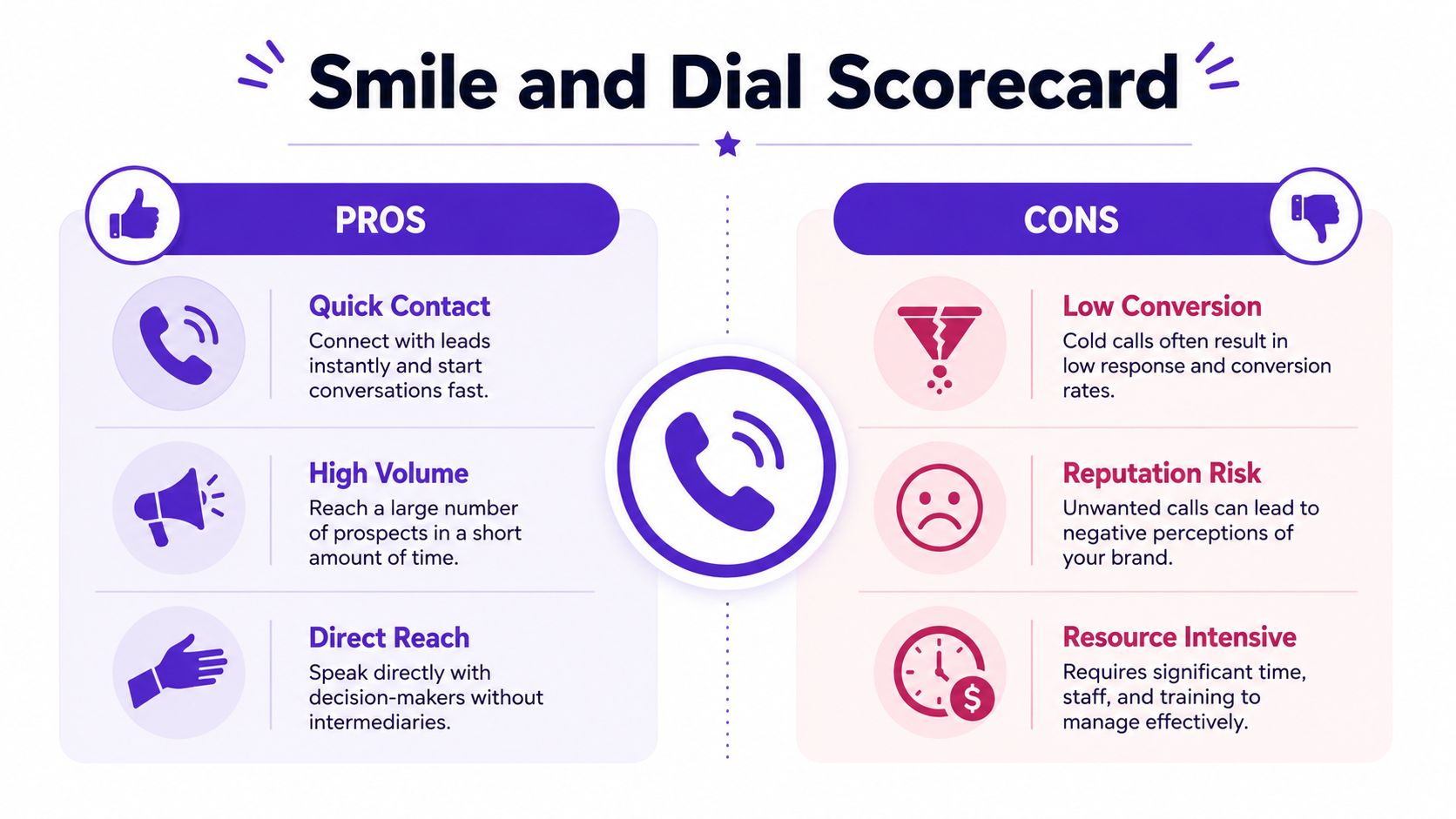
Smile and dial still has a few virtues. They're just not the virtues modern teams need anymore.
Why teams still use it
There are reasons sales orgs keep going back to it:
Easy to teach: New reps can understand the motion fast. Open list. Call people. Follow script.
Simple to manage: Leaders can watch dial count, call blocks, and outcomes without much ambiguity.
Useful for confidence building: Repetition does help some reps get comfortable hearing objections and thinking on their feet.
Direct access to attention: When someone picks up, you get immediate interaction instead of waiting on inbox behavior.
Those are real advantages. They're also operational advantages, not strategic ones.
Practical rule: If a prospecting method is easy for management but miserable for buyers and reps, it won't hold up for long.
Why the downsides hit harder now
The cracks show up fast in actual execution.
Efficiency falls apart: High-volume workflows reward pace, but they often create a conveyor belt of low-context conversations.
Burnout climbs: Reps can handle rejection. What they can't stand is repeated irrelevance.
Brand risk grows: Buyers don't separate a bad call from your company. They remember the interruption.
Opportunity cost gets ugly: Every hour spent dialing weak-fit contacts is an hour not spent engaging people already showing interest in your category.
This is the core issue. Smile and dial was built for a world with less visible buyer behavior. Today, prospects leave clues in public. They comment, engage, ask questions, and follow relevant voices. If your team ignores that and still leans on brute force, the workflow may feel busy, but it's strategically lazy.
The old playbook assumes effort creates efficiency. It doesn't. Better timing creates efficiency.
Brute Force Volume vs Precision Timing
The phone still earns its place. That's not the debate. One sales resource reports that cold calling gets a response rate about 5 percentage points higher than email outreach, that 78% of business leaders have taken a meeting from a cold call, and that 82% of buyers accept proactive outreach. The same source says Tuesday posts the strongest connects and positive call rates at 4.8%, while Tuesday and Wednesday account for 44% of all demos booked (Prospéo's smile and dial analysis).
Those numbers don't prove volume wins. They prove timing and qualification win.
Comparison of two prospecting models
Metric | Smile & Dial (Brute Force) | Intent-Based Social Selling (Precision) |
|---|---|---|
Lead source | Static lists | Live buyer behavior |
Timing | Rep decides when to interrupt | Buyer activity suggests when to engage |
Opener | Script-first | Context-first |
Success signal | Dials made | Relevant conversations started |
Rep effort | High repetition | Higher judgment, less wasted motion |
Buyer experience | Unexpected interruption | More natural entry point |
Coaching focus | Energy, script discipline | Relevance, timing, message fit |
That table is the part too many sales teams avoid because it exposes the inherent tradeoff. Smile and dial is easy to operationalize. Intent-based social selling is harder to fake.
If you want a broader view of how modern teams structure outreach before they ever touch the phone, this guide to B2B sales prospecting methods is worth your time.
What the economics actually reward
Brute force volume made sense when data was scarce and buyer intent was mostly invisible. Now intent is messy but observable. That flips the economics.
A rep who calls a random account may still get lucky. A rep who reaches out after spotting meaningful engagement has a reason to be there. That changes the opener, the tone, and the odds of a decent conversation. It also cuts one of the biggest hidden costs in outbound: wasted human attention.
Buyers don't hate outreach. They hate irrelevant outreach.
That's why the modern benchmark isn't “how many dials did we make?” It's “did we show up when the buyer had a plausible reason to care?”
The Modern Alternative Selling with Social Signals
The replacement for smile and dial isn't “never call again.” It's sell when context exists.
What strong social selling actually looks like
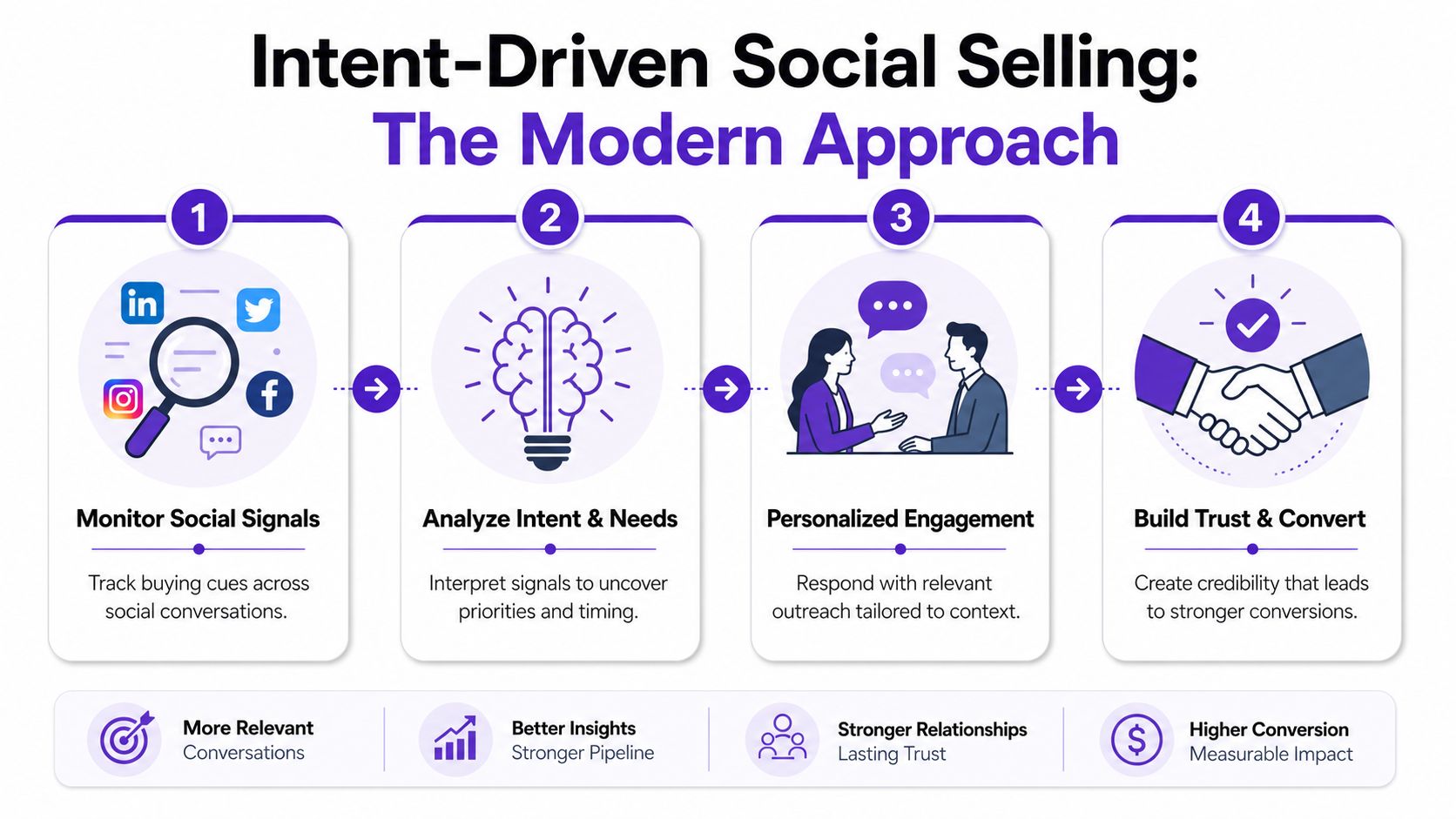
Good social selling has nothing to do with posting empty thought leadership and hoping pipeline appears. It's closer to field intelligence. You watch for signals that suggest a buyer is curious, frustrated, comparing options, or actively learning.
That can include behavior like:
Engaging with competitor content: They're paying attention to the problem space.
Commenting on expert posts: They're publicly revealing what they care about.
Joining a conversation around a relevant topic: They're already mentally in the market, even if they're not filling out forms.
Reacting to pricing, implementation, or demo discussions: That's not casual scrolling. That's buyer behavior.
If you want practical examples of how sellers do this well on the platform buyers already use all day, read this breakdown of social selling on LinkedIn.
A quick overview helps here:
Why this approach feels better for buyers and reps
The biggest advantage isn't just performance. It's posture.
When a rep enters a conversation based on a signal, they don't sound like a stranger demanding attention. They sound like someone who noticed the buyer is already thinking about the issue. That's a radically different interaction.
Relevance lowers resistance faster than enthusiasm ever will.
It's also better for your team. Reps stop spending their day hammering through names and start engaging with context. That improves message quality, morale, and coaching. Instead of telling people to “bring more energy,” you can teach them how to read a signal and respond intelligently.
That's the modern outbound motion. Not louder. Better timed.
Making the Switch A 3-Step Transition Plan
You don't need a dramatic sales transformation memo. You need a controlled shift.

Three moves that don't wreck the quarter
Audit what your team is doing now
Examine your current smile and dial workflow closely. Not the dashboard version, but the actual practice. Where are reps losing time, where do conversations stall, and what types of outreach consistently feel cold in the worst way?Run a small pilot with social-signal prospecting
Don't retrain the whole floor at once. Pick a few reps. Give them a clear ICP, signal sources, messaging rules, and a short testing window. Compare quality of conversations, not just surface activity.Equip reps with better openers
Signal-based selling still needs strong execution. Reps need a natural way into the conversation. This collection of conversation starters for outbound prospecting is a good place to tighten that part of the motion.
The key is restraint. Don't kill the phone. Reposition it. Calls work better when they come after context, not instead of it.
Your Burning Questions on Ditching the Dial Tone
FAQ
1. Is smile and dial dead?
No. But the lazy version should be. The smile still helps. The blind dialing model is what's aging out.
2. Should SDRs stop cold calling entirely?
No. They should stop treating cold calling like a numbers religion. Use the phone when it fits the moment.
3. Is social selling just posting content all day?
Not if you're doing it right. Strong social selling is about reading signals, entering relevant conversations, and messaging with context.
4. Do reps need a big personal brand to make this work?
No. They need credibility, decent timing, and a reason for the outreach. A giant audience is optional.
5. Will this reduce activity levels?
Usually it changes the activity mix. You may see fewer empty actions and more meaningful touches.
6. What skill changes matter most?
Research judgment, message quality, listening, and the ability to write like a human being. Reps who only know how to grind through a script will struggle.
7. Is smile and dial still useful for new reps?
It can be. Repetition teaches composure. Just don't confuse training wheels with a long-term go-to-market strategy.
8. How should leaders measure the new motion?
Track conversation quality, reply quality, meetings generated from relevant outreach, and how often reps engage around a real trigger.
9. What if my buyers aren't active on social platforms?
Some aren't visibly active, but many still engage with content, peers, creators, and industry discussion somewhere. The point is to find real behavior, not force one channel.
10. What's the simplest way to start this week?
Have each rep identify a narrow slice of accounts, monitor buyer-adjacent conversations, and build outreach around observed interest instead of static list logic.
The old sales floor loved certainty. Smile. Dial. Repeat. But certainty isn't the same as effectiveness. Today's better play is to earn your timing, not just your talk track.
If you're tired of forcing reps to grind through cold lists and want a cleaner way to find people who are already showing interest, take a look at RoverLead AI. It helps sales teams turn LinkedIn engagement into high-intent prospecting opportunities, so outreach starts with context instead of interruption.