
What Is Context Engineering? the Key to AI Sales in 2026

You gave the AI a prospect's LinkedIn profile, maybe a company summary, maybe a half-decent prompt you copied from a prompt library. It returned something like: “Hi Sarah, I noticed you're a visionary leader driving innovation at Acme.”
That message didn't fail because the model is stupid. It failed because the model was underfed, overconfident, and missing the one thing sales outreach lives or dies on: context.
For B2B sales teams, that's the whole game now. The winners won't be the reps with the fanciest prompt. They'll be the teams that can give AI the right buyer signals, the right company facts, the right memory, and the right rules for using all of it. That discipline has a name, and its importance is often underestimated.
Table of Contents
The Cringey AI Message You Almost Sent
You know the one.
It flatters the prospect with a vague compliment, mentions their job title, and then lands with the grace of a falling office chair. It sounds polished at first glance, but the second you read it like a human, it's obvious the sender knows nothing useful.
Why sales AI goes weird so fast
A lot of teams blame prompting. They assume the fix is another layer of “write in a friendly but concise tone” or “be more personalized.” That helps a little. It does not solve the underlying problem.
The main problem is that the model often has no idea what matters.
If you feed it a scraped profile and a generic instruction, it will do what language models do. It will autocomplete politeness. It will generate a statistically plausible sales message. And statistically plausible is exactly how you end up with outreach that sounds like it was written by a cheerful appliance.
Good outreach doesn't come from asking AI to “personalize.” It comes from giving AI something worth personalizing with.
For sales, the missing inputs are usually obvious in hindsight:
Recent buyer behavior: Did the prospect comment on a post about hiring, pipeline, pricing, or attribution?
Current company motion: Are they launching into a new segment, hiring sales reps, or talking publicly about efficiency?
Relevant internal memory: Do you already know this account uses a competing tool, or that a colleague spoke with them last quarter?
Rules of engagement: Should the model avoid pitching hard, cite only visible signals, or ask a narrow question instead of forcing a demo?
That bigger discipline is why this topic is getting attention. According to Atlan's write-up of Gartner predictions, context engineering is expected to be a feature in 80% of AI tools by 2028 and can improve AI agent accuracy by over 30%. The same source says business users often reject systems below an 80% accuracy threshold.
Sales teams don't need another novelty writer. They need AI that knows what to say, what not to say, and why.
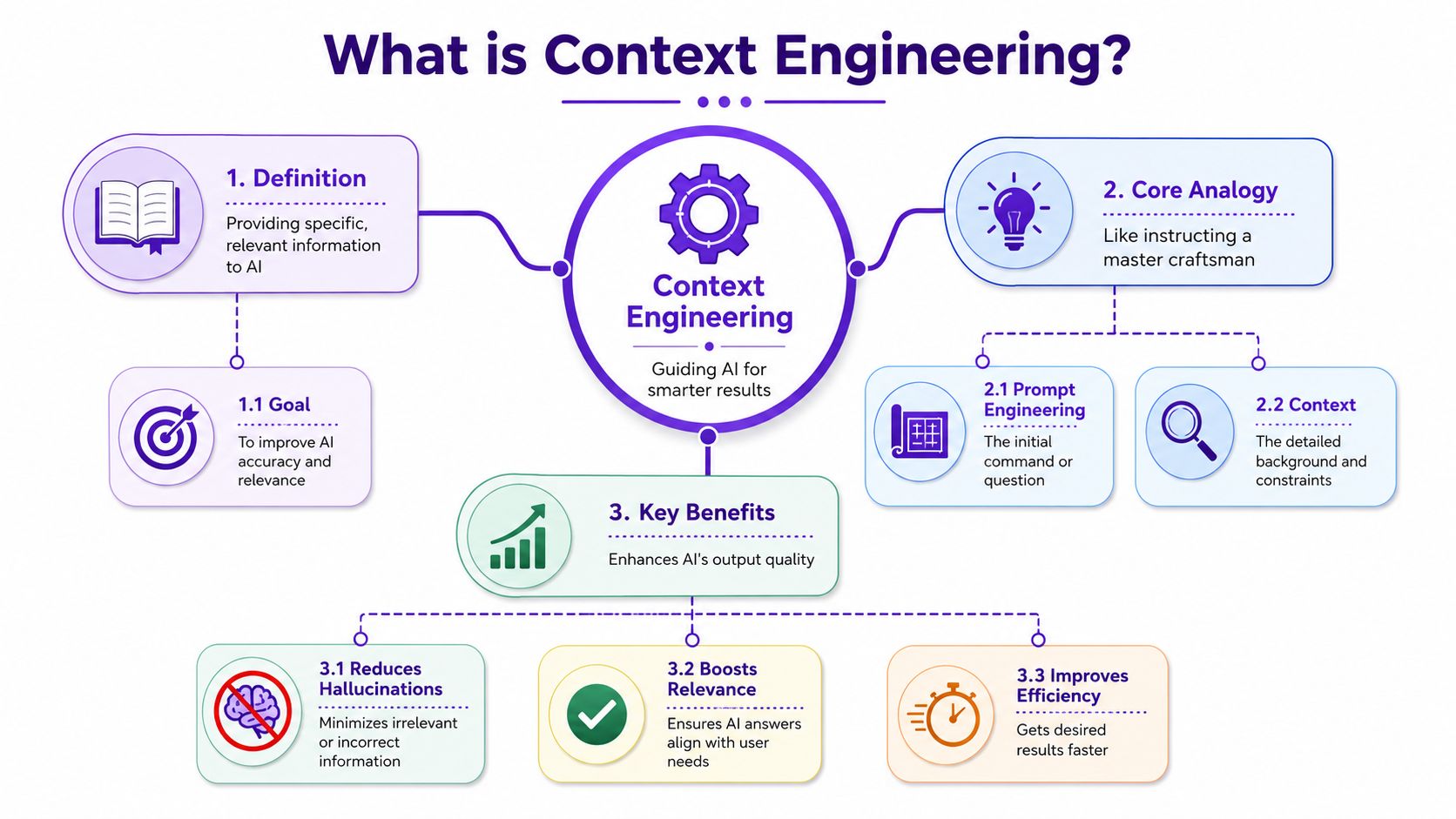
So What Is Context Engineering Anyway
Prompt engineering tells the chef what dish you want.
Context engineering stocks the pantry, labels the ingredients, adds the recipe, notes the allergy, and makes sure the chef isn't handed spoiled fish and a dessert menu when you asked for dinner.
That's the practical answer to what is context engineering.
The useful definition
LangChain describes it as a systems-level discipline: assembling the right information, tools, and memory at runtime so the model can complete a task accurately. In practice, that spans system instructions, retrieval, memory, tool access, and structured outputs, as explained in LangChain's overview of the rise of context engineering.
That “at runtime” part matters.
Sales isn't a static environment. Buyer signals change daily. LinkedIn conversations move fast. Company priorities drift. If your AI is working from a frozen prompt and stale account notes, it's going to sound behind the market, because it is.
What this looks like in sales
In B2B prospecting, context engineering means the AI doesn't just receive “write a message to this VP of Sales.”
It receives a package like this:
Who this person is: Role, seniority, company, segment
What they've done lately: Post likes, comments, hiring activity, public updates
What matters to your team: ICP fit, disqualifiers, competitor mentions, territory ownership
What the AI can use: CRM lookup, account notes, news retrieval, enrichment tools
How the answer should come back: Short opener, no fake familiarity, mention one relevant signal only
That's why this discipline has become more useful than endless prompt tweaking. If you want a grounded primer on applying AI to revenue workflows, this guide on how to use AI in sales complements the idea well.
The model can only sound smart about the buyer if the system around the model is smart about the buyer first.
Prompt Engineering vs Context Engineering
These aren't rivals. They're different jobs.
Prompt engineering handles the wording of the request. Context engineering handles the operating environment that makes the request workable. In simple terms, one is the instruction. The other is the briefing pack, memory, tool belt, and safety rails.
The side by side difference
Dimension | Prompt Engineering | Context Engineering |
|---|---|---|
Scope | The specific instruction given to the model | The full runtime system around the model |
Main goal | Improve how the request is phrased | Improve what the model knows and can access |
Typical inputs | Prompt text, examples, output formatting | Instructions, retrieval, memory, tools, schemas, rules |
Time horizon | Single interaction or task | Ongoing system design across workflows |
Common failure mode | Clever wording with weak grounding | Complex setup that still needs good prompting |
Sales analogy | Writing a better cold email template | Giving the rep account history, buyer signals, talk tracks, and CRM access before they write |
Best use case | Narrow tasks with stable inputs | Messy business tasks with changing information |
What works and what doesn't
A stronger prompt can improve tone, structure, and compliance with instructions. It can't magically invent buyer context. If the model never saw the prospect's recent comment, your customer story, or the account owner's notes, it can't use them.
On the other hand, a rich context stack still needs a sane prompt. If your system retrieves useful data but asks the model to “write a killer outreach message that blows them away,” you're still inviting nonsense.
The practical rule is simple:
Use prompt engineering to shape behavior.
Use context engineering to shape knowledge and action.
Most sales teams overinvest in the first and barely touch the second. That's why they get prettier garbage instead of better outreach.
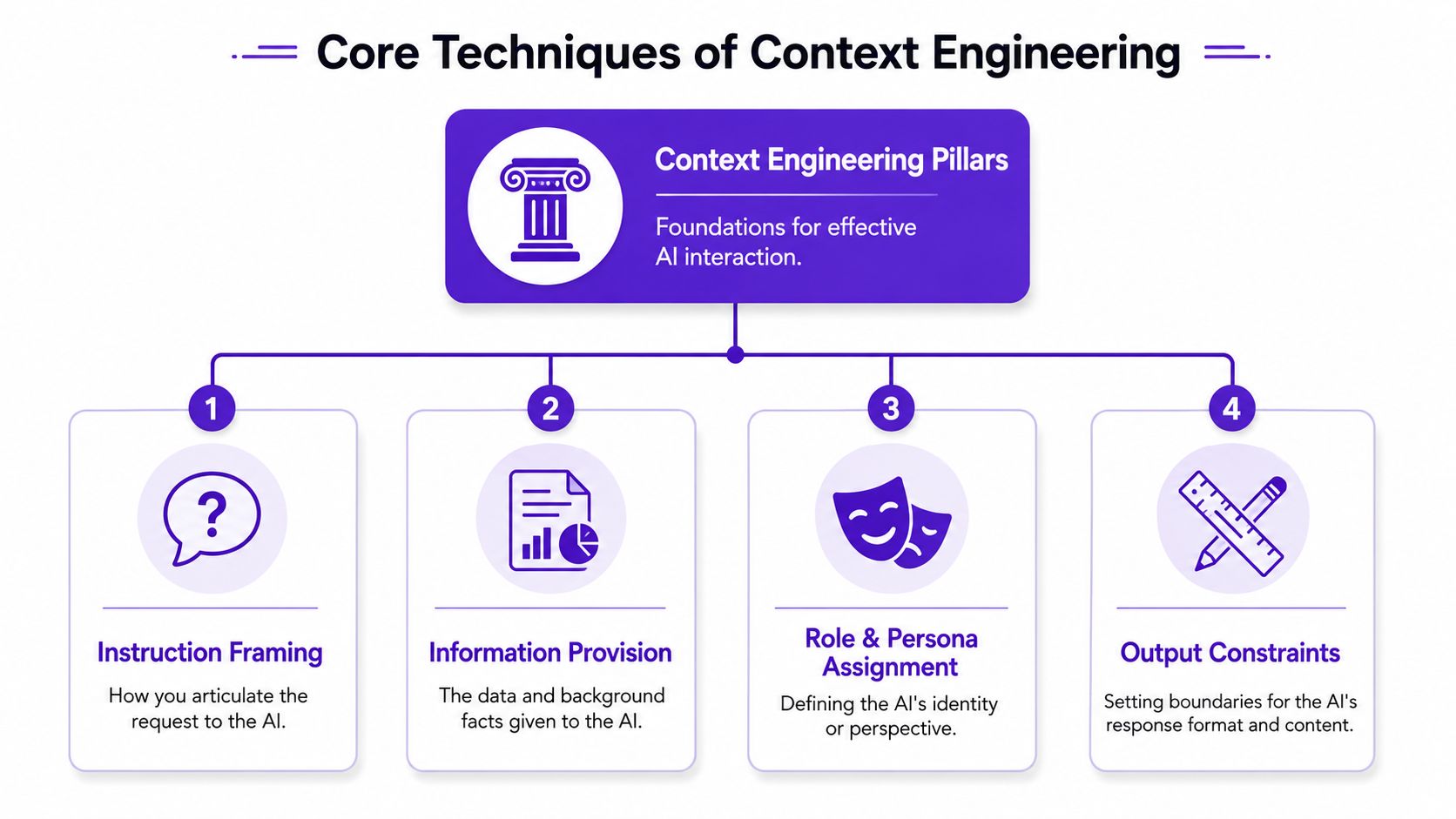
The Core Techniques of Context Engineering
The theory now stops wearing a blazer and starts doing actual work.
The best context engineering setups usually rely on a handful of core techniques. In sales, they determine whether your AI sounds current and credible or like it skimmed a profile and guessed.
Context window design
A bigger context window doesn't give you permission to dump everything in.
Elastic's guidance on context engineering and context-window budgeting is useful here: optimize what goes into the model so you don't blow the window with noise. That means filtering irrelevant material, selecting task-relevant documents, and supplying the right metadata so the model can use retrieved information well.
In sales terms, don't hand the model a ten-page account export when one recent comment, one company update, and one relevant note will do.
Why it matters for sales: better outreach comes from signal density, not data hoarding.
Retrieval with fresh sales context
Retrieval is how the system pulls in relevant information at the moment of use instead of hoping the base model somehow knows your buyer.
For prospecting, this might include recent LinkedIn activity, account news, website copy, CRM notes, call summaries, and product positioning docs. Good retrieval is selective. Bad retrieval is a junk drawer with API access.
If you're evaluating systems that operationalize this kind of signal-aware prospecting, this roundup of AI prospecting tools is a useful companion read.
State management that remembers the right things
Not every past interaction deserves permanent memory.
A useful state layer remembers what changes the next action. Did the prospect say “circle back next quarter”? Did your AE already send a note? Did the buyer engage with pricing content but ignore thought leadership fluff? That should influence future messaging.
What shouldn't happen is the model dragging stale or irrelevant history into every new draft.
Practical rule: store less than you think, and retrieve more carefully than you think.
Why it matters for sales: memory should preserve continuity, not recycle old awkwardness.
Tool use and function calling
At this point, the model stops being a writer and starts acting like a worker.
Tool use lets it fetch a profile, pull account data, check an internal note, query a CRM, or gather fresh company information. The trick isn't giving the model every tool under the sun. The trick is giving it the right tools with clear rules.
Why it matters for sales: the model can ground outreach in live information instead of hallucinating confidence from thin air.
Putting It to Work A LinkedIn Prospecting Example
Theory is nice. A message that gets ignored is still ignored.
Here's the difference between basic prompting and context engineering in a real B2B sales workflow aimed at LinkedIn prospecting.

Before the lazy prompt
A rep asks an LLM:
“Write a personalized LinkedIn message to a VP of Sales at a SaaS company based on their profile.”
The model sees a title, company name, and a few generic profile lines. It returns something like:
“Hi Amanda, I saw your experience leading revenue teams at NorthPeak. I'd love to connect and share how we help innovative sales leaders improve performance and drive growth.”
Technically, that is a message. Practically, it says nothing.
It doesn't mention what Amanda cares about now. It doesn't reflect any actual trigger. It doesn't show the sender noticed something specific. It's a template wearing a fake mustache.
After the context engineered workflow
Now the system assembles context before generation:
Prospect signal: Amanda commented on a LinkedIn post about ramp time for new reps
Company context: Her company recently posted an open role for sales enablement
Internal relevance: Your team has a case study about helping reps get usable account context faster
Instruction layer: Write a short LinkedIn opener. Mention only one observed signal. Don't claim research you didn't do. End with a question, not a pitch.
That produces something more like:
“Hi Amanda, I noticed your comment about rep ramp and the challenge of getting new hires useful account context fast. With your team also adding enablement support, I'm guessing that's a live priority. Curious how you're handling account research today without making reps do homework for half the morning?”
That's not magic. It's context.
For teams building a workflow around social selling, this guide to LinkedIn lead generation fits neatly with the same approach.
A quick walkthrough helps make the shift concrete:
Why the second version works
The better message doesn't sound better because the prose is fancier. It works because the AI had constraints and evidence.
It knew which signal to prioritize. It knew not to overclaim. It had enough context to ask a relevant question without pretending to know Amanda's entire strategy. That's the sweet spot for LinkedIn outreach. Specific, grounded, and not weird.
Your Context Engineering Questions Answered
Is context engineering only for technical teams
No. Engineers usually wire the systems, but sales leaders, RevOps, enablement, and growth teams decide what context matters. If your team can define ICP, signals, account stages, disqualifiers, and message rules, you're already doing part of the job.
Is it just a new name for prompt engineering
No. Prompting is one piece. Context engineering is broader and covers the runtime environment around the prompt.
Does this only matter for sales
Not at all. IBM notes that context engineering matters across customer support, sales, finance, HR, and operations, and that the process includes filtering irrelevant data, reranking or reducing context to fit the window, and separating instructions from data using formats like markdown or JSON in its context engineering overview from IBM. Sales just feels the pain faster because bad context produces bad outreach immediately.
What's the most common mistake
Teams stuff too much information into the model and call it sophistication.
Usually, that creates distraction. The model starts pulling from irrelevant notes, stale summaries, or loosely related docs. More input doesn't mean more clarity.
How is this different from fine-tuning
Fine-tuning changes model behavior through training. Context engineering changes what the model sees and can use at runtime. For most sales workflows, fresh runtime context matters more than trying to bake changing market information into a tuned model.
Do I need retrieval for every use case
No. Some narrow tasks work fine with fixed instructions and structured fields. But once the task depends on recent buyer activity, company updates, or account history, retrieval becomes much more useful.
Can small teams do this without building a giant AI stack
Yes. Start lean. Define the handful of context sources that improve decisions, then add rules for when they should be used. They don't need a science project. They need discipline.
What should the AI remember
Only what improves the next step.
Good memory includes buyer preferences, prior outreach status, account ownership, objections, and timing notes. Bad memory includes every transcript, every generated summary, and every half-relevant observation ever collected.
If the memory doesn't change the next action, it probably doesn't belong in the active context.
How do you measure whether context engineering is working
Use operational quality signals. Earlier in the article, Atlan's cited guidance highlighted metrics such as response accuracy, hallucination rate, task completion rate, trust score, context freshness, and conflict rates. In sales, that translates into a blunt question: does the AI produce grounded messages your reps will send?
What is context poisoning
It's when bad or misleading information gets into the context and steers the model the wrong way. That could be stale account notes, incorrect enrichment, contradictory instructions, or low-quality summaries. Once that junk gets reused, reliability drops fast.
Does model choice still matter
Of course. But better models don't rescue sloppy context forever. A strong model with weak context still misses buyer reality. A well-designed context system usually improves output more reliably than endless prompt tinkering.
If your team wants AI outreach that starts with real buyer signals instead of generic fluff, RoverLead AI is built for that job. It turns LinkedIn engagement into high-intent prospecting context your reps can use, then delivers grounded openers based on live signals, not static lead lists.