Mastering Sales Enablement Content for 2026 Success

You already know the scene. Marketing ships a polished asset. Sales nods politely. Then reps go right back to the scrappy one-pager in their own folder, the half-decent email snippet in Gmail drafts, and the battle-tested objection note they trust because it helps on calls.
That disconnect is why so much sales enablement content underperforms. The issue usually isn't effort. It's timing, usability, and fit. If a rep can't find the right asset in the moment it matters, the asset may as well not exist.
Good sales enablement content doesn't win because it looks expensive. It wins because it shows up at the right point in the deal, answers the buyer's next question, and helps the rep move the conversation forward without sounding like they swallowed a brochure.
Table of Contents
The Prettiest Case Study Nobody Ever Used
A team spends weeks building a flagship case study. Product wants technical depth. Marketing wants brand polish. Leadership wants the logo big enough to see from space. Legal trims out anything remotely interesting. The final piece looks sharp, sounds safe, and sits in a content library no rep opens twice.
Meanwhile, the top seller on the team sends three bullets in plain English. Problem. Outcome. Why the buyer chose you. The prospect replies, books the next meeting, and the deal moves.
That's not a content failure. It's an enablement failure.
The assets that get used aren't always the most beautiful. They're the ones reps can trust under pressure. Live calls don't reward elegance. They reward speed, clarity, and relevance. A rep needs something they can grab mid-conversation, skim fast, and use without translation.
Good sales enablement content earns its place in the workflow. It doesn't ask reps to admire it.
There's also a political trap here. Teams often create assets to satisfy internal stakeholders, not external conversations. You end up with a PDF that makes everyone in the launch meeting happy and nobody in the field faster.
What works looks less glamorous:
Short proof points: A customer story reduced to the few lines a rep can repeat naturally.
Objection-ready snippets: Content shaped around questions buyers really ask, not the ones internal teams wish they asked.
Easy retrieval: If the asset is buried in nested folders, reps won't go spelunking for it.
The hard truth is simple. Reps don't hoard content because it's pretty. They hoard it because it rescues awkward moments, sharpens positioning, and helps them close.
What Is Sales Enablement Content Really
Strip away the jargon and sales enablement content is just the material that helps reps run better sales conversations. Not more content. Better conversation support.
A useful way to think about it is a chef's mise en place. Before service starts, the ingredients are prepped, labeled, and within reach. The chef isn't hunting for salt while the pan burns. Sales works the same way. Reps need the right proof, framing, and objections material ready before the buyer asks.
That's the key difference from general marketing content. Marketing content often tries to attract attention. Sales enablement content helps a rep respond with precision.
What belongs in the toolkit
Some assets are customer-facing. Some are rep-facing. Both matter.
Customer-facing assets: Case studies, one-pagers, pricing summaries, demos, and proof points.
Rep-facing assets: Battle cards, talk tracks, discovery prompts, competitor notes, and FAQs.
Shared assets with different jobs: A webinar might educate the market, but a rep can also use a specific clip to handle a late-stage objection.
A lot of teams confuse “library” with “strategy.” That's how they end up with hundreds of files and very little adoption. A widely cited benchmark says 50% of all prospect engagement is generated by just 10% of sales enablement content, and organizations with a formal strategy see a 49% higher win rate on forecasted deals, according to G2's sales enablement statistics roundup.
That should change how you build. The goal isn't a giant archive. It's a curated set of assets where every item has a job. One asset opens a conversation. Another handles a competitor objection. Another gives procurement enough confidence to keep moving.
What it is not
It isn't a dumping ground for every deck, webinar, and blog post your company has ever produced.
Practical rule: If you can't explain when a rep should use an asset, don't publish it yet.
The best teams treat content like inventory with carrying costs. If it's outdated, hard to find, or vague, it creates drag. And sales has no patience for drag.
The Content Buffet Mapping Assets to the Buyer Journey
Timing matters almost as much as the asset itself. A pricing sheet too early can feel pushy. A top-of-funnel thought piece too late can feel evasive. High-performing content is mapped to the buyer journey, and best practices recommend organizing it by buyer challenge, sales stage, and use case so reps can retrieve the right material during live conversations, as outlined in SiftHub's guide to sales enablement content strategy.

Sales Enablement Content by Buyer Stage
Stage | Buyer Goal | Rep Goal | Example Content Types |
|---|---|---|---|
Awareness | Understand the problem and possible approaches | Earn credibility and frame the problem well | Blog posts, whitepapers, research reports |
Consideration | Compare options and evaluate fit | Prove relevance and reduce uncertainty | Case studies, product demos, webinars |
Decision | Justify the purchase and choose a vendor | Remove friction and support commitment | Pricing sheets, proposals, testimonials |
Many teams get sloppy with asset organization. They organize assets by product line or campaign name because it makes sense internally. Buyers don't buy by campaign name. Reps sell against a live question in a specific moment.
A better content structure groups assets around things like:
Buyer challenge: Compliance issue, slow reporting, tool sprawl, weak outbound performance.
Sales stage: Early discovery, active evaluation, procurement, champion coaching.
Use case: Competitive replacement, new initiative, expansion, pilot.
If you're trying to tighten stage-by-stage alignment, this breakdown of a B2B lead generation funnel is a practical companion to buyer-journey mapping.
The Mistake Most Teams Make
They treat content like a buffet where everything is available all the time and reps are expected to choose wisely.
That sounds flexible. In practice, it creates hesitation. Reps default to familiar assets, even when those assets are wrong for the moment. Buyers then get content that's either too broad, too technical, or too late.
The fix is simple, but not easy. For each stage, decide:
What question the buyer is trying to answer
What confidence the rep needs to build
Which asset best advances the next step
That's how content stops being random collateral and starts acting like a sales tool.
How to Create Content Reps Will Hoard and Use
The best asset in your library should pass a brutal test. Can a rep find it, understand it, and use it inside five seconds on a live call? If not, it's probably too long, too vague, or too buried.

Expert guidance consistently favors short, scannable formats such as battle cards, playbooks, and checklists because reps can use them in real selling moments, which increases adoption and message consistency, as noted in Spekit's overview of sales enablement content types.
Use the Five-Second Rule
Dense PDFs are usually written for approval, not for use. Reps need assets that behave like tools, not term papers.
Build for scanning:
Front-load the answer: Put the headline point first.
Use plain language: Reps don't translate corporate phrasing well under pressure.
Keep sections obvious: Problem, proof, objection, next step.
Design for mobile and search: A great asset nobody can find is office decor.
The fastest way to improve content quality is to interview top reps, not just product marketers. Top reps know the exact phrasing buyers react to. They know which objection is real, which one is a brush-off, and which proof point changes the tone of a call.
The field usually knows the difference between “interesting” content and “useful” content long before leadership does.
A quick training example is worth seeing in action:
A Battle Card That Actually Helps
Most battle cards fail because they try to become mini encyclopedias. A good one is narrower.
Include only what a rep needs in the moment:
Who this is for: Industry, role, or use case.
What pain usually shows up first: The trigger problem.
What to say: Two or three talk tracks in normal human language.
What to ask: Discovery questions that open the deal up.
What to prove: One customer story, one differentiator, one landmine to avoid.
What to send next: The follow-up asset that fits the stage.
If your reps start saving an asset to their desktop, pinning it in Slack, or forwarding it to new hires, you've made something useful. That's better validation than applause in a content review meeting.
From a Dusty Library to Timely Social Activation
Even strong content goes stale if the delivery model is passive. Most companies still treat sales enablement content like a library. They upload assets, send a launch email, and hope reps remember what exists when the right prospect moment appears. Hope is not a distribution strategy.
Why Timing Beats Volume
Two reps can send the same case study and get completely different outcomes. The difference often isn't the PDF. It's the moment.
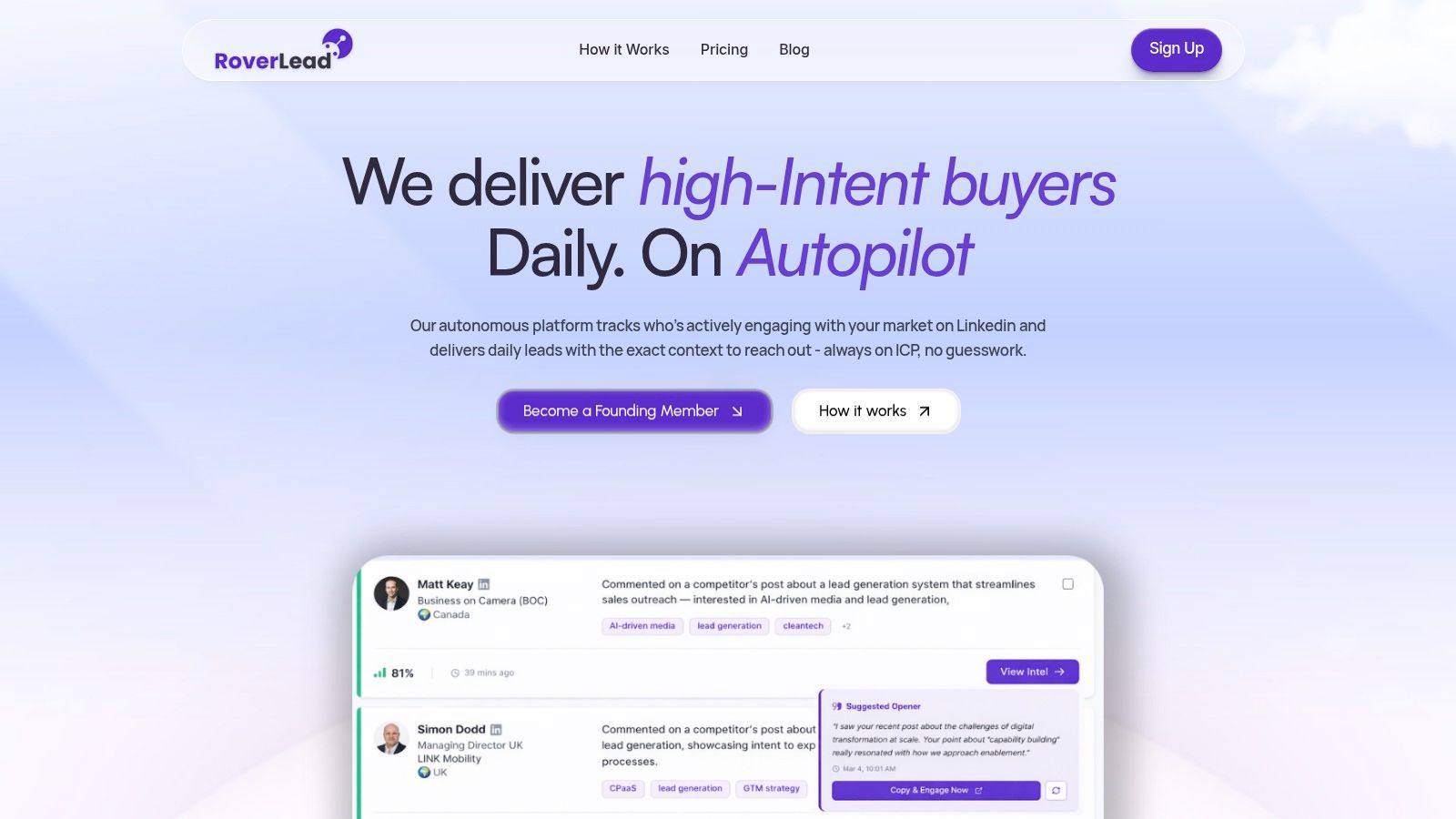
When a buyer has just commented on a competitor's LinkedIn post, asked a question in an industry thread, or engaged with a discussion around pricing, migration, or a known pain point, that's not random activity. It's context. That context tells the rep what the buyer cares about right now.
Sales teams that understand this stop asking only, “What content do we have?” They start asking, “What signal tells us this content is relevant today?”
That shift changes activation:
From static folders to triggered outreach
From generic follow-up to context-aware messaging
From asset promotion to conversation support
What Timely Activation Looks Like
A modern workflow connects buyer signals to the right enablement asset. If someone is engaging around a common operational problem, the rep shares a short proof piece that addresses that problem. If the signal suggests active evaluation, the rep uses comparison material or a pointed demo clip. If the signal looks late-stage, the rep brings pricing clarity or customer validation.
This is also where sales enablement and prospecting stop living in separate worlds. Intent-driven prospecting gives content a delivery engine. Without that engine, even well-built assets sit around waiting to be discovered. With it, reps can act when a prospect has already shown some level of relevance.
If you're evaluating the systems side of that motion, this overview of a sales enablement platform is a useful lens for thinking about activation, not just storage.
A dusty library helps nobody. Timely delivery turns the same content into a live selling advantage.
Measuring What Matters Revenue Impact Not Downloads
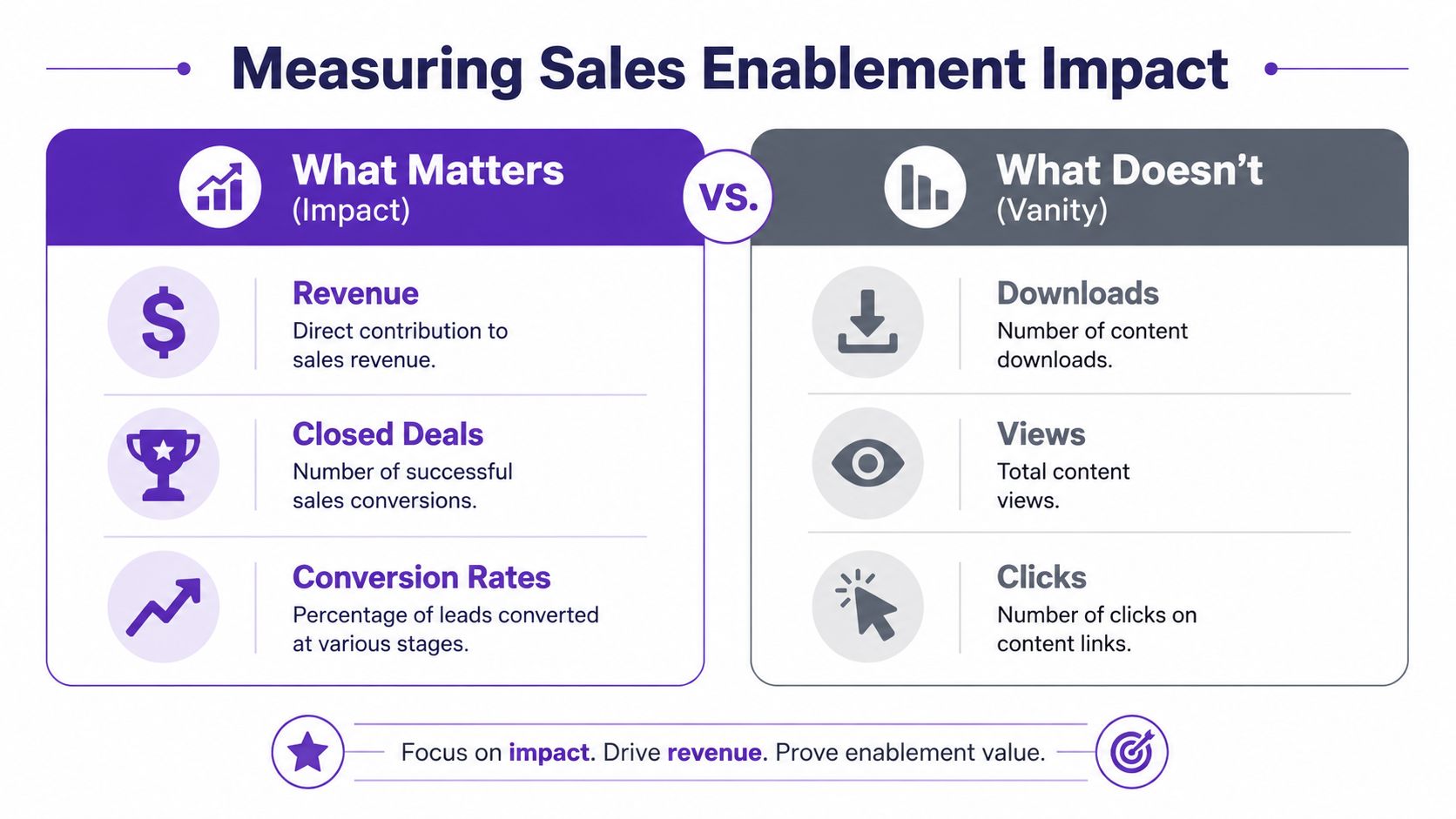
If your dashboard celebrates downloads, views, and clicks but can't tell you whether deals moved, you're measuring activity, not impact.
That's the trap with sales enablement content. Vanity metrics are easy to collect and easy to present. Sales leaders don't fund easy-to-present. They fund what changes pipeline quality, deal movement, and outcomes.
Vanity Metrics vs Deal Metrics
Recent guidance makes the standard clear. The goal is to prove revenue outcomes, not just usage. Better metrics include content influence on deals, deal velocity, and win rates. The same guidance also notes that organizations with a mature enablement strategy can reduce new hire onboarding time by 40–50%, according to Highspot's sales enablement content strategy guide.
A practical split looks like this:
Vanity metrics: Downloads, raw views, generic clicks
Useful metrics: Asset use in active deals, progression by stage, win rates on deals where key assets were used, onboarding support for new reps
The useful metrics are harder because they require tagging, version control, and CRM hygiene. That's also why they matter.
One hard question: Did this asset help a buyer move forward, or did it simply get opened?
If you want the surrounding process to improve as well, this guide to sales process optimization fits the same mindset. Measure what changes outcomes.
A Simple Measurement Habit
You don't need a perfect attribution model on day one. You do need discipline.
Start with a short list of “must-know” assets. Tag them by stage and use case. Ask reps to use approved links or tracked sends. In your CRM, review whether deals touching those assets progressed faster, stalled less, or closed more often than deals that didn't.
Also watch for the sneaky result. Some of the most valuable assets are not the most popular. A narrowly used procurement explainer might influence fewer deals than a broad one-pager, but matter far more in closing the deals it touches.
Popularity is not proof. Revenue influence is.
Your Sales Enablement Content FAQ
1. Who should own sales enablement content?
One team should coordinate it, but ownership should be shared. Sales, marketing, product, and customer-facing leaders all shape it. If one group builds in isolation, the content drifts away from real conversations.
2. What's the difference between sales enablement content and content marketing?
Content marketing attracts attention. Sales enablement content helps reps convert attention into progress. There's overlap, but the use case is different.
3. How many assets do we actually need?
Fewer than you think. Start with the moments that most often make deals stall. Build for those before you build anything fancy.
4. What content gets used most by reps?
Usually the shortest, clearest, most situation-specific assets. Battle cards, objection notes, proof snippets, call prep sheets, and concise one-pagers tend to beat long-form collateral in day-to-day use.
5. Should every product launch include new enablement content?
No. Every launch should include the right enablement content. Sometimes that means one updated battle card and a revised pricing explainer, not six new assets nobody requested.
6. How often should we audit content?
Regularly enough that reps trust the library. The moment they find outdated content twice, they start building private stashes. Then you've lost the system.
7. What's the fastest way to improve adoption?
Interview top reps, simplify formats, and make search painless. Then remove outdated assets with no mercy.
8. Should content be organized by product, persona, or stage?
Stage and buyer challenge tend to be more useful in the field. Product categories make internal sense. Reps sell in live situations, not org charts.
9. How do we get reps to stop using homemade materials?
Don't start by banning them. Study them. Reps often create homemade assets because the official version is too slow, too bloated, or too hard to find. Fix that first.
10. What's the biggest mistake teams make with sales enablement content?
They focus on creation and ignore activation. A strong asset delivered too late is still weak in practice. Timing, context, and accessibility decide whether content helps revenue or just fills a folder.
If your team already has content but struggles to use it at the right moment, RoverLead AI is worth a look. It helps B2B teams turn LinkedIn engagement into timely prospecting signals, so reps can reach out when buyers are already showing relevant intent instead of guessing from static lists. That makes your sales enablement content more than a library. It gives it a trigger.