
Regional Sales Manager Salary: A 2026 Guide to Your Pay

You've probably landed in one of two spots.
Either you're a newly promoted regional manager staring at an offer and wondering whether the number is strong, weak, or insulting. Or you're the sales leader trying to hire one and realizing the title “Regional Sales Manager” covers everything from a player-coach over two reps to a field-heavy operator running a messy multi-state patch with real quota weight.
That's why regional sales manager salary is such a slippery phrase. One site gives you a neat average. Another gives you a completely different one. Then a recruiter says, “Don't focus on base, focus on upside,” which is often code for “the base is light and the target is optimistic.”
The practical answer is simple. Don't ask only what the salary is. Ask what the job demands, what the plan pays when it works, and what the role costs if you're the one hiring.
Table of Contents
What Is Actually in a Regional Sales Manager Paycheck
The biggest mistake people make is treating one salary number like the whole answer. It isn't. In sales leadership roles, especially field-oriented ones, your paycheck usually has multiple moving parts, and those parts matter just as much as the headline number.
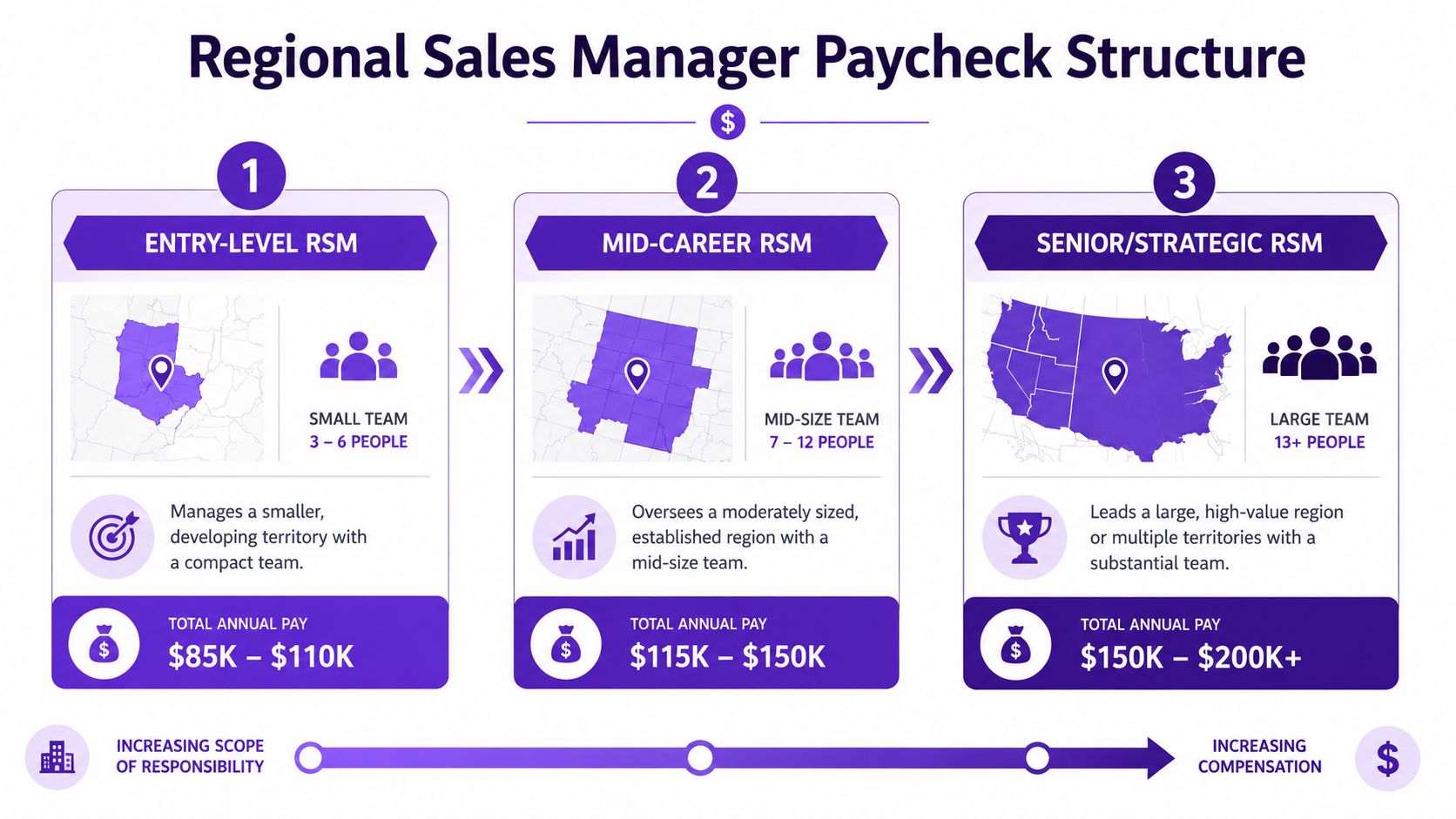
Base pay is only the floor
Start with base salary. That's the guaranteed money. It's what hits even when a quarter goes sideways, the territory gets reshuffled, or finance decides lead quality was “a shared challenge.” Base matters because it tells you how much risk the company expects you to carry personally.
But a regional sales manager rarely lives on base alone. Indeed's regional sales manager salary data reports a U.S. average salary of $105,668 per year plus $18,000 in annual commission. The same verified benchmark notes that variable pay is a defining feature of the role, and PayScale's ranges show commission up to $49k and bonuses up to $38k, often contributing 20% or more to base pay.
That's why smart candidates ask, “What's guaranteed?” and then immediately ask, “What pays out?”
Practical rule: If an offer looks good only when everything goes perfectly, it's not a strong offer. It's a bet.
The parts that matter in a real offer
A workable compensation package usually includes a few layers:
Base salary: Your fixed cash compensation.
Commission or incentive pay: Often tied to team quota, regional revenue, margin, or a mix of targets.
Bonus: Sometimes attached to annual goals, strategic account wins, retention, or leadership metrics.
Equity or long-term incentives: More common in startups or larger public companies with broader management bands.
Benefits and support: Health coverage, car allowance, travel reimbursement, phone, laptop, and expense policy all change what the role is really worth.
Here's the blunt version. OTE matters more than a naked base number, but only if the plan is realistic. A generous upside attached to a broken territory, an overloaded span of control, or a fantasy quota is just decorative.
A good plan pays for strong execution. A bad plan asks you to subsidize company wishful thinking.
When you review an offer, don't stop at “What's the salary?” Ask how the variable plan is measured, when it pays, whether accelerators exist, what happens if the territory is re-cut, and whether you inherit a clean region or a junk drawer. That's the difference between a role that compounds your earnings and one that gives you a polished title with a permanent headache.
Regional Sales Manager Salary Benchmarks for 2026
You get a recruiter call for a Regional Sales Manager role. One site says the job pays in the low $90s. Another puts it well north of $120k. A third folds in commission and makes the package look even bigger. That gap is exactly why both candidates and hiring leaders get burned when they chase one headline number.
The practical read is simpler. There is no single market salary for this title. There is a market range, and the right benchmark depends on whether you are pricing the hire or pricing your own move.
What the main benchmarks say
Use multiple sources side by side. That keeps you from treating self-reported pay, posted salary bands, and total compensation data like they mean the same thing.
Data Source | Average Base Salary | Reported Total Comp / Pay Range |
|---|---|---|
Salary.com | $126,490 | Most workers fall between $119,190 and $161,990 |
PayScale | $92,458 | Total pay ranges from $64k to $155k |
Indeed | $105,668 | Plus $18,000 in annual commission |
PayScale's regional sales manager benchmark shows a 2026 average base of $92,458 and total pay from $64k to $155k. That lower base figure usually reflects what happens when self-reported data pulls in a wide mix of company sizes, regions, and plan quality.
Indeed lands in the middle. Indeed's regional sales manager salary data shows $105,668 in average base pay, plus $18,000 in annual commission.
Salary.com comes in higher, with $126,490 as average base salary and a typical range of $119,190 to $161,990. That tells hiring leaders one useful thing right away. If your opening sits well below that band, you are probably shopping for talent in a better class than your budget supports.
Why the numbers do not match
The spread is not sloppy reporting. It comes from how each source builds the number.
What changes | Why it shifts the number |
|---|---|
Base vs total pay | Some sources isolate salary. Others pull in bonus and commission behavior. |
Self-reported pay vs employer data | Employee-submitted figures capture lived earnings. Employer-facing databases often reflect compensation structures and posted ranges. |
One title, different jobs | An RSM with six reps in one state is a different job from an RSM carrying a multi-state region, channel partners, and a turnaround quota. |
This matters at the offer stage.
Candidates should use these benchmarks to set a workable range, then judge the offer against the territory, quota, travel load, and team quality. Hiring leaders should use the same range to ask a harder question: what level of manager are we trying to attract, and what will it cost to land that person without missing the number six months later?
That is the part compensation surveys cannot answer for you. The title is the same. The job often is not.
Why Your Salary Is Not Average Key Factors That Drive Pay
A newly promoted Regional Sales Manager in Dallas and a turnaround hire dropped into the Northeast can share the same title, the same reporting line, and wildly different earning power. One inherits a stable team and clean accounts. The other gets open headcount, a messy forecast, and a region that misses plan three quarters out of four.
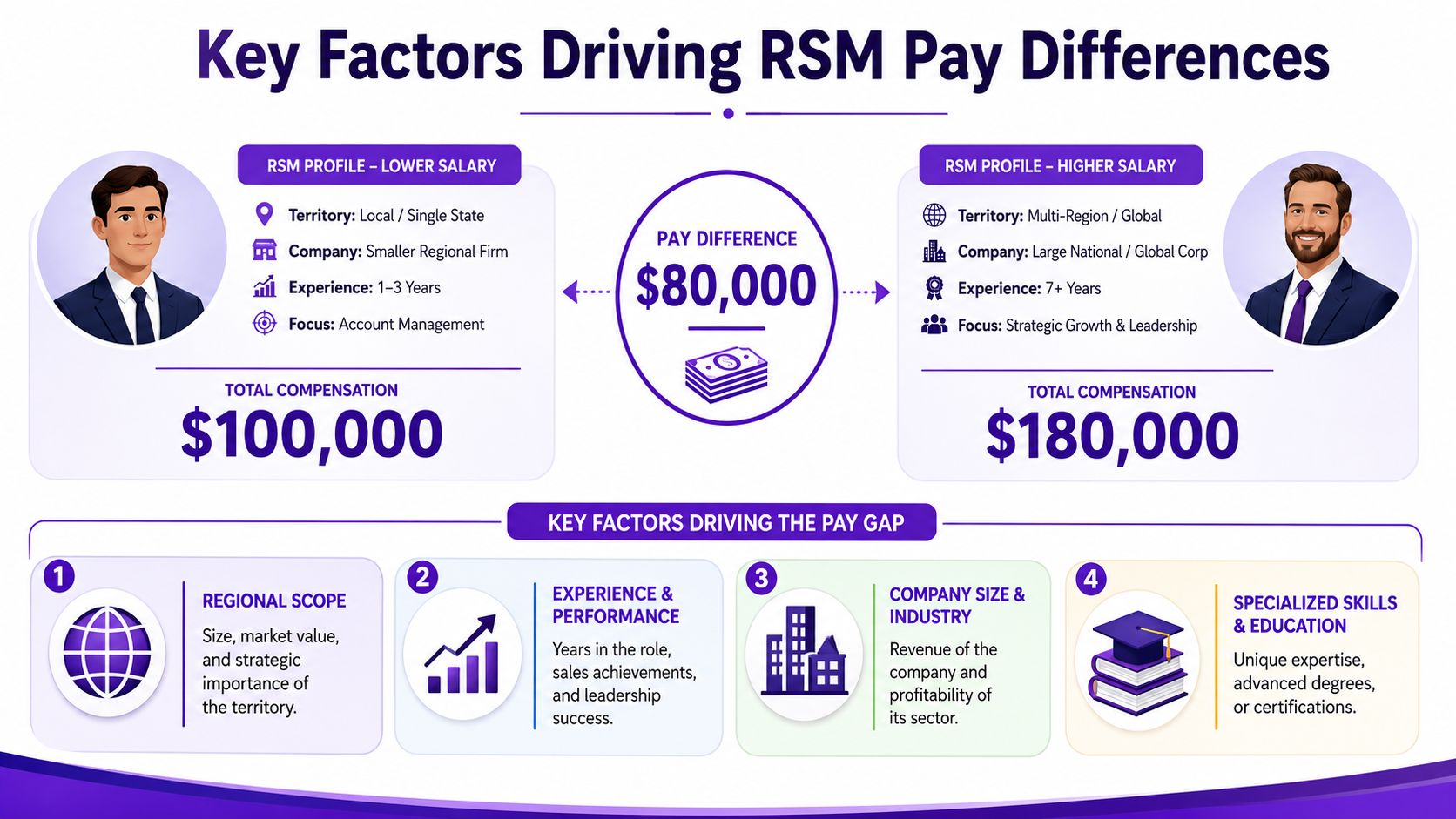
That gap is why “average salary” only gets you so far. Pay moves with difficulty, risk, and expected impact. Candidates feel that in the offer. Hiring leaders feel it in time-to-fill, ramp time, and missed revenue if they price the role like a generic management seat.
The title stays the same while the economics change
Location still matters, but geography is only the visible part of it. Company size, sales motion, and territory condition change the economics fast. Apollo's regional sales manager salary analysis notes that industry sector, territory complexity, and company size create 30% to 50% salary variation for the same title. It also reports Central Region total compensation averaging $180,498 with base salary at $129,392.
That spread makes sense if you have hired for this role.
A regional manager running a mature book with strong reps is often maintaining performance and tightening execution. A regional manager walking into a patch job is rebuilding coverage, coaching weak managers or reps, cleaning pipeline discipline, and fixing handoffs that should have been solved upstream. If the business expects that manager to repair execution, sales process optimization work becomes part of the job whether it appears in the posting or not.
What usually pushes pay up
Higher compensation tends to show up when the role carries more operational drag, more revenue risk, or both:
Broken or uneven territory design: A region with account imbalance, channel conflict, or poor white-space planning takes more management effort than a clean patch.
Big quota with low margin for error: The larger the number, the more forecast discipline, rep accountability, and deal inspection the company is buying.
Rebuild conditions: Open territories, weak bench strength, and chronic underperformance raise the value of a manager who can stabilize the team quickly.
Complex sale: Enterprise, regulated, technical, or multi-stakeholder deals usually justify more pay because coaching quality matters more.
Heavy field expectation: Frequent travel, partner management, customer escalation work, and in-person coaching add real load to the role.
Here is the trade-off that matters on both sides of the table. Candidates should not argue from title alone. Scope is the argument. Leaders should not benchmark from title alone either. Replacement cost is the argument.
Underpaying a hard region rarely saves money. It usually buys a weaker candidate pool, a longer vacancy, and slower recovery after the hire starts. Overpaying for an easy region is not smart either. The right package matches the actual lift required, not the label on the org chart.
How to Negotiate Your RSM Salary For Managers and Leaders
You get the call. The company likes your background, the territory sounds promising, and the recruiter says the package is “in range.” Then you learn the region has open reps, heavy travel, and a quota that assumes a clean patch that does not exist. On the hiring side, the same conversation looks different. You are trying to close a strong manager without blowing up comp bands or setting the wrong precedent.

That is why RSM salary negotiation is rarely about salary alone. It is a scope conversation, a risk conversation, and for leaders, a cost-of-hire conversation disguised as comp.
If you are the candidate
Lead with business impact. Title-based arguments are weak. A hiring leader will pay more for a manager who can fix coverage, tighten forecast calls, and get average reps to quota faster than for someone who just held the same title elsewhere.
Use specific proof:
Anchor your ask to the job's real load: Team size, vacancy risk, travel expectation, channel complexity, and how much cleanup the region needs.
Push on variable comp details: “Competitive OTE” means nothing by itself. Ask what paid out last year for managers in comparable seats, how many hit quota, and what can derail payout.
Negotiate the structure, not just the number: If base is tight, ask for ramp protection, a sign-on bonus, earlier review timing, or cleaner accelerators.
Test whether the company controls the obstacles: If pricing is unstable, lead flow is thin, or territories are sloppy, more of your pay should sit in base.
A simple line works well because it sounds like an operator, not a tourist:
“My ask reflects the work required to make this region perform, not the title on the business card.”
If you need sharper language around execution gaps, this article on sales process optimization for better execution can help you frame the operational case in terms leaders respect.
If you are the hiring leader
Good candidates can smell a mismatched offer in ten minutes. If the role carries rebuild risk but the package is priced like a maintenance job, they will either walk or join with one foot out the door.
The cleanest offers do three things. They match the actual difficulty of the seat. They explain how the manager can win. They show that leadership understands what the company is asking this person to absorb.
Use this check before you send the offer:
Can you explain why this base salary fits this region, not just the title?
Is the variable plan reachable with the headcount, territory design, and support you are providing?
Have you addressed ugly parts of the job directly, such as travel, open territories, or a turnaround mandate?
Would a strong candidate view the package as fair if they saw the first two quarters up close?
Strong hiring leaders do not hide the hard parts. They price them. That usually saves money over the life of the hire because it lowers the odds of a miss, a reset, or a backfill six months later.
One more thing worth watching before you hit send:
The best negotiation ends with both sides clear on what must happen for the role to pay well. That is what protects the manager's income and the company's investment.
The Sales Leaders View The Total Cost of a Regional Manager
A VP approves a Regional Manager hire at what looks like a fair salary. Six months later, the budget is blown anyway. The problem usually is not the base pay. It is everything attached to getting that person productive, keeping them in the field, and giving them a real shot at hitting the number.
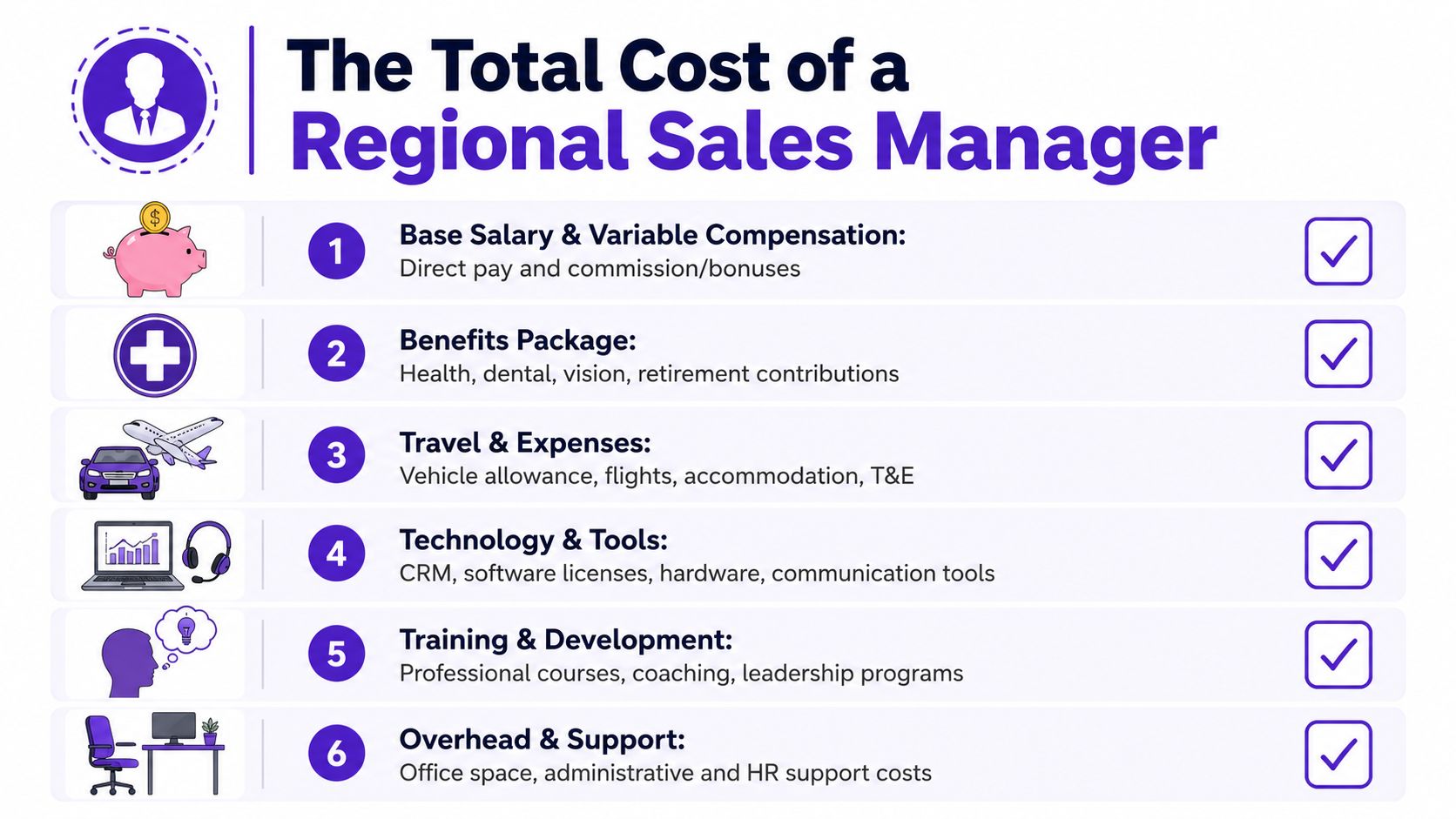
Salary is only the first number
Leaders get in trouble when they approve comp as if they are filling a box on an org chart. A Regional Manager is an operating expense with a revenue target attached. If you hire one into a scattered territory, a weak team, or a heavy travel motion, the salary is only the starting point.
That matters on both sides of the table. The manager wants to know whether the package is worth the load. The hiring leader needs to know what the role really costs before calling it profitable.
Here is the cost stack that usually gets underestimated:
Variable pay: Commission, bonus, accelerators, and any guarantee during ramp
Travel and entertainment: Flights, hotels, mileage, meals, ride share, customer events
Tech and equipment: CRM seats, dialers, forecasting tools, laptop, phone, expense systems
Onboarding and training: Product education, field coaching, leadership time, compliance work
Benefits and payroll burden: Health coverage, retirement match, taxes, and admin overhead
Recruiting and vacancy cost: Agency fees, interview hours, lost coverage while the seat stays open
A good budgeting conversation starts with a harder question. What does this manager need in order to carry the region without burning out or missing the number for reasons you could have seen coming?
The real mistake is underfunding the role
I have seen companies post a strong base salary, then strip out the support that makes the job winnable. Fewer field visits. No sales ops help. Thin enablement. Bad territory design. The hire looks expensive on payroll and cheap everywhere else, which is exactly backward.
That is why finance and sales leadership need the same frame. The right lens is contribution, not salary in isolation. If your CFO needs a cleaner way to separate top-line impact from actual earnings, this breakdown of revenue, profit, and income in practical terms helps.
A Regional Manager who costs more but stabilizes a region, lifts rep output, and shortens ramp can be a far better investment than a cheaper hire who needs a reset in two quarters.
The short version is simple. Budget the seat like a full business decision, not a compensation line item.
Your Top 10 Regional Sales Manager Salary Questions Answered
The fine print is where a lot of comp plans get spicy. Here's the short version.
Question | Answer |
|---|---|
Is base salary or OTE more important? | OTE matters more for earning potential. Base matters more for risk protection. You need both. |
Should I trust one salary website? | No. Use several benchmarks, then judge the offer against actual scope. |
Does geography still matter? | Yes. Local market conditions can move pay significantly. |
How much does commission matter? | In this role, variable pay is often a major part of total earnings. |
What should I ask about the comp plan? | Ask how it pays, what metrics drive it, and what similar roles actually achieved. |
Is a lower base okay if upside is strong? | Sometimes. Only if the territory, quota, and support make the upside believable. |
Do bigger companies always pay more? | Not always. Company size helps, but territory design and industry can matter just as much. |
What if I'm inheriting a weak region? | Push for ramp protection, a review point, or stronger base support. |
How should hiring leaders benchmark candidates? | Compare against market, geography, territory complexity, and likely travel burden. |
What else should a new RSM understand? | Learn how pipeline quality affects quota realism. This guide on how to qualify sales leads effectively is a useful place to tighten that muscle. |
Regional sales manager salary is never just a salary question. It's a job design question, a risk question, and a strategy question. Candidates should negotiate with eyes wide open. Leaders should hire with the full cost and full scope in view.
If your team wants more qualified pipeline without piling manual research onto reps and managers, take a look at RoverLead AI. It helps sales teams spot real buying intent on LinkedIn, prioritize the right accounts, and start warmer conversations with less guesswork.