What Is Prospecting in Sales: Master It in 2026

Sales prospecting is the process of finding and engaging potential customers, and in modern B2B sales that means prioritizing active buying intent over static lists. It matters because 96% of prospects research on their own before speaking with sales, and effective prospecting can increase conversion rates by up to 40%.
You can feel the old model breaking in real time. You build the list. It has the “right” company size, the “right” industry, the “right” titles. You write a respectable email sequence. Then nothing happens except silence and a vague sense that your CRM is mocking you.
That's usually when teams blame copy, cadence, or rep effort. Sometimes those are the issue. Often, the bigger problem is simpler. You targeted people based on who they are, not what they're doing right now.
That distinction is now the whole game in understanding what is prospecting in sales. The textbook version says prospecting is identifying and contacting potential buyers. Fine. The effective version says prospecting is identifying buyers showing signals and earning the right to start a conversation through relevance.
Table of Contents
Why Your Perfect Prospecting List Is Still Failing
A rep pulls a list of operations leaders at mid-market SaaS companies. The data is clean. Titles are relevant. The sequence is polished. On paper, it looks like a campaign that should print meetings.
Instead, it dies quietly. A few opens. Barely any replies. No real traction.

That's not bad luck. It's a targeting problem. The list tells you the account matches your ICP on paper, but it tells you nothing about whether anyone there cares today.
Recent guidance from Zendesk makes the gap painfully clear. 70% of B2B buyers expect sales to engage based on explicit signals of interest, like content interactions, not just demographic fit. Traditional prospecting guides still lean on firmographics, which is exactly why reply rates sag in practice. See the Zendesk breakdown of sales prospecting and buyer expectations.
Static fit is not the same as live intent
A company can be a perfect fit and still be a terrible prospect right now. No initiative. No urgency. No internal motion. No reason to care about your message this week.
That's why smarter teams pair firmographics with behavior. They care about things like content engagement, topic activity, pricing curiosity, hiring patterns, or competitor conversations. Static data tells you if an account belongs on the field. Behavior tells you if the ball is in play.
Good prospecting starts when a name on a list turns into a person with a reason to respond.
If your team is still scoring mostly on title, company size, and industry, it helps to rethink qualification through AI-powered lead scoring for intent-rich prioritization. That's usually where the list stops being “big” and starts being useful.
Prospecting Defined Beyond the Textbook
If you want the clean definition of what is prospecting in sales, here it is. Prospecting is the deliberate work of identifying potential buyers, researching them, and starting relevant conversations that can turn into pipeline.
In the field, though, that definition is too polite. Prospecting is not list building. It is not “activity.” It is not dumping names into a sequence and hoping the market feels generous. It is the front end of revenue creation.
HubSpot's sales data says 40% of reps call prospecting the hardest part of sales, which sounds about right. The same dataset also shows that effective prospecting, including research before outreach, can increase conversion rates by up to 40%. That's why it belongs in the category of revenue work, not admin work. The supporting figures are in HubSpot's sales statistics roundup.
Prospecting versus lead generation
People mash these together, but they're not the same thing.
Lead generation casts a wider net. Marketing content, forms, events, and campaigns create awareness and collect interest.
Prospecting is narrower and more deliberate. Sales decides who deserves attention now, why, and with what message.
A simple way to separate them:
Lead generation fills the top of the funnel. It attracts possible buyers.
Prospecting qualifies attention. It turns possible buyers into actual sales conversations.
Lead generation scales reach. Prospecting sharpens relevance.
What the best teams are really trying to do
Modern prospecting has three jobs.
First, it builds a predictable pipeline. Second, it tests whether your ICP is real or just pretty slideware. Third, and this is the big one, it tries to earn permission to engage through relevance.
Practical rule: If your outreach could have been sent to fifty other people unchanged, it probably shouldn't be sent at all.
That's the shift. The old question was, “How many people can we contact?” The better question is, “Who is most likely to care right now?”
The Main Prospecting Models Explained
There isn't one prospecting model. There are several, and each works differently depending on how demand appears and how your buyers prefer to engage.
Inbound vs. outbound at a glance
Attribute | Inbound Prospecting | Outbound Prospecting |
|---|---|---|
Trigger | Buyer raises a hand through a form, content, or interaction | Seller initiates contact |
Timing | Reactive to existing interest | Proactive based on targeting and signals |
Main strength | Higher immediate context | Greater control over pipeline creation |
Main risk | Can become passive and over-reliant on marketing flow | Can become noisy and generic |
Best use case | Capturing and qualifying known interest | Creating opportunities in target accounts |
Messaging style | Follow up on expressed interest | Create relevance from research and timing |
Inbound tends to feel easier because the buyer has already done something. Outbound tends to feel harder because you have to create the reason for the conversation. That doesn't make outbound worse. It just means lazy outbound gets punished faster.
Where ABP and social selling fit
Modern teams often blend models instead of picking one camp and defending it like a sports rivalry.
Account-based prospecting focuses on a defined set of target accounts. It's useful when deal size, complexity, or strategic fit matter more than raw volume.
Social selling works differently. Instead of interrupting strangers cold, you identify people already interacting with relevant topics, peers, creators, or competitors. That gives outreach context before the first message is sent.
If you're sorting through these approaches, it helps to understand what intent data actually means in prospecting. That's the layer that turns outbound from “find and call” into “spot and engage.”
A practical way to think about the models:
Inbound is demand capture.
Outbound is demand creation.
Account-based prospecting is focus.
Social selling is context.
None of these are magic on their own. They work when the rep knows why this account, why this person, and why now.
A Modern Prospecting Process That Actually Works
The process that works now is less like a checklist and more like a loop. You define fit, watch for signals, engage, learn, and refine. Then you do it again without pretending a static list from last quarter is still alive.
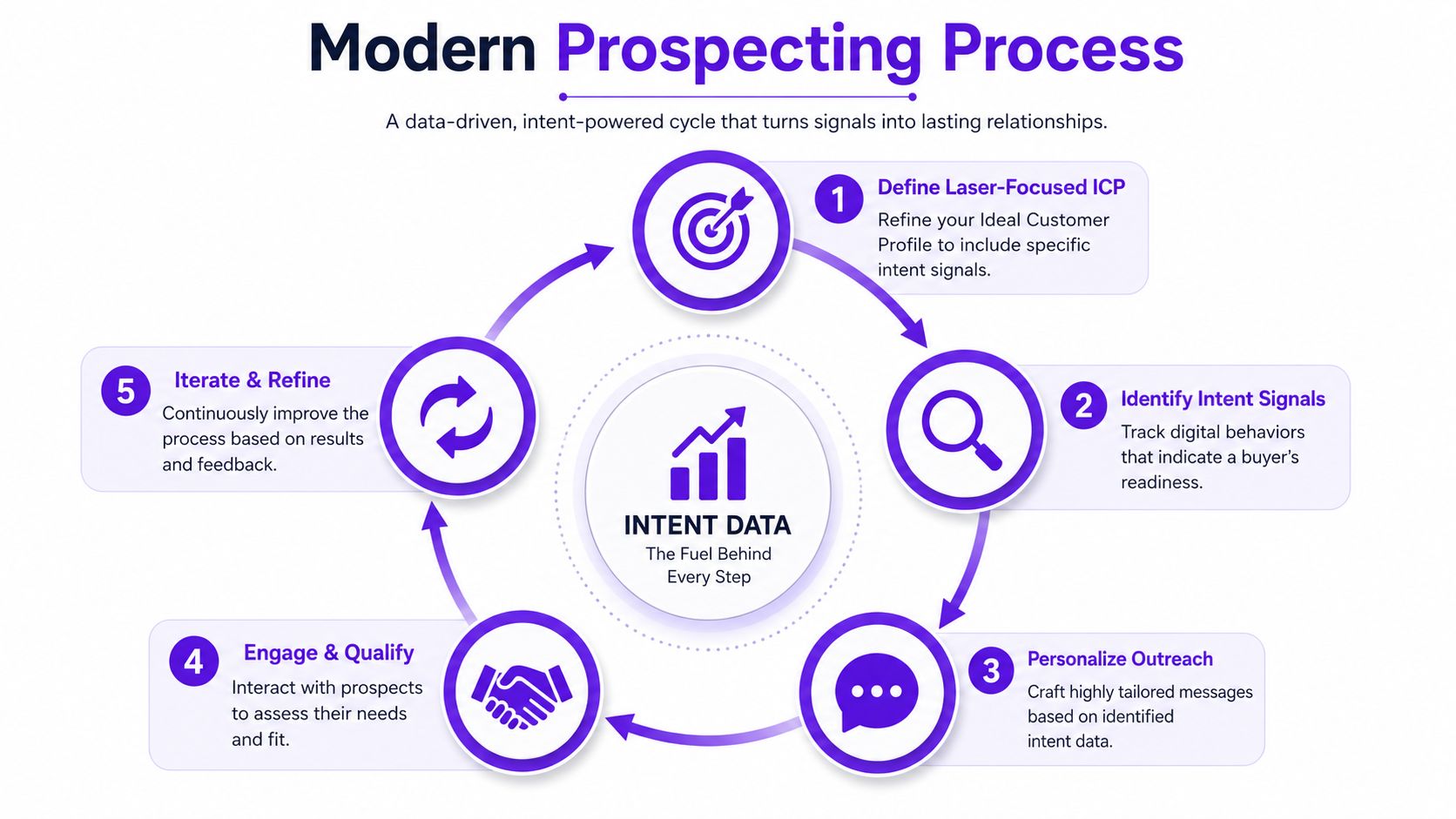
Forbes Advisor's sales data is a useful reality check here. It takes an average of 8 cold call attempts to reach a prospect, and successful deals often require five or more follow-up attempts after initial contact. That's in Forbes Advisor's sales statistics overview. In other words, one touch is not a strategy. It's a warm-up.
Start with an ICP that includes behavior
Your ICP needs two layers.
The first is the usual firmographic stuff. Industry, size, team structure, likely owner of the problem. You still need that. Randomness is not a go-to-market strategy.
The second layer is behavioral. What signals suggest the account is moving? A rep should be able to answer that in plain English.
Examples of useful behavioral signals include:
Research behavior: Reviewing pricing pages, comparing vendors, or downloading a guide.
Market movement: Hiring into a problem area, discussing a pain point publicly, or reacting to competitor content.
Engagement patterns: Repeated interaction with a topic tied to your category.
Run a sequence like an operator, not a spammer
Apollo's view of modern prospecting is useful because it frames the cadence properly. Effective teams use signal-based targeting, omnichannel orchestration, and automation for non-selling tasks. It also notes that modern sequences often involve 8 to 12 touchpoints across email, phone, and social over 3 to 4 weeks, and that prioritizing timing and relevance over volume can drive 2 to 3 times higher positive reply rates and 30% to 50% more meetings. Those benchmarks are covered in Apollo's guide to sales prospecting.
The trade-off is simple. Multi-channel outreach works. Random channel hopping does not.
A solid sequence usually includes:
A relevant first touch tied to a visible signal.
A second touch that adds value, not pressure.
A call or voice note when urgency looks real.
A social touch that shows you're paying attention, not lurking.
A follow-up loop that changes the angle instead of repeating the same ask.
Automation should handle reminders, enrichment, and task routing. Reps should handle judgment.
That's the line too many teams blur.
From Noise to Signal How to Prospect on LinkedIn
LinkedIn is either a gold mine or a landfill, depending on how you use it. Most sellers treat it like a direct mail channel with profile photos. That's why buyers ignore them.
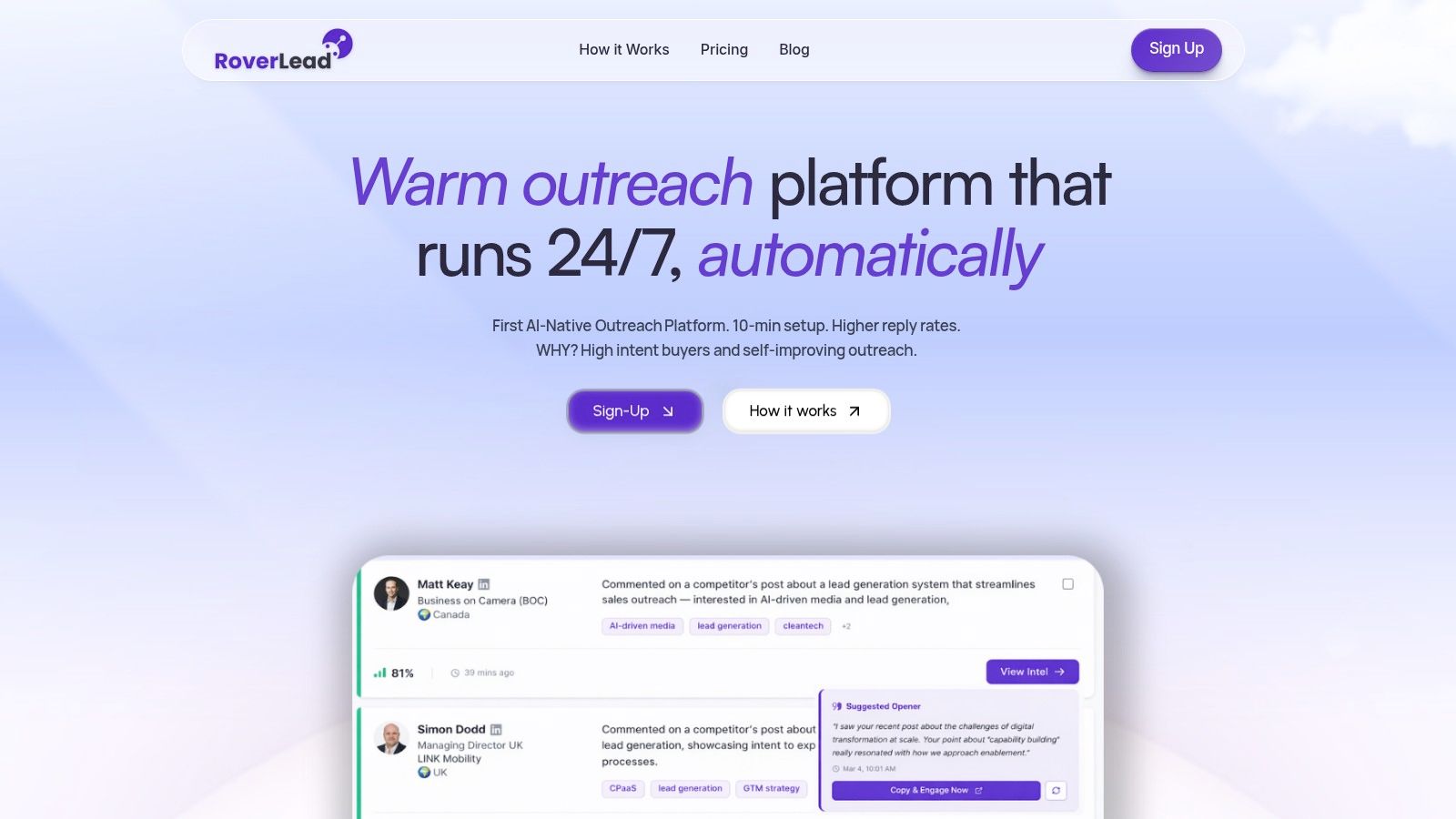
The context changed. A 2025 report cited by Sales Enablement Collective found that 60% of prospects distrust cold outreach from strangers, preferring engagement within their existing networks or around shared topics. That's why signal monitoring matters more than list building. The write-up appears in Sales Enablement Collective's piece on sales prospecting techniques and social selling.
What good LinkedIn prospecting looks like
Good LinkedIn prospecting doesn't start with a pitch. It starts with observing motion.
Look for people who are already doing one of these things:
Commenting on niche creators. They're signaling interest in a problem space.
Engaging with competitor posts. They may be exploring alternatives or evaluating the category.
Talking about operational pain. They're giving you the language to use back to them.
Reacting to team changes or launches. That often creates urgency around systems, process, or tooling.
That's why LinkedIn lead generation works best when it behaves less like spray-and-pray outreach and more like joining a live conversation already happening in public.
The fastest way to sound like spam is to ignore what the prospect just told the market about themselves.
A simple opener beats a clever pitch
A relevant opener on LinkedIn is usually plain. It should sound like a human who noticed something, not a sequence trying to impersonate one.
Hi Sarah, I help B2B teams streamline revenue operations with our advanced platform. Open to connecting?
Better opener: “Sarah, saw your comment on the RevOps workflow post about handoff friction. Curious whether that's showing up more in lead routing or in follow-up after demo requests.”
The second one works because it proves attention. It also gives the buyer an easy way to answer.
Here's a short walkthrough worth watching before you overcomplicate your social selling workflow:
LinkedIn prospecting is strongest when you sell into networks and topics, not just titles. That's the difference between interrupting strangers and showing up on time.
Prospecting Mistakes That Kill Your Pipeline
Most pipeline problems don't begin in discovery. They begin earlier, when the team confuses motion with progress.
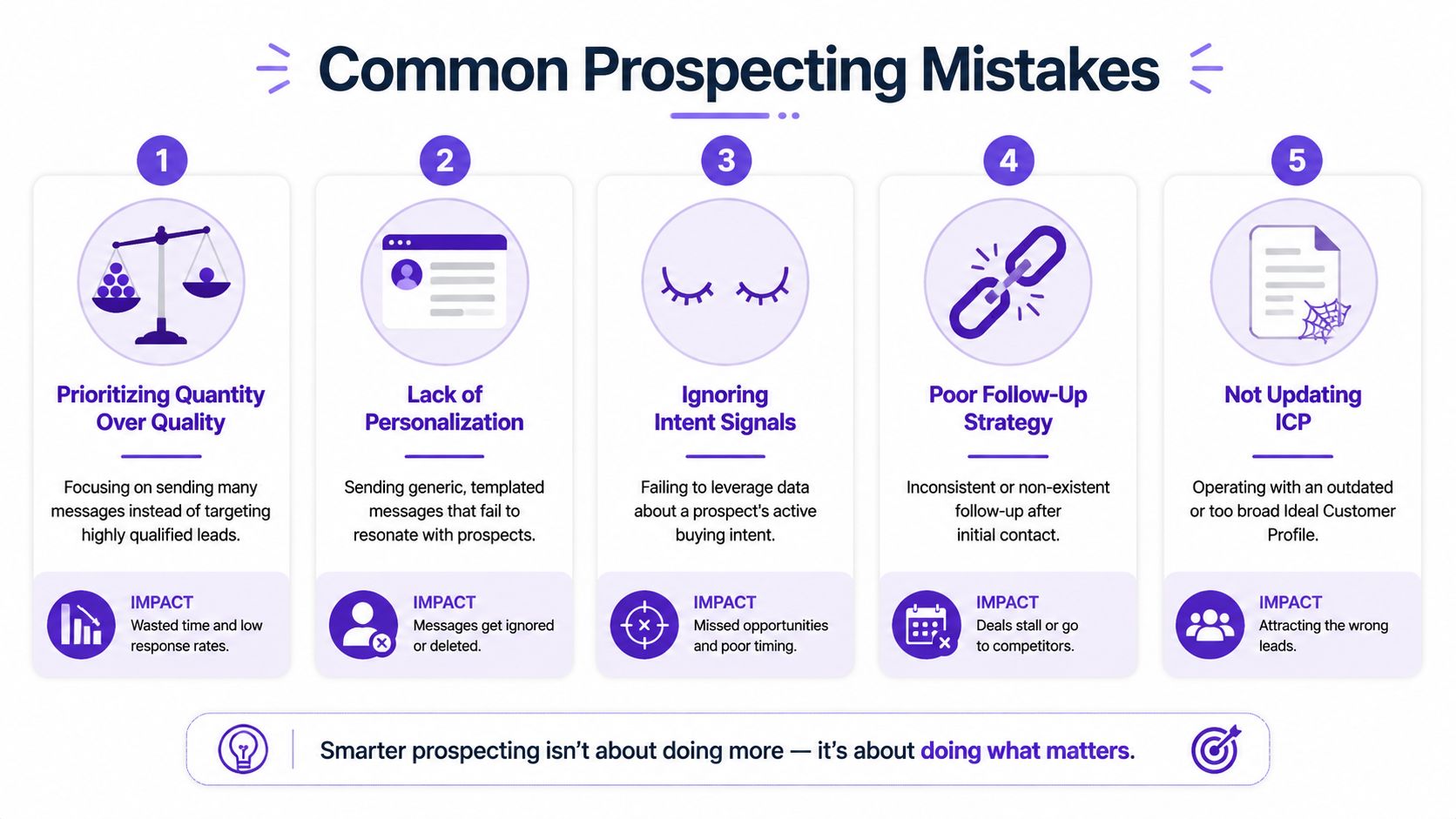
Apollo reports that when teams prioritize timing and relevance over sheer volume, they see 2 to 3 times higher positive reply rates and 30% to 50% more meetings booked. That's the clearest argument against brute-force prospecting in Apollo's prospecting benchmarks.
The habits that look productive and fail anyway
Here are the usual offenders.
Chasing volume for its own sake. A giant list feels comforting. It usually hides weak targeting.
Using generic templates. If the message leads with your company instead of the buyer's context, expect silence.
Giving up too early. Teams often quit before the follow-up sequence has done its job.
Ignoring visible signals. Public conversations, content engagement, and market motion are not decoration. They are your opening.
Letting the ICP go stale. Markets change. Buying triggers change. Your targeting should too.
The better alternative is less glamorous and more effective:
Mistake | Better move |
|---|---|
More names, less thought | Fewer accounts, better reasons |
Pitch first | Context first |
One channel | Coordinated email, phone, and social |
Static list | Living signal feed |
Activity obsession | Positive replies and meetings |
Field note: If your team says, “We sent a lot,” but can't explain why those buyers should care now, the problem isn't effort.
Frequently Asked Questions About Sales Prospecting
Sales Prospecting FAQ |
|---|
1. What is prospecting in sales, in one sentence?
It's the work of identifying likely buyers and starting relevant conversations that can become pipeline.
2. How is prospecting different from lead generation?
Lead generation creates interest at scale. Prospecting decides who deserves direct sales attention and why now.
3. Is cold outreach dead?
No. Irrelevant cold outreach is what's dying. Outreach still works when it is timely, specific, and tied to buyer context.
4. Should SDRs focus on email, phone, or LinkedIn?
Use all three when the account merits it. Buyers respond better when outreach is coordinated instead of trapped in one channel.
5. How many touches should a sequence include?
A modern sequence usually needs multiple touches across channels. As covered earlier, persistence is part of the job, not a sign the process is broken.
6. What makes a prospect “qualified”?
Fit and timing. Firmographics tell you fit. Behavior tells you timing.
7. Why do good-fit accounts still ignore outreach?
Because good fit is not the same as active interest. A buyer can match your ICP and still have no reason to engage today.
8. What should reps personalize first?
Start with the trigger. Reference the event, comment, topic, or behavior that made the outreach make sense now.
9. What should sales leaders measure?
Measure outcomes tied to actual engagement. Positive replies, meetings booked, and quality of conversations tell you more than raw send counts.
10. Who owns prospecting in a team?
Usually SDRs, BDRs, AEs, or founders depending on company stage. The best teams still treat it as a shared revenue discipline, not one person's problem.
RoverLead AI helps teams prospect the modern way. Instead of building static cold lists, it turns LinkedIn engagement into high-intent leads matched to your ICP, with signal context and AI-written openers that make outreach timely and relevant. If you want a cleaner way to find buyers who are already showing interest, take a look at RoverLead AI.