Account Based Prospecting: Ditch the Noise, Find the Signal

Your team is busy. The CRM is full of tasks, the sequence dashboard looks healthy, and somebody is probably celebrating that they sent another few hundred cold emails before lunch. Meanwhile, the calendar looks like a ghost town.
That's the problem with modern outbound. Failure often doesn't stem from a lack of effort. It arises from treating prospecting like a numbers contest. More volume, more templates, more “quick bumps,” more noise. Buyers hate it, reps hate it, and the only thing growing is list fatigue.
Account Based Prospecting is the fix. Not because it sounds strategic in a board deck, but because it forces teams to stop chasing random contacts and start building real entry points into accounts qualified to buy.
Table of Contents
The End of an Era for Cold Outreach
Cold outreach didn't die. Lazy cold outreach did.
Buyers still respond when the message is relevant, timely, and aimed at a problem they already care about. What they ignore is generic outreach written for nobody in particular. If your team is still pulling static lists, dropping people into the same sequence, and calling that pipeline generation, you're not running a sales motion. You're running a spam operation with better branding.
The market has already moved. The global account-based marketing market, which underpins account based prospecting, was valued at USD 1,410.5 million in 2024 and is projected to reach USD 3,811.4 million by 2030, growing at a 17.9% CAGR from 2025 to 2030. Companies using this shift have also seen a 20% lift in average deal size according to Grand View Research's account-based marketing market report.
That matters for one reason. Serious teams are moving resources away from broad lead generation and toward a smaller number of better accounts.
Practical rule: If your team can't explain why an account should buy now, they shouldn't be prospecting it yet.
Account based prospecting is the sales version of that discipline. Fewer accounts. Better timing. More context. More stakeholders involved. Less nonsense.
What Is Account Based Prospecting Really
The simple definition
Account based prospecting means you target a small group of high-fit accounts, research them properly, map the buying committee, and run coordinated outreach based on real business context.
It is not “personalization” where a rep pastes a company name into line one and calls it bespoke.
It is not “enterprise outbound” where someone uploads a list of logos into a sequencing tool and starts hammering directors with the same pitch.
It's a focused approach that treats each target account like its own mini-market. You identify where you can win, who matters, what changed, and why now. If your team is still fuzzy on buying signals, this primer on intent data for B2B prospecting is worth reading because intent is the difference between timely outreach and random interruption.
Account-Based Prospecting vs. Traditional Outbound
Dimension | Traditional Outbound | Account-Based Prospecting |
|---|---|---|
Targeting | Large lists built on broad filters | Small set of carefully chosen accounts |
Research depth | Minimal, often limited to job title and company | Deep account context, stakeholders, timing signals |
Messaging | Template-heavy and role-based | Account-specific and event-aware |
Buying focus | Individual lead | Entire account and buying committee |
Outreach style | Single-threaded | Multi-threaded across stakeholders |
Timing | Launch when the sequence is ready | Launch when the account gives you a reason |
Team alignment | Sales often works alone | Sales and marketing should operate from the same account priorities |
Success metric | Activity volume | Penetration and traction inside target accounts |
Most teams don't have an outreach problem. They have a targeting problem disguised as hustle.
The biggest shift is mental. Traditional outbound hunts for replies. Account based prospecting hunts for relevance inside the right accounts.
That change sounds simple. It isn't. It forces discipline, and discipline is much rarer than enthusiasm.
The Four Part ABP Framework That Generates Pipeline
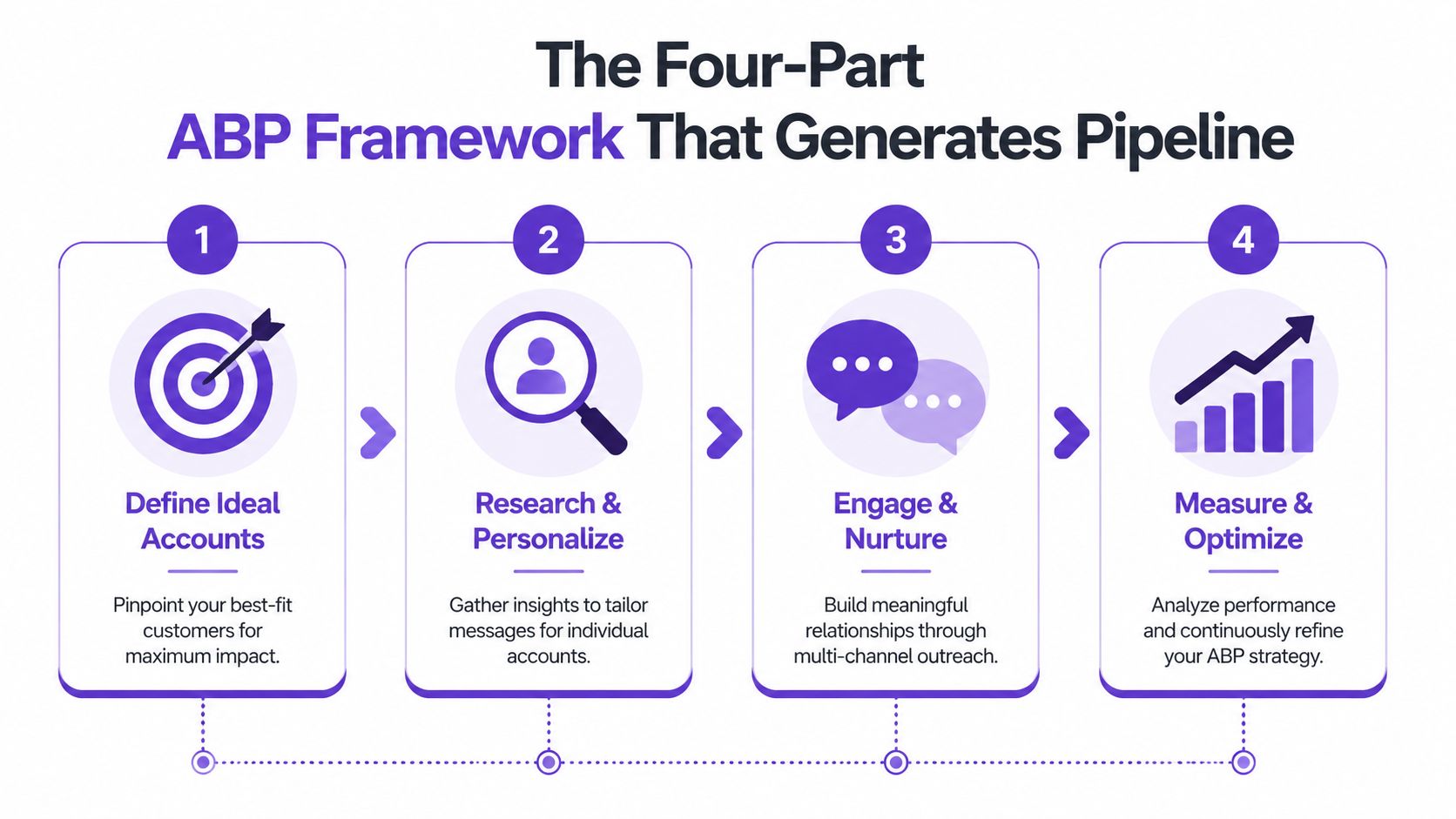
Start with ruthless account selection
Your ICP needs to be tighter than is commonly practiced. Not “B2B SaaS companies with a sales team.” That's fluff. You want concrete fit markers tied to the customers that close, onboard, and stick.
Start with:
Firmographic fit such as company type, size band, or market segment
Technographic fit if your solution works best alongside a specific stack
Clear operational pain that your product solves better than alternatives
If the account isn't a fit, no signal will save it. A badly matched account with a strong trigger is still a bad bet.
Build around signals, not guesses
A good account can still be the wrong account today. Timing matters.
Effective ABP works when teams prioritize accounts using firmographic and technographic fit, buying signal strength, and existing relationship access, and that's why the recommended focus is a curated list of 50–100 accounts for deep research, not a giant dump of names from a database. That guidance is laid out in SalesMotion's take on signal-driven account-based selling.
Signals worth watching include:
Hiring patterns that suggest budget or operational build-out
Leadership changes that often reset priorities
Funding events that can open new buying windows
Relationship access through employees, customers, partners, or warm paths
Prioritize like an adult
Not all target accounts deserve equal attention. That's where many teams go off the rails. They say they're doing ABP, then give every account the same treatment. That's just mass outreach with nicer language.
Use a simple ranking mindset:
Best-fit accounts with active signals go first.
Best-fit accounts with relationship access come next.
Fit-only accounts stay parked until something changes.
This keeps reps from spending Tuesday afternoon “researching” a dream logo that has no signal, no access, and no urgency.
Run coordinated outreach across the account
Once an account is prioritized, go multi-threaded. One contact is not a strategy. It's a hostage situation.
Account based prospecting works best when reps map the buying committee and coordinate outreach to multiple stakeholders over a 4–6 week period, as described in UserGems' guide to account-based prospecting. The point isn't to flood the company. The point is to create intelligent visibility across the people who influence the decision.
A solid motion usually includes:
Primary contact outreach tied to the signal
Supporting stakeholder outreach with role-specific angles
LinkedIn engagement before and during direct outreach
Internal account notes so everyone on your team sounds coordinated
One good account with real traction beats a hundred untouched names sitting in a sequence.
Winning on LinkedIn with Smart Prospecting Tactics
LinkedIn is where account based prospecting becomes painfully obvious. Done well, it feels sharp. Done badly, it looks like a rep with Sales Navigator and no self-respect.
Use LinkedIn like a listening tool
Most reps use LinkedIn as a contact database. Smart reps use it as a signal engine.
Watch for things like:
New role announcements from people entering your target accounts
Posts about team growth that suggest investment
Comments on competitor content that reveal awareness or frustration
Engagement with niche topics tied to your category
If you're still treating intent as a website-only concept, you're missing a huge part of the market. LinkedIn behavior often shows interest long before someone fills out a form. For a deeper look at turning platform activity into pipeline, this guide on LinkedIn lead generation for modern outbound teams is useful.
Here's what the workflow should support in practice:

A simple signal-based message flow
Say a target account hires a new VP of Sales. Don't send the usual “Congrats on the new role, would love to connect.” That message is the LinkedIn version of room-temperature coffee.
Try a flow like this instead:
Connection request
Mention the role change and the business context. Keep it light.
Example: “Saw you stepped into the VP Sales role at [Company]. New sales leaders usually inherit a mix of pipeline pressure and tooling cleanup. Thought it made sense to connect.”First follow-up
Tie your note to a likely operational challenge.
Example: “Noticed the team is hiring into revenue roles as well. That usually creates a fast need for better prospecting consistency across reps. Curious how you're thinking about that ramp.”Second follow-up
Offer a specific observation or question, not a brochure.
Example: “I took a look at how your team shows up on LinkedIn. There may be an opening to engage buyers around live category conversations instead of relying only on list-based outreach.”
This works because it doesn't pretend the rep has a relationship. It earns one by being observant.
Relevance beats cleverness. A plain message with good timing outperforms a fancy message sent for no reason.
How to Measure What Actually Matters in ABP
If you keep managing ABP with old outbound KPIs, you'll kill it before it works.
A rep can send a pile of emails, log calls, poke LinkedIn, and look productive all week while making zero progress inside accounts that matter. That's why activity metrics become dangerous in an account based model. They reward movement, not momentum.
Stop rewarding activity theater
You don't need another leaderboard for emails sent. You need evidence that your team is gaining ground inside target accounts.
This image captures the mindset shift well:

When managers obsess over volume, reps optimize for shortcuts. They recycle messaging, lower research standards, and chase easy contacts. That behavior destroys the whole point of ABP.
The two metrics that matter
Success in ABP isn't measured by activity volume. The two essential metrics are account coverage and account engagement, as explained in Varicent's breakdown of account-based sales development metrics.
Track them like this:
Account coverage
Are you reaching the right people across the account? Not just one manager who downloaded something once. You want meaningful contact with decision-makers, influencers, and likely blockers.Account engagement
Are those people interacting in ways that show real traction? Replies, repeat conversations, profile views, content engagement, and stakeholder crossover all matter more than raw output.
A healthy ABP dashboard should answer two questions. Did we penetrate the account? Did the account lean back in?
If the answer is no, more activity won't fix it. Better targeting and better timing will.
Common Pitfalls and How Automation Accelerates Results
Where teams sabotage themselves
The most common ABP mistakes are painfully predictable.
They build a target account list and spam it. That's not account based prospecting. That's a filtered blast.
They confuse mail merge with personalization. Adding a company name doesn't prove relevance.
They give up too early. Good accounts often need coordinated persistence.
They stay single-threaded. One contact goes dark and the whole “strategy” collapses.
They keep sales and marketing on separate planets. Mixed messaging kills trust fast.
The ugliest version is when leadership says, “We're doing ABP now,” but the reps still get measured like a call center. Nothing changes except the slide title.
Why automation helps when used correctly
Automation is useful when it removes grunt work, not judgment.
Good systems help teams spot signals faster, organize account context, and keep outreach coordinated. They also reduce the manual research burden that causes reps to cut corners. If you want a sense of the tool category supporting this shift, this roundup of account-based marketing tools for modern go-to-market teams is a practical place to start.
What automation should do:
Surface timely signals so reps know why they're reaching out now
Organize account context across stakeholders
Support message drafting without turning reps into template robots
Keep account priorities dynamic instead of frozen in a quarterly spreadsheet
What it should never do is justify more spam. Fast bad outreach is still bad outreach. It just burns the market quicker.
Your Account Based Prospecting Questions Answered
FAQ
1. How many accounts should a team target at once?
For serious ABP, keep the list tight enough that reps can research and work the accounts properly. The earlier framework covered the recommended range. Ignore it and you'll drift back into shallow list blasting.
2. Is account based prospecting only for enterprise sales?
No. It's most obvious in enterprise because more stakeholders are involved, but mid-market teams benefit too. Any sale with multiple influencers, longer evaluation, or meaningful contract value gets better with account-based discipline.
3. What's the difference between ABP and ABM?
ABM is the broader marketing strategy around target accounts. ABP is the direct prospecting motion used to create conversations inside those accounts. One warms and surrounds. The other gets the meeting.
4. How do I choose who to contact first inside an account?
Start with the person most likely to care about the current trigger event, then expand to adjacent stakeholders. Don't obsess over the highest title first. Relevance beats seniority when you're opening the door.
5. How personalized does outreach need to be?
Personal enough to prove you understand the account's context. Not so overbuilt that reps spend half a day writing one note. Good personalization is specific, timely, and role-aware. It isn't a novel.
6. How long should outreach run before we judge the account?
Long enough to give the account a coordinated, thoughtful effort across stakeholders and channels. Too many teams quit after a couple of touches, then claim the account wasn't interested. Usually the issue was weak execution, not lack of demand.
7. Should SDRs and AEs both be involved?
Yes, when the account value justifies it. SDRs can drive research, first-touch coverage, and signal monitoring. AEs should step in when seniority, nuance, or account strategy matters. Shared ownership usually beats strict handoffs.
8. What role does marketing play in account based prospecting?
Marketing should support account selection, messaging themes, and air cover around target accounts. If sales and marketing are chasing different companies or telling different stories, the account feels the disconnect immediately.
9. Can LinkedIn be a primary ABP channel?
Absolutely, especially when buyers are active there. But don't confuse posting with prospecting. The value comes from using LinkedIn behavior as context for direct outreach and stakeholder mapping, not from blindly liking posts and hoping for magic.
10. What's the fastest way to improve an ABP motion that isn't working?
Cut the account list. Tighten the signal criteria. Audit messaging for generic fluff. Then review whether reps are multi-threading or just talking to one person and calling it strategy. Most failing programs don't need more effort. They need less waste.
If your team is tired of guessing who to message on LinkedIn and why now matters, RoverLead AI is worth a hard look. It turns live LinkedIn engagement into high-intent prospecting opportunities, matched to your ICP, with context that helps reps start smarter conversations instead of sending another forgettable cold pitch.