Master Ai Powered Lead Scoring: Your 2026 Guide

Your reps are busy. That doesn't mean they're productive.
Right now, someone on your team is probably working a lead because it downloaded a whitepaper, opened two emails, and happens to have the right job title. Meanwhile, the buyer who's actively in market is leaving a trail of intent across LinkedIn, your site, and your category. Nobody sees it in time, so the rep keeps chasing the spreadsheet version of demand instead of the genuine opportunity.
That's the problem with most lead scoring. It rewards neat fields in a CRM and misses messy human behavior. Buyers don't purchase because they match a persona. They purchase when timing, pain, and interest collide. Good AI powered lead scoring catches that collision. Bad scoring just gives your sales team prettier junk.
Table of Contents
Your Sales Team Is Drowning in Bad Leads
A familiar scene. Marketing celebrates a batch of fresh MQLs. Sales opens the CRM and sees a graveyard with good formatting.
One lead grabbed an ebook months ago. Another works at the right company but hasn't shown any recent interest. A third looked promising until the rep checked LinkedIn and realized they're not a buyer, just a curious lurker. Your SDRs burn half the morning doing detective work that should've been done before the lead hit their queue.

That's why old-school qualification breaks down. It treats all “engagement” like equal interest. It isn't. A random content download and a string of buying signals are not cousins. They're barely roommates.
Independent benchmark research says machine-learning based lead scoring drives about 75% higher conversion rates from lead to sale compared with traditional scoring, with some advanced implementations reporting ROI improvements of 300 to 400% within the first year according to lead scoring benchmark data compiled by Landbase. That gap exists because machines are better at sorting signal from noise when the data is messy and fast-moving.
The hidden cost of “working everything”
Sales teams don't usually fail from laziness. They fail from bad prioritization.
When reps treat the whole list like opportunity, they:
Waste prime selling hours on leads that were never serious
Miss timing windows on buyers who are actively researching now
Lose trust in marketing handoffs because too many leads feel inflated
Default to gut feel instead of a repeatable process
If your team still qualifies mostly by title, company size, and a few stale activity points, fix the intake before you add more outbound muscle. A tighter process for qualifying sales leads helps, but manual filters alone won't keep up once volume rises.
Bad lead scoring is like giving your reps a metal detector in a parking lot and calling it gold mining.
What Is AI-Powered Lead Scoring Really
Most explanations make this sound fancier than it is. It's not magic dust. It's pattern recognition with consequences.
AI-powered lead scoring uses machine learning to rank leads by how likely they are to convert, based on combinations of signals instead of a hand-built points checklist. Traditional scoring says, “VP title gets 10 points.” AI scoring says, “This person visited pricing twice, engaged with a relevant topic recently, matches past wins, and their account behavior looks like deals you've closed before.”
It's a detective, not a bouncer
Traditional scoring works like a nightclub bouncer with a clipboard. Right title. Right company size. Maybe a form fill. In you go.
AI scoring works more like a detective. It notices sequences, timing, overlap, and context. It cares less about one isolated action and more about what the pattern suggests. That's why it can prioritize leads based on predicted likelihood, not just profile fit.
A good system usually pulls from multiple buckets:
Firmographic data like company size or industry
Behavioral data like page visits, repeat sessions, and content consumption
Engagement data from email, social, and other touchpoints
Outcome data from closed-won and closed-lost history
Why this matters in the real world
Most B2B teams don't have a lead shortage. They have an attention shortage.
AI scoring helps because it changes the operating question. Instead of asking, “Does this lead loosely fit our ICP?” it asks, “Based on what people who buy have done before, who deserves rep attention now?”
That's a better question. It leads to cleaner routing, tighter handoffs, and less rep whining in pipeline reviews.
Practical rule: If your scoring model can't explain why a lead is hot, your reps won't trust it. If your reps don't trust it, the model is furniture.
Traditional vs AI Scoring The Showdown
Let's put both approaches on the table.
Traditional Lead Scoring vs. AI-Powered Lead Scoring
Feature | Traditional Lead Scoring | AI-Powered Lead Scoring |
|---|---|---|
Data sources | Small set of manually chosen fields and actions | Broad mix of CRM, behavioral, engagement, firmographic, and intent signals |
Model type | Rules and point assignments set by humans | Machine-learning models trained on outcomes |
Adaptability | Static and slow to update | Learns from new data and can be retrained regularly |
Signal depth | Usually limited to simple criteria | Can analyze complex interactions across many signals |
Sales effort | Reps spend more time validating lead quality | Reps spend more time on prioritized opportunities |
Peer-reviewed research found that AI models such as Random Forest achieved 40 to 60% accuracy in predicting lead conversion, compared with 15 to 25% for traditional rule-based scoring, a 2 to 3x improvement according to the 2025 study summarized by Warmly.
What the old model gets wrong
Manual scoring sounds sensible until buyer behavior changes. Then it ages like milk.
A rule-based model can't easily see interaction effects. It doesn't understand that a lead becomes interesting because three things happened together in a short window. It only sees disconnected checkboxes. That's why teams end up overweighting obvious fields like title or company size and underweighting timing.
Common failure modes look like this:
Static logic. Someone sets the rules once, then everyone pretends the market froze.
Human bias. Revenue teams give extra points to things that feel important, not things that predict wins.
Weak recency awareness. Old engagement keeps cluttering the queue.
No learning loop. Closed-lost patterns rarely make it back into the model.
Where AI scoring earns its keep
AI doesn't get bonus points for sounding futuristic. It earns its keep when it changes who gets worked first.
A modern model can detect that a mid-fit account with sharp recent behavior is worth more than a perfect-fit account showing no active intent. That's the leap. It's not just more efficient. It's a better map of buyer readiness.
If you're still defending manual lead scoring in 2026, you're basically bringing a paper map to a real-time traffic app fight.
How the AI Magic Actually Works
Your rep opens the CRM on Monday morning and sees 47 “hot” leads. Half downloaded a generic ebook three weeks ago. Two visited pricing last night, came back this morning, and clicked the integration page. If your scoring system treats those leads like cousins instead of strangers, your model is not smart. It is blind.

The model matters less than the signal mix
Vendors love to sell the algorithm. Fine. But the input layer decides whether the output helps your pipeline or clogs it with polished nonsense.
AI systems can evaluate far more inputs at once than manual scoring frameworks, as Apollo's review of AI-powered lead scoring explains. That matters because buying intent rarely shows up in one field. It shows up in combinations, timing, and sequence.
A useful signal mix includes:
Explicit attributes like role, segment, company size, and tech stack
Behavioral activity such as repeat visits, page depth, and content patterns
Recency and velocity so yesterday counts more than last quarter
Cross-system context pulled from CRM, web analytics, product, and campaign tools
Mess up that context layer and the model learns from static, duplicate records, and stale activity. That is why context engineering for signal-rich systems matters. If identity resolution is sloppy, your scoring will be sloppy too.
Behavioral intent is where the edge comes from
Here's the point too many revenue teams miss. The core power of AI lead scoring is not the algorithm itself. It is the behavioral intent signal layer underneath it.
Firmographics answer “could this account buy?” Intent signals answer “are they moving now?” Sales teams need the second answer more.
That means tracking behavior your CRM usually ignores or flattens into trivia:
Topic-level engagement around problems you solve
High-intent page paths like pricing, integrations, security, and demo flows
Repeated return visits over short windows
Buying-committee patterns where multiple people from one account show up around the same time
Momentum over time instead of one-off clicks that mean nothing
Analysts at Salespanel's guide to predictive lead scoring note that stronger scoring setups depend on combining profile data with live behavioral signals, then updating the model as new engagement comes in. That is the operating principle that matters. Buy all the AI you want. Feed it stale form fills and broad firmographics, and you have built a very expensive coin sorter.
The model is the engine. The signals are the fuel. Cheap fuel still leaves you stranded.
Your Blueprint for Implementing AI Lead Scoring
Implementation is where good ideas go to die in a Jira board. Keep it practical.
Start with sales reality, not model fantasy
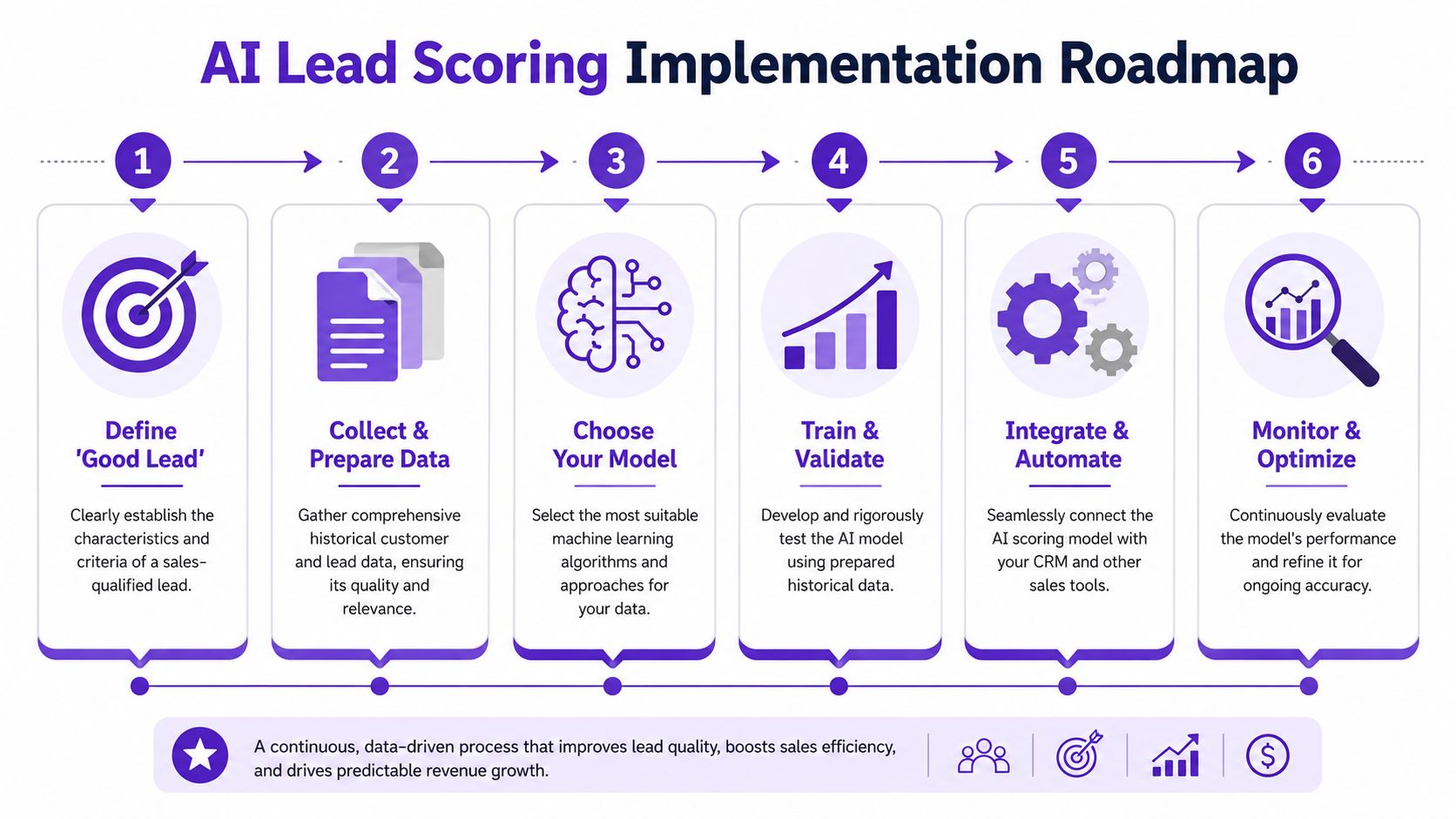
Before you touch tooling, force agreement on what a good lead looks like. Not in theory. In your pipeline.
Use this sequence:
Define “good” with sales
Pull examples of closed-won and closed-lost deals. Find the difference in behavior, not just profile.Audit your data layer
If your CRM is full of duplicates, missing fields, and random campaign debris, clean it first. AI won't rescue chaos.Unify your sources
CRM, web analytics, and marketing systems need to feed the same view. A unified feature vector is critical, and poor implementation of that layer can reduce predictive lift by 30 to 40% or more according to Monday.com's analysis of AI lead scoring setup.Choose your path
Buy a platform if speed matters. Build only if you've got strong data infrastructure and a clear reason not to buy.
Here's a useful explainer before you wire everything together:
If your records are thin, fix the input stack with better CRM data enrichment. Better scoring starts with better raw material.
Build the workflow, not just the score
A score sitting in a field is decoration.
You need operating rules around it:
Route hot leads fast to the right rep
Show score drivers so reps know why the lead matters
Trigger nurture for mid-priority leads instead of forcing sales to babysit them
Feed outcomes back into the model so it keeps learning
Operator note: Don't launch AI lead scoring until sales can answer one simple question: “What do I do differently when a lead score changes?”
The best implementation changes rep behavior. It shortens research time, sharpens timing, and gives context for outreach. If it only creates a new dashboard, you've built a museum exhibit.
Common Pitfalls and How to Sidestep Them
Most failures come from three dumb mistakes, not one grand technical issue.
First, garbage in still means garbage out. If your historical data is messy, incomplete, or detached from outcomes, the model will learn fiction. Clean your records, dedupe aggressively, and stop treating CRM hygiene like optional housekeeping.
Second, sales won't trust a black box. If a rep sees “92” with no explanation, they'll ignore it and go back to hunches. Show the drivers behind the score and tie them to real actions.
Third, set-it-and-forget-it kills accuracy. Buyer behavior shifts. Messaging changes. Channels evolve. If your team never revisits thresholds, inputs, and feedback loops, the model rots.
Use a simple rule set:
Make data ownership explicit so one team owns quality
Expose score logic in plain language inside the workflow
Review outcomes regularly and tune based on what closed, stalled, or died
AI is a force multiplier. It's not a substitute for operational discipline.
Frequently Asked Questions About AI Lead Scoring
Your team flips on AI scoring, then asks the right question: what makes the score useful in practice?
The answer is not fancier math. It is better inputs. If your model runs on stale CRM fields and form fills from last quarter, you get a polished guess. If it runs on live intent signals, recent engagement, and buying behavior, reps know who to call now, not next week.
A simple operating rule works well here. Refresh the model often, feed it closed-won and closed-lost outcomes, and set sales thresholds high enough that reps spend time on the leads with real buying motion. As noted earlier, frequent tuning beats worshipping a score that looked smart during setup.
FAQ
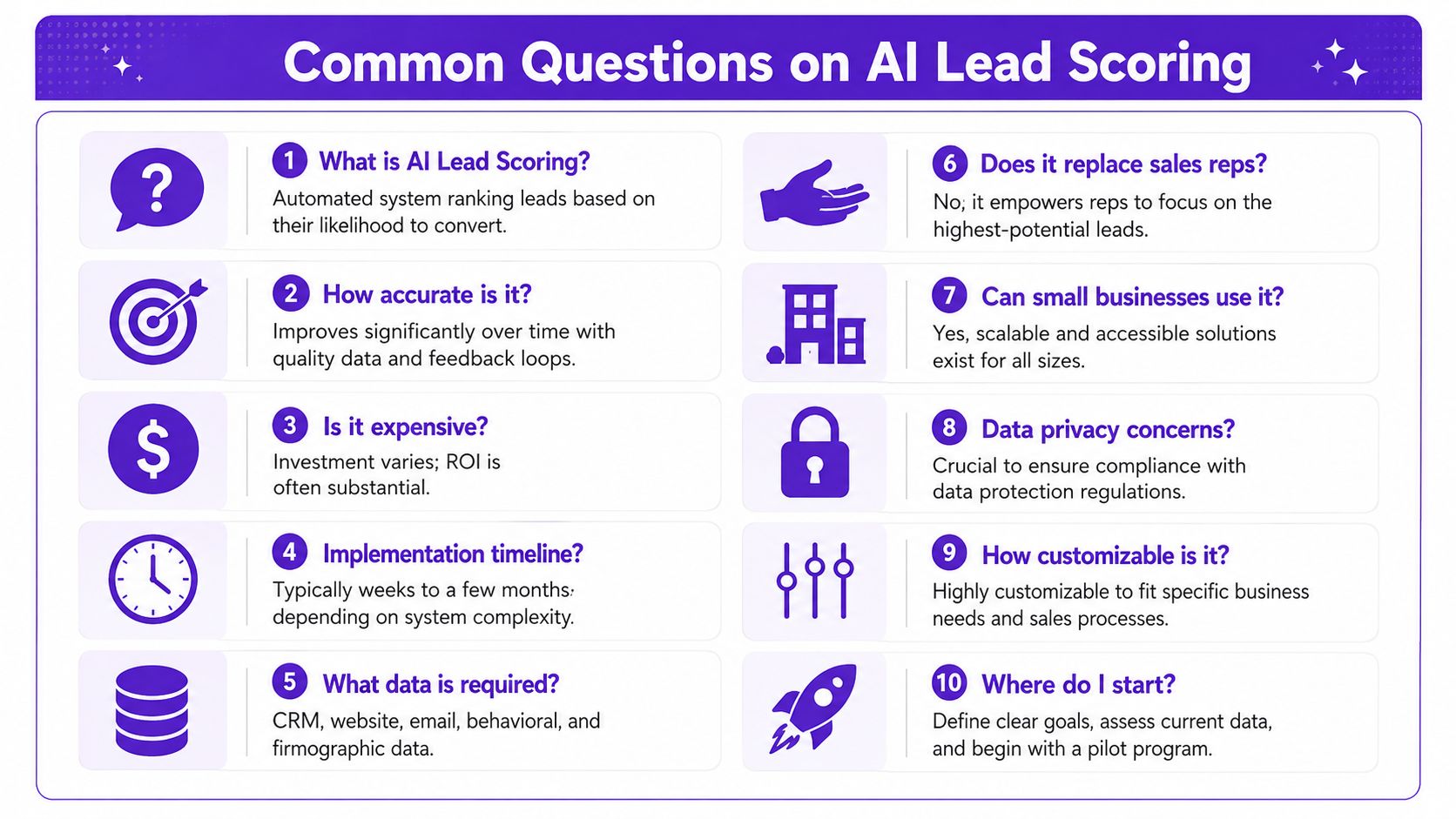
Question | Answer |
|---|---|
What is AI lead scoring? | It is a system that ranks leads by likelihood to convert using patterns from past deals and current behavior. |
Is it better than manual scoring? | Yes, if sales uses it inside the workflow and the inputs reflect reality. A spreadsheet score built on job title and company size alone is lipstick on a pig. |
What data does it need? | Start with CRM history, firmographics, engagement data, website activity, and outcome data. Then add the signals that matter most: recent intent, repeat visits, high-value page views, and buying actions across the account. |
Does it replace sales reps? | No. It helps reps stop playing prospector, detective, and psychic at the same time. |
Is this only for enterprise teams? | No. Smaller teams usually feel the win faster because every wasted call hurts more. |
How often should the model be updated? | Weekly is a strong cadence if new win and loss data is coming in. Fast-moving teams may review thresholds even more often. |
Do I need a data scientist to start? | No. You need clean data, clear ownership, and a platform your reps will use without a training sermon. |
What's the biggest implementation risk? | Feeding the model junk signals. Bad routing, missing activity data, and disconnected systems will poison the score faster than any algorithm can save it. |
Should scoring happen at the lead or account level? | In B2B, account-level context usually wins. Buying committees do not raise their hand one person at a time. |
What's the first sign it's working? | Reps respond faster, argue less about lead quality, and spend more time on accounts already showing heat. |
Good AI lead scoring is a prioritization engine, not a dashboard ornament.
If your team sells on LinkedIn and you're tired of static lists, RoverLead AI is worth a look. It turns real buying behavior into daily lead prioritization, surfaces high-intent prospects matched to your ICP, and gives reps context they can readily use. Less list-pulling. More timing. More conversations with people who already look ready to talk.