Outbound Calling Scripts That Don't Suck: A 2026 Guide

Your SDR has a script open on one screen, LinkedIn on another, and a CRM full of names that looked promising three weeks ago. Then the call starts with, “Hi, did I catch you at a bad time?” and dies exactly the way you'd expect.
That's the problem with most outbound calling scripts. They're built for interruption, not relevance. Reps are still using generic openers on people who just commented on a competitor's post, engaged with a pricing discussion, or followed a topic that screams active interest. At that point, the job of the call isn't to manufacture demand from thin air. It's to convert momentum that already exists.
Good outbound calling scripts sound less like a script and more like a fast, informed conversation. They use timing, context, and a clear next step. Bad ones sound like a hostage note written by committee.
Table of Contents
Why Most Outbound Calling Scripts Fail Horribly
Most bad calls fail before the rep finishes sentence one. The prospect hears a canned opener, detects zero context, and mentally files the call under “escape immediately.”
That's not just a style problem. It's a targeting problem dressed up as a script problem. The old belief is that if you just find the perfect opening line, you can turn a random list into pipeline. You can't.
The historical benchmark is brutal. The Baylor University Keller Center found traditional cold-call-to-appointment conversion was about 0.3%, or roughly 1 appointment per 330 dials on an unsegmented list, according to CloudTalk's summary of the Baylor finding. That's the sales equivalent of bringing a butter knife to a demolition job.
The real problem is the reason for the call
A script can improve delivery. It can sharpen positioning. It can help a rep avoid rambling. What it cannot do is magically create relevance where none exists.
Here's what usually breaks:
No trigger: The rep has no recent reason to call now.
No context: The opener could be used on any person at any company in any industry.
No adaptation: The same script gets used for a random cold account and a prospect who just engaged with a buying-related topic.
No exit path: When the call stalls, the rep keeps pushing instead of preserving the interaction.
Practical rule: If the only reason you're calling is “they match our ICP,” your script is already doing too much work.
The best reps don't worship outbound calling scripts. They use them as conversation scaffolding. They call when there's a credible trigger, especially a visible one from LinkedIn or other buying signals, and they tailor the first line to that trigger.
That changes the role of the script. Instead of trying to create interest from scratch, it helps the rep convert interest that already flickered.
The Anatomy of a High-Converting Script
A strong script isn't a monologue with line breaks. It's a modular sequence. Each part has a job. If one part is weak, the whole thing slips.
The opener earns a few seconds. The reason for the call earns attention. Discovery earns relevance. The close earns movement.
Traditional Script vs. Intent-Based Script
Component | Traditional Script (Fails) | Intent-Based Script (Converts) |
|---|---|---|
Opening line | Generic permission opener with no context | References a recent action, topic, or signal |
Reason for calling | Broad company pitch | Specific relevance tied to current interest |
Qualification | Checklist-style interrogation | Natural conversation guided by fit questions |
Rep behavior | Talks too much, sounds rehearsed | Uses context, listens, adapts |
Close | “I'll send something over” | Clear next step with time or channel attached |
Open with relevance, not ritual
Recent guidance says calling within minutes of high-intent activity significantly improves connection chances, and the strongest openers reference a recent prospect action rather than a generic permission-based line, as noted in Pipedrive's guide to outbound sales calls. That should change how you write scripts from the first word.
A weak opener sounds like this:
“Hi Sarah, this is Jake from Acme. We help companies streamline operations. Do you have a minute?”
A better one sounds like this:
“Hi Sarah, saw your comment on that RevOps thread about handoff delays. Calling because that's usually where teams start looking at workflow fixes.”
That second version works because it has a pulse. It knows why now.
Build the script in four functional parts
Opener: Give the prospect a reason to stay on the line.
Value statement: Keep it narrow and tied to the trigger, not your whole product deck.
Discovery: Ask enough to confirm fit without turning the call into airport security.
Close: Land on one next step, one channel, one commitment.
Good outbound calling scripts are short on flourish and long on clarity. They don't sound “creative.” They sound informed.
Crafting Your Core Script Components

Writing the script gets easier when you stop trying to write one perfect script. Build components instead. Then swap them based on the signal you saw.
Open with context, not fake friendliness
If the trigger came from LinkedIn, say so plainly. Don't pretend the call is random and then “happen” to mention the signal later.
Examples:
Comment-based opener: “Hi Dana, saw your comment on that post about slow SDR follow-up. Calling because that usually means the team is actively looking at process gaps.”
Competitor engagement opener: “Hi Marcus, noticed you were engaging with content around outbound sequencing. Reaching out because teams usually do that when the current workflow feels clunky.”
Pain-point opener: “Hi Priya, saw you've been active on posts about lead quality. Quick reason for the call. A lot of teams hit the same wall when firmographic lists look fine but timing is off.”
That kind of opener works because it explains why you, why now, and why this topic.
Run discovery like a conversation
The best scripts move quickly into discovery and keep a 70/30 listening-to-talking ratio during qualification, while weaving BANT-style questions naturally instead of making the prospect feel interrogated, according to VIDA's outbound call script guidance.
That means don't ask, “What's your budget, authority, need, and timeline?” unless your goal is to sound like a badly trained bot.
Try this flow instead:
“Curious, is this something you're actively trying to fix or just keeping an eye on?”
“How are you handling it today?”
“Who usually owns this on your side?”
“If this did move forward, what would trigger that?”
The rep's job during discovery is to diagnose, not perform.
For teams that pair calls with email follow-up, a tight written message is particularly beneficial. A good cold email template library can make the handoff from call to inbox feel consistent instead of stitched together by hope.
Leave voicemails that earn the next touch
Most voicemails are miniature product brochures. Delete those from existence.
Use this instead:
State your name and company
Mention the trigger
Give one reason the call matters
Point to the follow-up channel
Example:
“Hey Lauren, this is Chris from Northlane. Calling because I saw your recent engagement around outbound hiring and thought the timing might be relevant. I'll send a short note by email and LinkedIn so you have context. If it's useful, we can pick it up there.”
Short. Human. No TED Talk.
Mastering Objections and Channel Pivots
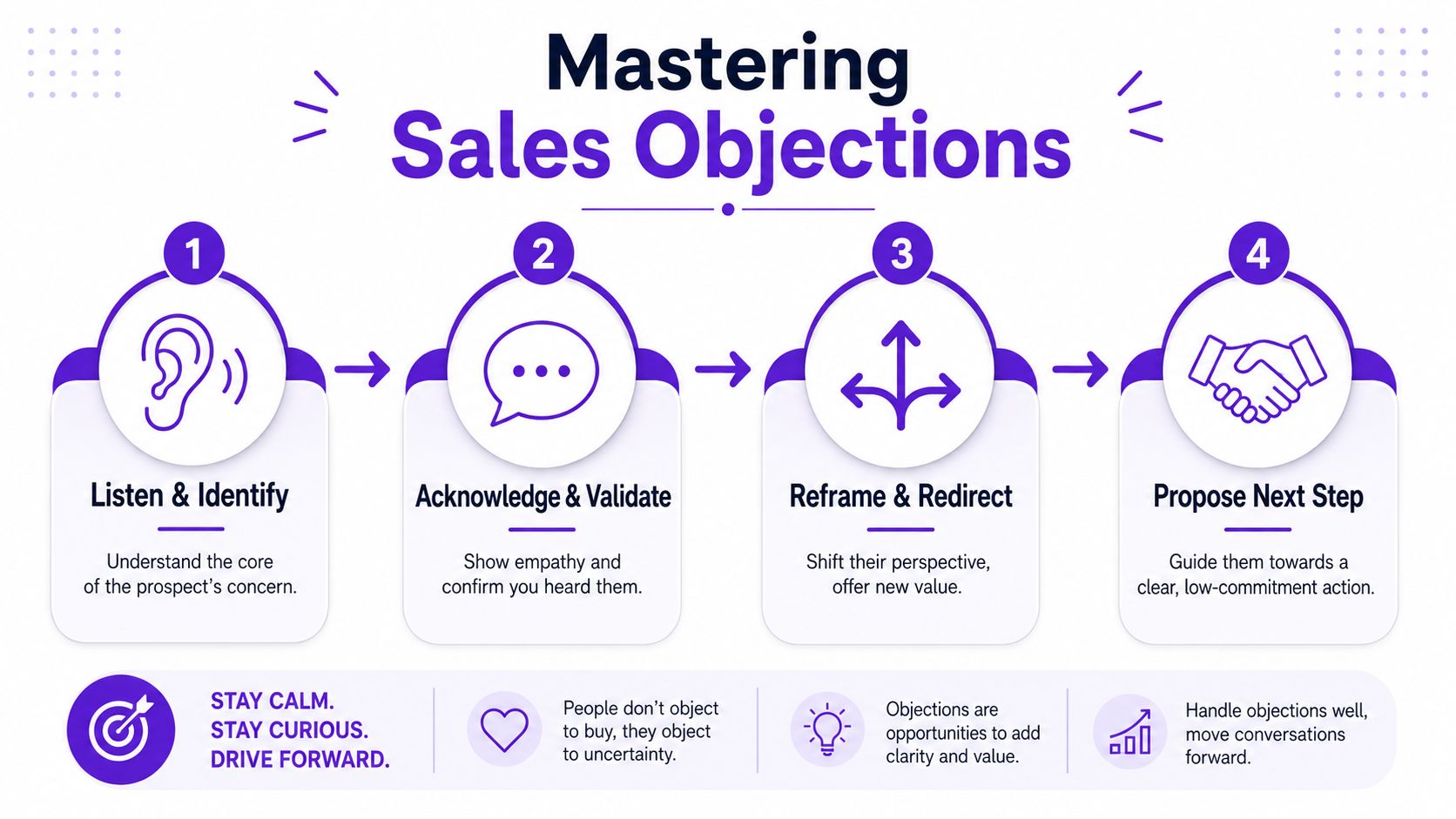
The reps who lose good opportunities aren't always the ones with weak openers. Often, they're the ones who hear resistance and treat it like a duel.
Stop treating every objection like a cage match
Classic brush-offs still show up. “Send me an email.” “Not interested.” “We already have something.” The mistake is trying to bulldoze through all of them with the same rebuttal.
Use a lighter touch:
Send me an email: “Happy to. Before I do, what would make that email worth opening?”
Not interested: “Fair enough. Usually that means bad timing or wrong priority. Which one is it?”
We already have a tool: “Makes sense. I'm not trying to rip that out on a Tuesday afternoon. Where does it still frustrate the team?”
These responses work because they lower tension and get to truth faster.
A lot of reps still lean on brute-force dialing habits instead of adapting. If that sounds familiar, Smile and dial is worth rethinking as a mindset. Energy helps. Context helps more.
A useful reminder before the next tactic:
When the phone is the wrong channel
One gap in many script guides is obvious once you've managed a team for more than five minutes. Some prospects do not want to talk on the phone. Pushing harder usually kills the interaction.
CloudTalk notes that the first goal is often just to buy 30 seconds, not force a full pitch, and that strong reps offer an “out” through an alternative channel rather than insisting on a live conversation in its guide to sales call script templates.
That's the channel pivot. It sounds like this:
“No problem. Is email better, or would LinkedIn be easier? I can send a one-liner and you can decide if it's worth a follow-up.”
That line respects the buyer, preserves intent, and keeps momentum alive. In modern outbound calling scripts, that's not a backup move. It's part of the design.
Testing and Optimizing Your Scripts with Data
The script in your playbook should never be treated like sacred text. It's a working draft with a headset on.
Test one thing at a time
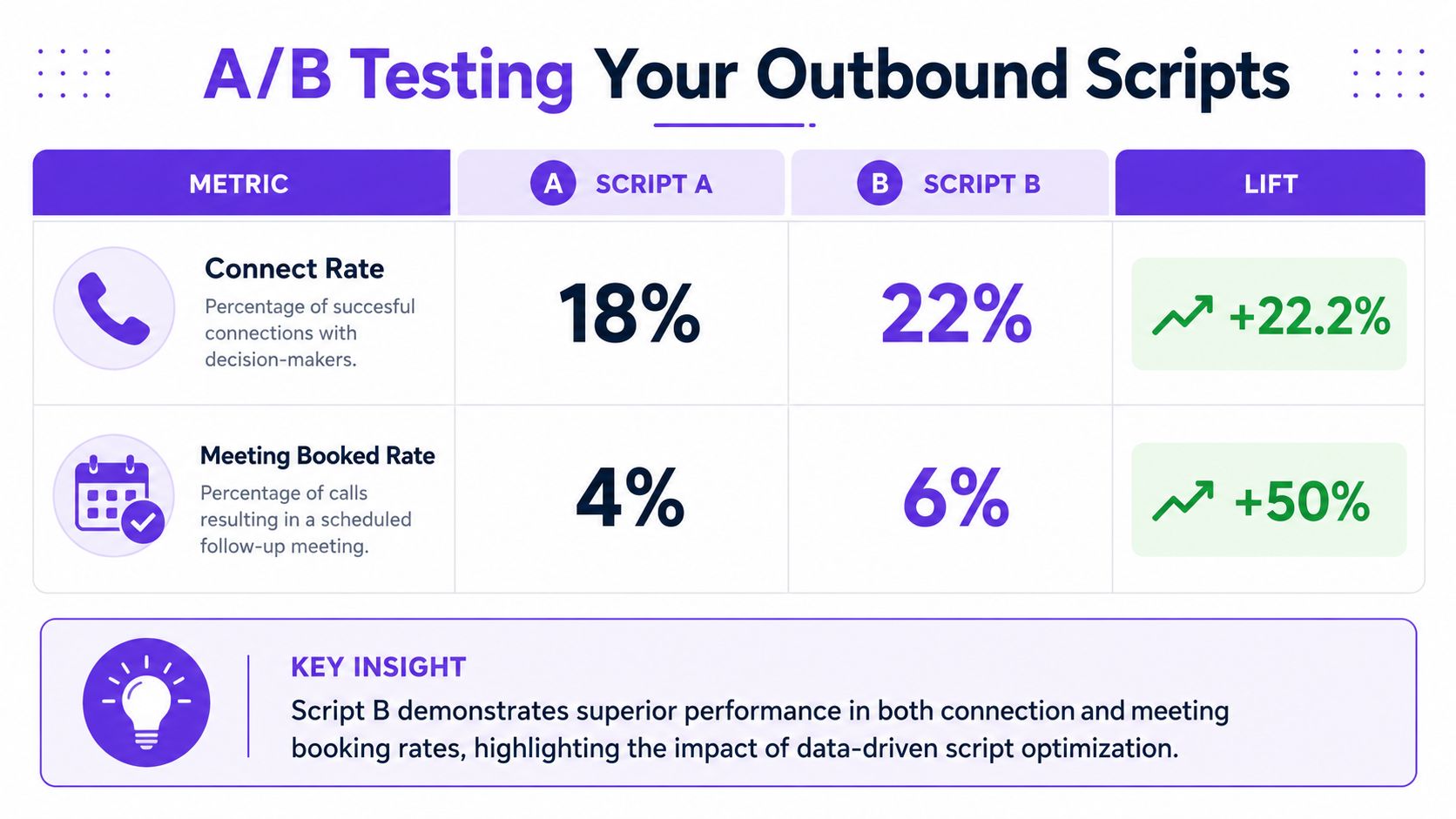
If you change the opener, value prop, CTA, list source, and rep assignment all at once, congratulations, you've learned nothing.
A cleaner process is to change one variable at a time and evaluate it over enough live conversations to see a real pattern. SalesHive recommends analyzing 50 to 100 live connects per variant before declaring a winner, and notes that with baseline success rates around 2% to 3%, you need that volume for a clearer signal in its A/B testing guide for cold calling scripts.
Test candidates that matter:
Opener: Trigger-based versus generic
Value statement: Pain-led versus outcome-led
Question sequence: Early qualification versus later qualification
Close: Demo ask versus low-friction follow-up ask
A script doesn't improve because the team “likes it better.” It improves when the buyer responds better.
Measure the script, not just the meeting
Meetings booked matter. They are not the whole picture.
Track the indicators that tell you where the script is helping or hurting:
Live connects: Did the rep get conversations with the right people?
Meetings per connect: Did the script progress the conversation?
Average talk time: Did the opener hold attention long enough to qualify?
Objection frequency: Are certain phrases triggering the same resistance?
Next-step clarity: Are reps ending with a specific commitment or vague promises?
If your team is still managing this with scattered call notes and gut feel, a proper sales engagement platform makes optimization much less chaotic.
One more practical note. More recent outbound stats show that attempt strategy matters too. Cognism's 2025 report says it takes three cold call attempts on average to connect with a lead, 93% of conversations occur by the third call, and over 98% by the fifth call. It also places average cold calling success at 2.3%, according to Cognism's cold calling statistics roundup. If your script testing ignores attempt cadence, you're judging the line without judging the sequence.
Frequently Asked Questions About Outbound Scripts
Question | Answer |
|---|---|
Should reps read outbound calling scripts word for word? | No. Read them enough to internalize the flow, then speak like a person with a job, not a voicemail system. |
What makes a script sound natural? | Context, shorter sentences, and fewer “positioning statements.” If the line sounds weird in normal conversation, it's weird on a call. |
How long should the opening be? | Short. The opener should earn attention, not explain your company history. |
What's the best source of context for modern outbound calls? | Recent buying or research signals. LinkedIn engagement is especially useful because it gives reps language, timing, and topic clues. |
Should every prospect get the same script? | No. A static script for all leads ignores intent level, timing, and channel preference. |
How many call attempts should be built into a sequence? | Use a structured sequence, not one heroic call. As noted earlier, most conversations happen by the third attempt, and very few new ones happen after the fifth. |
What should reps do when someone says “send me an email”? | Treat it as a fork in the road, not an automatic loss. Ask what would make the email worth reading, then send a short, relevant note. |
Are voicemails still worth leaving? | Yes, if they're brief and connected to a follow-up touch. No, if they sound like a product demo with no oxygen. |
What should be banned from every script? | Generic permission openers with no context, fake enthusiasm, and long company pitches before the rep earns interest. |
Can AI help write outbound calling scripts? | Yes, especially for drafting variants and summarizing signals. But reps still need judgment. AI can suggest language. It can't replace timing, listening, or common sense. |
If your team is tired of calling cold lists that looked good on paper but had no actual buying momentum, RoverLead AI is worth a look. It helps sales teams turn LinkedIn engagement into high-intent leads with context, timing, and AI-written openers, so your outbound calling scripts start from real interest instead of wishful thinking.