Customer Relationship Management Types: A No-Nonsense Guide

You bought the CRM. You sat through the demos. Everyone nodded when the vendor showed the pretty dashboard and promised a cleaner pipeline.
Six months later, reps are still updating fields they hate, marketing is tossing leads over a wall, customer success is cleaning up messes, and leadership is wondering why a polished system can somehow coexist with a very ugly quarter.
That usually isn't a software problem. It's a categorization problem. Teams buy one CRM expecting it to fix every revenue issue, when in reality they need to understand the actual customer relationship management types first. A CRM can be a workhorse, a brain, a coordination layer, a strategic philosophy, or an intent engine. If you use the wrong one for the job, you're basically bringing a filing cabinet to a fistfight.
Table of Contents
The Three Main CRM Flavors Operational Analytical and Collaborative
Your CRM Is Great So Why Is Your Pipeline Empty
A familiar scene. A head of sales signs off on Salesforce, HubSpot, Dynamics, or some other respected platform. The setup gets done. Pipelines are built. Sequences are connected. Dashboards go live. Then quota doesn't magically improve, and everyone starts looking for a culprit.

Most of the time, the reps aren't lazy and the platform isn't broken. The team just bought the wrong type of system for the problem they had. If your issue is manual admin, you need process automation. If your issue is bad targeting, you need analysis. If your issue is siloed handoffs, you need shared context. If your issue is weak prospect timing, a traditional CRM alone won't save you.
The real mistake
Leaders often shop by feature checklist instead of by operating model. That leads to predictable pain:
Too much logging, not enough selling: Reps spend more time feeding the machine than talking to buyers.
Great reports on bad inputs: Leadership gets dashboards, but the underlying data is stale or shallow.
One record, three realities: Sales, marketing, and support all think they know the customer, and none of them match.
Buy the CRM for the bottleneck you have, not the logo your board recognizes.
If your contact records are thin, start with better data hygiene before blaming forecast quality. A good primer on CRM data enrichment usually solves more than another dashboard ever will.
The Three Main CRM Flavors Operational Analytical and Collaborative
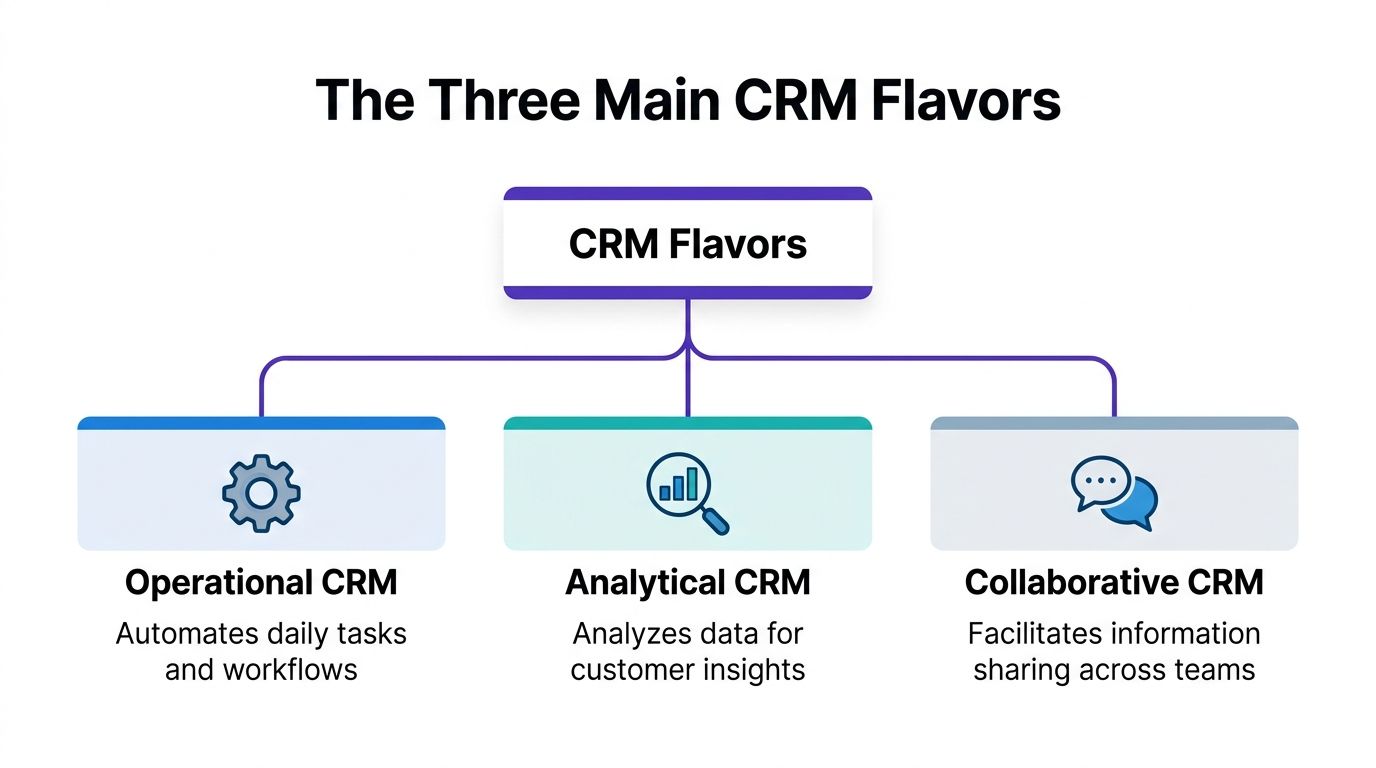
Most guides explain CRM types like they're ice cream flavors. Cute, but not useful. In practice, the classic three each do a very different job.
Operational CRM
Think of Operational CRM as the workhorse. It handles the repetitive stuff that should never depend on memory and sticky notes.
Operational CRM: the system that automates customer-facing work across sales, marketing, and service.
A common starting point for many teams, and for good reason. Operational CRM is the layer that keeps leads moving, follow-ups scheduled, deals staged, and service requests tracked. But it only counts as true operational CRM if it includes all three core components: Sales Force Automation, Marketing Automation, and Service Automation, as outlined in Wikipedia's CRM architecture overview. Miss one, and you've got a partial tool pretending to be a full system.
A decent sales enablement stack matters here too. If your reps have process but no usable assets, messaging, or workflows, the CRM becomes a fancy chore list. That's where a sales enablement platform earns its keep.
Analytical CRM
If operational CRM is the workhorse, Analytical CRM is the brain. It asks why buyers convert, where they stall, which segments matter, and what patterns your team keeps missing.
Analytical CRM turns raw activity from sales, marketing, finance, and support into decision-making fuel.
It doesn't just store records. It centralizes data so teams can segment customers, spot trends, estimate value, and make better bets. When analytical CRM is done right, leadership stops arguing from anecdotes and starts working from actual patterns.
Collaborative CRM
Now for the nervous system. Collaborative CRM exists so teams don't behave like separate companies sharing the same logo.
Collaborative CRM gives everyone the same customer context, so one hand knows what the other hand just emailed.
This matters most when handoffs are expensive. If support logs an issue and sales doesn't see it, trust evaporates. If marketing promises one thing and customer success delivers another, renewal conversations get awkward fast. Collaborative CRM is built to share customer information across teams and, in many B2B setups, across external stakeholders such as suppliers, vendors, and distributors.
Where each one shines
Type | Best at | Usually fails when |
|---|---|---|
Operational | Workflow automation and task consistency | Teams expect it to explain buyer behavior |
Analytical | Pattern detection and planning | Data is fragmented or low quality |
Collaborative | Cross-team coordination and shared context | Nobody agrees on process ownership |
The mistake isn't choosing one of these. The mistake is assuming one of them is enough for every growth stage.
A Quick Reference Guide to CRM Types
The CRM market is big enough to punish lazy buying decisions. The global CRM market reached $91.43 billion in 2023 and is projected to grow at a 12.6% CAGR through 2032, according to Flowlu's CRM statistics roundup. Money is pouring into this category. That doesn't make every implementation smart.
Here's the version busy operators need.
CRM Types Comparison
CRM Type | Primary Goal | Key Users | Ideal For... |
|---|---|---|---|
Operational CRM | Automate sales, marketing, and service workflows | SDRs, AEs, RevOps, support teams | Teams drowning in repetitive tasks and inconsistent follow-up |
Analytical CRM | Turn customer data into insight and forecasting | RevOps, marketing ops, sales leadership, analysts | Companies with enough data to segment, predict, and prioritize |
Collaborative CRM | Share customer context across functions and partners | Sales, marketing, support, account teams, partner-facing teams | Organizations where handoffs and mixed messaging hurt deals or retention |
Strategic CRM | Build a customer-centered operating model | Leadership, GTM leaders, customer success, product teams | Companies trying to improve long-term customer value, not just short-term throughput |
How to use this table without overthinking it
If your reps are missing follow-ups, don't buy a heavier analytics suite. If your executive team is making pipeline calls based on gut feel, don't expect pipeline stages alone to fix that. If your customer experience changes depending on who the buyer spoke to last, you've got a collaboration problem, not a sequence problem.
The fastest way to waste CRM budget is to solve an organizational problem with a feature pack.
A lot of teams also need more than one lens at once. An operational core plus analytical reporting is common. Operational plus collaborative is common too. Strategic CRM, covered next, is different because it isn't just software. It's the operating philosophy that stops your systems from becoming disconnected machinery.
The Fourth Type Most Guides Miss Strategic CRM
This is the one listicles skip because it's harder to sell in a screenshot.
Strategic CRM isn't mainly about automating tasks or syncing records. It's about building a customer-centric business culture so the company makes decisions around long-term value, not just short-term transaction volume. SafetyCulture's overview of Strategic CRM frames it around improving Customer Lifetime Value, which is the right lens.
Why it matters
Operational CRM can help a rep move a deal. Analytical CRM can help a leader understand a pattern. Collaborative CRM can stop departments from tripping over each other. Strategic CRM asks a more uncomfortable question: are your teams, incentives, and processes designed around the customer at all?
If the answer is no, the other CRM types just help you become more efficient at the wrong behaviors.
What strategic CRM looks like in the wild
Leadership alignment: Revenue, service, and product teams don't optimize for conflicting outcomes.
Process design: Handoffs, messaging, and account plans reflect what the customer needs next.
Value lens: The business pays attention to retention, expansion, and relationship quality, not just closed-won celebrations.
A CRM can't create customer centricity by itself. It can only expose whether you have it.
This is why two companies can run the same platform and get very different outcomes. One uses the system to push records through a funnel. The other uses it to build a better customer business.
The Emerging Fifth Type Intent-Driven Prospecting
Traditional CRM types are mostly backward-looking. They store who someone is, what happened, and what stage a rep assigned. Useful, yes. Timely, not always.
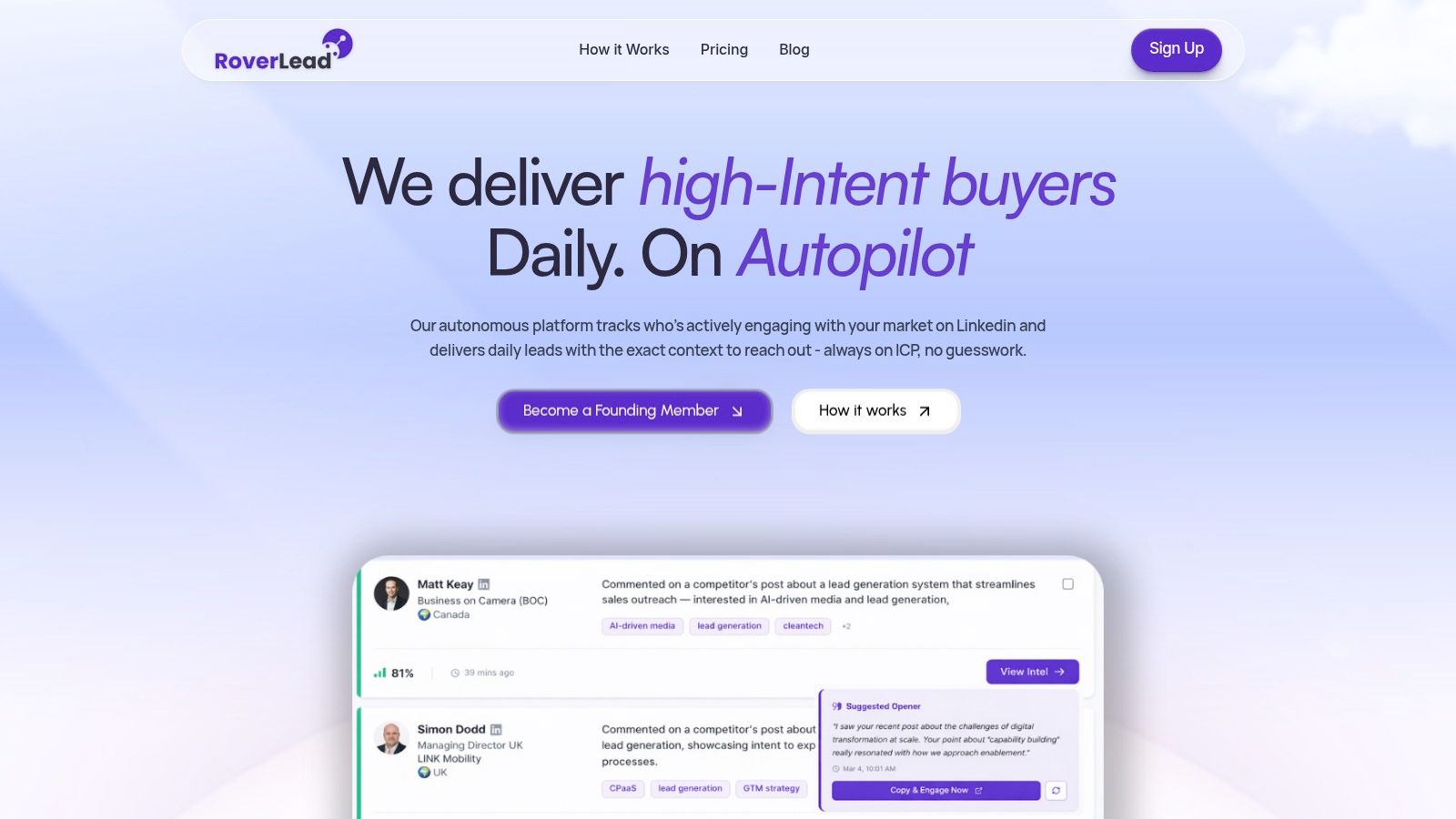
Modern B2B selling needs a fifth layer: Intent-Driven prospecting.
Why the old model is too reactive
A standard CRM record tells you a prospect downloaded something, opened something, or got added to a list. That's history. It doesn't tell you enough about what they're actively paying attention to right now.
That's a serious gap because 68% of B2B buyers now expect vendors to recognize their active intent signals before they formally express interest, according to Gartner newsroom coverage. Most traditional CRM setups weren't built for that. They were built to manage contacts and workflows, not live buying signals.
What intent-driven prospecting actually means
Intent-driven prospecting watches for behavior that suggests motion. Not vague demographics. Not static lists. Actual signs that a buyer may be entering a problem-solving window.
That can include:
Topic engagement: They keep interacting with content around a pain point your product solves.
Competitive curiosity: They engage with competitors, adjacent vendors, or market discussions.
Commercial signals: They show interest in pricing, demos, implementation questions, or peer recommendations.
Network-based context: They engage inside communities or creator circles tied to your niche.
This is why old-school list pulls keep underperforming. Static firmographics age badly. Intent has a pulse.
Where it fits with the classic CRM stack
Intent-driven prospecting isn't a replacement for operational, analytical, collaborative, or strategic CRM. It fills the front-end gap those systems struggle with. It helps answer: who should we talk to now, and why now?
For teams evaluating the category, a useful starting point is to compare modern AI prospecting tools that can surface live buying signals rather than just enrich a stale database.
A quick explainer helps if your team still thinks prospecting means exporting a list and hoping for the best.
What works and what doesn't
What works is relevance plus timing. A rep sees a credible signal, adds context, and reaches out like a human who pays attention.
What doesn't work is slapping more automation onto low-intent outreach and calling it modern GTM. That's not intent-driven. That's just faster irrelevance.
Buyers don't mind outreach nearly as much as they mind clueless outreach.
A Sales Leader's Checklist for Choosing the Right CRM
You don't pick the right CRM by asking which brand wins the demo. You pick it by diagnosing where revenue gets stuck.
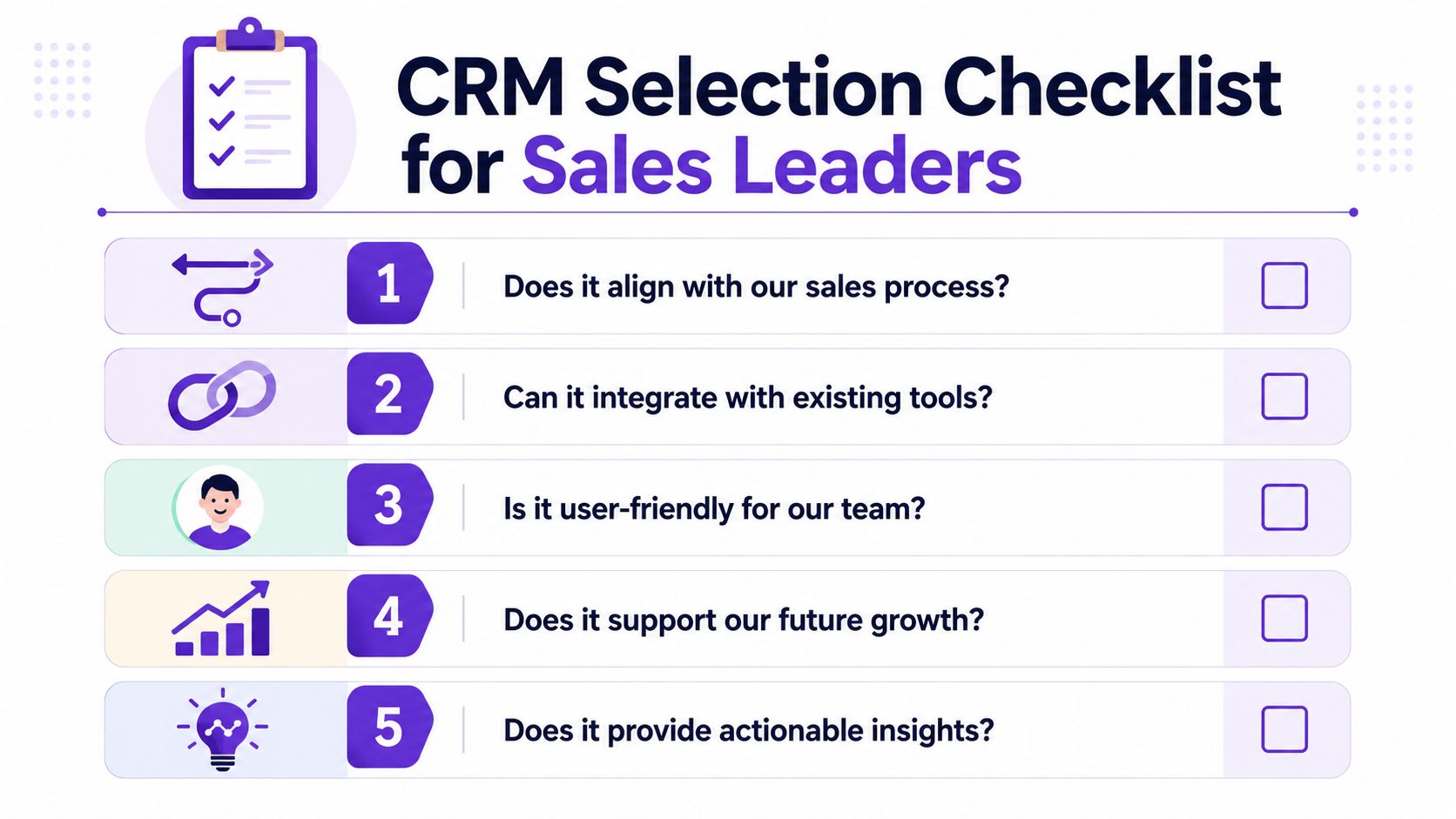
Ask these questions before you sign anything
Are reps wasting time on manual admin?
If yes, you need stronger operational CRM. Start with workflow automation, cleaner opportunity management, and service handoff basics.Do you have plenty of data but weak decisions?
That's an analytical CRM problem. Reports alone don't count. You need centralized data and patterns your managers can act on.Are teams basically strangers with shared Slack access?
That points to collaborative CRM. This matters more than people admit. Companies with robust collaborative CRM implementations see a 15 to 25% improvement in customer satisfaction scores because teams can resolve issues proactively and keep messaging consistent, as described by TechTarget's definition of Collaborative CRM.Are customers getting a different experience from every department?
That's not a training issue first. It's a system and process issue. Strategic CRM thinking needs to sit above the tooling.Is your pipeline full of names but short on buying readiness?
Then your stack needs an intent layer. More records won't fix weak timing.
A blunt selection rule
If a vendor can't explain how their product supports your actual sales motion, don't let the feature grid seduce you. A beautiful dashboard attached to a confused process is still a confused process.
What smart teams do differently
They map pain to type first, then shortlist vendors second. They also test adoption realities. A CRM that reps hate won't become strategic because procurement got a discount.
Frequently Asked Questions About CRM Types
1. Which CRM type should a small B2B team start with
Usually operational CRM. Small teams need consistency before sophistication. If follow-up, pipeline stages, and service requests are messy, fix that first.
2. Can one CRM platform cover multiple types
Yes, many platforms blend functions. But blended features don't guarantee strong execution. A tool can claim analytics, collaboration, and automation while doing one of them well and two of them badly.
3. Is Strategic CRM a software category or a business philosophy
Mostly a business philosophy. Software supports it, but leadership behavior, incentives, and customer process design determine whether it exists.
4. What's the biggest mistake during CRM migration
Moving bad data and bad habits into a cleaner interface. Teams often treat migration like a technical project when it's really an operating-model cleanup.
5. How do you know if analytical CRM is actually working
Your team should make better decisions, not just prettier dashboards. If managers can segment accounts more intelligently, spot churn risk sooner, or prioritize effort with more confidence, it's working.
6. Do collaborative CRM features only matter for large companies
No. Small companies feel the pain too. In fact, when a small team has poor handoffs, everyone notices faster because there are fewer layers to hide the mess.
7. Are industry-specific CRMs worth it
Sometimes. If your sales motion has unusual workflows, compliance steps, channel dependencies, or partner involvement, a vertical CRM can save customization pain. If not, a flexible general platform often does the job.
8. Cloud versus on-premise still matters
It does, but less as a philosophical debate and more as a governance decision. Teams typically care about implementation speed, integrations, and admin burden. A slow, overcontrolled deployment can kill adoption before value appears.
9. How should modern CRMs handle LinkedIn and other platform rules
Carefully. Spray-and-pray automation is exactly how teams get themselves into trouble. It's evident in the fact that 65% of sales teams are abandoning conventional operational CRM types in favor of compliant intent CRM models that work within platform constraints such as LinkedIn's anti-spam rules, according to McKinsey's digital sales perspective. Compliance-by-design is no longer a nice-to-have.
10. What's the right way to think about customer relationship management types today
Think in layers, not labels. You still need the classic categories. But modern B2B teams also need strategy on top and intent at the front. Otherwise the CRM becomes a record of deals you were late to.
RoverLead AI helps sales teams prospect from live LinkedIn intent instead of stale cold lists. If your CRM is organized but your pipeline timing still feels off, RoverLead AI gives you an intent layer built for modern social selling, with signal-based lead discovery, ICP matching, and AI-written openers that help reps act while buyer interest is still warm.