High Ticket Sales Meaning: A Modern Explainer for 2026

Your team is probably doing all the “right” sales activities and still feeling oddly stuck. The calendar is full. The pipeline looks busy. Reps are sending cold emails, booking demos, chasing follow-ups, and somehow the revenue line still feels like it's jogging in place.
That's usually when people start googling high ticket sales meaning and get fed a parade of vague advice about luxury products, slick closers, and magical persuasion scripts. Useful if you sell watches on Instagram. Not so useful if you sell software, consulting, or professional services into an actual business.
The modern version is different. A lot different. If you're targeting larger deals, you're not trying to “convince a buyer” anymore. You're trying to help a group of people decide that change is worth the risk. If your team is still prospecting like it's a one-person decision, that's the bug.
And before you chase bigger accounts, tighten your target. If your ideal customer profile is still fuzzy, fix that first with a clear ICP definition in business terms. High-value selling gets expensive fast when you aim at the wrong companies.
Table of Contents
So You Want to Close Bigger Deals
Let's be honest. Chasing small deals all quarter is exhausting.
You can win a lot of activity trophies that way. More demos. More proposals. More “just circling back” emails. But if every deal is small, your team ends up working like a call center with better slide decks. Revenue grows, maybe, but only if everyone keeps sprinting.
That's why bigger deals look so attractive. One solid win can change a month. A handful can change a year. But sales teams frequently make a predictable mistake. They take the same old playbook, add more effort, and expect enterprise outcomes. More cold calls. More sequences. More pressure. Then they wonder why the buyer goes quiet after the second meeting.
Bigger deals don't reward louder selling. They reward better navigation.
The reason is simple. High-value deals carry more risk, more scrutiny, and more internal debate. Buyers don't just ask, “Do I like this?” They ask, “Can I defend this decision to finance, IT, operations, procurement, and my boss?”
That's the shift behind high ticket sales meaning in 2026. It's not about sounding premium. It's about operating like a guide in a messy decision process where timing, relevance, and stakeholder alignment matter more than charm.
What High Ticket Sales Really Means Today
Most definitions of high ticket sales are lazy. They treat it like a price label. That's incomplete.
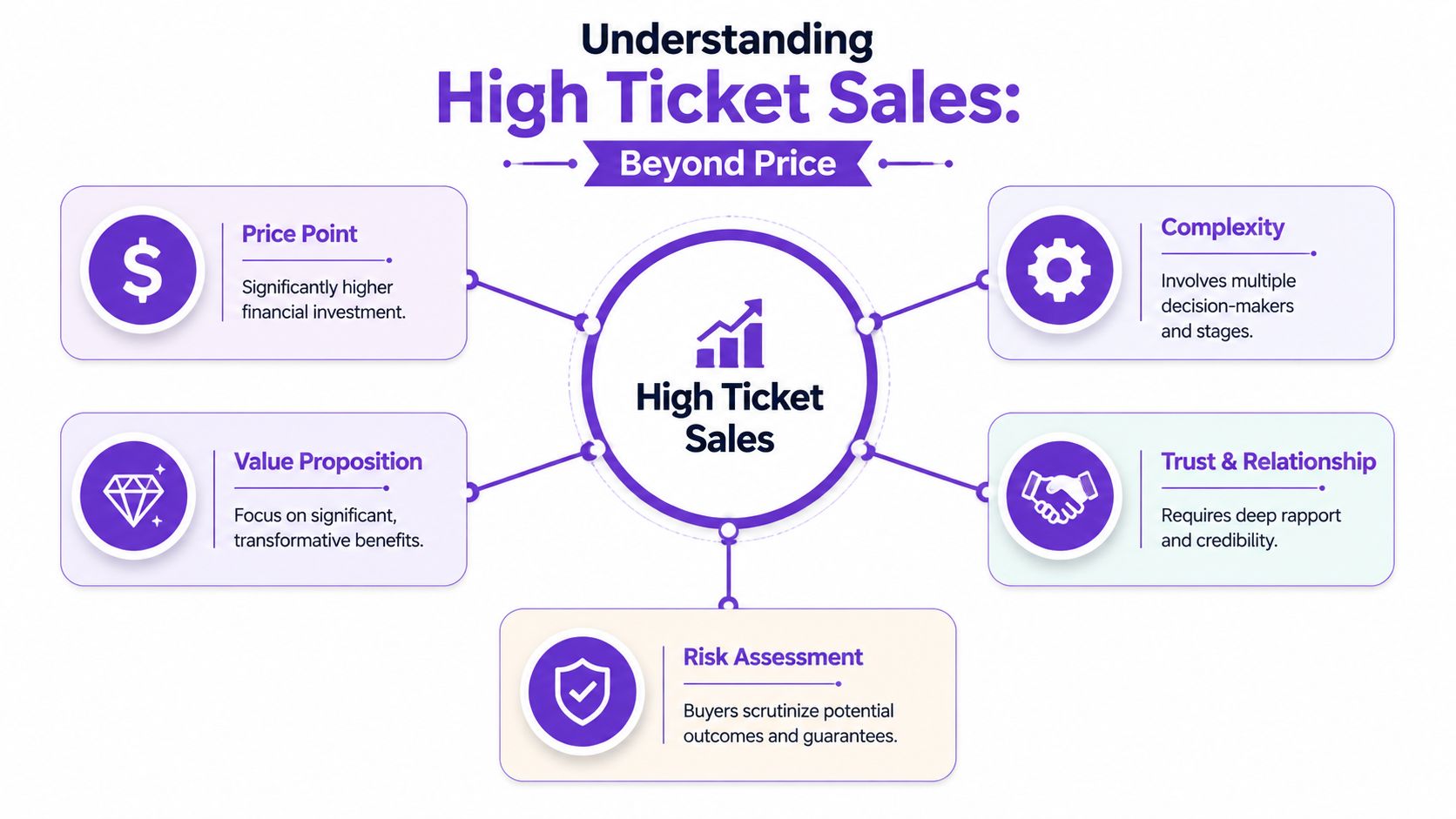
In B2B, a deal becomes high ticket when the price and perceived risk trigger a more formal buying process. According to Apollo's high-ticket sales analysis, high-ticket sales is technically defined not by a fixed price threshold, but by the structural complexity of the buying decision, with B2B deals generally requiring a minimum floor of $5,000 to $20,000, and timelines often stretching from 60 to 180 days.
Price matters, but process matters more
A cheap purchase can still feel risky in the wrong context. A more expensive purchase can move quickly if the buyer has authority and urgency. But in most B2B environments, once the investment crosses into serious budget territory, the deal stops being a simple yes-or-no and becomes an internal project.
High-ticket sales is defined not by the price tag, but by the organizational complexity the price tag creates.
That's the definition most guides miss.
You're not only selling outcomes. You're selling confidence, proof, and a clear path through internal friction. That's why these deals demand better discovery, sharper positioning, and content that helps buyers justify the decision after your call ends.
A quick visual makes the point better than another fluffy paragraph.
What changes once a deal becomes high ticket
When a sale moves into high-ticket territory, several things change at once:
The buyer gets less impulsive. They research, compare, ask awkward questions, and pull in colleagues.
The seller has to get more consultative. Generic pitch decks die here.
Risk becomes central. Buyers want ROI logic, implementation clarity, and fewer surprises.
Trust has to travel internally. Your champion might like you, but they still need others to agree.
If you sell consulting, enterprise software, or a specialized service, this is the version of high ticket sales meaning that matters. Not “expensive stuff.” Complex decisions.
High Ticket vs Low Ticket Sales Compared
If you use a low-ticket playbook in a high-ticket environment, you'll create noise, not pipeline. The two models run on different economics, different buyer behavior, and different success metrics.
One useful way to frame it is this: high-ticket sales runs on concentrated value, while low-ticket sales runs on repeatable volume. In high-ticket selling, a single win can equal dozens of smaller accounts. Low-ticket selling depends on throughput. High-ticket buyers also research for weeks or months and often involve multiple decision-makers because the investment is substantial.
High Ticket vs. Low Ticket Sales Models
Dimension | High-Ticket Sales | Low-Ticket Sales |
|---|---|---|
Typical price point | Usually starts in meaningful B2B budget territory, often tied to formal review | Lower-cost purchase, often easy to approve |
Sales cycle length | Longer, consultative, often measured in months | Shorter, often quick or immediate |
Primary sales metric | Deal value, quality of fit, progression through complex stages | Volume, conversion rate, transaction count |
Buyer psychology | Risk mitigation, ROI validation, internal alignment | Convenience, speed, impulse, clear utility |
Stakeholder involvement | Multiple people may weigh in before approval | Often one buyer or a simple approval path |
Messaging style | Tailored, evidence-based, role-specific | Broad, direct, benefit-first |
Relationship to seller | Consultative and trust-heavy | Transactional or lightly assisted |
Sales motion | Discovery, education, consensus building | Marketing-led, checkout-driven, or simple outbound |
Best channel approach | Context-rich outreach and buyer enablement | Scalable automation and efficient conversion paths |
Economic model | Volume drops, value concentrates | Volume carries the model |
The mistake isn't selling one model or the other. The mistake is mixing them up.
A team selling high-value services shouldn't obsess over the same activity metrics as a transactional inside-sales team. If the deal is complex, the motion has to match.
Navigating the Modern High Ticket Sales Process
Most pipeline stages look tidy in a CRM and chaotic everywhere else. That's normal.
The modern high-ticket process is not a straight line from discovery call to signed order form. In 2026, high-ticket B2B sales involve 8 to 13 distinct stakeholders per transaction, and over 70% of B2B buyers complete purchases of $50,000 or more through a fully remote sales process. That means the seller's job has shifted from persuading an individual to guiding a buying committee.
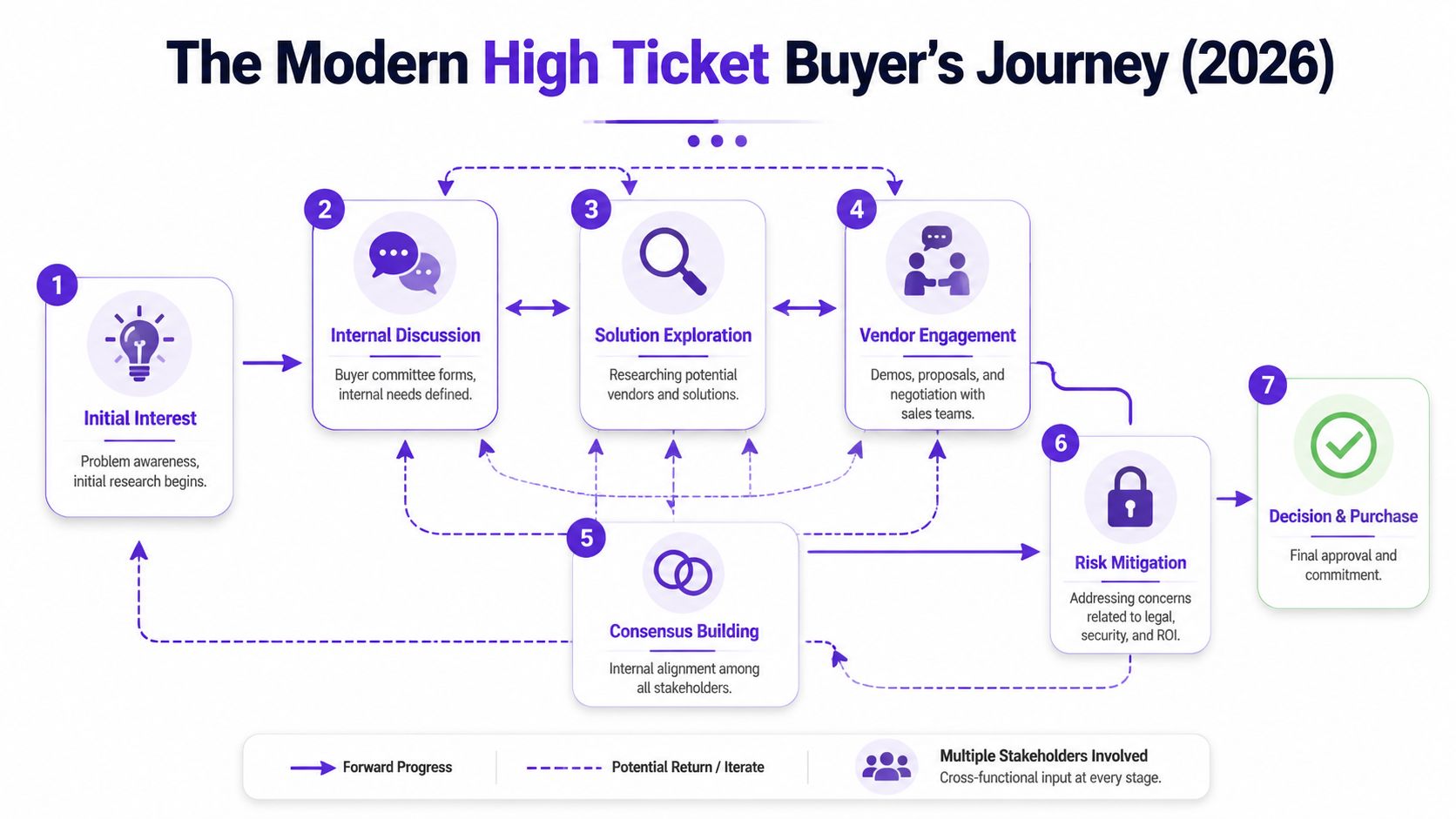
The real job is consensus building
Your champion is not the deal.
Your champion is one person trying to carry your case into rooms you're not in. Finance wants economic logic. IT wants security comfort. Operations wants practical adoption. Legal wants clean terms. Leadership wants confidence that this won't become an expensive mess by next quarter.
Practical rule: If your deal depends on one enthusiastic contact, it isn't stable yet.
That's why strong reps stop acting like closers and start acting like coordinators of evidence. They help the buyer answer internal questions before those questions become silent objections.
If your team needs a stronger operating system for this, a structured approach to sales process optimization matters more than another objection-handling script.
What strong teams actually do
The teams that move these deals forward tend to do a few things well:
They identify the cost of inaction early.
Not in a cheesy “what happens if you do nothing?” way. In a serious business way. What is the current process costing in delay, risk, inefficiency, or missed opportunity?They build a business case with the buyer.
They don't toss over a proposal and hope. They co-create the reason the deal deserves approval.They map stakeholders before procurement gets involved.
Waiting until the end to discover security, compliance, or executive concerns is how deals go from “nearly done” to “mysteriously stalled.”They equip the champion.
A great champion needs material they can reuse internally. Clear summaries. ROI framing. Risk answers. No jargon soup.They keep momentum in remote environments.
Fully remote buying is convenient for the buyer and dangerous for the seller. It's easier for people to postpone, disappear, or defer. Good reps create next steps with purpose, not vague goodwill.
That's the modern process. Messy, political, and very winnable if you respect how decisions happen.
How to Find High Ticket Buyers Who Are Ready Now
Sales teams often still hunt for high-ticket buyers like it's 2018. Build a list. Filter by title. Export contacts. Launch sequence. Hope somebody replies before they mark you as background radiation.
That approach struggles because high-ticket deals are sensitive to timing. A perfectly matched account with no active interest is still a cold prospect. A slightly smaller account showing clear buying behavior is often the better opportunity.
Why cold outreach struggles here
Cold outreach isn't dead. It's just overrated for complex sales.
Busy buyers don't want generic messages from strangers who found them through firmographic filters. They respond when the outreach matches something they're already thinking about. That might be a pricing discussion, a comment on a niche post, engagement with a competitor, or a public conversation around a painful problem.
Modern high-ticket buyers expect personalization rooted in real-time intent. Teams using intent-based social selling on LinkedIn achieve 2 to 3x positive reply rates and 30 to 50% more meetings compared to cold-list methods, because they engage based on behavior, not static titles.

If you want the strategic layer behind that shift, start with a solid grasp of intent-based marketing. Sales teams that understand intent stop guessing who might be interested and start engaging people who are already leaning in.
The signals worth paying attention to
Not every signal is useful. “Works at a target company” is not a signal. It's a directory entry.
Watch for behavior that suggests real evaluation:
Public engagement with relevant experts
Comments and discussions can reveal urgency, objections, and language buyers use.Interest around pricing, demos, or competitor content
That's often where polite curiosity turns into active consideration.Repeated interaction with a specific problem space
One like means little. A pattern of engagement usually means something changed internally.
Relevance beats reach in high-ticket prospecting.
The practical recommendation is simple. Stop opening conversations with what you sell. Start with why the timing makes sense to talk now. That one change does more for reply quality than another rewrite of your “quick question” opener ever will.
A Quick FAQ on High Ticket Sales
Ten practical questions sales teams keep asking
1. Is high ticket sales just another way to say expensive sales?
No. Expensive is a price description. High ticket is a buying complexity description. If the purchase triggers scrutiny, justification, and internal coordination, you're in high-ticket territory.
2. What's the biggest mistake teams make when moving upmarket?
They keep the same outbound habits and expect larger deals to behave like small ones. Bigger accounts need better diagnosis, cleaner messaging, and stronger stakeholder navigation.
3. Do you need a personal brand to win high-ticket deals?
Need is too strong. But credibility helps. Buyers trust reps and founders who show clear thinking in public, especially when the product or service is hard to evaluate from a website alone.
4. Are scripts useful in high-ticket selling?
Only as scaffolding. Strong reps don't sound rehearsed. They use a structure for discovery and positioning, then adapt to the buyer's language and business case.
5. What KPIs matter most in a long sales cycle?
Track deal progression quality, stakeholder access, next-step clarity, and business-case strength. If you only track meetings booked, you'll reward activity that doesn't turn into revenue.
6. Can SDRs succeed in high-ticket sales, or is this all AE territory?
SDRs can absolutely create pipeline here, but the job changes. They need context, timing, and sharper account judgment. Spray-and-pray prospecting burns good accounts.
7. Does high-ticket selling work in a rough economy?
Yes, but only if the offer connects to a serious business problem. When budgets get tighter, vague value suffers first. Clear ROI and risk reduction hold up better.
8. How do you transition from smaller deals to larger ones?
Start by tightening your ICP, sharpening your proof, and learning how buyers justify purchases internally. Then change your outreach from generic pitching to issue-led conversations.
9. Should proposals come early or late?
Late enough that the buyer sees the business case, early enough that momentum doesn't die. Sending a proposal before alignment usually creates a document, not a decision.
10. What does high ticket sales meaning really come down to?
This: you're not selling a premium item. You're helping a group make a confident decision under uncertainty. Teams that understand that sell better, forecast better, and waste less effort on dead-end outreach.
The practical takeaway isn't glamorous. Win bigger deals by respecting buyer complexity, spotting real intent, and giving stakeholders a reason to agree. That's what moves the needle.
If your team is tired of guessing who might be in-market, RoverLead AI is worth a look. It helps sales teams turn LinkedIn engagement into high-intent leads matched to their ICP, so reps can engage buyers based on real behavior instead of static lists. That means better timing, more relevant outreach, and a sales motion built for how high-value B2B deals start now.