What Is a Good Cost Per Acquisition for B2B in 2026?
Let's be honest. You probably feel like you're paying way too much to land a new customer. That sinking feeling you get when reviewing your ad spend isn't in your head. Your Cost Per Acquisition is the final price tag for each new name on your client list, and for most B2B teams, that price is getting dangerously high.
If you’re staring at your marketing dashboard wondering why it costs more to get less, you’re not alone. The old playbook—just pour more money into ads to get more leads—is broken. This isn’t just another blog post defining a metric. It’s a guide to fixing your Cost Per Acquisition before it bleeds your budget dry.
Table of Contents
Your Cost Per Acquisition Is Probably Too High
That constant pressure to hit targets pushes sales and marketing teams down a familiar, flawed path. You keep feeding the channels that used to work, hoping for the same results. But with rising ad costs and prospects tuning out the noise, you're just spending more for fewer and fewer qualified conversations.

The shared headache for B2B teams is that traditional outreach is losing its punch. This creates a vicious cycle:
You burn cash on ads. Budgets for Google or LinkedIn go up, but the returns keep shrinking.
You get low-quality leads. The "leads" that do come in are tire-kickers, wasting your sales team's time.
Your pipeline stalls. Despite all the spending, the sales pipeline doesn't grow, and the pressure on everyone mounts.
The real problem is a focus on quantity over quality. Blasting cold outreach to broad audiences based on static job titles or company size ignores the one thing that actually matters: timing.
This guide will give you a clear path forward. We're going to move from simply measuring Cost Per Acquisition to actively controlling it. The solution is a smarter, intent-based strategy that finds customers who are ready to buy now—drastically improving your efficiency and slashing your final acquisition cost.
Understanding Cost Per Acquisition
Let’s cut right to it. Cost Per Acquisition, or CPA, is the brutally honest price tag on each new paying customer you land from a specific marketing campaign.
This isn't about clicks, leads, or impressions. CPA is about the final conversion—the person who actually pulls out their wallet and buys from you. It’s the receipt for a new customer.
The Simple CPA Formula
The math is refreshingly simple. You only need two numbers: how much you spent on a campaign and how many new customers you won because of it.
CPA Formula: Total Campaign Cost / Number of Conversions
So, if you spend $5,000 on a LinkedIn campaign and it brings in 50 new paying customers, your CPA is $100. Simple.
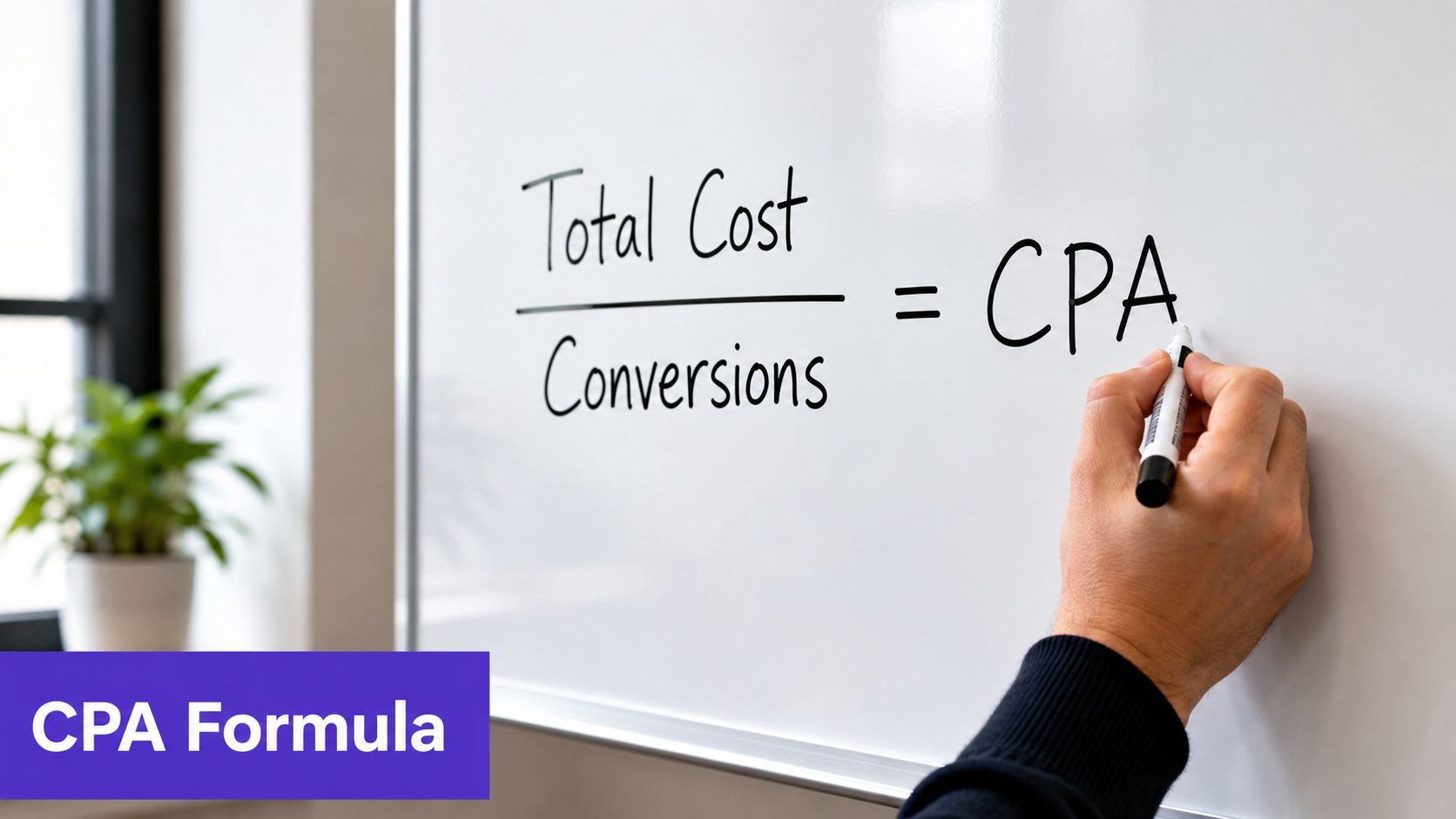
Knowing this number is your first real step toward figuring out if a campaign is working. It lets you ask the right question: Is that $100 a bargain or a budget-killer?
CPA vs. CAC: What Is the Difference?
It’s crucial not to mix up CPA with its bigger, all-encompassing cousin, Customer Acquisition Cost (CAC). They sound similar, but they tell you very different things.
CPA is a campaign metric. CAC is a business metric.
Cost Per Acquisition (CPA) measures the cost to get one customer from one specific campaign.
Customer Acquisition Cost (CAC) rolls up all sales and marketing costs—salaries, software, overhead, everything—and divides it by the total number of new customers acquired in a period.
A "good" CPA is one that keeps you profitable, but that target is getting harder to hit. Recent data from SimplicityDX shows the average cost to acquire a customer has shot up by over 52%, climbing from $19 to $29. To see how different scenarios play out for your own business, you can model them with our ROI calculator.
You can dive deeper into these trends and what they mean for your bottom line by exploring more insights on CAC vs CPA.
If you’ve watched your cost per acquisition climb month after month, you’re not just having a bad quarter. It's not you, it's the system. The game has changed.
Relying on the old playbook is like showing up to a drag race with a horse and buggy. It's not just inflation making things tough; the ad platforms themselves are working against you. Let's break down the real reasons your budget isn't going as far as it used to.
The Auction Is Crowded and Expensive
The simple answer? It's a supply and demand problem. More businesses are dumping money into platforms like Google, LinkedIn, and Meta than ever before. The thing is, the number of high-intent prospects hasn't kept pace.
This creates a hyper-competitive auction for every single eyeball. You're bidding against a stadium full of competitors for the same handful of people, and it’s driving the cost of every click through the roof. Your well-tuned campaigns are delivering less, and your budget feels like it's evaporating.
The data backs this up. Benchmark reports show customer acquisition costs have shot up by 40% to 60% between 2023 and 2025. One analysis from Phoenix Strategy Group clocked an average CAC of $802 in a 2025 study. That same year, Google Ads cost per lead climbed another 5.13%. This isn't just your dashboard; it's a market-wide correction. You can see the full breakdown in the 2025 benchmark report.
Your Audience Has Gone Numb
Your prospects are swimming in noise. From the second they log on, they're hit with a firehose of ads, cold DMs, and connection requests. This creates two massive headaches for you.
Banner Blindness: People have literally trained their brains to ignore anything that remotely looks like an ad. Your beautiful, expensive creative might as well be invisible.
Audience Saturation: The first time someone sees your ad, it might be interesting. The tenth time, it's wallpaper. Keep hitting the same audience with the same message, and they just tune you out.
This saturation is especially toxic when it comes to old-school cold outreach. Blasting generic messages to static lists based on job titles isn't just a waste of money—it actively burns bridges with people who might have become customers down the line.
The fix isn't to just throw more money at the problem and shout louder. The fix is to get smarter.
Instead of fighting for scraps in crowded channels, modern teams are shifting to intent-based plays. It’s about finding the people who are already looking for a solution. This one shift sidesteps both the competition and the audience blindness problem entirely.
CPA Benchmarks Across Channels and Industries
So, is your cost per acquisition good? The honest answer is almost always a frustrating “it depends.”
Trying to compare your B2B SaaS company’s CPA to a DTC t-shirt brand is a recipe for bad decisions and a lot of needless anxiety. It’s like comparing apples to enterprise software. Context is everything.
A “good” CPA is entirely relative to your average deal size, sales cycle length, and who you’re selling to. A $500 CPA would be a complete disaster for a company selling a $49/month tool. But for one closing $50,000 annual contracts? It’s an absolute steal.
Comparing Costs Across Platforms
Different channels come with wildly different price tags. For B2C, the numbers can be all over the place. Data from Triple Whale's analysis of e-commerce brands showed a median Google Ads CPA of $23.74, while Meta Ads sat at $38.19. That’s a huge gap.
But in B2B, the stakes—and the costs—are much higher. The numbers below are guideposts, not gospel. Think of them as a starting point to see where you stand.
Average Cost Per Acquisition (CPA) By Channel (2026 Estimates)
This table provides estimated CPA benchmarks for popular B2B marketing channels, helping you compare your performance against industry averages. Note that these are averages and can vary significantly.
Channel | Average B2B CPA (Low End) | Average B2B CPA (High End) | Primary Targeting Method |
|---|---|---|---|
Google Ads (Search) | $50 | $250+ | Keyword/Intent |
Meta Ads (Facebook/IG) | $75 | $350+ | Demographic/Interest |
LinkedIn Ads | $100 | $500+ | Firmographic/Job Title |
As you can see, simply blasting ads on LinkedIn can get expensive, fast. The old playbook of broad targeting and hoping for the best is becoming a guaranteed way to burn cash.
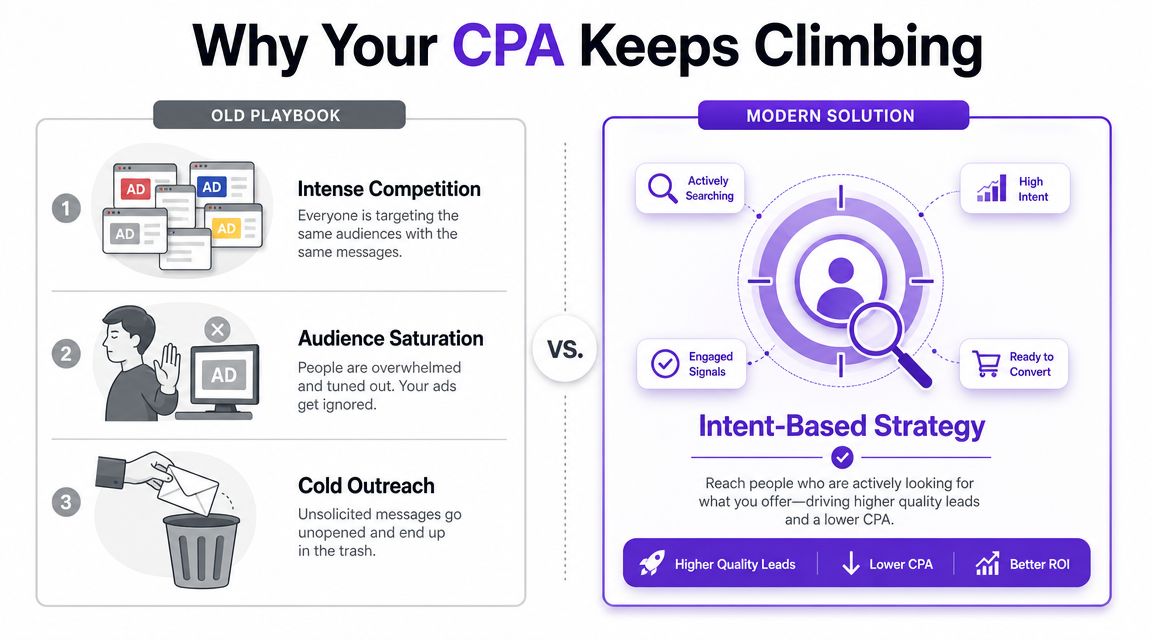
This is the core problem. The old approach is a money pit thanks to intense competition and a saturated audience. A modern, intent-based strategy offers a much smarter path to results.
This shift isn't just a tactic; it's fundamental to mastering B2B demand generation today. You stop chasing everyone and start focusing only on those who are ready to listen.
How to Lower Your Cost Per Acquisition
Alright, let's get into the playbook. You know what your Cost Per Acquisition is, and you know why it's climbing. Now it's time to actually fix it.
This isn't about finding one magic bullet or slashing your budget. Lowering your CPA is about making smarter, strategic improvements across your entire acquisition process. Each fix builds on the last, creating a more efficient, cost-effective machine.
Here are the fixes that will have an immediate impact on what you spend to win a new customer.
Start with the Low-Hanging Fruit
Before you tear down your whole strategy, make sure the basics are locked in. Small tweaks here can produce surprisingly big results, lowering costs by plugging obvious leaks in your funnel.
Optimize Your Landing Pages: Your landing page is where conversions live or die. If it’s slow, confusing, or the form is a novel, you’re just lighting money on fire. A/B test your headlines, CTAs, and form lengths. A 1% lift in conversion rate here has a massive downstream effect on your CPA.
Refine Your Ad Creative and Targeting: Is your ad speaking your audience’s language, or is it just corporate noise? Generic ads get scrolled past. Test different images, copy, and offers that connect with specific pain points. Get ruthless with your targeting—stop paying to show ads to people who will never, ever buy.
Improve Your Lead Nurturing: Most leads aren't ready to buy the moment they click. A solid nurturing sequence keeps your brand top-of-mind, warming up prospects until they're ready for a conversation. This directly increases your lead-to-customer conversion rate, which is a straight-up reduction in your final CPA.
Shift to High-Intent Prospecting
Those foundational fixes are table stakes. The real game-changer is a fundamental shift in how you find prospects in the first place.
The old way—blasting cold outreach to lists built on static job titles or company size—is a primary reason CPA is so high. It's wildly inefficient, untargeted, and frankly, a waste of everyone's time.
The modern solution is to stop guessing and start focusing on intent.
Instead of asking, "Who could buy my product?" you start asking, "Who is looking to buy a solution like mine right now?"
This means you stop scraping cold, firmographic-based lists and move to a smarter, signal-based approach. You start tracking buying signals—prospects discussing a competitor’s pricing, asking questions in online communities, or engaging with content that solves their exact problem.
This is where AI-powered tools become your unfair advantage. They can monitor these buying signals across platforms like LinkedIn at a scale no human team ever could. Imagine getting a curated feed of prospects who have already raised their hands and shown they are in-market. This intelligence is the foundation of an effective B2B lead generation funnel that’s built on timing and relevance, not volume.
When you engage these prospects at their moment of interest with a message that shows you were paying attention, the response is completely different. You get more positive replies and more meetings from far less outreach, which slashes the true cost of acquiring not just a lead, but a real customer.
Let's put this into practice with a real-world story.
Picture a B2B SaaS company we’ll call “InnovateCRM.” They had a solid product but a pipeline that was barely breathing. Their Cost Per Acquisition was an astronomical $450.
They were pouring money into LinkedIn Ads and running cold email campaigns that felt like shouting into a void. The team was stuck in the old playbook: targeting by static job titles and sending generic pitches, hoping something would stick. It wasn't working. Morale was tanking, and the burn rate was unsustainable.
The Shift from Hunting to Listening
Instead of just throwing more money at ads, the team made a critical shift. They stopped hunting for titles and started listening for intent.
They brought in an AI-powered prospecting tool, similar to RoverLead AI, to track active buying signals on LinkedIn. This completely changed the game. They were no longer looking for "VPs of Sales," but for people who were acting like they needed a new CRM.
Their new focus was on prospects who were already raising their hands, by:
Asking about competitor pricing in industry groups.
Engaging with content from CRM thought leaders.
Commenting on posts about the headaches of a bad implementation.
This wasn't cold outreach anymore. It was a warm, timely follow-up. Sales conversations started with, "Saw you were talking about the limits of [Competitor X]..." instead of the tired, "I'd love to show you a demo."
The difference was night and day. By focusing only on prospects who showed active interest, they stopped wasting cash on people who weren't in-market. They weren't interrupting; they were joining conversations already in progress.
The results came fast. InnovateCRM saw a 2-3x jump in positive reply rates to their outreach. Better yet, they booked 40% more qualified meetings—without spending a single extra dollar on ads.
This efficiency rippled straight to the bottom line. Because they were converting prospects at a dramatically higher rate, their Cost Per Acquisition plummeted from $450 to under $150. That’s a 66% reduction, turning a money pit into a predictable growth engine.
CPA Questions That Keep Marketers Up at Night
We've covered the what and the how of Cost Per Acquisition. Now, let's get to the real-world questions that always pop up in meetings and frantic Slack threads. These are the nuances that separate teams that just track metrics from teams that actually use them to win.
CPA vs. CAC: What's the Real Difference?
This is easily the most common point of confusion, and it’s where most teams talk past each other.
Think of it this way: CPA is the price of a single victory. CAC is the cost of the entire war.
Your Cost Per Acquisition (CPA) is tactical. It measures the direct cost of a specific conversion—a sale, a demo, a sign-up—from one campaign. It tells you if that specific Google Ad or LinkedIn campaign is pulling its weight.
Customer Acquisition Cost (CAC), on the other hand, is strategic. It’s the total cost of your entire sales and marketing machine—salaries, software, ad spend, everything—divided by the total number of new customers you landed. It tells you if your business model is actually sustainable.
A campaign CPA of $150 might feel great, but if your CAC for the quarter is $1,500 after you factor in all the operational drag, you have a much bigger problem.
How Often Should I Check My CPA?
Don't wait for the quarterly business review. That's a recipe for burning cash. The right cadence matches the speed of your market and your sales cycle.
For fast-moving digital campaigns, you should be in there weekly, if not daily. This is how you spot a bad ad before it drains your budget, or double down on a winner while it’s hot.
If you’re in B2B with a longer sales cycle, a monthly check-in makes more sense. It gives the campaigns enough time to breathe and for leads to mature. Anything less is just noise.
Can My Cost Per Acquisition Actually Be Too Low?
It sounds counterintuitive, but yes. And it's a dangerous trap.
A suspiciously low CPA is often a red flag. It usually means you're only targeting the absolute bottom-of-the-funnel—people who were already about to buy. You're harvesting existing demand, not creating new opportunities.
While the low number looks great on a spreadsheet, it’s a sign you aren't spending enough to reach new audiences or build a pipeline for next quarter. If your CPA feels "too good to be true," you are almost certainly leaving growth on the table to hit a short-term goal.
Ten More Quick Answers to Common CPA Hurdles
What’s a “good” CPA? It's always relative. A good CPA is one that is significantly lower than your customer's lifetime value (LTV). If you're not making at least 3x your acquisition cost back over the customer's life, your model is broken.
How do I factor in non-direct costs? You don't—not for CPA. The moment you add salaries and overhead, you’re calculating CAC. Keep CPA focused on direct campaign costs to measure channel efficiency.
Should I track CPA for each channel? Always. This is the only way to know if LinkedIn is a better investment than Google Ads for your specific offer. Don't blend them.
My CPA is high. What’s the first thing to fix? Your landing page. A leaky, low-converting landing page is the fastest way to light your ad budget on fire.
Does CPA apply to organic marketing? It does, but the math is fuzzier. You can estimate it by dividing your total SEO and content costs (including salaries) by the customers you acquired from organic search.
How does sales cycle length affect CPA? Longer cycles almost always mean higher CPAs. It simply takes more time, effort, and marketing touchpoints to get a deal across the line.
What’s a common mistake when analyzing CPA? Looking at it in a vacuum. CPA means nothing without the context of your average contract value (ACV) and lifetime value (LTV).
Can I measure CPA for free trial sign-ups? Absolutely. The "Acquisition" is the trial sign-up itself. It's a perfect use case.
Why did my CPA suddenly spike? The usual suspects: new competitors drove up ad auction prices, your audience has ad fatigue, or it's a seasonal shift in demand.
Is a low CPL (Cost Per Lead) always good? Definitely not. A cheap CPL that generates junk leads will result in a sky-high CPA. Focus on the cost to get a customer, not just a name in your CRM.
Ready to stop guessing and start engaging prospects who are actively looking for a solution? RoverLead AI uses autonomous agents to find high-intent leads on LinkedIn based on real buying signals, delivering a curated feed of prospects ready for a conversation. See how it works.