Outbound Inbound Meaning: A Guide for B2B Sales Teams

You're probably here because someone on your team said “we need more inbound,” someone else said “outbound is dead,” and now everyone is arguing while pipeline slips.
This happens all the time. Teams turn outbound inbound meaning into a false choice instead of a practical operating model. One camp wants SEO, content, and patience. The other wants cold email, LinkedIn, and meetings next week. Both are right. Both are wrong when they work in isolation.
The issue isn't terminology. It's that too many B2B teams still run sales like it's a cage match between push and pull, when buyers now move across both. They read, compare, lurk, click, comment, ignore, revisit, and only then talk. If your GTM motion can't handle that messiness, you don't have a strategy. You have a preference.
Table of Contents
The Real Outbound and Inbound Meaning in Sales
Let's clear up the dumbest part first. In sales, inbound and outbound are not about freight, shipping lanes, or boxes moving through a warehouse. That confusion is common enough to derail search results and muddy conversations, which is exactly why sales teams need a sharper definition.
The cleanest mental model is this: inbound is a magnet, outbound is a megaphone.

Who starts the conversation
The core difference is simple. Who initiates the interaction decides whether the motion is inbound or outbound. Vida.io defines it plainly across sales, marketing, and logistics: in inbound, the customer, caller, or supplier starts the conversation, while in outbound, the business takes the initiative to reach out in its directional breakdown of inbound vs outbound concepts.
That definition matters because it keeps your team from mixing tactics with outcomes.
Inbound sales motion means the buyer comes to you first through channels like SEO, content, referrals, webinars, or an inbound demo request.
Outbound sales motion means your team starts the interaction through cold email, telemarketing, direct mail, social DMs, event outreach, or account-based prospecting.
If your rep messages a prospect on LinkedIn first, that's outbound. If the prospect downloads a guide and books a call, that's inbound.
Practical rule: Stop defining inbound and outbound by channel alone. Define them by who made the first move.
Why this distinction matters
This isn't academic. It changes your budget, team design, tech stack, and expectations.
Inbound requires content, patience, and follow-up discipline. Outbound requires targeting, message testing, and rep execution. If your team still treats every lead source the same way, you're flattening high-intent buyers and forcing SDRs to clean up a process problem.
If you want a broader view of how this connects to pipeline creation, this guide on B2B lead generation definition is worth a read.
Inbound vs Outbound A Head to Head Comparison
Teams don't need another fluffy “both have pros and cons” summary. They need to know what they're buying when they choose one motion over the other.
Here's the blunt version. Inbound usually brings better-fit prospects. Outbound gives you speed and control. Ignore either one and you create a hole in the funnel.
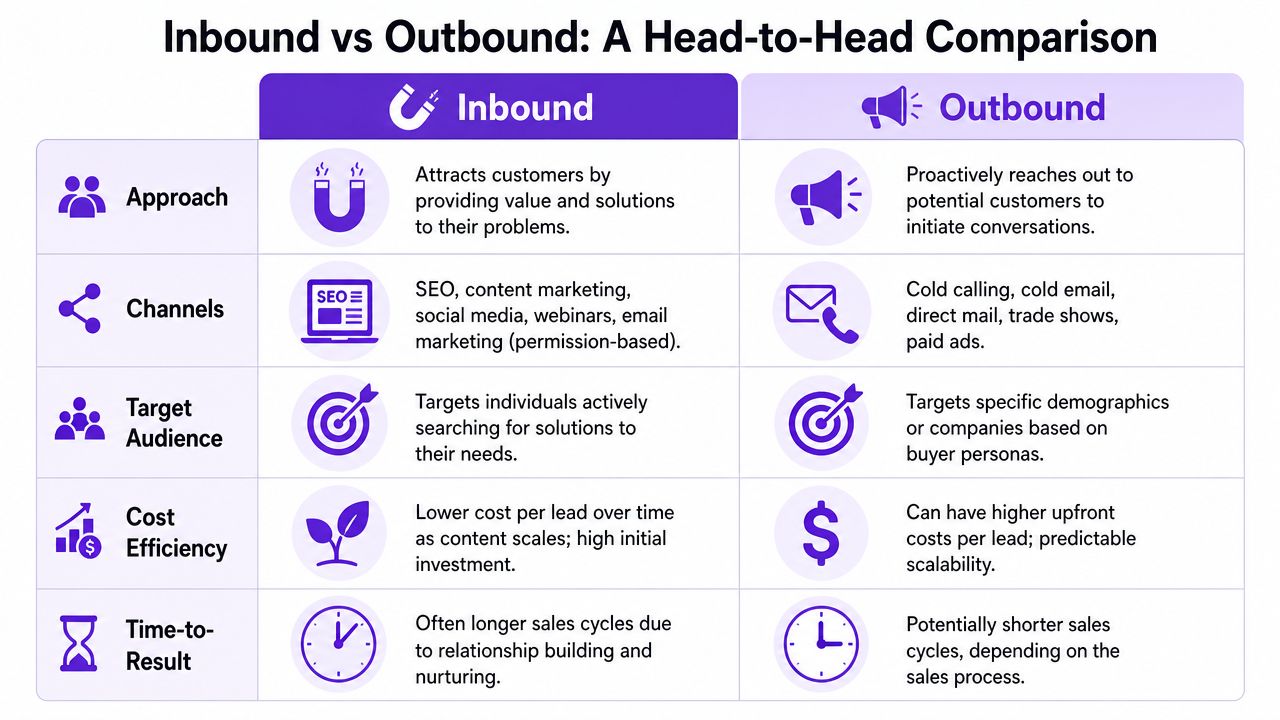
Inbound vs outbound at a glance
Criterion | Inbound Marketing ('Pull') | Outbound Sales ('Push') |
|---|---|---|
Primary motion | Attracts interest | Initiates contact |
Typical channels | SEO, content, organic social, webinars, lead nurture | Cold email, cold calling, direct mail, social DMs, events |
Lead intent | Higher intent, self-selected | Mixed intent, seller-selected |
Time to results | Slower build | Faster ramp |
Message control | Lower | Higher |
Best use case | Trust-building and demand capture | New market entry and pipeline creation |
What the numbers say
One stat should end the lazy argument that these two are interchangeable. Inbound marketing achieves a 14.6% close rate for SEO-driven leads, versus 1.7% for cold outbound calls, according to Landbase's analysis of outbound vs inbound GTM strategy. That's not a small gap. It's a giant neon sign pointing to lead intent.
Landbase also notes that inbound leads can take 6 to 12 months to generate meaningful pipeline, while inbound carries a 62% lower cost per lead. So yes, inbound is efficient. No, it is not fast.
A separate comparison from Salesforce adds the missing piece. 63% of consumers begin shopping journeys online by searching for solutions, and combined inbound plus outbound programs can drive 20 to 30% higher conversion rates when measured together in a complementary funnel, according to Salesforce's inbound vs outbound marketing overview.
Here's the practical read on those numbers:
Inbound wins on efficiency. People already want help.
Outbound wins on control. You choose accounts, timing, and message.
The combo wins on coverage. One creates awareness, the other captures and nurtures it.
A quick explainer helps if your team needs a visual reset.
Inbound is what buyers use when they're ready to learn. Outbound is what sellers use when buyers don't know you exist yet.
The channels people keep mixing up
Outbound tactics specifically include telemarketing, cold email, direct mail, social media DMs, in-person prospecting visits, and event-based outreach, as outlined in Ficilcom's outbound implementation guide. LinkedIn Ads also classifies cold calling and direct mail as core outbound components in its marketing terms reference on inbound vs outbound.
That means the category isn't fuzzy. Teams just make it fuzzy when they want to justify their favorite channel.
The Problem with the Pure Inbound vs Outbound Debate
The old debate is broken because buyer behavior changed and sales advice didn't.
Pure inbound sounds elegant. Publish useful content, rank, nurture, convert. Pure outbound sounds decisive. Build a list, write sequences, book meetings. Both stories are too neat for how B2B buying works now.

The permission paradox
Modern outbound has a relevance problem, not an outreach problem.
The sharpest framing I've seen is the permission paradox. 90% of high-intent buyers now expect engagement to be triggered by real behavior, like comments or content interactions, yet 78% of sales guides still push static firmographics. That misses a 2 to 3x reply rate advantage for behavior-triggered outbound, according to LinkedIn's funnel approach discussion.
That's the line too many teams miss. Buyers don't hate outreach. They hate irrelevant outreach.
A cold list built from job title, industry, and headcount is not intent. It's admin work with a spreadsheet.
Why “cold” is often just lazy
If someone comments on a competitor's post, engages with content on a painful operational problem, or starts asking pricing questions in public, they're not random anymore. They've told you something. A rep who reaches out based on that signal isn't interrupting blindly. They're responding to context.
That's why the old binary fails. Inbound and outbound don't live in separate buildings anymore. They overlap in the buyer's actual behavior.
Buyers will tolerate proactive outreach when it feels earned by context.
If your team still blasts static lists, stop. Read up on intent-based marketing and rebuild your prospecting around signals, not assumptions.
The strategic mistake
The worst GTM mistake isn't choosing inbound or outbound. It's choosing pure inbound or pure outbound.
Pure inbound leaves you waiting for demand you haven't helped create. Pure outbound leaves you shouting at people who have no reason to care. The smarter model is behavior-triggered outbound layered onto strong inbound assets.
That means your content does the warming. Your outbound does the timing.
Building a Hybrid Sales Engine That Actually Works
Theory is nice. Pipeline is nicer.
A hybrid engine works when your inbound and outbound motions feed each other instead of fighting for credit. Often, teams exhibit sloppiness in this aspect. Marketing publishes content that sales never uses. Sales runs outbound that ignores every signal marketing creates. Then leadership wonders why attribution is a mess.
A simple operating model
Start with one useful piece of inbound content. Not fluff. Something a real buyer would save, share, or comment on. A LinkedIn post, webinar clip, teardown, or point-of-view memo works fine.
Then have reps work outward from engagement signals around that content and adjacent conversations.
A solid hybrid workflow looks like this:
Publish content with a point of view. Generic “5 tips” content won't create signal.
Track engagement quality. Comments, repeat profile views, and discussion patterns matter more than vanity reactions.
Route warm signals to reps fast. Timing matters more than perfect copy.
Send a context-based opener. Reference the behavior, not a generic pitch.
Move the conversation into the right lane. Some leads want a demo. Others need a useful asset or quick answer first.
What this looks like in the field
Let's say a founder posts about a messy problem in RevOps, procurement delays, or outbound compliance. A target buyer comments with a strong opinion. That person just raised their hand in public.
An old-school SDR ignores that and keeps hammering a stale sequence. A good SDR sends a short message tied to the comment and asks a sharp follow-up. That's still outbound because the rep initiated contact. But it borrows the relevance usually associated with inbound.
In operational terms, warm outbound gets stronger. In call center language, outbound is still business-initiated, but it performs better when supported by systems and data. FedEx's business glossary notes that AI-driven telephony and messaging enable 30 to 50% higher meeting conversion in outbound when targeting warm leads with personalized messaging validated by CRM analytics in its definition of inbound and outbound operations.
That's the blueprint. Not more volume. Better triggers.
How to avoid the usual hybrid mess
Most hybrid systems fail because ownership is vague. Fix that with a few hard rules:
Marketing owns signal creation. Content, webinars, social presence, and retargeting build the surface area.
Sales owns signal response. Reps shouldn't wait days to follow up on relevant engagement.
Ops owns routing and tracking. If signal data dies in Slack, your system isn't real.
Leadership owns the model. Don't force teams into channel turf wars.
Field note: The best outbound teams don't ask, “Who fits our ICP?” They ask, “Who fits our ICP and did something that suggests timing?”
If your sales process still treats every prospect the same, fix the process before blaming the reps. This guide on sales process optimization is a strong place to tighten the handoffs.
Measuring What Matters for Each Approach
Vanity metrics waste time. Impressions don't pay payroll. Neither do open rates by themselves.
If you want to judge inbound and outbound fairly, measure each by its job. Inbound should be judged on captured demand and conversion quality. Outbound should be judged on conversation creation and pipeline generation.

Inbound metrics that matter
KPI | What it tells you |
|---|---|
MQL to SQL conversion | Whether content is attracting the right people |
SQL to close rate | Whether intent turns into revenue |
CAC by channel | Which inbound sources are worth scaling |
Lead to customer rate | Whether top-of-funnel quality is real |
Don't obsess over traffic alone. A traffic spike with weak lead quality is just a busier website.
Outbound metrics that matter
KPI | What it tells you |
|---|---|
Positive reply rate | Whether your targeting and message are relevant |
Meetings booked per 100 contacts | Whether outreach creates actual sales opportunities |
Pipeline generated | Whether booked meetings turn into value |
Sales cycle by source | Whether outbound is creating urgency or friction |
For call-heavy teams, separate activity from outcomes. A rep can make a lot of dials and still produce nothing worth forecasting. Inbound and outbound call center roles are different for the same reason. Inbound teams handle support and inquiries, while outbound teams focus on sales, lead generation, surveys, and appointment setting, as explained in ROI Call Center Solutions' breakdown of inbound and outbound call centers.
One dashboard, two lenses
Use one dashboard, but don't force one success formula.
For inbound, ask: Are we attracting fit and converting intent?
For outbound, ask: Are we creating qualified conversations efficiently?
For both together, ask: Which touch patterns lead to closed business?
That last question is the one that matters. Most real deals are touched by both.
Inbound and Outbound Strategy FAQ
Is inbound better than outbound for B2B sales?
No. Inbound is better for capturing existing demand. Outbound is better for creating opportunities before buyers come to you. Treating one as “better” is lazy management.
Is outbound always cold?
No. Outbound only means your team initiated contact. If that contact is based on relevant behavior, it can be highly contextual and well-timed.
Can a startup do both without a huge team?
Yes. But don't try to run every channel. Pick one inbound lane, usually content or founder-led LinkedIn, and one outbound lane, usually targeted email or LinkedIn outreach.
What's the biggest mistake with inbound?
Publishing content nobody on the sales team uses. If content doesn't help prospects move, it's marketing theater.
What's the biggest mistake with outbound?
Building lists from static firmographics and pretending that counts as targeting. It doesn't. It's just filtered guessing.
Is LinkedIn outreach inbound or outbound?
If your rep sends the first message, it's outbound. If the buyer reaches out after consuming your content, it's inbound. The platform doesn't decide. The initiator does.
Can content marketing support outbound?
Absolutely. Strong content gives reps something credible to reference, share, and build around. It also creates intent signals you can act on.
How should teams attribute deals touched by both?
Use a hybrid view. First touch, lead source, and influenced revenue all matter. Don't let channel politics erase how buyers move.
When should a company lean harder into outbound?
When entering a new market, launching something new, or dealing with a thin organic presence. Waiting for inbound alone is too slow in those situations.
When should a company lean harder into inbound?
When the category demands education, trust is a major buying factor, or the team wants compounding demand capture instead of constant outreach pressure.
If your team is tired of guessing who might be ready and wants to work from real buying signals instead, RoverLead AI is worth a serious look. It helps B2B teams turn LinkedIn engagement into high-intent prospecting opportunities, so reps can reach out when context exists, not when a static list says it's time.