10 B2B Sales Intelligence Tools for Smarter Selling

The best signal is the one your team can act on. A database filter can identify a well-matched account, a website visit can suggest interest, and an intent score can rank activity, but none of those signals automatically deserves the same follow-up. Treating them as equal is how sales teams end up blasting relevant people at the wrong time.
This comparison of B2B sales intelligence tools evaluates ten platforms by the buying signals they surface, where those signals belong in a sales workflow, which teams will benefit, and who should avoid paying for each product. The practical distinction is between static contact data, account and third-party intent, web engagement, and live LinkedIn behavior.
B2B sales intelligence tools help sales teams identify, understand, prioritize, and engage potential buyers using company, contact, behavioral, and buying-signal data. Below, you'll find a comparison table, detailed tool reviews, implementation guidance, internal resources for deeper research, a selection checklist, and a ten-question FAQ. RoverLead AI gets special attention because its Signal Agents and AI openers approach social selling differently from another static database.
Table of Contents
What B2B sales intelligence tools actually do
A CRM records what your team already knows. Sales intelligence helps discover what your team should know next. That may mean finding a decision-maker, enriching a missing field, identifying an account researching a topic, or spotting a prospect actively engaging with relevant LinkedIn content.
The category now spans several distinct jobs:
Contact intelligence: Finds professional emails, phone numbers, job titles, company details, and organizational relationships.
Enrichment: Updates CRM records with firmographic, technographic, and other contextual fields.
Web intent: Connects identifiable website activity with target accounts so teams can prioritize inbound and outbound follow-up.
Third-party intent: Detects account-level research around topics across publisher or content networks.
Account intelligence: Combines engagement, intent, identity, and journey information for account-based marketing.
Social behavior signals: Tracks observable actions such as comments, posts, creator engagement, and competitor interactions.
The category has moved well beyond static list-building. One industry estimate values the sales intelligence market at USD 2.95 billion in 2022 and projects USD 6.68 billion by 2030, representing a 10.8% CAGR from 2023 to 2030, according to Gitnux's B2B sales intelligence industry overview. Another estimate places the market at USD 4.85 billion in 2025, with growth to USD 12.45 billion by 2034, while reporting that North America represented 42.30% of global revenue in 2025 in the same market overview.
That growth reflects a workflow change. Teams increasingly want software that prioritizes accounts, enriches records, and surfaces timely signals instead of handing reps another spreadsheet with a very confident-looking job title.
Comparison of the ten tools
Top 10 B2B Sales Intelligence Tools Comparison
Product | Core focus & signals | UX / Quality (★) | Pricing / Value (💰) | Target audience (👥) | Unique selling points (✨) |
|---|---|---|---|---|---|
RoverLead AI 🏆 | Signal-led LinkedIn prospecting; 10+ buying signals; AI openers | ★★★★☆ | 💰 Starter $149/mo/user; Growth $449; Enterprise custom; 7‑day trial | 👥 SMB & enterprise sales teams using LinkedIn | ✨ Autonomous Signal Agents, context + AI-written openers, LinkedIn‑compliant |
ZoomInfo SalesOS | Large B2B DB, org charts, real-time intent & routing | ★★★★☆ | 💰 Sales‑led enterprise pricing | 👥 Large sales orgs & data/ops teams | ✨ Deep US coverage, mature admin & integrations |
Apollo.io | Contact database + sequences, enrichment & AI tools | ★★★★☆ | 💰 SMB-friendly tiers; self-serve plans | 👥 SMBs, SDR/BDR teams | ✨ All-in-one data + engagement + AI writing |
Cognism | GDPR-first global contact data, enrichment & technographics | ★★★☆☆ | 💰 Sales‑led; negotiated packages | 👥 EMEA-focused teams & compliance-conscious orgs | ✨ Compliance-first sourcing, multiple delivery models |
Clearbit | Real-time enrichment & Reveal de-anonymization APIs | ★★★★☆ | 💰 API/pricing tiers; sales‑led for enterprise | 👥 Dev/ops teams, marketing & routing workflows | ✨ Developer-friendly APIs, real‑time lead enrichment |
Lusha | Browser overlay for quick LinkedIn lookups (credit model) | ★★★☆☆ | 💰 Credit-based, self-serve & enterprise | 👥 SDRs prospecting directly from profiles | ✨ Fast browser overlay, transparent credits |
LeadIQ | Chrome capture + verified contact push to CRM/SE tools | ★★★★☆ | 💰 Credit model; pricing on request | 👥 Reps needing clean CRM ingestion & sync | ✨ Verified captures, de-duplication & CRM mapping |
6sense | ABM & Revenue AI: account prioritization & buyer stages | ★★★★☆ | 💰 Enterprise ABM pricing | 👥 Account-based marketing & revenue teams | ✨ Predictive account modeling & cross-channel activation |
Bombora | Third‑party Company Surge intent data (topic-level) | ★★★☆☆ | 💰 Data/subscription fees; sales‑led | 👥 ABM, demand gen & media teams | ✨ Industry-standard intent co-op for topic scoring |
Demandbase One | ABM platform with intent, identity resolution & DSP | ★★★★☆ | 💰 Enterprise ABM pricing & onboarding | 👥 Large ABM-focused marketing + sales orgs | ✨ Identity resolution + multi-channel activation |
1. RoverLead AI
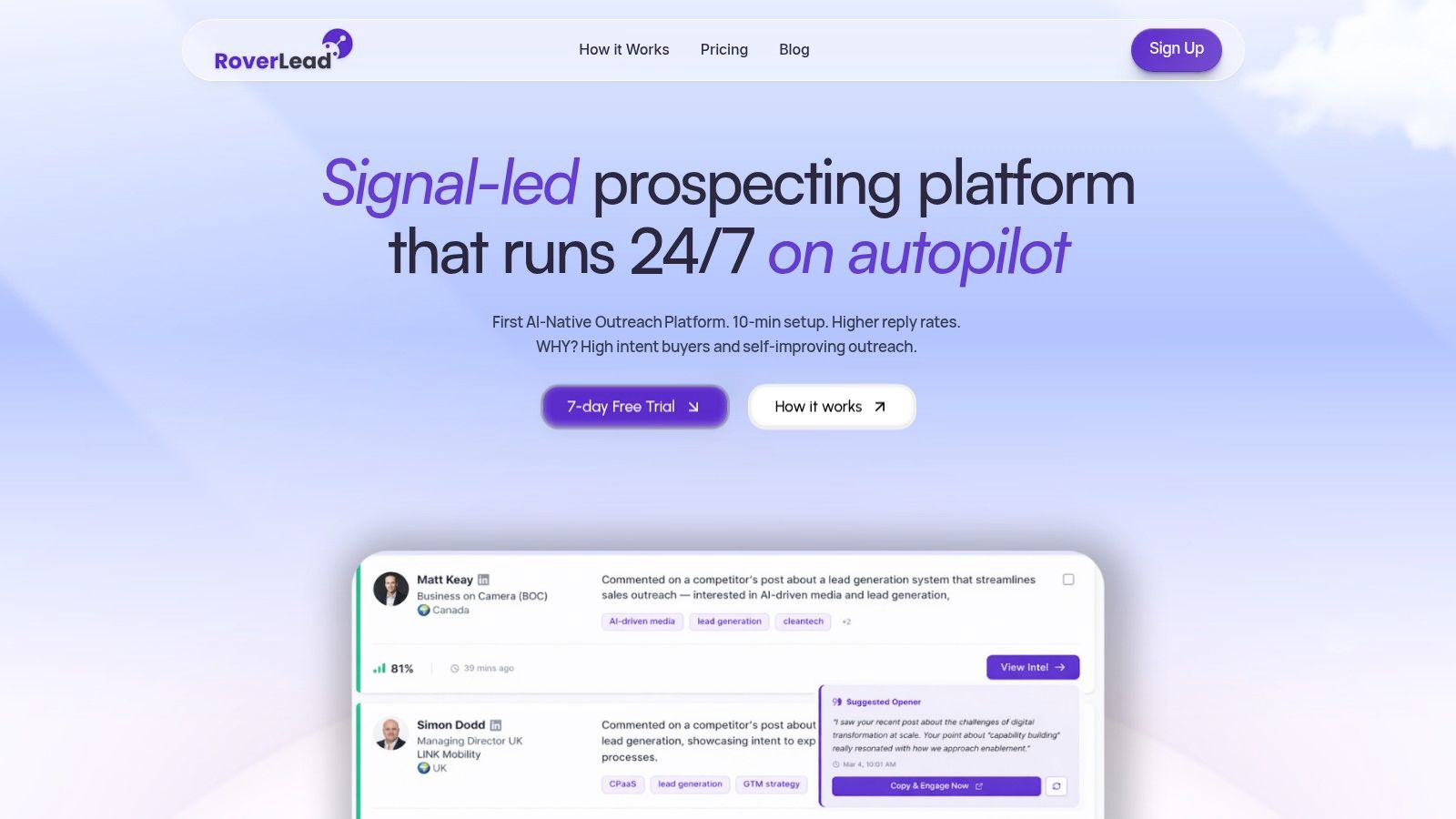
RoverLead AI starts with a harder, more useful question than a contact database: who is behaving like a potential buyer right now? Users define their ICP, keywords, competitors, and niche experts. Self-learning Signal Agents then monitor more than ten buying signals across LinkedIn, including comments, content interactions, pricing or demo discussions, creator activity, and competitor engagement.
The core signal is live LinkedIn behavior, rather than static firmographics or a list of email addresses. Each alert includes the interaction that triggered it and an AI-written opener, so reps can begin with a relevant observation instead of manufacturing familiarity.
Where RoverLead fits
RoverLead belongs at the top of a social-selling workflow. Signal Agents monitor the market, produce a daily shortlist, and help reps move from observed behavior to relevant outreach. That replaces manual Sales Navigator list pulls with ongoing LinkedIn signals, while safety features support LinkedIn-compliant operation.
The supplied product information reports 2–5x positive reply rates, 30–50% more meetings, and up to approximately 60% less research time, available through RoverLead AI. These figures are self-reported, not independently validated. Results will vary with ICP activity on LinkedIn, message quality, and how quickly reps act on alerts.
That workflow suits B2B sales leaders, SDRs, founders, agencies, and consultants whose prospects actively use LinkedIn. Teams targeting a low-activity niche, needing only bulk email contacts, or unable to assign someone to daily signal review should avoid paying for it.
Starter pricing begins at $149 per month per user with two Signal Agents. Growth is $449 per month per user with up to ten Agents. Enterprise pricing is custom, and a 7-day free trial is available, according to the product information. Per-user pricing can become expensive as headcount grows, and performance still depends on whether the target market creates visible LinkedIn behavior.
2. ZoomInfo SalesOS
ZoomInfo SalesOS is built for organizations that need broad company and contact coverage, buying-committee context, and administrative control. Its core signal is usually account and contact intelligence, with additional intent, website de-anonymization, and workflow capabilities available across the wider go-to-market product family.
The platform helps larger sales organizations map companies, understand organizational structures, prioritize accounts, and route activity into prospecting or outreach workflows. It can make sense when sales, marketing, and operations need a shared data layer rather than separate tools stitched together with hope and a spreadsheet.
The trade-off
ZoomInfo's strength is breadth. Its product family includes SalesOS, MarketingOS, OperationsOS, and Copilot, which gives enterprise teams room to build governance, routing, enrichment, and activation processes around the data.
That breadth is also the limitation. Pricing is sales-led and typically higher than SMB-oriented alternatives, and the platform can feel heavy for a small team that needs a few accurate contacts each week. A founder or lean SDR team may pay for administrative depth it won't use.
Use ZoomInfo when account coverage, org charts, integrations, governance, and enterprise workflows matter more than speed of setup. Avoid it when your main problem is finding people already demonstrating public buying behavior, because a large database won't tell you which contact is ready for a conversation today. The B2B sales intelligence tools comparison offers a useful adjacent resource for comparing database-led and signal-led approaches.
3. Apollo.io
Apollo.io combines contact data with execution. Its platform includes a 230M+ contact database, more than 65 filters, intent topics and filters, enrichment, CRM integrations, sequences, basic CRM functionality, and AI tools for list building, writing, and research, as described on the Apollo.io website.
The practical signal is primarily contact and account fit, with basic intent layered into a workflow that can immediately launch outbound sequences. That combination suits SMBs and scrappy sales teams that don't want to buy a database, engagement platform, and research assistant separately.
Apollo's best quality is convenience. A rep can identify a segment, enrich records, write messaging, and enroll contacts without switching between several products. Strong documentation and a broad feature set also make it relatively quick to deploy.
Where it falls short
Database depth and accuracy can vary by region and ICP. That matters if your market is geographically narrow, highly specialized, or difficult to identify using standard job titles and firmographics.
Advanced intent and operations features are lighter than those found in dedicated ABM suites. Apollo also isn't the strongest answer if your differentiator is real-time social behavior, because a contact filter and an intent topic don't provide the same evidence as a prospect publicly discussing a problem.
Choose Apollo when you need data plus outbound execution in one subscription. Avoid it if your main requirement is advanced account orchestration, deep governance, or highly contextual LinkedIn prospecting.
4. Cognism
Cognism focuses on compliant global B2B contact data, with particular value for teams selling across EMEA. Its signals are mostly contact intelligence, firmographics, technographics, and intent integrations, delivered through prospecting, CRM enrichment, and data-access options.
The platform supports prospecting and enrichment, batch or warehouse delivery, app-based access, and compliance-focused sourcing. Optional mobile-number verification adds a direct-dial workflow for teams that depend on phone outreach. Its strongest operational argument is not flashy automation. It's confidence that regional data handling and sourcing requirements have been treated as core product concerns.
Best use case
Cognism fits a multi-region team that needs compliant contact data and flexible delivery models. A RevOps team can use it for enrichment, while SDRs can use prospecting interfaces and integrations to find and update records.
The limitation is scope. Cognism has fewer native engagement and sequencing features than an all-in-one platform, so teams will usually pair it with a sales engagement tool or CRM workflow. There's also no public list pricing, which means packaging and negotiation are part of the buying process.
Practical rule: Buy Cognism for data quality, regional coverage, and compliance needs. Don't buy it expecting a complete outbound execution layer.
Teams should test sample records in their target countries before committing. A database can be excellent in one region and merely adequate in another, especially for niche roles, smaller companies, or markets with limited public information. Explore the Cognism platform when compliant multi-region data is the bottleneck.
5. Clearbit
Clearbit is an enrichment and web-intent platform, not a traditional net-new contact database. Its central signals are firmographic and technographic attributes, plus identifiable website activity that can support lead routing, qualification, scoring, and personalization.
The product provides real-time enrichment with 100+ attributes, selective and batch enrichment, Reveal and Visitor Report functionality for identifying company traffic, and APIs that push data into downstream systems, according to Clearbit. That makes it most useful after a visitor, form submission, or CRM record already exists.
A marketing and RevOps team can use Clearbit to enrich an inbound lead, identify the company behind a visit, route a high-fit account to the right owner, and personalize a web experience. The workflow is less “find me a new list” and more “make the activity already entering our system useful.”
What to watch
Clearbit's developer-friendly APIs are a major advantage for teams with technical resources. It can support scoring and routing logic without forcing every decision through a rep-facing interface.
It's less suitable for discovering net-new contacts than database-first platforms. The free tier and several legacy free offerings were sunset as of April 30, 2025, according to the supplied product notes, so teams should confirm current packaging before planning around older articles or screenshots.
If your main problem is anonymous account activity and incomplete CRM records, Clearbit is a sensible candidate. If your sales team needs a daily list of people actively discussing a pain point on LinkedIn, enrichment alone won't solve the timing problem. The CRM data enrichment guide provides useful context for evaluating that layer.
6. Lusha
Lusha is designed for reps who prospect directly from LinkedIn, Sales Navigator, and company websites. Its buying signal is usually profile-level contact availability, such as an email address or mobile number, surfaced through a browser overlay.
The workflow is deliberately simple. A rep opens a profile, checks available contact details, spends credits, and pushes the record into the next system. Self-serve plans and a free option make Lusha approachable for individuals and small teams that don't want a sales-led procurement process.
Why reps like it
Speed matters during prospecting. Lusha keeps the lookup close to the page where the rep is already researching, which reduces context switching and makes one-off account work less painful.
The credit model is also easy to understand at a high level, although credit consumption and feature access vary by tier. Global depth and accuracy may lag larger enterprise data clouds for niche ICPs, so users should verify the records that matter rather than assuming every returned number is equally reliable.
Lusha works well when the rep already knows whom to investigate and needs contact data to continue. It's less useful as a prioritization engine because it doesn't explain why that person should be contacted now. Teams seeking behavioral LinkedIn signals should treat Lusha as a contact capture layer, not a substitute for intent monitoring.
Visit Lusha if your sales motion begins with profile browsing and your team values fast, self-serve contact lookups.
7. LeadIQ
LeadIQ sits between LinkedIn browsing and CRM execution. It captures verified emails and mobile numbers from LinkedIn or company pages, then syncs them with CRM and sales engagement platforms. Its most useful signals are contact details, job changes, and profile context discovered during active research.
The browser extension makes LeadIQ a good fit for SDRs who already have target accounts and contacts in view. De-duplication, field mapping, enrichment, and governance controls help prevent every rep from creating a slightly different version of the same person in Salesforce.
Where it earns its place
LeadIQ's credit model distinguishes email and mobile usage, which helps teams plan budgets around their actual prospecting mix. Phone credits cost more than email credits, so a call-heavy motion needs a different model from an email-first workflow.
Its database isn't the largest, and many teams pair it with other data sources. That isn't necessarily a flaw. A focused capture tool can be more useful than a giant platform when the rep has already identified the account and needs clean handoff into Outreach, Salesforce, or another execution system.
Avoid LeadIQ if you expect one product to provide broad account discovery, deep intent modeling, and full sequencing. Choose it when your bottleneck is capturing and routing clean contact records while reps browse the web. The LeadIQ platform is worth testing with the exact LinkedIn segments your team works every day.
8. 6sense
6sense is an ABM and Revenue AI platform built around account-level intent, predictive in-market modeling, and buyer journey stages. It combines third-party intent with first-party engagement signals to help sales and marketing coordinate around accounts that appear to be moving through a buying process.
That account focus changes the workflow. Marketing can activate audiences, sales can prioritize account research, and RevOps can connect activity across CRM, email, advertising, and data warehouse systems. The product is most valuable when multiple teams already agree on target accounts and can act on a shared model.
Not a casual purchase
6sense requires onboarding, data alignment, and process discipline. A small team with a short target list and one seller may find the platform excessive, especially if no one owns account scoring, stage definitions, or signal follow-up.
The predictive layer is also not a magic buying oracle. It should inform prioritization, not replace qualification. Reps still need to identify the right people, confirm the business problem, and earn a response.
Use 6sense when your organization has a genuine account-based motion and needs coordinated activation across marketing and sales. Avoid it when your basic need is contact discovery, enrichment, or simple social prospecting. The 6sense platform makes the most sense as an orchestration layer, not as a lightweight replacement for a prospecting database.
9. Bombora
Bombora surfaces third-party B2B intent through Company Surge, showing which accounts research topics related to an offering. That signal belongs early in account prioritization, before a form fill or sales conversation, when marketing and sales are deciding where to spend limited attention.
The platform passes topic-level account activity through APIs and partner integrations. Teams can then send those signals into advertising, CRM, marketing automation, or ABM workflows. It does not provide the contact records or person-level context needed for outreach.
Precision needs work
Topic configuration determines whether the signal helps or distracts. Broad topics bring noise, while narrow topics can miss relevant research. Compare topic relevance, account fit, recency, and first-party engagement before assigning an account to an outbound sequence. A surge supports prioritization. It does not justify an aggressive pitch by itself.
The supplied benchmark coverage reports median precision of 0.51 across 47 deployments, rising to 0.63 in mature programs, as summarized in the MarketsandMarkets overview of sales intelligence tools. These figures describe third-party topic-intent benchmarks, not a guarantee for every Bombora deployment.
Don't ask whether an account has intent. Ask whether the signal is precise enough for the next action.
Bombora suits teams that already have contact data and need broader research behavior to guide account selection. A small sales team seeking a rep-ready list or person-level LinkedIn activity should avoid paying for it. Read more about what intent data means before deciding how much weight the signal deserves.
10. Demandbase One
Demandbase One is built for account-level buying signals, combining proprietary intent, identity resolution, engagement scoring, journey analytics, and B2B advertising activation. It can show which companies are researching relevant topics, how their engagement is changing, and where those accounts sit in a buying journey. Those signals belong in account prioritization, campaign audiences, web personalization, and sales follow-up, rather than a rep's contact-finding workflow.
Its Data Stream and APIs send account activity to warehouses and downstream systems. Marketing can activate the same audience through advertising or personalized web experiences, while sales receives accounts ranked by engagement. The trade-off is operational: teams need agreed account definitions, routing rules, and a contact data source before a rep can act.
Demandbase fits organizations running structured account-based marketing tools programs across sales and marketing. A solo seller or small outbound team should avoid paying for channel orchestration when the immediate need is a verified email, browser extension, or person-level social signal.
Use it when advertising, identity, web personalization, and account prioritization must share one operating model. Skip it when the workflow starts with finding individual prospects. The Demandbase One platform is an ABM system for coordinated account engagement, not a quick lookup tool.
Choose the signal your workflow can use
The right tool depends on the buying motion, not the longest feature page. Start by defining your ICP, target region, sales cycle, and next action. Then decide which signal you need:
Contact data: Choose ZoomInfo, Apollo, Cognism, Lusha, or LeadIQ when the problem is finding or verifying people.
Enrichment: Choose Clearbit when existing CRM, form, or website activity needs better context.
Web intent: Use a platform that can identify relevant account visits and route them quickly.
Third-party topic intent: Consider Bombora when account-level research behavior can improve prioritization.
ABM intelligence: Consider 6sense or Demandbase when sales and marketing share target accounts and activation workflows.
LinkedIn behavior: Choose RoverLead AI when public engagement, competitor activity, creator interactions, and contextual outreach are central to the motion.
The market itself is moving quickly. One market estimate values global sales intelligence at USD 3.62 billion in 2025 and projects USD 9.44 billion by 2035, with a 10.07% CAGR, according to Mordor Intelligence's sales intelligence market report. That expansion creates more choice, but it also creates more overlapping tools and more opportunities to buy data nobody follows up on.
A practical selection checklist
Define the action: Decide whether a signal triggers research, a task, an email, a LinkedIn message, an ad, or no action.
Test the region: Sample records from your actual ICP and geography before trusting vendor-wide claims.
Check integrations: Confirm CRM sync, enrichment behavior, deduplication, APIs, warehouse delivery, and sales engagement handoff.
Model the cost: Include per-user fees, credits, phone lookups, onboarding, implementation, and required companion tools.
Assign ownership: One person should own signal definitions, routing, response-time expectations, and outcome reporting.
Measure outcomes: Track tool-sourced opportunities, meetings, reply quality, research time, conversion by signal type, and pipeline influenced.
Combining tools is justified when each owns a different layer. Apollo plus a sales engagement workflow can cover data and execution. Clearbit can enrich inbound activity. Bombora can add account-level research context. RoverLead AI can identify person-level LinkedIn behavior and supply the evidence and opener needed for social selling. Buying three overlapping contact databases, however, usually creates reconciliation work rather than intelligence.
AI adoption is already mainstream in large revenue organizations. A research summary reports formal AI deployment among 61% of B2B sales teams, 74% of enterprise sales organizations with 500 or more reps, and AI use for lead scoring at 54%, with outbound prospecting and list building identified as the highest-value use case at 67%, according to Stealth Agents' AI in sales research. The lesson is practical: AI works best when it connects a reliable signal to a clear workflow.
Frequently asked questions
What's the difference between a CRM and sales intelligence?
A CRM stores contacts, accounts, opportunities, activities, and pipeline records. Sales intelligence adds data and signals that help teams decide whom to target, what's happening at an account, and when outreach may be relevant. The two systems complement each other.
Which signal types are most useful?
It depends on the motion. Contact data supports reachability, web activity supports inbound prioritization, third-party intent supports account research prioritization, and LinkedIn behavior can provide person-level context for social selling. No signal guarantees a buying decision.
How accurate is intent data?
Accuracy varies by provider, topic, geography, match rate, precision, and recency. A 2026 practitioner framework recommends evaluating those dimensions separately rather than relying on one blended score, as summarized in the MarketsandMarkets sales intelligence tools overview.
What should intent trigger?
Use low-confidence signals for research, account monitoring, or light personalization. Reserve direct outreach for signals supported by fit, recency, first-party activity, or a specific observable behavior. A score alone shouldn't dictate an aggressive sequence.
How do LinkedIn workflows differ from database prospecting?
Database prospecting starts with a person or account record. LinkedIn workflows can start with a public action, such as a comment, post interaction, or competitor engagement, then identify a relevant person and construct outreach around that context.
Are LinkedIn prospecting tools compliant?
Compliance depends on product design, account behavior, platform rules, and how users operate the workflow. Look for safety controls, conservative automation, clear usage guidance, and a product that doesn't encourage indiscriminate activity.
When should a team combine tools?
Combine tools when they solve distinct problems. For example, one platform can provide contact data, another can enrich inbound accounts, and a third can surface behavior signals. Avoid combinations that duplicate the same records without improving actionability.
Which tools suit SMBs?
Apollo, Lusha, LeadIQ, and RoverLead AI can suit smaller teams, depending on whether the priority is contact access, browser capture, or LinkedIn behavior. The best choice is the one a small team can deploy and use consistently.
Which tools suit enterprise teams?
ZoomInfo, 6sense, Demandbase, Cognism, and Bombora are better suited to organizations with larger data, governance, ABM, compliance, or integration requirements. Enterprise capability only creates value when the team has owners for implementation and follow-up.
How should teams measure ROI?
Track opportunities and meetings sourced from each tool, response quality, conversion by signal type, time spent researching, and pipeline contribution. Compare those outcomes with all subscription, credit, implementation, and integration costs.
RoverLead AI turns LinkedIn engagement into daily, ICP-matched prospect shortlists using Signal Agents, contextual evidence, and AI-written openers. If your team wants behavior-driven social selling instead of another static list, visit RoverLead AI and test whether live LinkedIn signals can improve your next outreach workflow.