Outbound Lead Generation: A Practical B2B Playbook

“Send more outreach” is still the most popular advice in outbound lead generation. It's also the fastest way to turn a weak targeting problem into a larger weak targeting problem.
In 2026, the useful question isn't how many connection requests or emails your team can send. It's whether the person you contacted had a reason to respond now, whether the message reflected that reason, and whether an accepted connection progressed toward a meeting. Pipeline value starts after the click, the open, or the accepted request.
Table of Contents
Building Your Ideal Customer Profile and Spotting Intent Signals
Frequently Asked Questions About Outbound Lead Generation
Why Most Outbound Campaigns Fail Before the First Message
Most campaigns fail before the first message because the list was built around who a prospect is, not what they're doing. A title, industry, and company size can describe a plausible buyer, but they can't tell you whether that buyer has an active problem or any reason to speak with you this week.
The benchmark reality is unforgiving. A 2026 analysis of more than 2 million cold emails found an average reply rate of 2.09%, with only 14.1% of replies classified as positive or interested. That produced an effective interested-reply rate of 0.64%, roughly one interested response for every 157 contacted prospects. The benchmark analysis makes the operational consequence clear: targeting, relevance, and timing matter more than raw send volume.
The old volume model has lost its edge
Other 2026 summaries place average cold email reply rates around 3.43%, down from about 5.1% in 2024, while typical campaigns often sit between 1% and 5%. Performance around 5% to 10% is considered strong in that benchmark context. The historical outbound benchmark summary connects the decline with inbox saturation and stricter filtering.
That doesn't mean outbound is dead. It means broad static lists are now expensive ways to test whether a message matters. A campaign can have clean copy, a clever subject line, and disciplined follow-up, yet still produce little pipeline if the recipient has no active context.
Practical rule: Treat every prospect record as incomplete until you can answer, “Why this account, why this person, and why now?”
Deliverability still matters, so teams should also protect sender reputation and follow the fundamentals in this guide to avoid spam filters. But technical hygiene can only help a relevant message reach the inbox. It can't make an irrelevant pitch interesting.
What Outbound Lead Generation Actually Means for B2B Teams
Outbound lead generation is the deliberate process of identifying potential buyers, initiating contact, qualifying their response, and creating sales conversations without waiting for them to discover your company first. In practice, that includes prospect research, list selection, signal detection, messaging, sequencing, and measurement.
Outbound gives sales teams control over whom they approach and which accounts receive attention. Inbound gives buyers more control over timing because they initiate the interaction through search, content, events, referrals, or other owned channels. Neither should be treated as a moral position. They're different operating systems for creating demand.
Outbound and inbound at a glance
Dimension | Outbound | Inbound |
|---|---|---|
Pipeline timing | Faster feedback from direct prospecting | Usually builds gradually through content and demand capture |
Targeting | Selects accounts and roles directly | Captures people who discover or respond to existing assets |
Cost structure | People, data, tooling, and outreach infrastructure | Content, distribution, paid acquisition, and marketing operations |
Control | High control over account selection and campaign focus | Less control over who discovers the brand |
Best use case | Niche markets, named accounts, new offers, and urgent pipeline gaps | Established demand, education-heavy categories, and compounding acquisition |
Main risk | Low relevance can create poor replies and wasted activity | Strong traffic may not reach the specific accounts sales wants |
Outbound works well when your market is narrow, your buyer is identifiable, and your team needs direct feedback. Inbound deserves more investment when buyers actively research the category and you can consistently produce useful content that earns attention.
The strongest teams combine both. An inbound interaction can create an outbound reason to follow up, while outbound conversations reveal objections and language that marketing can turn into better content. For a sharper distinction between the sales motion and the lead-generation system, see what outbound sales means.
Building Your Ideal Customer Profile and Spotting Intent Signals
A useful ICP is more than a row of firmographic filters. It combines fit with evidence of present relevance.
Start with the account characteristics that make your offer viable. Include industry, business model, geography, company size, technology environment, existing process, and the role that typically owns the problem. The ideal customer profile framework is a useful foundation, but a static profile shouldn't be the final targeting system.

Add behavior to the profile
Layer observable signals onto the account record. Useful examples include:
Competitor engagement: A prospect comments on competitor content or discusses an alternative approach.
Content interaction: The account engages with material about a problem your product solves.
Commercial behavior: Someone interacts with pricing, demo, implementation, or comparison content.
Hiring activity: A new role signals expansion, a process change, or pressure on an existing team.
Role movement: A newly promoted leader may be reassessing tools, vendors, or operating methods.
A signal doesn't prove buying intent. It gives the SDR a reason to investigate rather than guess.
Use a simple prioritization model
Score accounts across three dimensions: fit, signal strength, and messageability. Fit asks whether the account resembles customers you can serve. Signal strength asks whether recent behavior suggests a relevant problem. Messageability asks whether you can explain the connection in one clear sentence.
Prioritize accounts with strong fit and recent behavior first. Put high-fit but signal-poor accounts into a slower nurture motion, not the same sequence as active prospects. Tools such as RoverLead AI can monitor LinkedIn engagement around niche topics, competitors, creators, and expert content, then surface prospects with contextual information for review. The tool should support judgment, not replace it. A signal is an invitation to research, not permission to write a creepy dossier.
Channel Playbook for LinkedIn and Email and Cold Calling
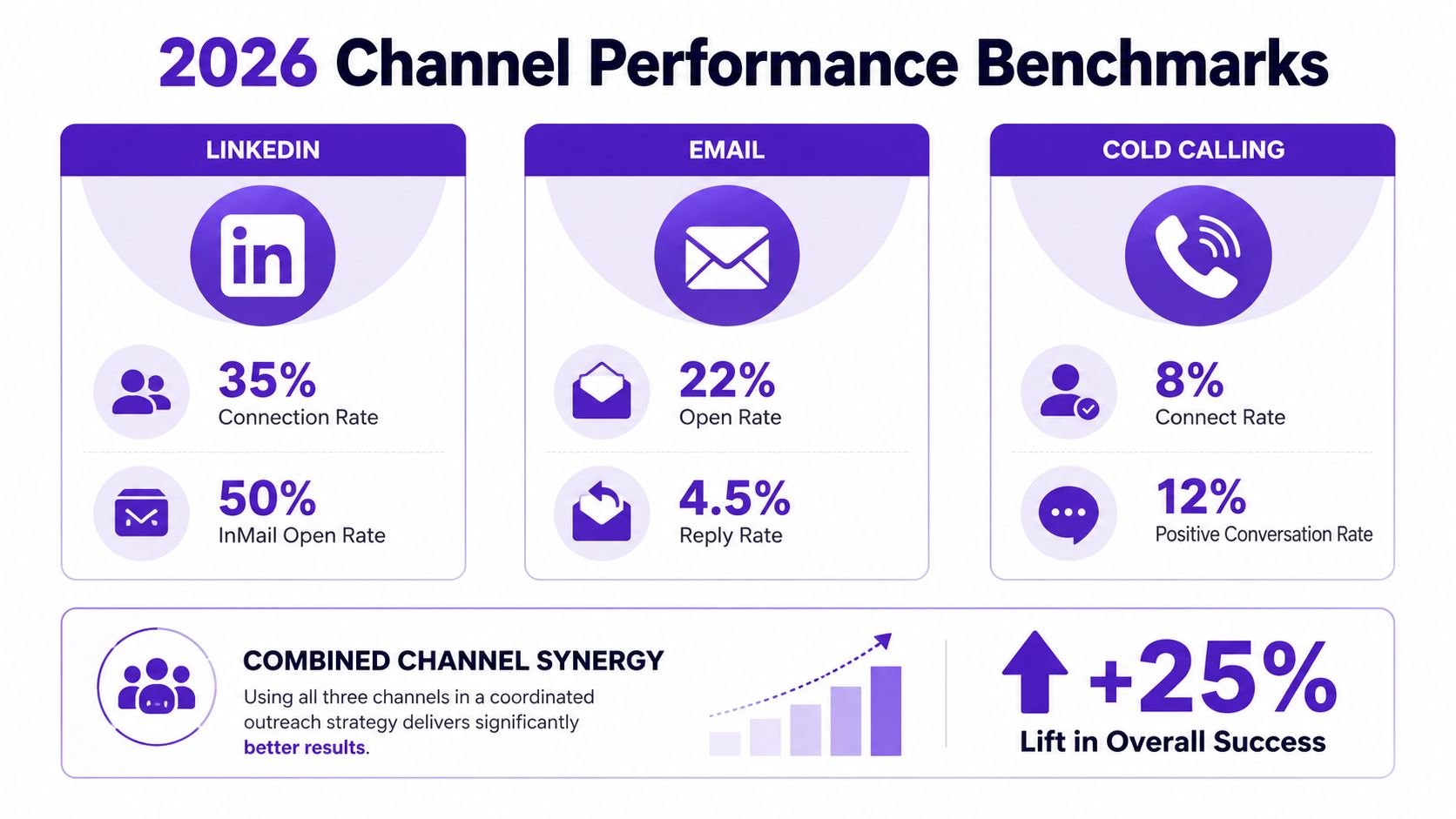
Each channel has a different job. LinkedIn creates recognition and context, email delivers a focused business case, and calling tests urgency through a live conversation. Treating them as interchangeable produces clumsy sequences.
The strongest benchmark comparison comes from coordinated channel use. Aggregated data reports 12% to 25% reply rates for LinkedIn and email cadences, compared with 1% to 3% for cold email alone, described as roughly a fourfold to eightfold lift. The same benchmark source reports that positive replies can convert to meetings at 60% to 80%, which suggests that earlier funnel quality often limits performance more than calendar friction. The multi-channel benchmark data supports stacking channels instead of asking email to carry the whole campaign.
Give each channel a role
LinkedIn: Use the prospect's public context to build familiarity and identify relevant interactions.
Email: State the trigger, the likely business implication, and a low-friction next step.
Cold calling: Ask a sharp question and test whether the issue is active, owned, and worth discussing.
Free LinkedIn accounts also have a practical constraint. Independent guides report a monthly commercial-use search limit of roughly 250 to 350 searches, after which users may see only three search results per query until the monthly reset. The LinkedIn limits guide is a reminder that indiscriminate searching can consume access before the team finds its best prospects.
A sensible cadence might begin with a relevant LinkedIn interaction, follow with an email tied to the same signal, and use a call only after the rep can explain why the account was selected. The goal isn't to pester someone in three places. It's to create one coherent narrative across three surfaces.
For more detail on using LinkedIn as a prospecting channel, explore LinkedIn lead generation tactics.
Messaging Frameworks and Cadence Templates That Convert
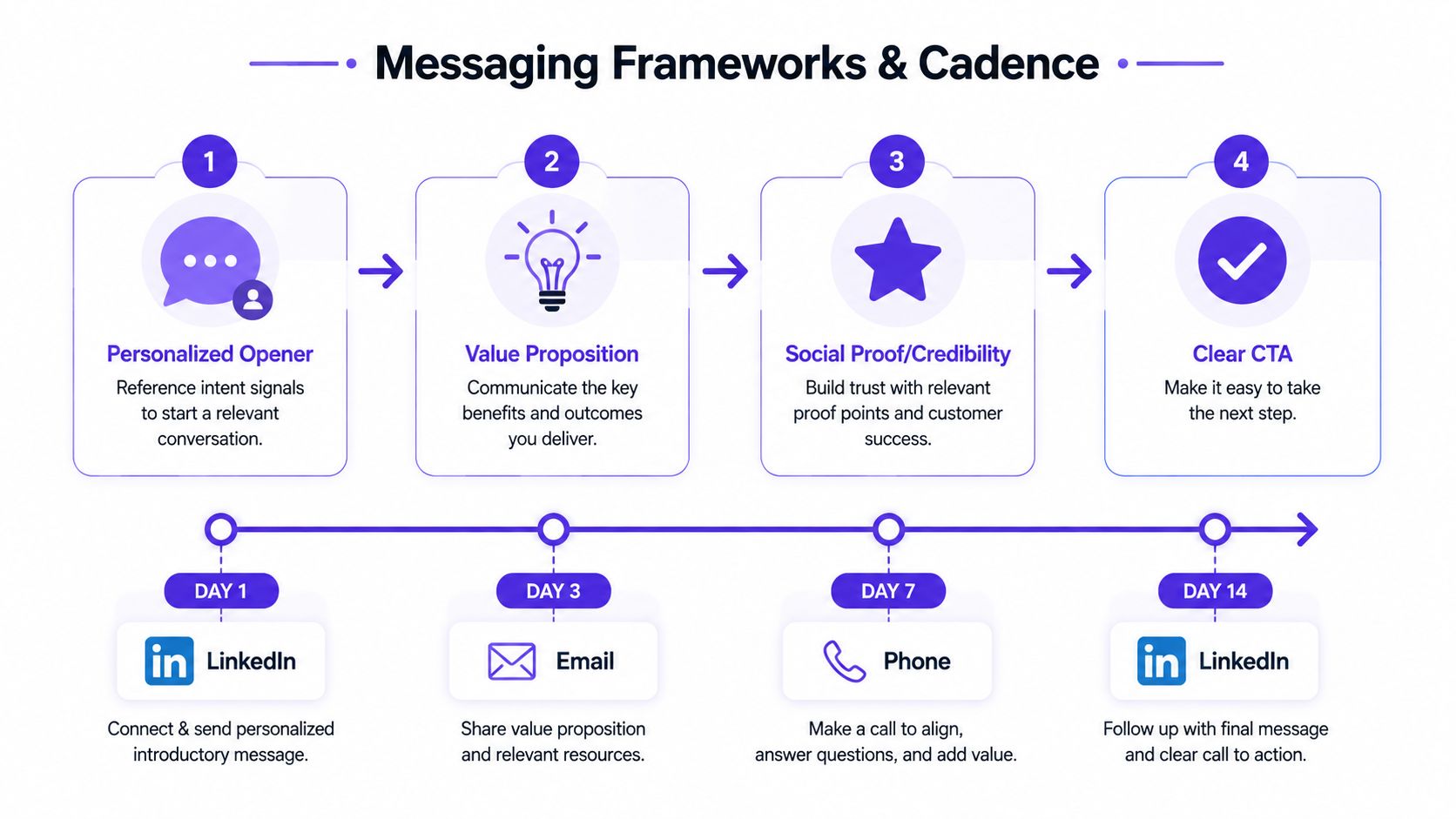
A good outbound message answers four questions quickly:
Why are you contacting me?
What problem might this connect to?
Why should I believe you understand it?
What's the easiest next step?
Write from the signal outward
A strong opener names the observed context without pretending to know more than you do. For example, “I noticed your team is hiring for outbound roles, which often creates pressure around lead research and follow-up” is more credible than a generic claim about “transforming revenue.”
Then connect the context to one business consequence. Keep the value proposition narrow, and use proof only if it's relevant to the role and situation. Finish with a question that lets the prospect answer without booking immediately.
A practical 14-day sequence can look like this:
Day | Channel | Angle |
|---|---|---|
1 | Relevant connection or thoughtful engagement | |
3 | Signal-based opener and one business implication | |
7 | Phone | Specific diagnostic question |
14 | Email or LinkedIn | New angle, useful observation, or graceful close |
Don't send four versions of “just following up.” Each touch should add context, test a different hypothesis, or make it easier to decline.
AI can help research signals, summarize accounts, and suggest variations. It doesn't automatically make outreach personal. One 2026 LinkedIn study found AI prompt usage lifted reply rate only slightly, from 7.0% to 7.3%, while another industry summary says buyers can identify AI-generated outreach within the first sentence. The reply-rate analysis supports a restrained approach: use AI for interpretation and preparation, then edit the message until it sounds like a human who looked.
KPIs and Reporting for Outbound Pipeline
A dashboard full of sent messages can make a weak campaign look busy. Activity matters, but activity without progression is just expensive cardio.
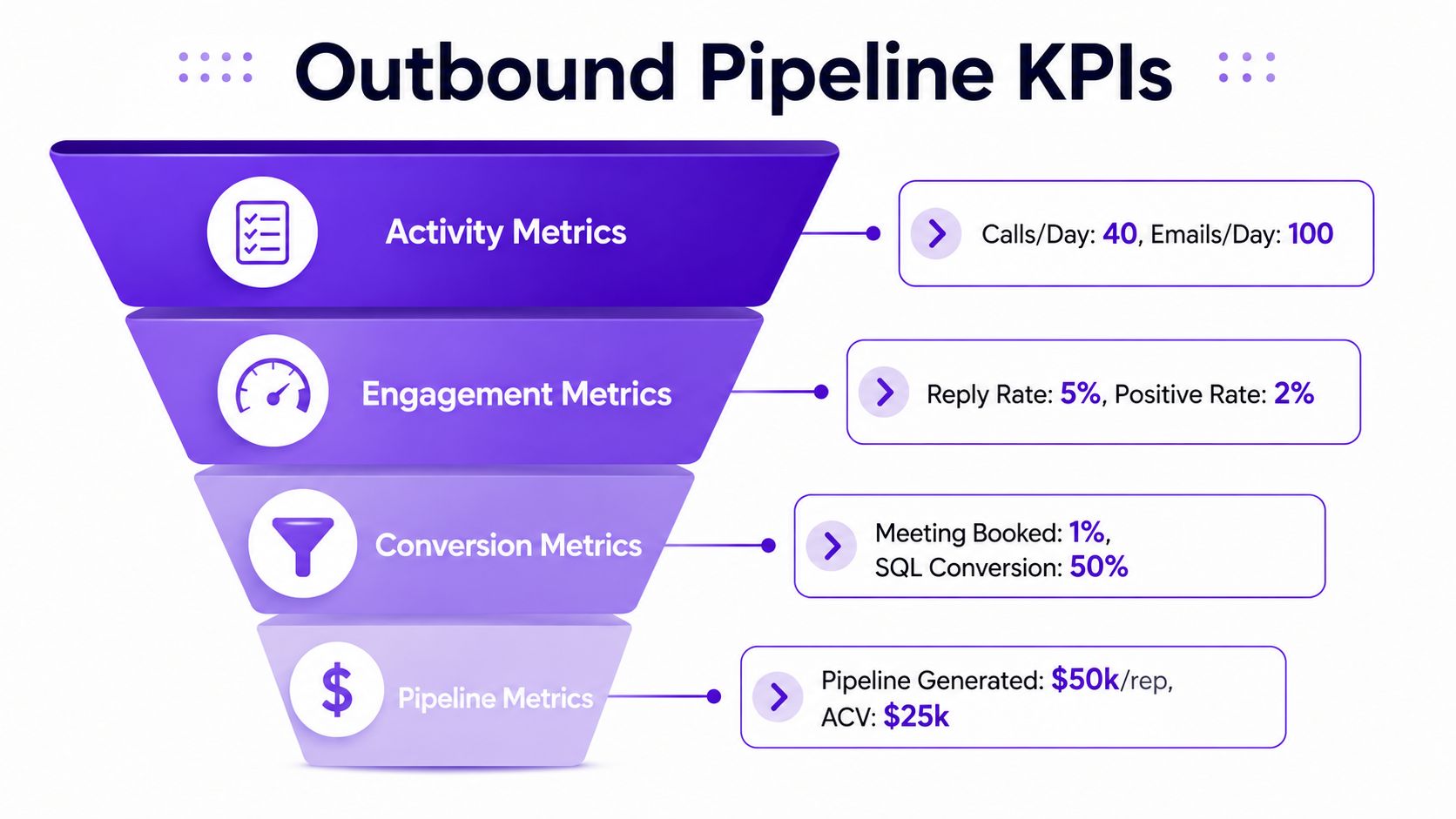
Track the funnel in stages: targeted accounts, delivered messages, meaningful engagement, positive replies, meetings, qualified opportunities, and pipeline. The benchmark data covering cold outreach reports that roughly 91% of cold emails receive no response, so a team should diagnose the entire path rather than celebrate delivery or open activity alone. The outbound benchmark summary provides context for why zero-response volume is a poor definition of productivity.
Diagnose the leak, not the symptom
Low engagement: Check deliverability, account selection, and whether the opening reflects a real signal.
Replies without interest: The message may be attracting curiosity but not presenting a credible business problem.
Positive replies without meetings: Review qualification, CTA friction, calendar handling, and response speed.
Meetings without opportunities: The ICP, qualification criteria, or promised value may be wrong.
Report by cohort, not only by rep. Compare campaigns by segment, signal type, role, channel mix, and message angle. A rep working a narrow, difficult segment shouldn't be judged against someone working a highly active market using the same activity quota.
Weekly reviews should end with one decision. Keep the audience, change the message. Keep the message, change the signal. Or stop the segment entirely. Pipeline reporting earns its keep when it changes what the team does next.
Common Outbound Mistakes and How to Fix Them
The biggest mistake is optimizing for connection acceptance instead of pipeline movement. LinkedIn benchmark data shows acceptance rates holding relatively steady around 27% to 29%, while one large dataset reported accepted-connection reply rates falling from 32.2% in 2025 to 22.0% in 2026. Another benchmark found only 2.0% of accepted connections booked meetings. The LinkedIn benchmark research exposes the gap between a social metric and a revenue metric.
Fix the problem by tracking accepted connections through replies, meetings, and opportunities. A connection is not a win if the conversation never starts.
Other failure points
Static list building: Add behavioral triggers and refresh priorities instead of treating every matching account equally.
Search-limit blindness: Plan LinkedIn research around scarce search access and use qualified signals to focus manual work.
AI as a volume multiplier: Use automation to interpret activity and draft options, then apply human review before sending.
Email-only campaigns: Stack LinkedIn, email, and calling around one message rather than repeating the same pitch everywhere.
Feature-first copy: Lead with the prospect's likely operational problem, not your product tour.
The pattern is consistent. Teams don't usually need more tasks. They need better decisions about which prospects deserve those tasks.
Frequently Asked Questions About Outbound Lead Generation
What's the best time to send?
There's no universal send time that beats relevance. Test timing by segment and prioritize active signals over calendar folklore.
Should I build a large list or a small one?
Start with the smallest list that can test a clear ICP and message hypothesis. Expand only after positive replies reveal repeatable fit.
When should outbound give way to inbound?
Invest more in inbound when buyers research the category and your team can sustain useful content. Keep outbound for named accounts and targeted gaps.
How should SDRs handle gatekeepers?
Treat them as informed participants. Ask who owns the problem and explain the business context plainly.
Are LinkedIn connection requests still useful?
Yes, but acceptance is only an early indicator. Track replies, meetings, and opportunities after acceptance.
Is cold calling still viable?
Yes, when the call follows research and a specific reason to contact the account. Blind dialing makes a difficult channel harder.
How should SDR performance be measured?
Use activity for coaching, but judge performance through qualified replies, meetings held, opportunities created, and pipeline contribution.
What should I do when reply rates fall?
Check deliverability, list freshness, signal quality, message relevance, and recent market changes before rewriting everything.
How do I personalize without sounding fake?
Reference one observable business context and connect it to one plausible problem. Don't cram a prospect's biography into a sales email.
When should I invest in intent-data tools?
Invest when manual research is slowing coverage or your team can't consistently identify why an account might be in-market. Start with a defined signal workflow, not a tool shopping spree.
RoverLead AI helps sales teams turn LinkedIn engagement around topics, competitors, creators, and expert content into contextual prospecting opportunities matched to an ICP. If your team wants to replace static list pulls with signal-aware research and review, visit RoverLead AI and build a more relevant outbound workflow.