What Is Ideal Customer Profile: Guide 2026

Most advice on what is ideal customer profile still treats it like a prettier persona. That's how teams end up with a slide full of adjectives, a mailbox full of bad leads, and a sales team that stops trusting marketing. A real ICP isn't a wishlist. It's a company-level decision tool that answers one blunt question, does this account fit our solution right now.
The useful version blends fit and intent. Fit tells you whether a company can win with your product, while intent tells you whether it's moving, budgeting, and looking. Without both, you've got a filter, and a filter without validation is just a guess. If your ICP still lives only in a document, not in routing, scoring, or outreach, it's probably costing you pipeline.
Table of Contents
The ICP Mistake That Quietly Kills Your Pipeline
Many teams think they have an Ideal Customer Profile. They have a wishlist on a slide. The problem starts when marketing writes a broad audience description, sales nods politely, and then everyone wonders why outreach feels random. That's not an ICP, it's a mood board.
Practical rule: If your profile can't help a rep decide whether to spend time on an account today, it's not doing the job.
The persona trap makes this worse. Personas are useful for messaging, but a persona describes a human inside the account, not the account itself. An ICP should tell you whether the company is a strong fit based on firmographic, technographic, and behavioral or intent signals, the same kind of layered model described in modern ICP frameworks from ZoomInfo's guide to ideal customer profiles. That's also why a CRM cleanup alone doesn't fix the problem. If the data only says “industry” and “size,” you're missing the timing piece.
A filter without validation is still just a guess. The best profiles are built from patterns in your best customers, then tested against current cohorts, not last quarter's assumptions. If you want the cleanup side of this to behave, start with CRM data enrichment before you argue about messaging. Dirty inputs make poetic ICPs and lousy pipeline.
What Is an Ideal Customer Profile, Really
An Ideal Customer Profile is a data-backed description of the company type that gets the most value, buys faster, stays longer, and expands more often. It is the filter that tells a sales team which accounts deserve attention now, based on fit and likely buying behavior. That matters because a useful ICP has to help reps make a live call, not just fill a slide.
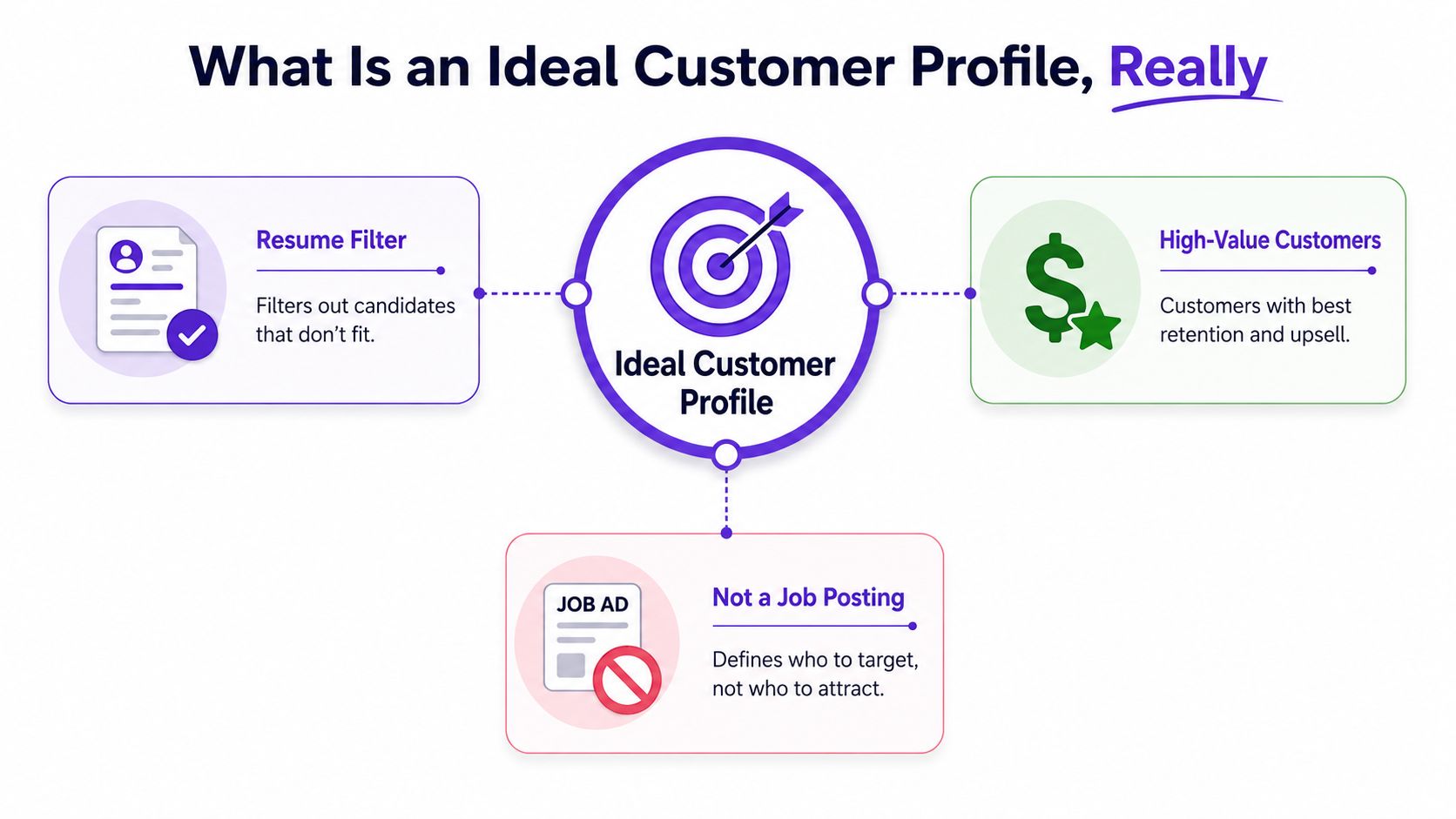
Salesforce frames strong ICPs around patterns in your best customers, especially shared traits, buying triggers, and long-term value, which is why ICPs sit at the center of prioritization and account-based marketing (Salesforce ICP guidance). In practice, the point is not to describe your “target market.” It is to predict whether a business fits the solution now, with enough confidence to route effort correctly.
The four layers that matter in 2026
Firmographics tell you whether the account belongs in the universe at all. Industry, company size, revenue, and geography are the first screen, like a B2B SaaS vendor deciding whether a 70-person company in North America belongs in the queue. Qualtrics also calls out employee count, customer base size, annual revenue, annual budget, and support model as useful profile inputs (Qualtrics ICP article).
Technographics tell you whether the company can realistically use your product. A RevOps tool selling into teams already running Salesforce, a warehouse, and a reverse-ETL stack is dealing with a very different buyer than a company still spreadsheeting its way through monthly reporting. ZoomInfo's 2026 guide treats tech stack as a core fit layer, not a nice-to-have detail (ZoomInfo's 2026 ICP guide).
Behavioral or intent signals tell you whether the account is moving. Buying triggers, content engagement, hiring patterns, or competitor research all matter because they suggest action, not just resemblance. That distinction between fit and intent is the whole game.
Use-case or budget fit tells you whether the pain is severe enough and the economics make sense. If the buyer lacks authority, funding, or urgency, the account can look ideal on paper and still go nowhere. Strong profiles are built from closed-won and retention data, then checked against the buying path.
ICP vs Buyer Persona vs TAM at a Glance
The fastest way to ruin an ICP is to confuse it with a persona. The second fastest way is to confuse it with TAM, which is what happens when everyone starts talking about “the market” and nobody can route a lead.
Dimension | Ideal Customer Profile | Buyer Persona | Total Addressable Market |
|---|---|---|---|
What it describes | The company most likely to buy, succeed, and expand | The person inside the company who influences or makes the decision | The full universe of possible accounts or buyers |
Primary use | Prioritization, routing, scoring, account selection | Messaging, content, objections, enablement | Sizing, forecasting, market opportunity |
Best question | Is this account worth our sales team's time right now? | What does this person care about and how do they buy? | How big is the possible market? |
Example for a RevOps SaaS company | Mid-market SaaS firms with Salesforce, a warehouse, and active growth signals | RevOps leader who owns reporting and tooling | All companies that could theoretically use analytics software |
Use the right tool for the right job. An ICP helps sales decide where to spend time. A persona helps marketing decide how to speak. TAM helps leadership decide whether the market is large enough to pursue.
A lot of teams build the persona first because it feels tangible. That's fine, until the persona starts masquerading as account strategy. If you sell to mid-market RevOps teams, the persona might be “RevOps leader who lives in dashboards and hates manual reporting.” The ICP is still the company definition, such as 50 to 500-person SaaS firms with the right stack and buying signals. One is a message compass. The other is a routing rule.
The Building Blocks of a Strong ICP
A usable ICP doesn't need a 14-tab spreadsheet. It needs enough signal to tell you why one account deserves attention and another doesn't. For a B2B analytics SaaS selling to RevOps leaders at 50 to 500-person SaaS companies in North America, the profile starts to look less like theory and more like a working filter.

What belongs in the first draft
Firmographic anchors are the easiest place to begin. Industry, size, revenue, and geography define the lane. If your best deals keep coming from SaaS firms in North America with 50 to 200 employees, that pattern belongs in the profile instead of in someone's memory.
Technographic clues show whether the account's stack can support the product. If your analytics platform depends on clean CRM data, a warehouse, and reverse-ETL, then those tools are useful signals. A company with the right people but the wrong infrastructure may look attractive and still churn your team's time.
Your first ICP draft should read like a search filter, not a brand story.
Behavioral triggers tell you when the account is waking up. Job posts for RevOps hires, recent funding, tool migrations, leadership changes, and content engagement are all useful because they show motion. You don't need to over-interpret them. You just need to know which signals should move an account from “someday” to “today.”
Use-case and budget signals are where teams get fuzzy. Pain severity matters. Authority matters. Funding matters. If the problem isn't expensive enough, or the buyer can't act, the deal will drift. The profile should capture those realities before sales burns a week on polite non-answers.
If you're mapping this into a real data model, what demographic data is and why it's only the starting point is worth keeping in mind. Demographics alone never tell the whole story, they just tell you where to begin.
How AI Prospecting Turns an ICP Into Daily Pipeline
Static ICPs expire fast. They live in docs, get reviewed in quarterly meetings, and then fall behind the market the moment buying behavior changes. AI prospecting platforms turn the ICP into a live filter, then add fresh intent signals on top of it so reps work accounts that are active now, not just accounts that look like a fit on paper.
RoverLead AI is one example of that shift. It lets teams define an ICP, then layer in the signals that matter, such as competitors, industry influencers, and topics to watch. The platform tracks engagement around those sources and turns that activity into a daily feed of accounts that match the profile. The point is simple, use the ICP as an operating system for daily targeting instead of letting it sit in a spreadsheet.
The practical difference shows up fast. A static ICP gives you a snapshot. A signal-driven ICP gives you a shortlist. RoverLead AI customers report 2 to 3x positive reply rates, 30 to 50% more meetings, and up to 60% less research time because timing and relevance are handled by the system rather than by the rep (RoverLead AI). Those are outcome claims, not magic. They make sense when reps stop guessing who to contact and start working from observed behavior.
How AI prospecting tools turn profile data into daily outreach follows the same logic. The ICP sets the boundaries, and the platform keeps watching for motion inside those boundaries. That is a better use of an ICP than treating it like a one-time checklist.
The setup is short enough for real teams to use. Define the ICP, add keywords, competitors, and experts, then let the system monitor more than one signal stream instead of relying on a quarterly export. The value is not just speed. It also keeps reps from becoming part-time researchers just to send one relevant message.
Five ICP Mistakes That Keep Reply Rates Low
The first mistake is building a persona and calling it an ICP. That usually ends with messaging that sounds smart and routing that performs badly. Fix it by making the profile company-level first, then layering personas on top.
The second mistake is filtering only on firmographics. Industry and size matter, but they don't tell you whether the account is in motion. Add intent signals, or you'll keep chasing companies that look right and behave wrong.
The third mistake is copying a competitor's ICP word for word. Their economics, product, channel, and sales motion aren't yours. If you borrow their profile, you inherit their blind spots too.
The fourth mistake is making the ICP so narrow that the pipeline dries up. Precision is good, but overfitting kills coverage. A profile should improve prioritization, not eliminate half the market because the spreadsheet looked elegant.
The fifth mistake is never revisiting the profile after the first build. Markets shift, buying committees change, and product value changes with them. A living ICP gets revised from won and lost data, not from nostalgia.
A 30-60-90 Day Plan to Build and Validate Your ICP

Days 1 to 30
Pull closed-won and closed-lost data, then interview five top customers. The point isn't to ask them what they “like.” It's to find repeated patterns in why they bought, what they used, and where the deal moved fast or stalled. Draft a version one ICP and wire it into CRM scoring so the profile starts affecting real work.
Days 31 to 60
Add technographic and intent layers, then create a feedback loop between sales and marketing. That's where how to qualify sales leads becomes operational, because qualification should reflect the same signals the ICP uses. Run a controlled pilot against your old targeting so you can see whether the new profile changes who gets routed, who gets worked, and who gets ignored.
Days 61 to 90
Measure fit against conversion rate, deal velocity, and net revenue retention. If the profile predicts those outcomes in current cohorts, keep it. If it doesn't, re-estimate it from recent won and lost data instead of polishing last year's slide deck.
A good ICP is judged by whether it still predicts revenue outcomes now, not by whether the wording sounds sharp in a meeting. That's the maintenance habit many teams skip, and it's why so many profiles age into irrelevance.
FAQ
What is ideal customer profile in plain English
It's the definition of the kind of company that is most likely to buy, succeed, and stay. Good ICPs combine firmographic, technographic, and behavioral signals instead of relying on a broad market description.
Is an ICP the same as a buyer persona
No. An ICP describes the company. A buyer persona describes a person inside the company. You usually need both, but they solve different problems.
What data should go into an ICP
Start with industry, size, revenue, geography, and tech stack. Then add buying triggers, pain points, budget fit, and anything else that proves the account is active and reachable.
Why do ICPs fail so often
They're often built from guesses, old assumptions, or copied templates. Another common failure is treating static firmographics as if they were enough to predict conversion.
How often should an ICP be updated
As often as the market changes enough to affect revenue outcomes. If recent won and lost deals don't match the profile, the profile is stale.
Can small teams use an ICP effectively
Yes, and they probably need one more than anyone. A tight ICP helps limited sales resources focus on accounts that are more likely to convert.
What's the difference between fit and intent
Fit is whether the company structurally matches your solution. Intent is whether it's actively looking, budgeting, or moving toward a purchase.
Should marketing and sales share the same ICP
They should share the same company definition, then use it differently. Sales uses it for prioritization and routing. Marketing uses it for targeting and messaging.
What's the biggest sign an ICP is wrong
When it stops predicting conversion, retention, or deal velocity in current cohorts. If the elegant definition doesn't map to revenue, it's decoration.
Can AI prospecting help with ICP execution
Yes. It can turn a static profile into a live lead feed by matching your fit criteria with active intent signals, which is a much better use of the model than letting it sit in a slide deck.
If your ICP still behaves like a document instead of a daily signal engine, it's time to fix that. RoverLead AI turns LinkedIn engagement into leads matched to your ICP, so your team can work active accounts instead of guessing who's ready. Visit RoverLead AI and see how a living ICP can drive cleaner daily pipeline.