B2B Sales Automation: The 2026 Playbook for Higher Reply
You know the scene. The SDR opens Sales Navigator at 8 a.m., pulls a fat list, fires off a pile of connection requests, and by lunch has a few polite replies and an empty calendar. The team worked hard. The pipeline still looks stubbornly flat. That usually isn't a grit problem, it's a signal problem, and that's exactly where b2b sales automation either earns its keep or turns into expensive busywork.
The old playbook was built around static lists and repetitive cadence. The 2026 version is built around intent, because buyers don't want to be chased the moment they fit a firmographic box, they want to be contacted when they show buying behavior. That shift sounds subtle until you've watched two teams run the same outbound motion and one of them spends half its week proving to prospects that nobody is paying attention.
Table of Contents
Why Your Sales Team Is Working Harder and Closing Less
At 8:07 a.m., the SDR opens LinkedIn, finds 500 names, filters by title and headcount, then starts the day by trying to guess who might care. By 12:15, the tally is ugly, 200 connection requests sent, three lukewarm replies, zero meetings booked. That isn't laziness, and it isn't even a follow-up problem. It's what happens when outreach starts from a list instead of a buyer signal.
I've watched teams celebrate activity while the pipeline refuses to move. The rep hits every task in the sequence, the manager sees clean checkboxes, and the forecast still drifts because the underlying timing is wrong. That's why b2b sales automation matters most when it reduces wasted motion, not when it just speeds up the wrong motion. One industry compilation says 76% of companies now use some form of sales automation, while another estimates 75% of organizations globally use it in some form and 61% of B2B firms have already adopted sales automation solutions, which tells you the category is mainstream even if plenty of teams are still using it badly. The same sources report a 14.5% increase in sales productivity, a 12.2% reduction in marketing overhead, and an 18% shorter sales cycle when teams automate lead management and workflows, mostly because reps stop drowning in admin and start working on actual selling. sales automation statistics for 2025
Practical rule: If automation doesn't change who gets contacted, when they get contacted, and why they get contacted, it's probably just a faster way to spray more mediocre messages.
The interesting part is that the gap between activity and outcome is where teams accidentally live. They're busy, but not responsive. That's why the useful question isn't “How do we automate more?” It's “How do we stop automating around the wrong inputs?” If your current process still starts with static firmographics, you're not behind on tools, you're behind on timing. For a related operations lens, the way this shows up inside the rest of the funnel is worth connecting to sales process optimization.
What B2B Sales Automation Actually Means in 2026
Think of b2b sales automation less like spreadsheet macros and more like a nervous system. Buyer signals come in, internal data gets interpreted, and seller actions fire back out in near real time. The point isn't to make the rep busier with machine-generated noise. The point is to cut the delay between a buyer doing something meaningful and a seller responding like a human who noticed.
That's also why adoption matters here. If 76% of companies already use some form of automation, then the baseline is no longer whether a team has automation at all. The more useful question is whether the system does the three jobs that separate automation from glorified admin software. First, it captures events. Second, it routes them to the right place. Third, it triggers follow-up while the buyer signal is still warm. Without those behaviors, you've got workflow software, not sales automation. For a broader view of the handoff between demand capture and seller motion, the lead-side framing is useful reading in lead generation automation.
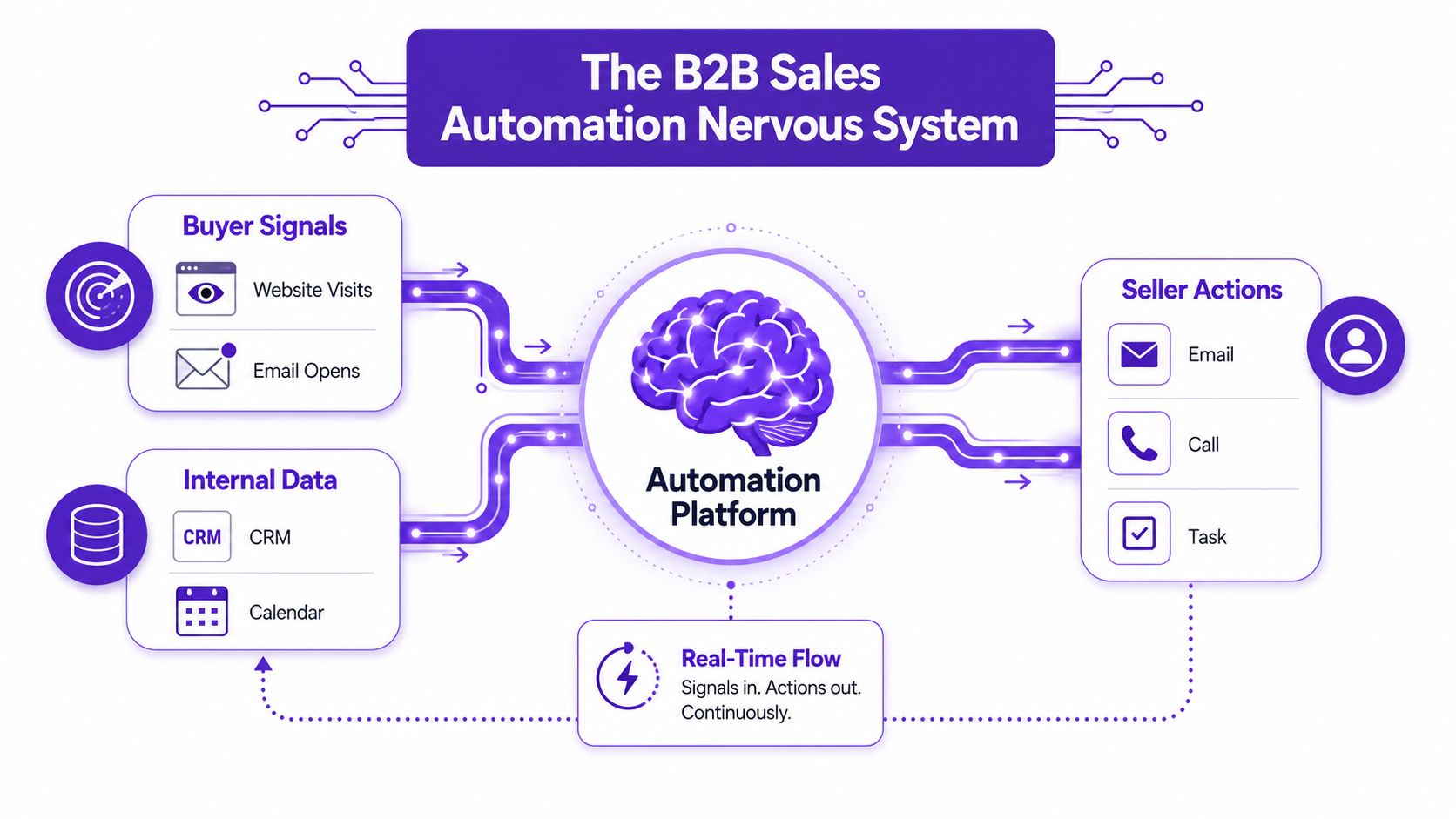
Event, route, respond
In practice, the event might be a form fill, a pricing-page visit, a CRM stage change, or a LinkedIn interaction that says “this account is paying attention.” The route is the part too many teams skip, and then wonder why good leads land in the wrong queue. The response is the action a rep actually needs, a task, an opener, a call reminder, or a clean handoff into the next workflow.
Simple test: if your stack still needs someone to notice the signal manually before anything happens, it's not automation yet.
The 61% B2B adoption figure matters because it hints at the lag inside the mainstream. Lots of teams say they automate. Fewer teams automate the right thing. A spreadsheet can move names through a cadence. A modern stack moves intent through a selling system.
List-Based Automation vs Signal-Based Automation
The cleanest way to see the difference is to stop pretending all automation behaves the same. A static list still feels efficient when you're building it, but it gets stale fast, and stale outreach has a nasty habit of training buyers to ignore you. Signal-based automation starts from behavior, so the message arrives with context instead of wishful thinking. For a practical intent-data lens, the companion piece on what intent data is fits neatly beside this comparison.
Criterion | List-Based Automation | Signal-Based Automation |
|---|---|---|
Data freshness | Built from static firmographics and old exports | Updated from live behavior and recent interactions |
Personalization depth | Generic opener, usually role-based | Contextual opener tied to what the prospect actually did |
Reply likelihood | Often low, because timing is guesswork | Higher, because outreach follows a real signal |
Rep research time | Heavy, because reps keep checking profiles by hand | Lower, because context is surfaced automatically |
Compliance risk | Higher when volume is the main lever | Lower when behavior and network context guide outreach |
A list-based approach can still make dashboards look tidy. It just doesn't tell you whether the person is ready to hear from you. That's the trap. The rep gets a long queue, the manager gets a busy calendar, and buyers get another generic blast from someone who clearly hadn't checked whether they were in market. The result isn't just inefficiency. It's relationship damage.
Signal-based automation changes the economics because it changes the reason for contact. You're no longer saying, “You fit our profile, so we're emailing you.” You're saying, “You just showed the kind of behavior that makes this relevant.” That difference matters in any market where buyers research first, and it matters even more when most of the inbox has already been trained to ignore untargeted volume.
The Five Core Components of a Modern Automation Stack
A modern stack works only when the pieces are wired together, not when they're bought in isolation. I've seen teams pay for a shiny routing layer while their CRM was full of duplicates, stale fields, and ICP drift. That's how you get automation that looks advanced and behaves like a drunk intern with a keyboard.

CRM hygiene and intent signals
The first layer is CRM hygiene. If the records are messy, everything downstream gets noisier, and the automation just amplifies the mess. The next layer is intent signal capture, which is where modern systems watch for behavior instead of relying on static lists. One useful model is to monitor 10+ behaviors, because a narrow signal set tends to miss the buyer's actual window of attention.
Scoring, orchestration, and handoff
Predictive scoring matters because not every signal deserves the same response. AI models can use historical conversion patterns, current engagement, and buying cues to sort the right accounts from the merely curious, and that's where teams start seeing the benefit reflected in productivity. The same verified sources point to a 14.5% increase in sales productivity and an 18% shorter sales cycle when automation is used well, which tracks with what I've seen when scoring and routing stop being manual guesswork. Workflow orchestration is the plumbing that keeps CRM, enrichment, and outreach tools synchronized. Human handoff is the last mile, and it's the bit that keeps the process from sounding like a machine talking to itself. The cited sources also tie automation to a 12.2% reduction in marketing overhead, which makes sense when teams stop paying for redundant manual work and duplicate data cleanup. A broader platform view is helpful in sales engagement platform.
Operational truth: the stack works when every component hands clean context to the next one. If one layer drops the ball, the whole thing starts sending the wrong person the wrong message at the wrong time.
How Signal Agents Change the SDR's Daily Routine
Maya runs RevOps at a 40-person SaaS company, and her old workflow was painfully familiar. Her SDRs pulled Sales Navigator lists every morning, sorted by title and geography, then spent most of the day checking profiles one by one and writing openers that sounded fine in isolation and bland in production. The calendar didn't hate the effort. It just refused to reward it.
After she switched to a Signal Agents workflow, the day looked different in a way the team felt immediately. Setup took about five minutes to define the ICP, keywords, competitors, and a few experts the team wanted to track. After that, the feed started surfacing curated accounts based on real engagement, including creator activity, competitor interactions, pricing and demo discussions, content reactions, and profile views. The AI wrote openers from observed behavior, which meant the reps weren't starting from “saw you're a VP at a growth-stage company” for the thousandth time. The system also stays LinkedIn-compliant because it works inside network behavior instead of blasting strangers.
The practical shift was simple. Maya's team stopped spending their mornings assembling a list and started using the day's signals. That change is where the usual lift shows up, because the rep is reaching out while the account is active, not after the trail has gone cold. In RoverLead's own published product notes, customers report 2–3x positive reply rates, 30–50% more meetings, and up to 60% less research time, which matches the basic logic of replacing static prospecting with live intent capture. RoverLead AI is one option in this category, since it turns LinkedIn engagement into a daily feed of high-intent prospects matched to a user-defined ICP and produces AI-written openers from that activity.
A short clip gives the idea without the jargon.
What changes on the calendar: less research, fewer cold guesses, and a lot more “this person just did something worth acting on.”
A Phased Implementation Roadmap That Actually Ships
Phase zero is the part teams skip because it doesn't feel like progress. Write down what not to automate, discovery, live objection handling, pricing negotiation, and relationship-building. That guardrail matters because automation amplifies bad data, and it also amplifies sloppy judgment. If the job still needs a human brain, let it stay human.
The next two phases are the foundation. In weeks 1 to 2, clean the CRM and lock the ICP definition so the system has a decent input. In weeks 3 to 4, wire in signal capture and event-driven triggers so the stack reacts to actual buyer behavior instead of a weekly export. HubSpot's observation that 96% of prospects research companies and products before engaging with a sales representative means the timing window opens before most reps are even aware the account is hot. sales automation statistics for 2025
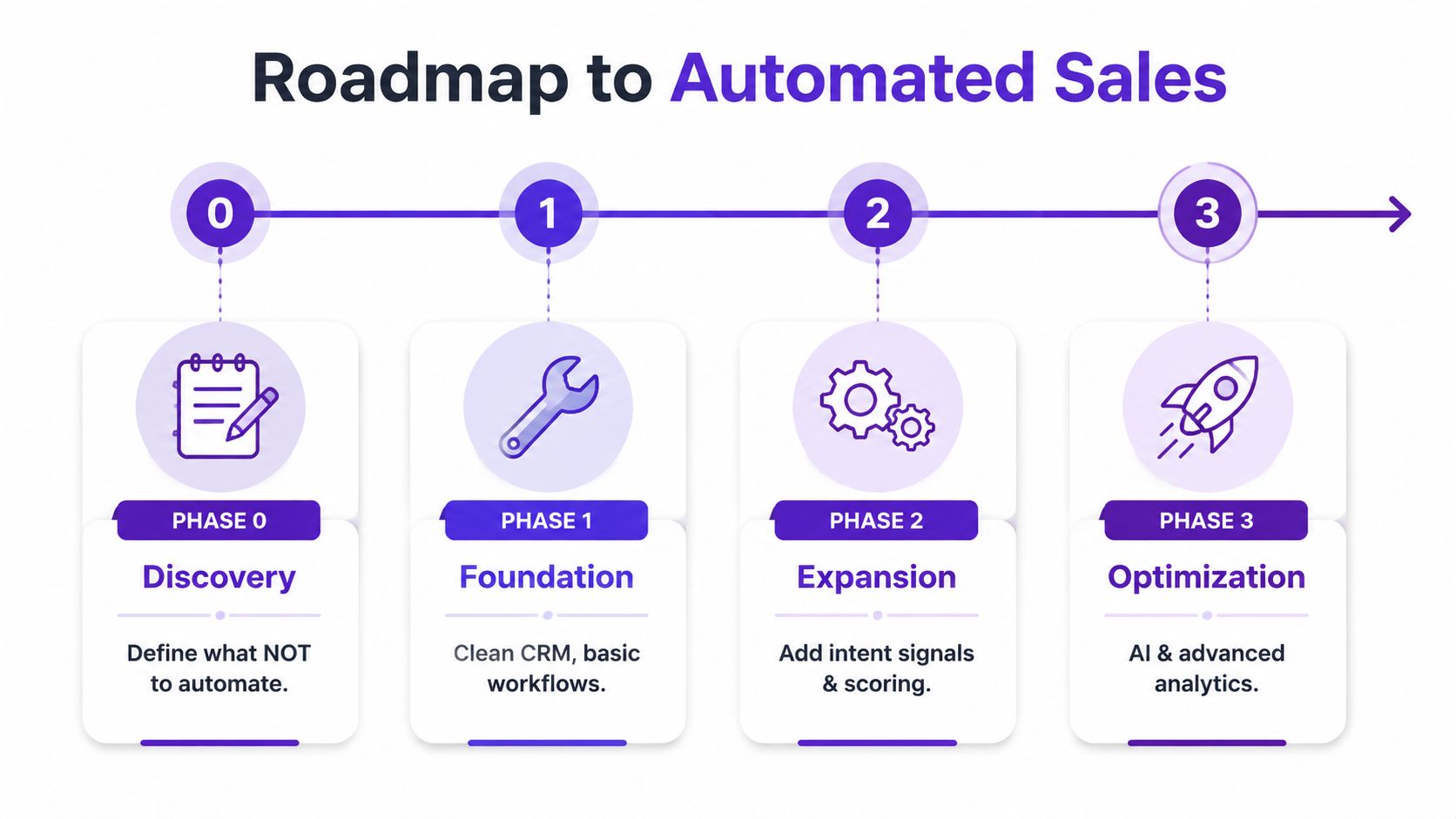
Build, then tune
In weeks 5 to 8, layer predictive scoring and AI-written openers on top of the cleaned data and event feeds. After that, week 9 and beyond becomes the tuning loop, where you watch what converts and adjust the routing rules, opener logic, and handoff timing. Teams that rush straight to the flashy layer usually end up automating noise. Teams that respect the order tend to get a system that gets used.
Common Pitfalls That Turn Automation Into Spaghetti
The first failure mode is automating before the ICP is clear. The symptom is obvious, reply rates sag and SDRs start saying the leads “look fine” while ignoring half the queue. The cause is usually upstream fuzziness, not a bad sequence. The fix is boring but effective, define who you want before you automate how you talk to them.
The second failure mode is layering tools on top of dirty CRM data. That's where automation becomes a very efficient way to misroute accounts, duplicate work, and irritate the exact people you were trying to reach. A clean stack doesn't need perfect data, but it does need consistent data. If the records are stale, every trigger starts lying. I learned this one the hard way on a rollout where the routing logic was sound and the CRM was still a mess. The logic didn't fail. The inputs did.
Where AI helps and where it doesn't
The third failure mode is treating volume as the lever. More sends don't fix bad timing, they just make bad timing harder to notice. The fourth is replacing human judgment with templated objection handling, which is where sales automation starts to sound like it was written by a committee of polite robots. That's the point where a prospect can feel the script before they finish the first sentence.
Rule of thumb: automate repetitive, low-judgment work. Keep discovery, objection handling, negotiation, and relationship-building human.
The McKinsey point about machine learning cutting compensation-planning time by up to 50% is a useful contrast. AI wins when the input is structured and the judgment is low, not when the conversation depends on nuance, trust, or live interpretation. That's the same line I'd use in a vendor review. If a tool can't explain where it needs human judgment, it probably plans to hide the mess rather than solve it.
A fast vendor evaluation checklist
LinkedIn compliance posture: Ask how the product behaves inside platform limits and what it won't do.
Signal coverage: Check whether it listens to 10+ behaviors or just obvious account changes.
ICP configurability: Make sure you can shape the audience without waiting on a support ticket.
Human-in-the-loop openers: Verify that a rep can review or adjust the message before it goes out.
CRM sync depth: Confirm that actions, views, and outcomes flow back cleanly.
Transparent pricing: Push for pricing you can model without a decoder ring.
Roadmap co-shaping: If you're early, ask whether founding customers can influence what gets built.
The best tool matches how your buyer signals, not how your rep likes to send. For some teams, a founding-tier plan with priority support and a locked rate can be worth a serious look, especially if the workflow is still being shaped around how the team really sells.
Quick Answers Before You Sign Anything
How much does b2b sales automation cost? It varies a lot. SaaS tools can start in the low hundreds per seat per month, while custom enterprise builds cost more and usually need implementation help. Signal-based platforms often price by monitored signal or by rep, so the key question is whether the tool matches the workflow you're trying to run.
How fast will we see meetings? If the system is built around live signals and the team uses it consistently, movement usually shows up fast enough for managers to notice. RoverLead's published customer outcomes point to 30–50% more meetings, which is a useful benchmark for what signal-based timing can achieve when the setup and the ICP are tight.
Is it LinkedIn-safe? Only if the platform works within compliance limits and tracks behavior instead of scraping or blasting strangers. Safety isn't a marketing badge, it's a product design choice.
How do we measure ROI? Track reply rate, meetings booked, cycle length, and research hours saved against your pre-automation baseline. If the tool can't tie those metrics together, the finance team is going to notice eventually.
Buyer checklist to keep on the table
LinkedIn compliance
Signal coverage
ICP configurability
Human-in-the-loop openers
CRM sync
Transparent pricing
The right tool should fit how your buyer signals interest, not how your rep prefers to crank out messages. That's the difference between a system that earns trust and one that just produces more activity reports.
If you want a cleaner way to turn LinkedIn engagement into daily, high-intent leads, RoverLead AI does that by matching live signals to your ICP and drafting context-aware openers for outreach. It's built for teams that want to replace static list pulls with actual buying intent, so if that's the direction you're heading, visit RoverLead AI and see whether the workflow fits your team.