What Is Demographic Data? B2B Sales Guide 2026

Your team has a list. It's clean, segmented, and full of the usual comfort food: job titles, company size, region, industry. On paper, it looks like pipeline. In reality, it often behaves like a filing cabinet.
That's usually when people start asking what demographic data is. Fair question. The better question is why a well-built list can still produce silence.
Demographic data matters. It helps you understand who a market is made of and where patterns live. It can even expose underserved demand that won't show up in a standard account list. But for B2B sales, demographics alone won't tell you who's in motion. That's the gap many sales teams feel long before they can name it.
Table of Contents
So You Have a Prospect List Now What
A sales leader pulls a list of “ideal” accounts. The SDR team has seniority filters, company size bands, and nice tidy territories. A week later, the outreach dashboard looks like a ghost town.
That doesn't mean the list is wrong. It means the list is incomplete.
Most static prospecting starts with useful but stale inputs. You know who the people are and where they sit. You don't know whether they care right now. That's why outreach based only on titles and company size can feel like yelling into a canyon and waiting for your own echo.
There's a second problem hiding underneath. People asking what demographic data is rarely understand how it can reveal underserved demand conditions invisible in standard account lists. This analysis of demographic overlays and underserved markets notes that U.S. Census Bureau data is described as “nearly equivalent to currency” because it helps forecast community changes and spot underserved markets.
Static lists tell you who fits. They rarely tell you who's ready.
That's why smart teams treat demographics as the first pass, not the finish line. They use them to shape territory, segment outreach, and pressure-test assumptions. Then they add a more dynamic layer. If your team is still building outbound around list quality alone, it's worth revisiting how B2B sales prospecting works when timing enters the picture.
Demographic Data Defined Without the Jargon
Demographic data is the stat sheet for a population. It describes the measurable characteristics of a group so you can understand who's in it.
According to ATTOM's summary of demographic data and the U.S. Census Bureau, ScienceDirect defines demographic data as “general statistics about a defined population,” and describes it as “almost as valuable as currency” for governments and businesses. That same summary notes that the U.S. Census Bureau collects statistics on education, income, and more for over 330 million U.S. residents.
Demographic data answers the plainest question in go-to-market work: who are these people, as a group?
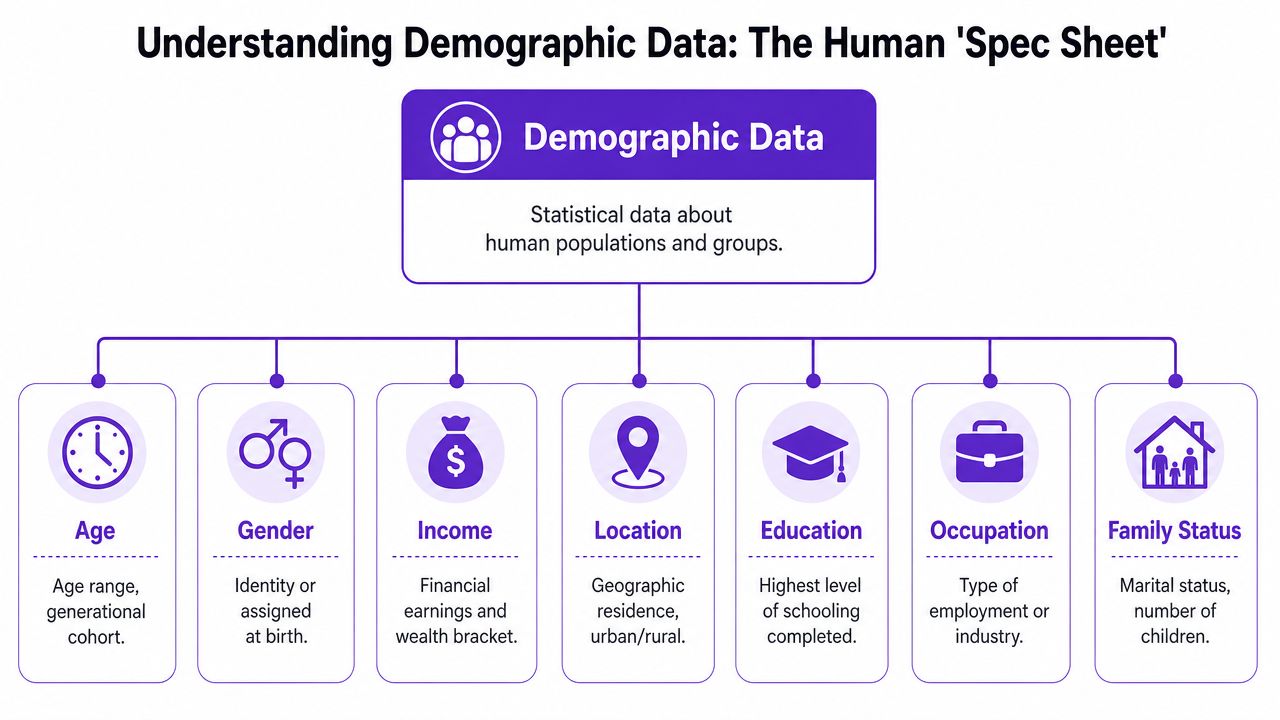
What usually falls under demographics
Some fields are obvious. Others get tossed into the same bucket so often that people forget how broad the category is.
Basic identity markers include age range, race and ethnicity, sex, spoken language, and geographic location.
Socioeconomic traits include education, income, employment status, occupation, and homeownership.
Household and life-stage factors can include marriage rates, birth rates, death rates, and family status.
Context-heavy fields can stretch into things like religious affiliation, political affiliation, hobbies, and interests in some business settings.
The point isn't to collect every field because a spreadsheet can hold them. The point is to understand what shapes a market, a segment, or a service area. Good demographic work gives you a baseline. Bad demographic work gives you trivia.
Demographics vs The Other Graphics
People mix up demographic, firmographic, psychographic, and behavioral data all the time. Fair enough. The names sound like a committee got paid by the syllable.
The practical difference is simpler than the labels suggest. Each data type answers a different question, and sales teams get into trouble when they expect one type to do another type's job.
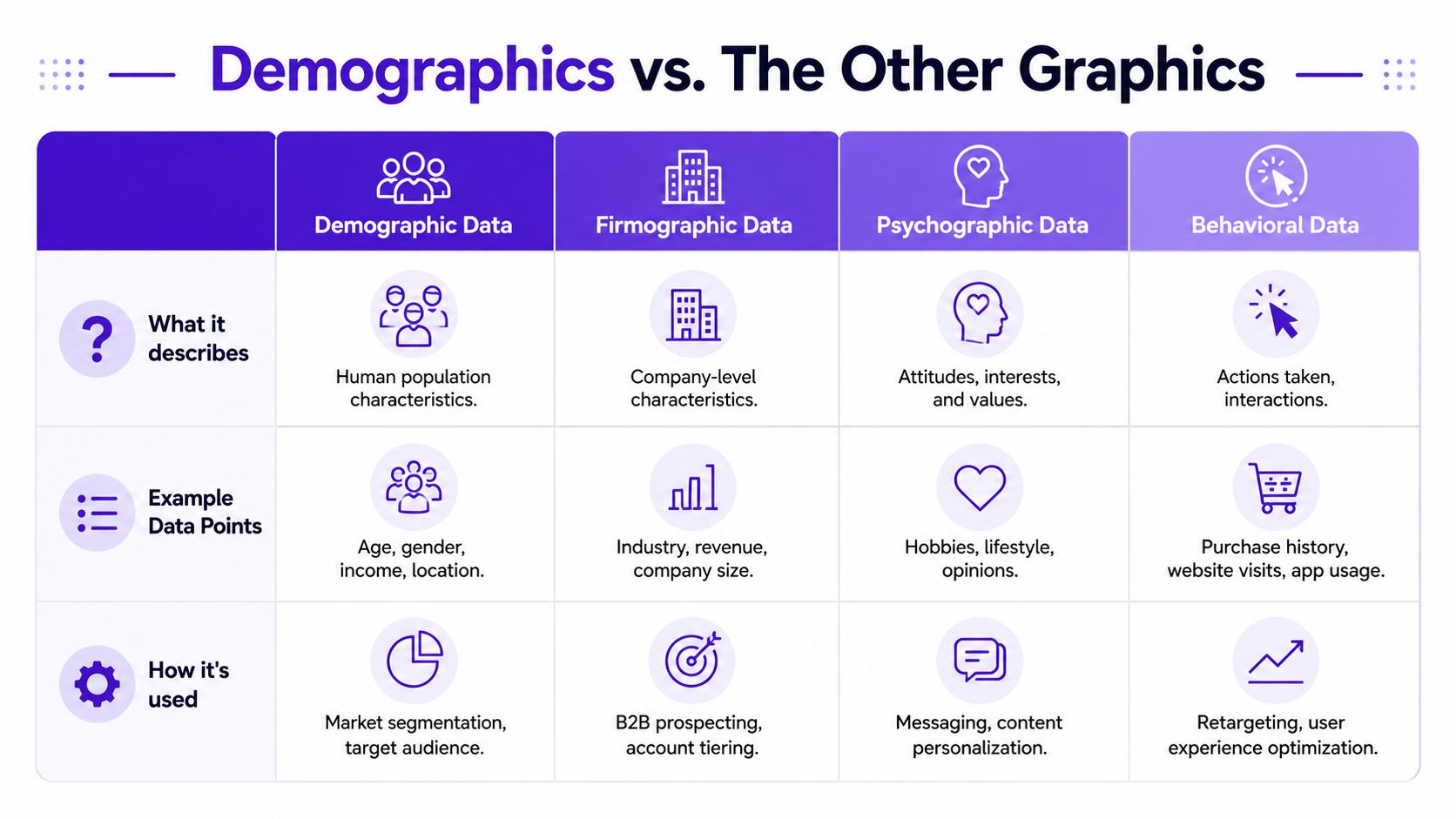
The fast mental model
Demographics tell you who they are.
Firmographics tell you where they work.
Psychographics tell you how they think.
Behavioral data tells you what they're doing.
ScienceDirect notes that, unlike behavioral data, demographic data is available immediately upon a user's first interaction, which makes it useful for early segmentation. It also notes that behavioral data takes time to accumulate and reveals user intent more directly. You can review that distinction in ScienceDirect's overview of demographic data in digital analytics.
That trade-off matters. Promptness is useful. Static broadness is the bill that arrives later.
Data Types At a Glance
Data Type | What It Answers | Primary Use | Example |
|---|---|---|---|
Demographic | Who are these people? | Market segmentation | Age range, income, education, location |
Firmographic | What kind of company is this? | Account selection in B2B | Industry, employee count, company structure |
Psychographic | What do they value? | Messaging and positioning | Interests, attitudes, preferences |
Behavioral | What are they doing now? | Prioritization and timing | Content engagement, site activity, product interactions |
Practical rule: use demographics to shape the audience, but use behavior to decide who gets your attention first.
A B2B team that relies only on demographics and firmographics can build a clean target list. A team that layers in behavioral or intent signals can decide who deserves a call today instead of someday.
How B2B Teams Use Demographic Data for Prospecting
B2B teams still need demographic data. Not because it closes deals by itself, but because it keeps prospecting from turning into random acts of activity.

Where demographics help
Demographics are useful when teams need to define market coverage, segment outreach, and build an ICP with enough specificity to be usable. Titles, seniority, geography, language, and related person-level attributes can sharpen targeting fast. If your ICP still reads like “mid-market companies that want growth,” that's not an ICP. That's a wish.
Teams also use demographic inputs to tailor messaging. A founder selling into regional operators won't write the same message to a multilingual buyer in a dense metro area that they'd send to a smaller local team. The data doesn't write the copy for you, but it stops you from sounding oblivious.
For teams tightening account selection, a clear ICP in business proves to be more than a slide in a kickoff deck.
Where the list starts lying
The problem starts when teams mistake qualification for readiness.
Knowing someone's title, function, or location helps you say, “This person could buy.” It doesn't tell you, “This person is actively researching, comparing, or discussing solutions.” That's why static list pulls age badly. They preserve fit but lose timing.
QuestionPro notes that digital platforms increasingly offer demographic datasets through APIs, which means teams can feed those attributes into prospecting systems in real time. That's useful infrastructure. But even a beautifully synced stack still needs a stronger signal than “matches segment.”
A better workflow looks like this:
Start with fit: define who belongs in your market.
Filter for context: territory, language, role, and operating environment.
Prioritize by motion: look for research behavior, pricing conversations, or category engagement.
Write outreach to the moment: not just to the persona.
At this stage, teams often add product usage data, website analytics, LinkedIn activity, CRM enrichment, or category-level intent tools.
A short explainer helps if you want to see how sales teams think about turning data into action:
Data Collection and Quality Best Practices
Most demographic data problems aren't about definitions. They're about bad collection, weak maintenance, and overconfidence in old records.
Where teams get demographic data
Common sources include public datasets, surveys, CRM records, forms, enrichment vendors, and internal product data. In federal and academic research, U.S. Census restricted-use demographic microdata can provide geographic precision down to the block level for the Decennial Census, which is far more detailed than public-use versions that are often aggregated.
That level of precision is powerful, but it also makes a practical point. Source quality varies wildly. Two datasets can both be called “demographic” and still have very different levels of usefulness.
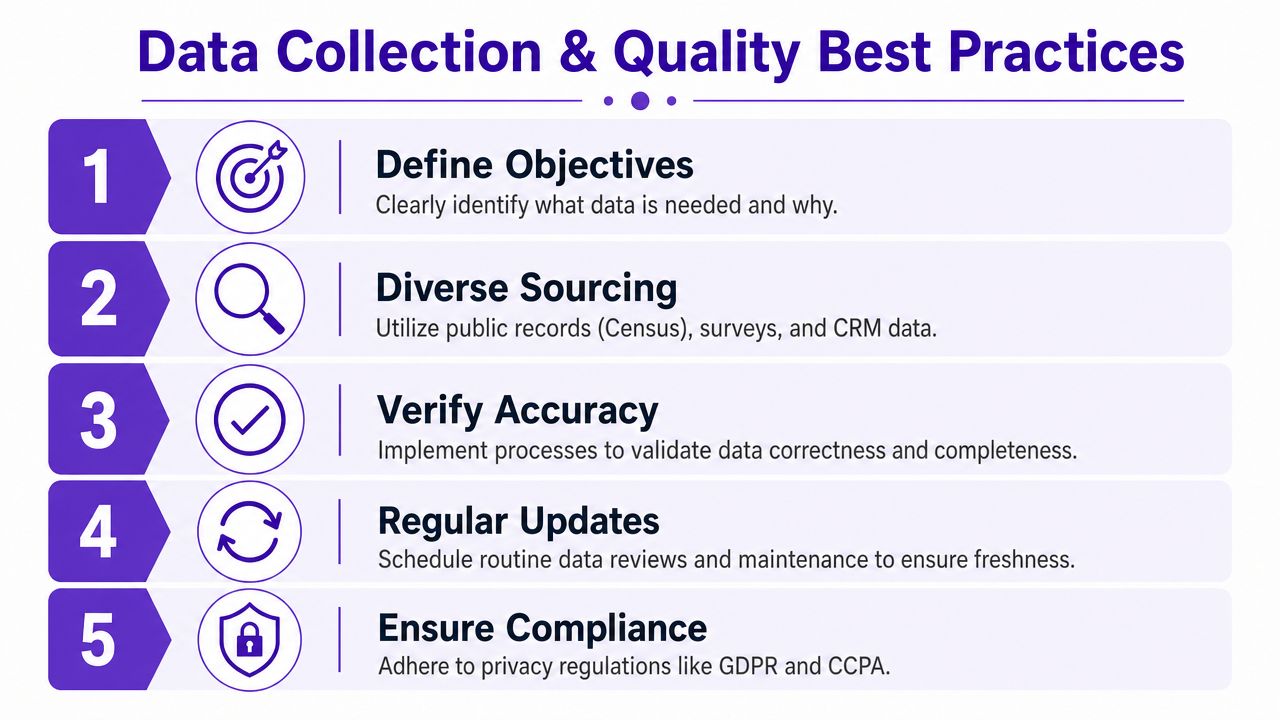
The hygiene checklist
Start with a business question. If you don't know what decision the data should improve, you'll collect fields because they're available, not because they matter.
Check freshness early. A polished record from the wrong era is still wrong. Titles change, territories shift, and household or market conditions move.
Validate across systems. CRM, forms, and enrichment tools often disagree. Somebody has to decide which system wins.
Respect privacy rules. GDPR and CCPA aren't optional footnotes. They shape what you collect, store, and activate.
Avoid creepy segmentation. If a field would make a prospect uncomfortable in outreach, think twice before operationalizing it.
Clean data is not the same as useful data. A perfectly formatted dead field is still dead.
If your CRM is carrying too much stale or conflicting profile data, CRM data enrichment is usually the first repair job worth doing.
Beyond Demographics The Shift to Intent Data
Demographics tell you the market. Intent data tells you who's leaning in.
That shift matters because modern prospecting isn't just a targeting problem. It's a timing problem. Organizations often don't lose deals because they can't describe their audience. They lose them because they reach out before interest exists, after a decision is already underway, or with no clue what triggered the buyer's attention.
Intent signals are the traces buyers leave when they start moving. That might be category research, repeated engagement with a topic, competitor interaction, pricing-related behavior, or visible conversation around a problem your product solves. Those signals are not perfect, but they're far closer to buying reality than a frozen list of traits.
The old model asks, “Does this person fit?” The better model asks, “Why this person, and why now?”
That's why the smartest sales motions now pair static fit with dynamic signal. One option is intent data platforms that identify active buying behavior. Another is RoverLead AI, which turns LinkedIn engagement into daily prospecting signals by tracking interactions around relevant creators, competitors, and topics, then matching that activity to your ICP.
Demographics still matter. They help you avoid chasing everyone. But if you stop there, you'll keep building lists instead of building momentum.
Your Demographic Data Questions Answered
Frequently Asked Questions
Question | Answer |
|---|---|
What is demographic data in plain English? | It's measurable information about a group of people, such as age, location, education, income, or occupation. |
Is demographic data the same as a buyer persona? | No. demographics are raw characteristics. a persona is a working profile built from demographics plus goals, pain points, behaviors, and context. |
Is demographic data only for B2C marketing? | Not at all. B2B teams use person-level attributes alongside company data to segment outreach and shape ICPs. |
What's the difference between demographic and firmographic data? | Demographic data describes people. Firmographic data describes companies. In B2B, you usually need both. |
Can demographic data help with territory planning? | Yes. It can reveal regional patterns, language needs, and underserved areas that basic account lists miss. |
Is demographic data enough for prospect prioritization? | Usually no. It shows fit, not urgency. You need behavioral or intent signals to decide who deserves attention now. |
Where can teams get demographic data? | Public sources, surveys, CRM records, product data, enrichment providers, and government datasets are common starting points. |
How often should demographic data be updated? | On a routine schedule tied to your sales cycle and data source reliability. Static records decay faster than most teams assume. |
Are there ethical risks in using demographic data? | Yes. Teams can over-segment, infer too much, or use sensitive traits in ways that feel invasive or unfair. |
Can AI improve demographic data workflows? | Yes, especially for cleanup, enrichment, segmentation, and prioritization. But AI can't fix weak source data or bad strategy. |
If your team is done babysitting static lists, RoverLead AI is worth a look. It adds a live layer of prospecting signal by turning LinkedIn engagement into matched opportunities, so you can pair demographic fit with actual buying motion instead of guessing who might care.