What Is a Customer Engagement Platform: Unify Data & Drive

Your team probably says it's “doing customer engagement” already. Marketing runs webinars. Sales sends sequences. Support handles tickets. Social gets comments. Product tracks usage. Everyone has a dashboard. Nobody has the same story.
That's where things go sideways.
A prospect likes three LinkedIn posts about your category, visits your pricing page, signs up for a webinar, and then gets hit with a generic cold email that reads like you found them in a spreadsheet from 2022. Meanwhile, support is dealing with an unresolved issue from the same account. Marketing calls it momentum. Sales calls it a weak lead. The buyer calls it noise.
That mess isn't a people problem. It's a systems problem. And if you care about intent-based prospecting, it's the difference between seeing a signal and wasting it.
Table of Contents
The Disconnected Mess Most Businesses Call Engagement
A familiar scene. Marketing celebrates a fresh webinar lead on Monday. By Wednesday, a rep sends that person a canned outbound email with zero context. On the same day, support has an open ticket from that account, and someone on social notices the same buyer commenting on a competitor's post.
Nobody's lazy. Everybody's blind.
Most businesses spread customer context across a CRM, email platform, ad tools, support desk, product analytics, call notes, and social monitoring. Each tool does its job. Together, they create a pile of half-truths. Sales sees contact records. Marketing sees campaign responses. Support sees frustration. Product sees usage. No one sees the whole person.
What this looks like in the wild
You can spot the symptoms fast:
Bad timing: Sales reaches out while the customer is upset, confused, or mid-resolution with support.
Generic messaging: Marketing nurtures based on a form fill, not actual buying behavior.
Missed intent: A strong signal on LinkedIn or your website never reaches the rep who could act on it.
Awkward handoffs: Teams treat the same account like three different accounts.
The problem usually isn't lack of activity. It's lack of coordination.
That's why “engagement” often turns into theater. Plenty of campaigns. Plenty of touches. Not much relevance.
Why it hurts revenue, not just experience
This isn't just a branding issue. It directly affects pipeline quality. If your team can't connect behavior across channels, it can't tell the difference between curiosity and real intent. You end up rewarding the loudest lead, not the best one.
And that's the hidden tax. Teams spend time following up on disconnected events instead of connected patterns. A like becomes a lead. A lead becomes a sequence. A sequence becomes silence.
The fix isn't another dashboard. It's a system that joins the dots and helps teams act while the signal still matters.
So What Is a Customer Engagement Platform Really
A customer engagement platform, or CEP, is the system that makes all those disconnected signals useful.
In plain English, it's the central nervous system for customer interactions. It takes input from different touchpoints, turns that into one usable profile, and helps your team respond in the right channel with the right context. Not eventually. When it still counts.
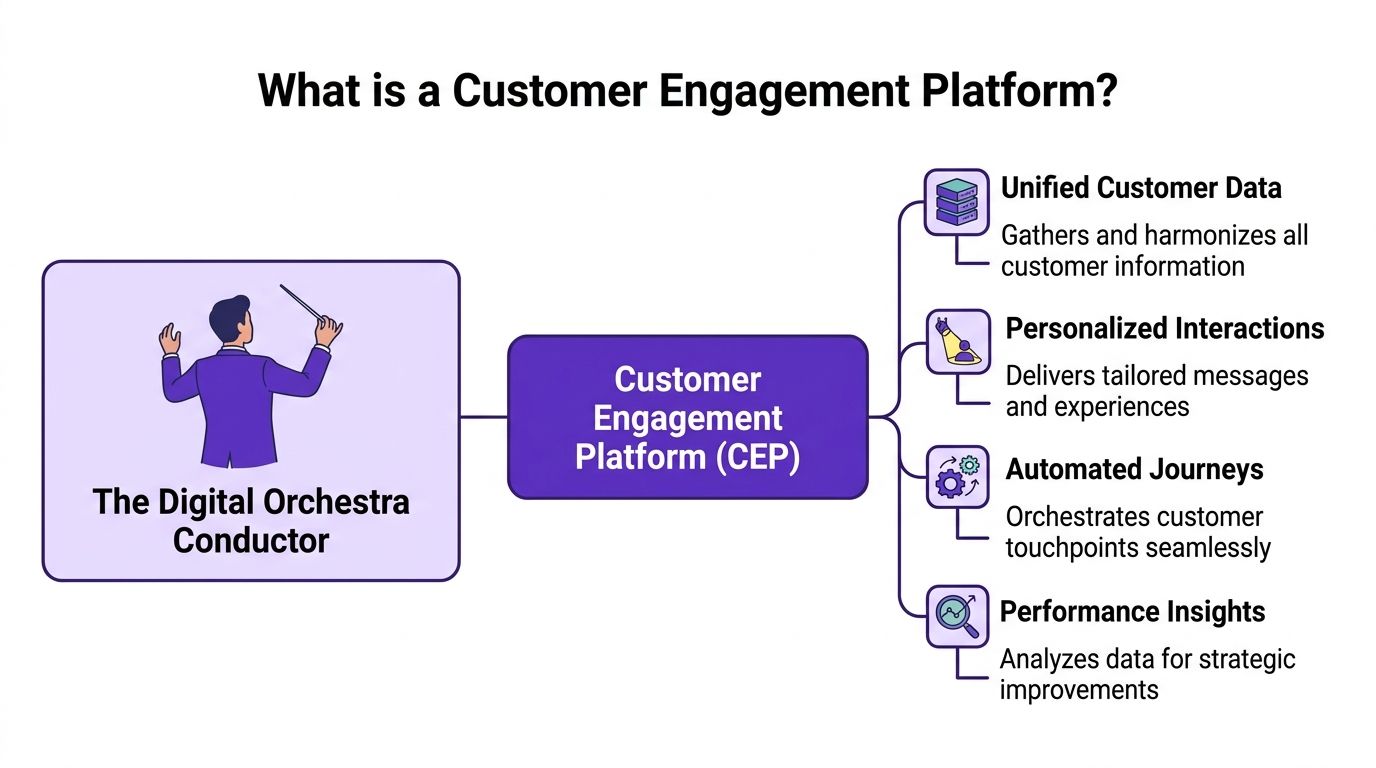
A practical definition from Blueshift's explanation of a customer engagement platform says a CEP unifies customer data, powers AI-driven decisions, and orchestrates cross-channel messaging, combining the roles of a CDP, marketing automation, journey orchestration, and AI-powered decisioning so teams can act across email, push, SMS, web, in-app, and paid media channels.
It's not just a database
This often leads to confusion.
A CEP does store and unify data, yes. But that's not the interesting part. Its fundamental job is decisioning and action. It helps answer questions like:
Who is this person right now
What have they done across channels
What should happen next
Which team or system should do it
A plain database gives you records. A CEP gives you motion.
Why this matters for intent-based prospecting
Intent signals are often small on their own. A site visit. A content interaction. A reply. A support event. A social comment. On separate screens, those look random. In one system, they form a buying pattern.
That's the gap a CEP closes. It connects top-of-funnel attention to bottom-of-funnel action. Someone liking a post isn't pipeline. Someone repeatedly engaging with a topic, visiting the right pages, and interacting at the account level might be.
Practical rule: If your system can't turn behavior into a next best action, you don't have engagement infrastructure. You have storage.
A good CEP keeps the left hand and the right hand in the same body. That sounds obvious. In a lot of stacks, it still isn't.
CEP vs The Usual Suspects CRM and More
Your stack already has enough acronyms to start a fight in RevOps. So the fair question is this: is a CEP different, or is it just old software in a new jacket?
Yes, it's different. The cleanest way to see it is by role.
CEP vs. Other Platforms At a Glance
Platform | Primary Focus | Key Function |
|---|---|---|
CEP | Coordinated customer action | Unifies data, decides what should happen next, and orchestrates engagement across channels |
CRM | Relationship recordkeeping | Stores contacts, accounts, pipeline activity, and sales history |
CDP | Data unification | Consolidates customer data from multiple systems into a usable profile |
Marketing automation platform | Campaign execution | Sends automated marketing messages and nurtures based on rules |
The simple version
A CRM is your account memory. It's where sales tracks people, deals, tasks, and notes. Very useful. Also not built to interpret fast-moving behavior across every channel.
A marketing automation platform is your campaign engine. It sends emails, nurtures leads, and triggers workflows. Good at distribution. Usually less good at understanding the full customer moment.
A CDP is your organizer. It pulls together web, mobile, CRM, POS, support, and related data so the business can build a single customer view. That matters a lot. In fact, the Customer Data Platform market is projected to grow from USD 9.72 billion in 2025 to USD 37.11 billion by 2030 at a 30.7% CAGR, which tells you companies are taking data unification seriously.
A CEP sits on top of that foundation and does something the others don't do well on their own. It turns unified context into coordinated action.
Where teams get this wrong
A lot of teams expect a CRM to behave like a CEP. It won't. A CRM is fantastic for pipeline management and account visibility. It is not mission control for every customer interaction.
Others expect a CDP to solve engagement by itself. It won't either. A CDP gives you organized information. A CEP uses that information to orchestrate the next move.
If you're comparing categories, consider this:
CRM: knows the account
CDP: knows the data
MAP: sends the campaign
CEP: decides and coordinates
For a related sales-side angle, this breakdown pairs well with this look at sales engagement platforms.
The fastest way to waste a good signal is to route it through the wrong system.
The Must Have Capabilities of a Modern CEP
Not every platform calling itself a CEP deserves the label. Some are dressed-up email tools. Some are CDPs with better branding. Some are orchestration layers held together with optimism and middleware.
Such a platform must include key elements.
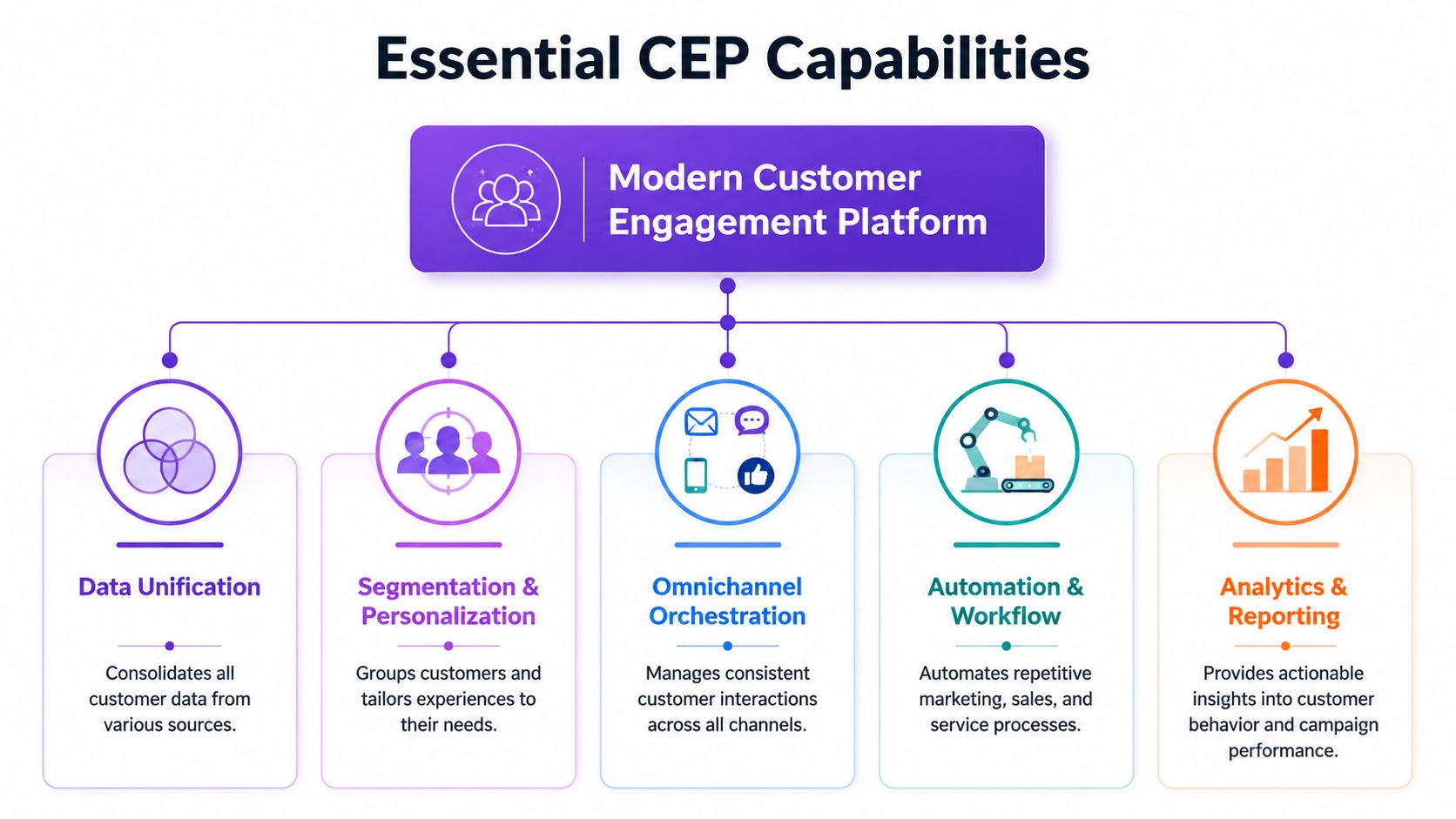
The category is getting bigger for a reason. The global Customer Engagement Solutions Market is valued at USD 28.13 billion in 2026 and is projected to reach USD 45.9 billion by 2031, with omnichannel customer experience identified as a primary growth driver. Translation: companies want systems that stop channels from acting like separate planets.
Unified profiles that don't lie
A modern CEP needs a durable customer profile that pulls from the systems your teams use. Website behavior, CRM records, support interactions, product events, messaging activity. All of it.
If the profile is stale, partial, or hard to trust, the rest falls apart. You can't personalize well with contradictory data.
Decisioning that goes beyond rules
Basic if-this-then-that logic is fine for simple workflows. It's not enough for real engagement.
A useful CEP should help determine priority, timing, and next best action based on what's happening now. Consequently, intent becomes practical. The system should help separate passive interest from buying motion.
If your team is trying to improve profile quality before orchestration, CRM data enrichment usually becomes part of the groundwork.
Journey orchestration in real time
Static campaigns look tidy on a whiteboard and silly in production.
Buyers don't move in neat lines. They ghost. Reappear. Escalate. Research competitors. Open support issues. Forward content internally. A CEP needs to adapt as those moments happen, not after a weekly sync.
True omnichannel execution
A lot of vendors wave their hands and say “omnichannel” because they support email plus one extra thing.
Real omnichannel engagement means the system can coordinate messages and actions across channels without treating each one like a silo. The point isn't to be everywhere. The point is to be consistent where the customer already is.
Good orchestration doesn't feel busy. It feels coherent.
The Real ROI Connecting Engagement to Revenue
A rep sees that an account liked a post. Marketing calls it engagement. Sales ignores it. Two days later, that same account hits your pricing page, reads a comparison article, and a buying committee member opens a product email. If those signals stay scattered, nothing happens. If they get stitched together fast, somebody books a meeting.
That's the ROI. A CEP turns messy activity into intent your team can use.
From engagement metrics to buying signals
Plenty of teams can tell you what happened. Fewer can tell you whether it means anything.
As Amplitude's guide to measuring customer engagement explains, useful measurement depends on detailed event tracking across clicks, views, scrolls, purchases, feature activations, and logins, then connecting those actions to explain user behavior. The tracking matters, but the business value comes from interpretation. A CEP helps teams separate casual attention from signs of active evaluation.
That distinction matters more in B2B than vendors like to admit. Someone liking a post is nice. Someone from the same account returning to high-intent pages, engaging with comparison content, and responding to outbound is a different story entirely.
What this looks like in the field
Say an account has gone quiet. Then a director comments on a LinkedIn thread about replacing a legacy tool. Later that week, two people from the same company visit your comparison page and a case study. An SDR also sees that a previously cold contact opened the latest email and clicked through.
In a normal stack, marketing celebrates the engagement, sales keeps working stale priorities, and nobody connects the dots in time.
In a CEP, those signals roll up to the account level and gain weight together. The rep gets context, not noise. Outreach changes from “bumping this up” to a message tied to a live problem the buyer is already researching. That's how intent-based prospecting closes the gap between social interest and pipeline creation.
Where teams actually get the return
The payoff usually shows up in a few places:
Better prioritization: Reps spend more time on accounts showing current buying motion, not last quarter's MQLs.
Faster response: Teams contact prospects while interest is active, not after it cools off.
Stronger handoffs: Marketing sends sales context that helps start a relevant conversation.
Cleaner reporting: Revenue teams can trace which signals led to meetings, opportunities, and pipeline.
There's a trade-off here. If you label every interaction as intent, reps stop trusting the system. If the bar is too high, you miss good opportunities. Good teams tune signal scoring with sales feedback, then keep adjusting. No magic. Just discipline.
If you want to pressure-test the business case before changing process, use a sales ROI calculator for pipeline impact to estimate what faster, better-timed outreach could produce.
Revenue improves when the right rep gets the right context while the buyer still cares.
Choosing and Using a CEP Without the Headaches
Buying a CEP is easy. Getting value from one is where teams usually faceplant.
The common mistake is trying to rebuild the whole customer journey on day one. That's how you end up with a six-figure “transformation” and a team still exporting CSVs by month three.

What to look for before you buy
A CEP should fit your actual operating model, not the fantasy one from the demo.
Integration depth: It needs to connect with your CRM, support stack, product data, and messaging channels without heroic custom work.
Real-time behavior: If data updates too slowly, sales and success will stop trusting it.
Usable orchestration: If only one technical specialist can build journeys, adoption will stall.
Governance: Teams need clear ownership over signals, triggers, and suppression rules.
How to roll it out without chaos
Start with one use case that has obvious business value. Sales-ready intent routing is a strong candidate. Churn-risk intervention can work too. Pick one. Make it visible. Prove the system can help a team act better than before.
Then measure the right things. Twilio's framework for customer engagement metrics groups them into behavioral, sentiment, outcome, and channel-specific metrics. That's a useful sanity check because it stops teams from worshipping one dashboard number and calling it strategy.
A healthy rollout usually looks like this:
Map one journey: Don't boil the ocean.
Define your signals: Decide what counts as meaningful action.
Set ownership: Who acts on what, and when.
Measure outcomes: Focus on churn, retention, pipeline movement, or cycle speed, not pretty engagement scores.
Your CEP Questions Answered
Question | Answer |
|---|---|
What is a customer engagement platform in one sentence? | It's a system that unifies customer data and coordinates the next best interaction across channels. |
Is a CEP the same as a CRM? | No. A CRM records relationships and pipeline activity. A CEP coordinates engagement based on behavior and context. |
How is a CEP different from a CDP? | A CDP organizes customer data. A CEP uses unified data to trigger decisions and actions. |
Does a small business need a CEP? | Sometimes yes, but not always. If your channels are multiplying and signals are getting lost, the need shows up fast. |
What's the first step before buying one? | Define the use case. If you can't name the problem clearly, software won't rescue you. |
Can a CEP help sales, not just marketing? | Absolutely. It can surface context that helps reps reach out with better timing and relevance. |
Does a CEP replace sales tools like LinkedIn Sales Navigator? | No. It complements them by adding context, orchestration, and signal handling across systems. |
What channels should it support? | The ones your buyers actually use. More channels aren't better if they aren't coordinated. |
What usually breaks implementation? | Weak data hygiene, fuzzy ownership, and trying to launch too many workflows at once. |
What should success look like? | Better timing, better coordination, and clearer business outcomes from engagement efforts. |
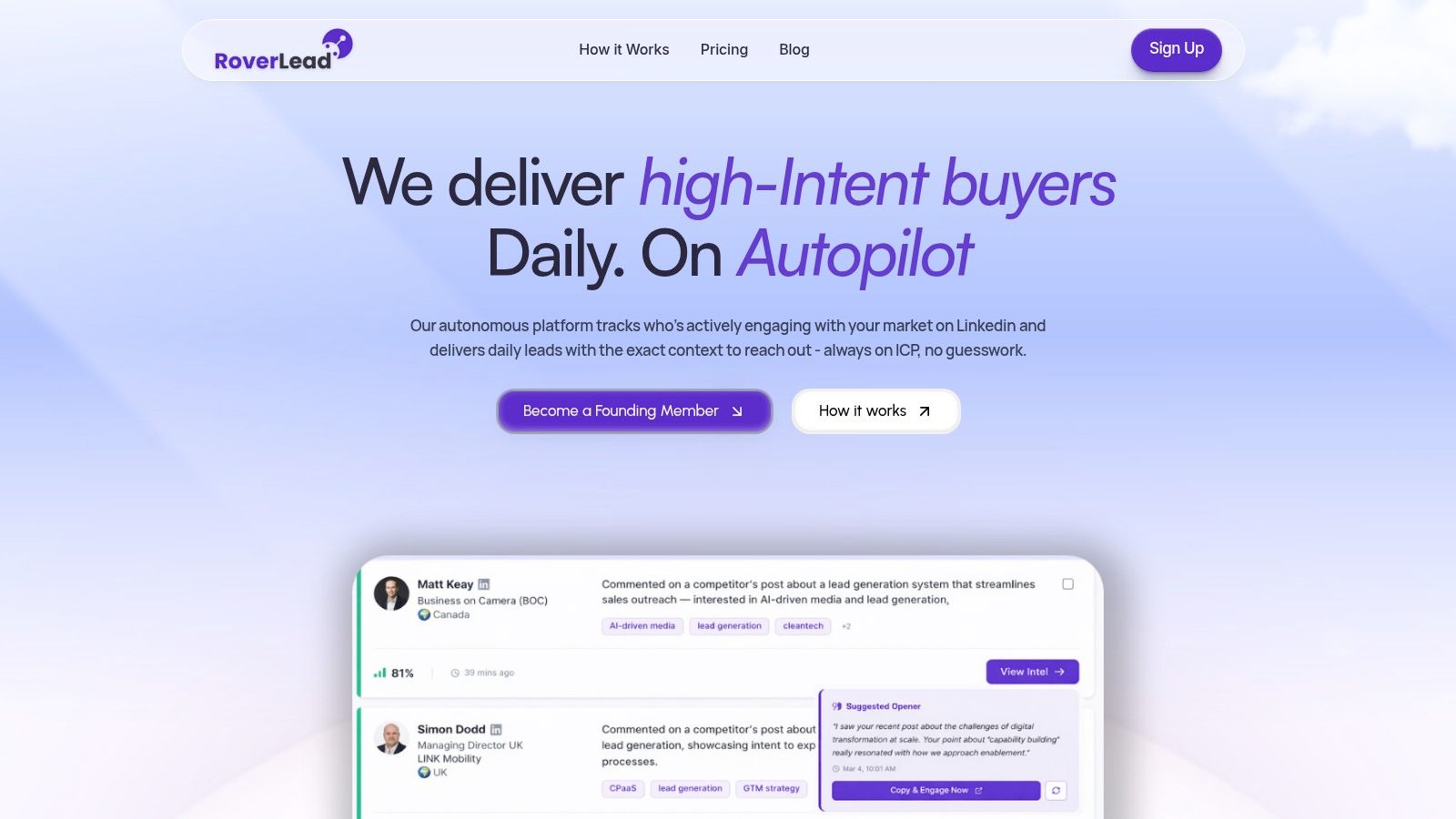
If your team wants to turn LinkedIn activity into sales-ready context instead of more noise, RoverLead AI is built for that job. It helps B2B teams spot real buying signals, match them to ICP, and act while the moment is still warm. Less list pulling. More intent. Better conversations.