What Is Outbound Sales and How B2B Teams Win with It

Outbound sales is the seller-initiated side of B2B revenue. In 2026, the volume-first version is collapsing while signal-based outbound is producing 2–3x reply rates.
If your team is running cold dials, templated emails, and LinkedIn nudges every day but the calendar still looks like a ghost town, you're not imagining it. Outbound still drives 42% of pipeline on average for B2B companies, and 55–65% for firms in the $5M–$50M range (Salesmotion), but the old “more touches, more meetings” playbook is getting punished by low relevance. The channel didn't die, it got pickier.
The useful question isn't whether outbound works. It's whether the way you're running it still matches how buyers behave.
Table of Contents
Why Outbound Feels Broken Even When You're Doing Everything Right
Why Most Outbound Fails and What Signal-Based Outbound Does Differently
Why Outbound Feels Broken Even When You're Doing Everything Right
The SDR opens the day with a list, a dialer, and a queue of follow-ups that looks responsible on paper. By lunch, the team has pushed out 100 connection requests, sent the same polished sequence to a fresh list, and booked one meeting that may or may not show.
That's where the frustration starts. The work is real, the activity is high, and the calendar still isn't cooperating.
Outbound earns its bad reputation when teams confuse motion with momentum. A rep can do everything “right” and still lose because the prospect never had a reason to care at that exact moment. That's why the modern complaint isn't really about outbound, it's about low-relevance outbound.
Practical rule: if the list is static and the message is generic, don't blame the channel when the response is flat.
A lot of teams keep pushing because stopping feels dangerous. But the better move is to inspect the inputs, especially timing, fit, and the signal behind the list. The old smile-and-dial reflex still has a place, but it can't carry a motion by itself, and it's worth reading the hard-won reality in this practical take on smile-and-dial outbound.
What Outbound Sales Actually Means in 2026
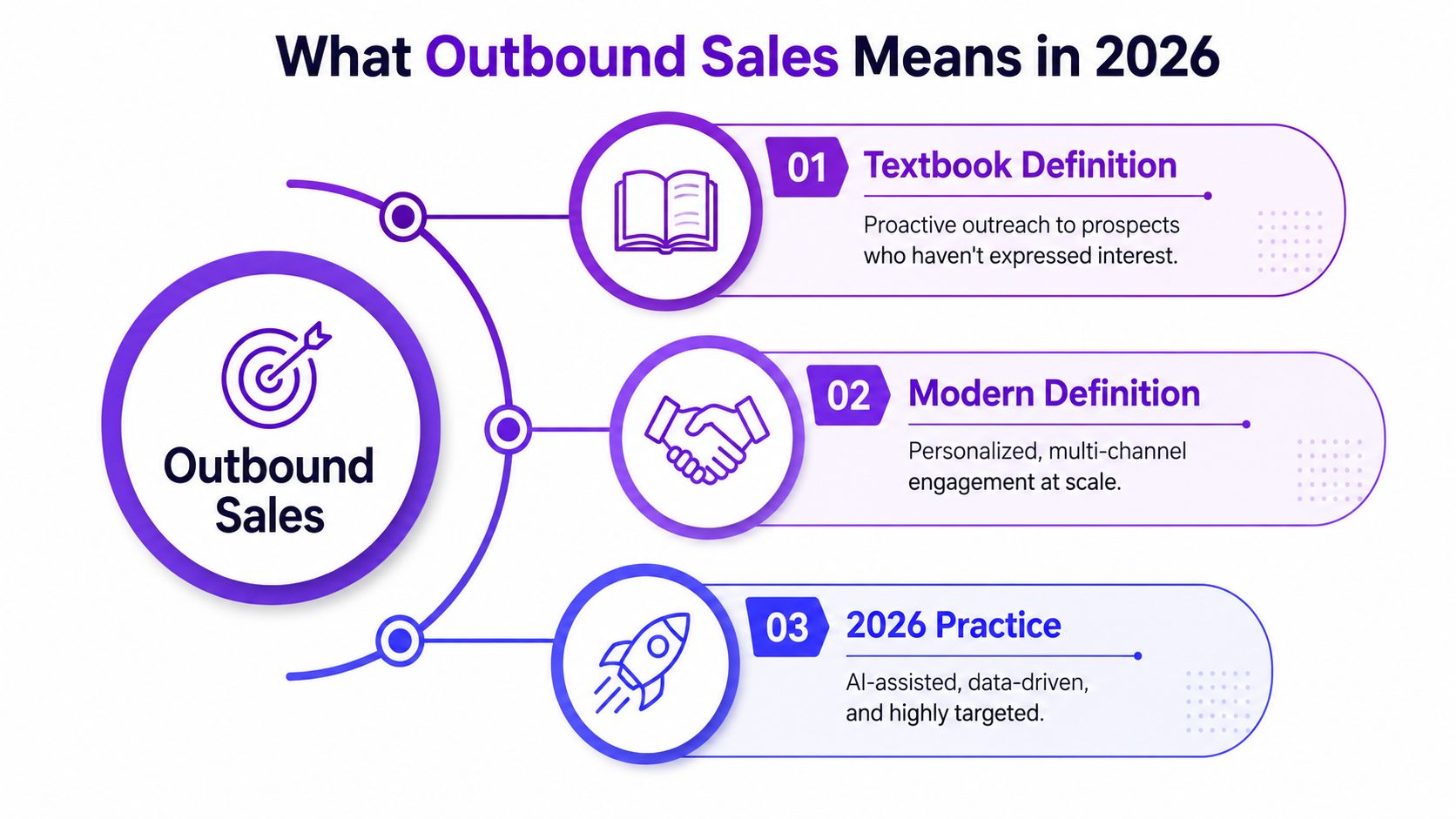
Outbound Sales in its basic form
At the simplest level, outbound sales is seller-initiated outreach. The business starts the conversation through email, phone, or social channels instead of waiting for a form fill, demo request, or referral.
That basic definition still matters because too many explainers make outbound sound like nothing more than cold email. It's broader than that. In modern B2B, outbound can include a prospect who has already engaged with content or attended an event, so the first move is proactive even when the contact isn't purely cold (Revenue.io).
Outbound Sales in a modern motion
The operational definition is tighter. You choose an ideal customer profile, ICP, decide who fits, and start conversations with those accounts on purpose. That's why several sales glossaries tie outbound to target account pursuit, new market entry, and filling an empty pipeline, not just generating activity (Salesmotion).
The modern version goes one layer deeper. Outbound works best when it's run against observed intent, not just static fit. LinkedIn's own guidance emphasizes buying signals like content engagement, job changes, and team expansion, which is a cleaner way to choose who to contact than relying on a stale list alone (ZoomInfo).
A working definition for your team
Here's the version I'd use in a sales meeting: Outbound sales is the seller-initiated motion of identifying high-fit prospects, timing outreach around real buying signals, and creating pipeline before the buyer raises their hand.
That definition is more useful than the textbook one because it forces a practical test. If your sequence can't explain why this prospect, why now, and why this channel, it's probably just activity dressed up as strategy.
Outbound vs Inbound and When to Run Each
Outbound and inbound aren't rivals. They're different triggers, different economics, and different answers to the same revenue problem.
Dimension | Outbound | Inbound |
|---|---|---|
Trigger | You start the conversation | The prospect starts it |
Control | High control over accounts and contacts | Lower control, driven by demand capture |
Cost pattern | Costs more rep time and orchestration | Scales with content, SEO, and brand |
Best for | Creating pipeline, target accounts, new markets | Capturing existing demand, maturing brands |
Stage fit | Strong when inbound hasn't scaled yet | Strong when awareness already exists |
If you work in a company where brand pull is still thin, outbound usually carries more of the load. That's not a moral judgment, it's just go-to-market math. The important thing is not pretending one motion replaces the other.
Practical rule: inbound compounds, outbound creates. Teams that need predictable pipeline now usually can't wait for content to become a revenue engine.
This is why the debate is often framed badly. The decision is whether you're trying to capture demand or create it, and most B2B teams need both running in parallel. If you want a cleaner breakdown of the mechanics, the companion guide on outbound vs inbound meaning is the right side-by-side reference.
The Core Channels and How a Modern Workflow Actually Runs
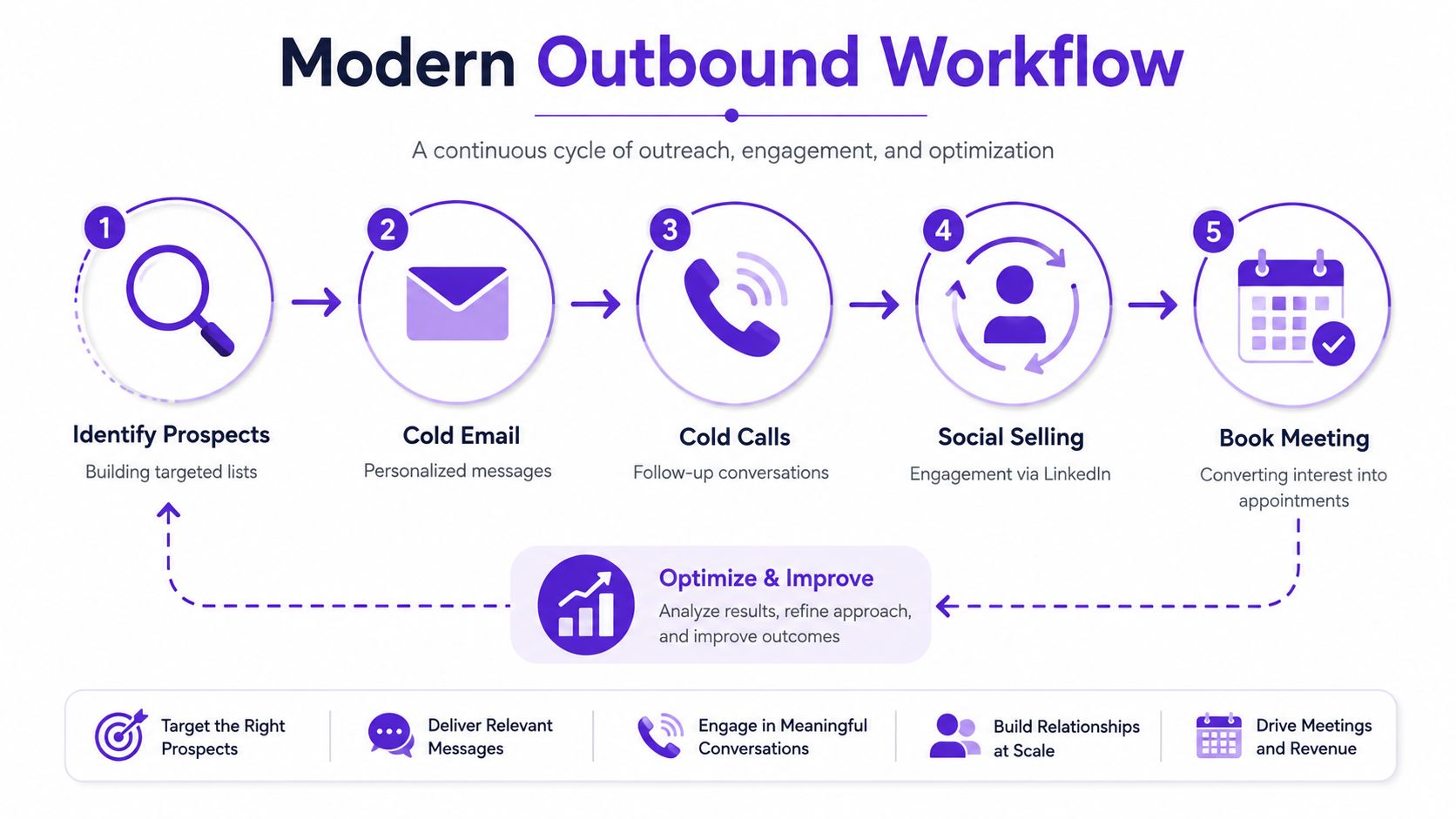
Outbound is a channel mix, not a single channel. The three that matter most in B2B are cold email, cold calling, and LinkedIn, and they work best as one coordinated motion rather than separate little kingdoms.
Cold email
Start with a tight list or a live signal. The message should reference one relevant reason the prospect should care, then end with a simple ask. Cold email still scales well, but the benchmark reality is blunt, average cold email reply rates sit around 3.43% in 2026, with strong campaigns typically landing in the 1–5% range (Pintel).
That's not a reason to panic. It's a reason to make every line earn its place.
Cold calling
Use the call as a timing check, not a speech recital. The best reps don't treat the phone like a megaphone, they use it to confirm whether the signal is real and whether the problem is alive right now.
Cold calling still works when the fit and timing are right, but the average cold call conversion to a warm lead is about 2.3% (Pintel). That's exactly why the opener has to be sharp and the follow-up has to be fast.
LinkedIn social selling
LinkedIn is where static outbound starts to look old. A sensible workflow is simple, find the signal, engage lightly, reach out with context, and hand off cleanly when a meeting is earned. The platform is especially useful because it lets you work from visible activity instead of pure list assumptions.
For teams that want a more structured social-selling motion, the practical walkthrough on LinkedIn lead generation is the most relevant reference. The key shift is this, single-channel outbound is getting squeezed, so multi-channel orchestration is now the baseline, not the fancy option.
Metrics and KPIs That Tell You If Outbound Is Working
Outbound motions usually break in a familiar way. Reps stay busy, sequences keep firing, and the dashboard still looks active, but the numbers that matter never move. That usually means the team is measuring output instead of traction.
Start with positive reply rate. It shows whether the target, timing, and message are lining up with a real buying moment. For broader context on current outbound benchmarks, Pintel is a useful reference, but the number itself matters less than the direction of travel. If replies are thin, look first at relevance and timing before you start rewriting copy.
The next filter is qualified meeting rate. Replies can flatter a campaign. Qualified meetings tell you whether the conversation is worth a seller's time. If meetings are coming in but opportunities are not, the problem is usually loose qualification, weak discovery, or a handoff that lets good intent leak out before it reaches pipeline.
Pipeline quality matters more than volume.
A rep can book a calendar full of calls and still miss the point if those meetings do not survive the next stage. That is why the best teams track the shortest path from signal to held meeting, not the longest path from activity to vanity.
Pipeline created per rep is the other number worth watching closely. Activity without pipeline is just motion. Once you start comparing who is producing real opportunities, you can separate healthy execution from busywork and see whether the motion is commercial or just administrative. If you want a cleaner operating view of the dashboard, sales activity tracking is the right companion. It keeps the team focused on the actions that produce conversations, meetings, and opportunities, not just logged touches.
Why Most Outbound Fails and What Signal-Based Outbound Does Differently
Most outbound fails because teams contact people at the wrong time with a message built from static data. Title, company size, and industry are useful filters, but they don't tell you whether the prospect is paying attention today.
That's the core weakness of list-based outbound. Two reps can send the same sequence to similar contacts and get wildly different results because one list contains buyers who are active, while the other is mostly people who are merely a fit on paper. The problem isn't always the writing. It's often the timing.
Signal-based outbound changes the game by watching for live behavior. Comments on competitor posts, pricing-page discussions, content engagement, job changes, and team expansion all hint that a buying conversation may already be underway. Outreach lands better when it joins that conversation instead of trying to start one from zero.
One independent source also notes that many buyers increasingly dismiss outbound because cold outreach feels intrusive, which makes the relevance problem even more obvious (Indeed). That doesn't kill outbound. It just raises the bar.
A useful mental model is this, fit tells you who could buy, signal tells you who might buy now. Teams that learn to separate those two things stop spraying messages at strangers and start working the parts of the market that are already awake.
A Modern LinkedIn Playbook for B2B Outbound Teams
Team A does what a lot of teams still do. They pull a static list from Sales Navigator, send templated DMs, and wonder why the reply rates hover around the miserable middle. The motion looks busy, but the prospect experience feels generic, so the response stays thin.
Team B works differently. They define ICP, keywords, competitors, and experts, then watch engagement signals in real time. When a target comments on a topic, reacts to a competitor's post, or starts discussing pricing, they reach out the same day with context grounded in that activity.
One practical option in this category is RoverLead AI, which tracks LinkedIn engagement signals and turns that activity into a contextual opener. That's not a magic trick, it's just a cleaner use of live intent than a frozen list pull.
The difference shows up in the work itself. One team spends hours researching each account manually. The other team uses live signal context, so the opener is faster to write and feels less like a blind guess.
There's also a compliance angle worth saying plainly. This kind of LinkedIn workflow isn't about gaming the platform, it's about social selling inside the platform's own engagement graph. The behavior is the targeting layer.
Later in the same motion, a follow-up note or call can reference the exact signal without sounding creepy. That's the key win, not some mystical inbox hack. It's relevance with better timing.
A 30-60-90 Plan to Modernize Your Outbound Motion
Days 1 to 30, tighten the ICP and stop pretending every decent-looking account belongs in the sequence. Cut the channels that aren't producing qualified conversations, then instrument the numbers that matter, positive reply rate, qualified meeting rate, and opportunities created.
Days 31 to 60, layer in signal sources. Use competitor engagement, topic comments, job-change alerts, and content interaction as the reason for outreach, not as decoration. Rewrite templates so they reference observed behavior instead of assumed pain, because prospects can smell a generic pitch in about half a second.
Days 61 to 90, orchestrate email, phone, and LinkedIn into one cadence. A prospect might see a post, get an email, receive a call, and then get a follow-up that ties back to the same live signal. The motion feels coordinated because it is.
Two mistakes usually sink the rollout. The first is measuring activity instead of pipeline. The second is treating outbound like a campaign rather than a system. Campaigns end. Systems compound.
By the end of the quarter, the team should know which signals produce replies, which channels produce meetings, and which reps can turn live intent into pipeline without burning half the day on research. That's the modern answer to what is outbound sales, a timing-driven motion that rewards precision more than volume.
If you want outbound to stop feeling like a blind grind, RoverLead AI turns LinkedIn engagement into daily, high-intent leads matched to your ICP. Visit RoverLead AI to see how signal-based prospecting can replace static list pulls with live buyer context and faster outreach.
FAQ
What is outbound sales in simple terms
It's the seller-initiated side of B2B sales. Your team starts the conversation instead of waiting for the buyer to raise their hand.
Is outbound sales the same as cold calling
No. Cold calling is one outbound channel. Outbound also includes cold email, LinkedIn outreach, and coordinated multi-channel sequences.
Does outbound sales still work in 2026
Yes, but it works best when the target list is tight and the outreach lines up with real buying signals. Broad, generic outreach is where teams get punished.
What is the main difference between outbound and inbound
Outbound starts with the seller. Inbound starts with the prospect.
Why do so many outbound sequences fail
They're aimed at people who fit on paper but aren't in motion. Static lists plus generic messaging usually produce weak response.
What channels matter most for outbound
Cold email, cold calling, and LinkedIn are still the core B2B channels. Teams often get better results when they use them together.
What metrics should I watch first
Track positive reply rate, qualified meeting rate, and opportunities created. Those three tell you more than open rates and other vanity metrics.
What counts as a buying signal
Job changes, team expansion, content engagement, competitor interactions, and pricing or demo discussions are all useful signals when they're timely.
When should a company rely more on inbound than outbound
When brand, content, and organic demand are already generating enough pipeline. Until then, outbound usually has to carry more of the load.
How can LinkedIn improve outbound
LinkedIn gives you live engagement data, which helps you contact people when they're already paying attention. That's a much better starting point than a stale list.