
Buying Signals in Sales: How to Spot and Act on Intent

The most popular advice about buying signals in sales is also some of the least useful: watch for a website visit, a content download, or a LinkedIn like, then contact the person immediately. That approach confuses activity with intent. It fills SDR queues with curious researchers, burns personalization time, and can make a prospect feel watched rather than helped.
Real purchase readiness rarely arrives as one neat event. It appears as a pattern, such as repeated engagement, several stakeholders from one account becoming active, a relevant operational change, and a fresh reason to solve a problem. The practical advantage comes from recognizing that pattern quickly, then matching the outreach to the evidence.
Table of Contents
Why Most Buying Signal Lists Get It Wrong
A single page view tells you almost nothing. Someone may be researching a category, gathering material for a colleague, checking a competitor, or clicking through a site. The same applies to a social reaction. A LinkedIn like is easy to produce and difficult to interpret, so treating it as a sales trigger is a reliable way to create false positives.
That matters because premature outreach has a cost. Reps spend time investigating accounts that aren't ready, while buyers receive messages that leap from “you looked at something” to “let's book a demo.” The problem isn't signal collection. It's the assumption that every event deserves the same response.

The useful unit is the pattern
Signal stacking means combining multiple indicators from the same account and judging them together. A pricing-page visit becomes more meaningful when it follows a comparison-page visit, a webinar attended by another stakeholder, or a relevant leadership change. Repeated behavior from multiple people is stronger still, because it suggests an internal conversation rather than isolated curiosity.
A useful buying-signal program asks four questions:
Who engaged? Seniority and role affect the likely buying influence.
What did they do? Pricing, implementation, and comparison activity usually carries more context than a broad educational view.
How often did it happen? Repeated engagement beats a one-off action.
What changed at the account? Hiring, funding, leadership, and technology events can create a buying window.
Practical rule: One weak signal earns observation. Several aligned signals earn research. A fresh cluster involving the right stakeholders earns outreach.
This is broader than traditional intent data, which often emphasizes inferred research behavior. The distinction helps teams avoid the classic mistake of optimizing for alert volume instead of buyer context.
What Buying Signals Actually Are
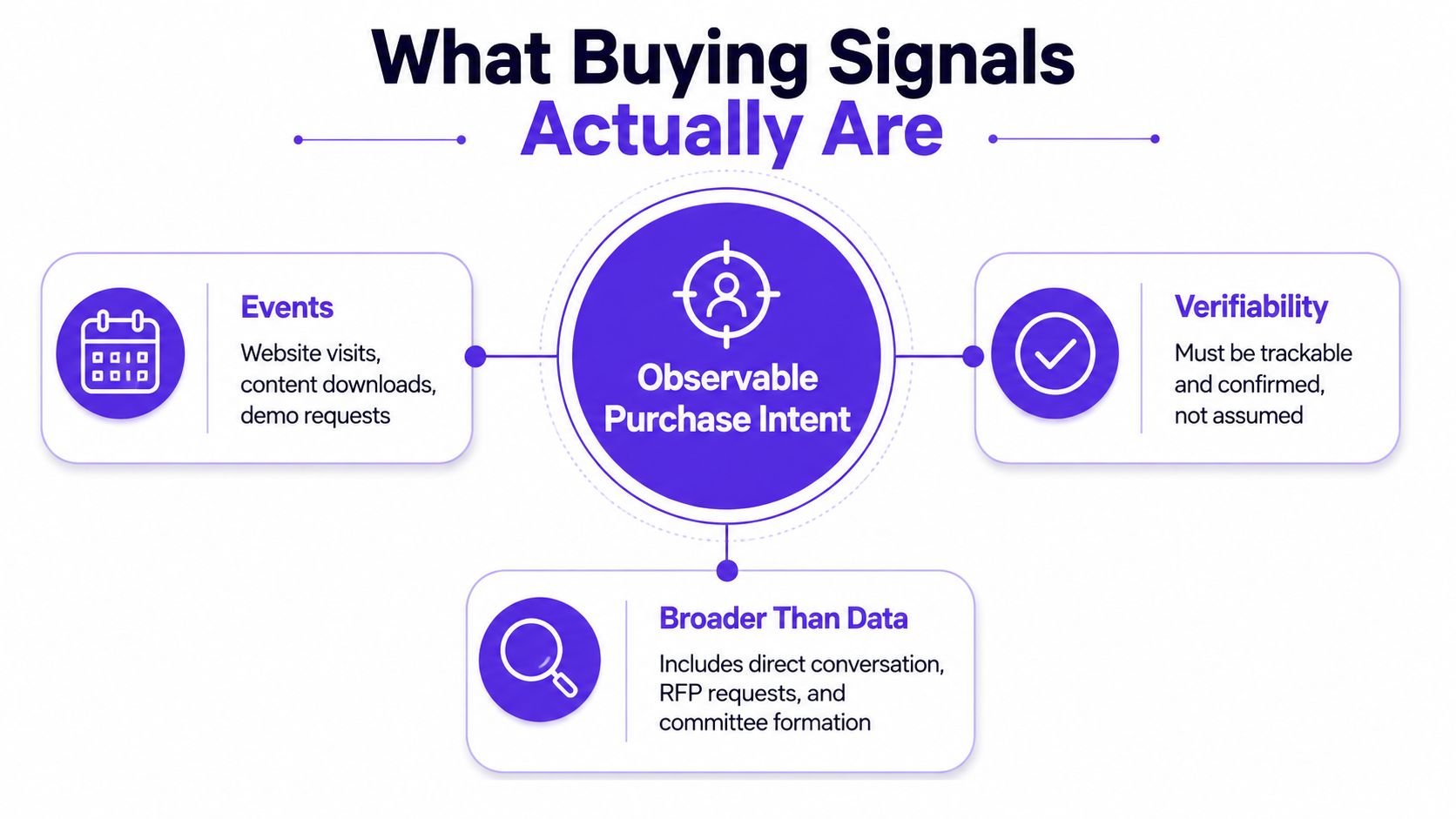
A buying signal is an observable, verifiable event that indicates a prospect is moving closer to a purchase decision. The event might be a direct action, a public company change, or an interaction recorded in your CRM. Buying signals are therefore broader than intent data, because they can include first-party behavior, public triggers, and direct sales conversations rather than only inferred research activity. This distinction is also outlined in the difference between buying signals and intent data.
Forrester formalized buying signals as a B2B framework in April 2024, defining them as signals buyers transmit throughout the customer lifecycle that sales teams must capture, connect, and interpret to improve revenue interactions. Its framework treats intent as a continuous behavioral pattern across research, evaluation, purchase, adoption, and review, rather than a single event such as a demo request. You can read the framework in Forrester's B2B buying signals research.
Three signal sources
The first source is first-party behavior. This includes repeated pricing or comparison-page visits, demo requests, downloads, webinar attendance, product usage, and messages exchanged. These events happen in environments your team can usually observe and connect to an account.
The second is public account activity. Funding announcements, executive appointments, hiring changes, expansion plans, technology adoption, and other operational developments can reveal that a company has a new priority or a fresh reason to evaluate vendors.
The third is CRM interaction data. A new stakeholder joining a meeting, a request for security information, a pricing question, or a shift toward implementation planning can expose movement inside an active opportunity.
The useful distinction is not “digital versus non-digital.” It's verifiable evidence versus assumption. A signal should be traceable to an event, connected to a relevant account, and interpreted in context. A behavioral-data framework can help teams organize those first-party actions without pretending that every click carries the same meaning.
Hard Signals Versus Soft Signals
Sales teams often favor hard signals because they're easy to record. A form submission fits neatly into a CRM field. A leadership change or technology adoption requires more interpretation, yet those external changes can reveal a stronger buying window than routine engagement.
The right answer isn't to choose one category. Hard signals show what a person or team did. Soft signals show what may be changing around the account. Their value increases when they support the same story.
Hard vs Soft Buying Signals Comparison
Signal Type | Examples | Predictive Strength | Response Window |
|---|---|---|---|
Hard | Demo request, pricing inquiry, messages exchanged, product usage | Direct evidence of active evaluation, especially when tied to a qualified account | Immediate, while the request or conversation is fresh |
Hard | Repeated pricing or comparison-page visits, downloads, webinar attendance | Meaningful when behavior repeats or involves several stakeholders | Fast follow-up when activity clusters |
Soft | Headcount growth, relevant hiring, leadership appointments | Useful evidence of a new mandate or operational priority | Prompt research, followed by context-led outreach |
Soft | Funding, technology adoption, expansion plans | Can expose budget, transformation, or scaling pressure | Act when the trigger aligns with ICP and solution fit |
Soft | Broad social engagement or a single educational view | Weak in isolation, useful for monitoring | Nurture until another signal appears |
A 2025 analysis of 1 million B2B software purchases reported stronger correlations for AI tool adoption (+46%), headcount growth (+38%), recent software purchases (+38%), VP-level hires (+28%), and recent funding (+25%). Job-posting increases showed +7%, while SOC compliance showed 0%, according to the B2B buying-signal analysis from Prospeo.
The lesson is uncomfortable but useful. Easy engagement events are visible, not necessarily decisive. Operational changes can deserve more weight, particularly when they coincide with first-party evaluation behavior. Teams using LinkedIn should still treat social activity as context, not proof. A focused LinkedIn lead-generation process works better when it combines engagement with account fit, role relevance, and timing.
Building a Signal Scoring Model That Works
A scoring model should help a rep decide who deserves attention now, not produce a beautiful number nobody trusts. Start with this practical formula:
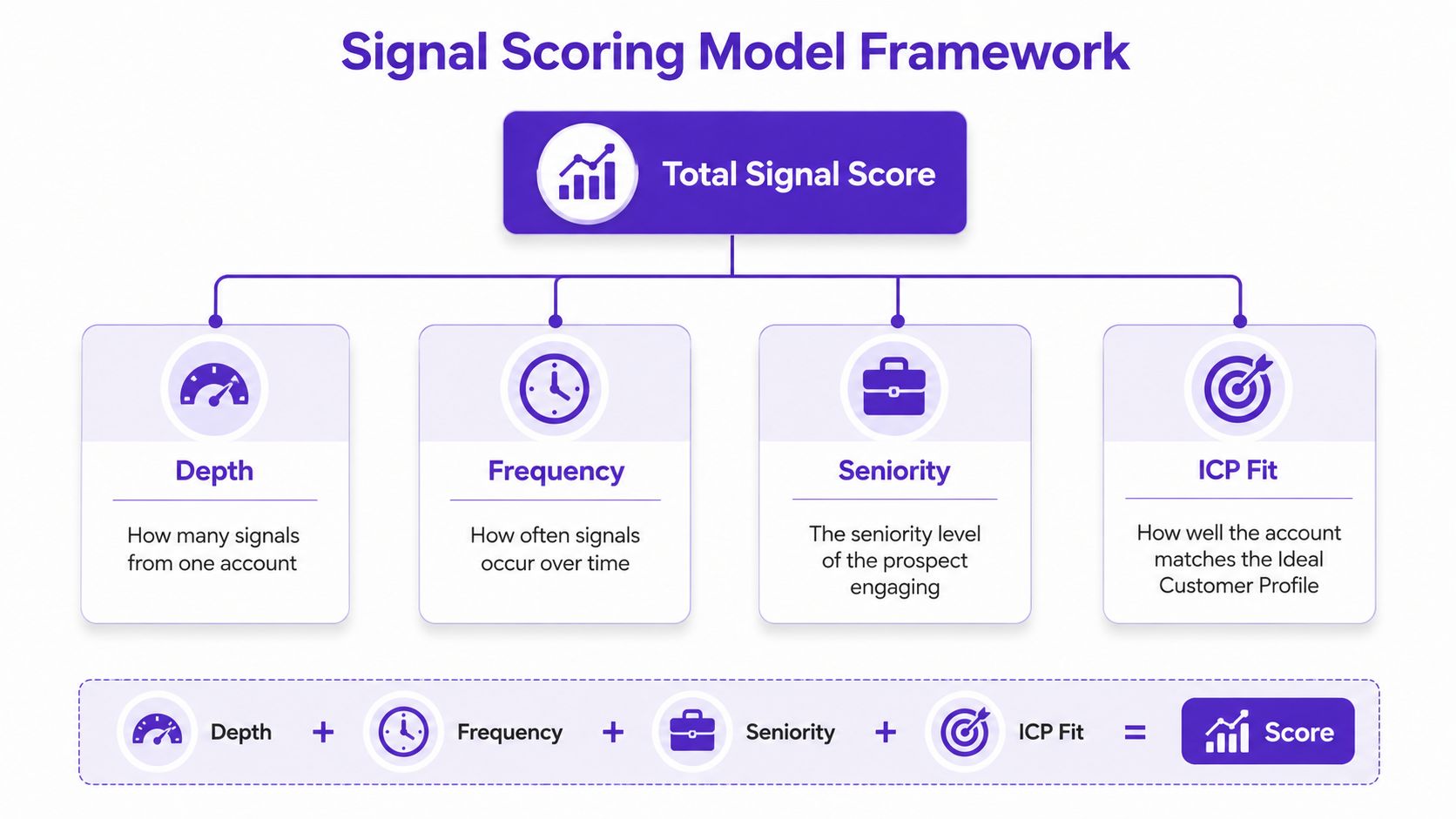
Depth + Frequency + Seniority + ICP Fit = Actionable Intent
Depth
Depth measures how far the behavior has moved toward a decision. A blog read is early exploration. A pricing-page visit, comparison-page visit, implementation question, or product-use action carries more decision context. Don't score every page equally, because buyers don't treat every page equally either.
Frequency
Frequency captures repetition and account-level momentum. Several visits over time are more informative than one visit. Several people from the same company engaging within a short window are stronger still, because the activity may reflect committee formation.
Seniority
A VP, executive, or budget owner can influence a purchase differently from an individual contributor. Seniority shouldn't erase the value of practitioner activity, though. A technical evaluator may be essential to the decision. Use seniority as a weighting factor, not a shortcut.
ICP fit
A compelling signal from an account outside your market isn't automatically an opportunity. Score firmographic fit, use case, company maturity, geography, and role relevance alongside behavior. The buying-signal framework from Leadfeeder expresses the same principle as Depth + Frequency + Seniority + ICP Fit = Actionable Intent.
Freshness matters because signal value decays. A 2026 B2B buying-intent analysis projected meeting conversion of 15-25% for accounts with 3+ signals including organizational changes when contacted within 24-48 hours, compared with 3-8% for weaker single-signal accounts. The same analysis put a well-tuned program around 10-18% overall, and identified response latency and signal stacking as the main levers. See the 2026 buying-intent benchmark analysis.
Use thresholds to route action:
High score: Contact quickly with a message tied to the signal cluster.
Middle score: Research the account and use a structured, relevant sequence.
Low score: Keep monitoring until another meaningful event appears.
The model doesn't replace judgment. It gives judgment better raw material.
For teams refining an existing process, predictive lead scoring is most useful when its recommendations remain explainable. Reps should see which behaviors, stakeholders, and account changes created the score, not just the score itself.
LinkedIn and Cross-Channel Signal Examples in Action
A sales signal becomes useful when it changes what the rep says and when the rep says it. The following scenarios show how to read clusters without making the outreach feel like surveillance.
Scenario one, competitor conversation
A prospect comments on LinkedIn posts about competitor pricing. That isn't proof they're buying, but it reveals a live commercial question. Check whether the person matches your ICP, whether other colleagues engage with related content, and whether the account shows first-party evaluation behavior.
The right message doesn't mention that you saw the comment and shouldn't pretend to know the buyer's intent. Address the business issue instead: “Teams comparing platforms often run into questions around implementation scope and total ownership. I can share a neutral checklist if that would help.”
Scenario two, several stakeholders engage
A manager, operations lead, and VP from the same account interact with your thought leadership within a week. That cluster is stronger than any individual reaction because it suggests the topic has crossed roles. Before contacting everyone, identify the likely business owner and use the content theme as the conversation opener.
The outreach should offer a useful next step, such as a focused discussion for the people involved, rather than a generic demo. Avoid naming every observed action. Buyers want relevance, not a forensic report.
Scenario three, expansion plus rising consumption
A company announces expansion plans while employees increase their consumption of content related to your category. Expansion provides context, while content activity provides a possible response. The combination can justify timely outreach, but only if your solution fits the operational challenge created by that expansion.
Ask about the initiative, not the tracking. For example, connect the company's public growth priority to the workflow your product supports, then share a concise resource that helps the team assess options.
Scenario four, cross-channel acceleration
Pricing-page activity combined with LinkedIn engagement deserves faster handling than either event alone. Webinar attendance paired with a relevant job change also creates a stronger narrative. In both cases, the rep should confirm freshness, identify the right stakeholder, and tailor the first message to the account's apparent problem.
A 2025 buyer-behavior report based on 6 million real B2B buyer interactions emphasizes repeated views, engagement depth, and stakeholder-level activity. Another 2025 buyer report says 90% of buyers research before first contact and almost two-thirds use GenAI tools as much as or more than traditional search. Those findings, summarized in the 2025 buyer behavior report, make a strong case for interpreting cross-channel patterns instead of waiting for a form fill.
Tooling and Playbooks for Signal-Based Selling
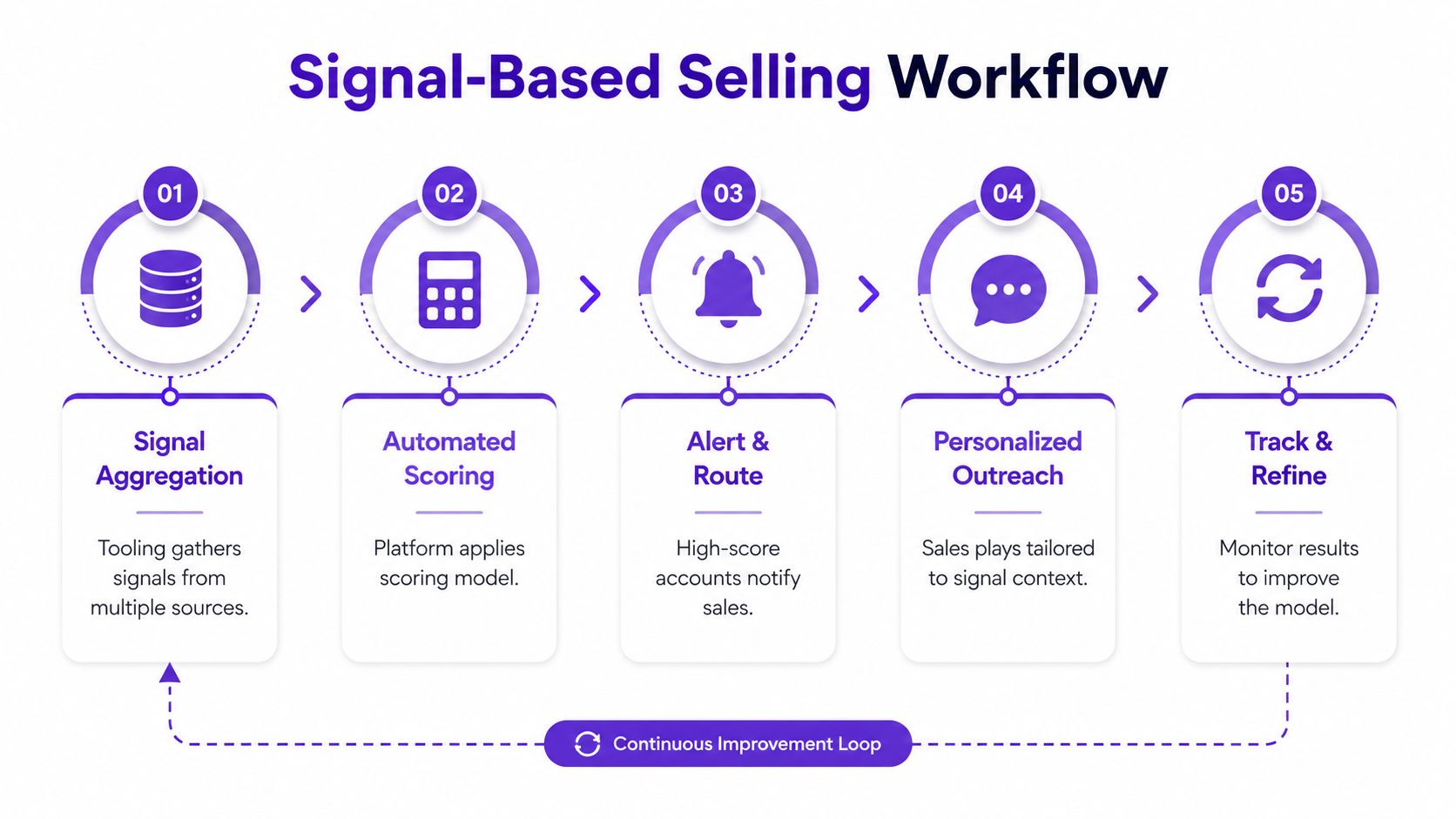
Signal-based selling needs more than another dashboard. It needs a workflow that moves from detection to interpretation to action, with clear ownership at each step.
Aggregate and score
Bring together first-party behavior, LinkedIn engagement, CRM activity, and public account changes where your systems can support it. The purpose isn't to collect everything. It's to connect the events that explain whether an account is entering a buying window.
Platforms such as RoverLead AI monitor LinkedIn engagement and buying-adjacent activity, including comments, content interactions, pricing or demo discussions, and competitor engagement, then surface prospects matched to an ICP with contextual openers. That can replace static Sales Navigator list pulls with a living feed, but reps still need to validate the signal before sending.
Route and respond
Set alerts around meaningful clusters, not every low-value action. A high-score account should route to the owner with the signal context, likely stakeholders, and suggested angle. A weaker event can enter a watch list or nurture workflow.
Measure the operating system, not vanity activity:
Signal-to-meeting conversion: Which signal combinations create qualified conversations?
Response latency: How quickly does a rep act after a high-confidence cluster forms?
Pipeline velocity: Do signal-qualified opportunities move through stages more efficiently?
False-positive rate: How often does an alert produce no relevant business context?
Automation should find the moment. A human should decide whether the moment deserves a message.
Review the model with closed-won, closed-lost, and no-response outcomes. Remove signals that create noise, increase weight for combinations that consistently produce useful conversations, and coach SDRs on interpretation rather than demanding blind speed. A signal program fails when alerts become background decoration. It works when every alert has a clear owner, a response standard, and a reason to exist.
Frequently Asked Questions About Buying Signals
How can teams separate intent from casual research?
Use a decay window and require signal stacking. A pricing-page visit may expire quickly if no related activity follows. Repeated engagement, a second stakeholder entering the account, and a relevant business change create stronger evidence. Set an expiry for isolated events so old activity does not inflate a current score.
What should reps do when signals conflict?
Check the account context before choosing a message. Hiring activity alongside a budget freeze may indicate a protected department with a specific need, or it may show unrelated activity. Ask which team owns the change and whether the observed signal connects to the problem your offer addresses.
Do signals work for existing customers?
Yes. Leadership changes, expansion, and new initiatives can indicate an expansion opportunity. Declining usage or a departing champion should instead trigger retention research, including a check for a replacement owner and current product adoption.
Are signals useful for enterprise deals?
Yes, because enterprise readiness often develops before a formal request. Stakeholder additions, operational changes, and cross-functional engagement can reveal committee formation and timing. Route the account only after confirming that the people involved influence the same initiative.
How should SDRs handle weak signals?
Record the event with an expiry date and wait for corroboration. A second related action, an account change, or a conversation signal can move it into active research. Do not let an old, isolated event keep an account permanently active.
Which signal deserves immediate action?
Prioritize a direct request, active pricing discussion, or fresh cluster involving several relevant stakeholders. Capture the context in the alert, then confirm the event is recent before contacting the account.
Should soft signals ever trigger outreach alone?
Usually, use them to guide research. Outreach becomes more credible when an external trigger connects to first-party activity or a direct conversation.
How can teams avoid creepy messaging?
Name the business change or problem, not every action you observed. The buyer should see the relevance without feeling individually monitored.
What does GenAI research change?
Buyer activity becomes harder to observe through traditional search and website analytics. Give more weight to stakeholder patterns, direct conversations, and public account changes, then validate the signal with the buyer.
How often should the scoring model be reviewed?
Run a quarterly audit comparing high-score alerts with meetings and closed-won opportunities. If high-score alerts rarely produce meetings, reduce the weight of weak individual events and increase the weight of combinations that repeatedly precede useful conversations. Treat the score as a decision aid, not a permanent rule.
RoverLead AI turns LinkedIn engagement and cross-channel buying signals into daily, ICP-matched prospects with context for relevant outreach. Visit RoverLead AI to see how signal agents can help your team replace static prospect lists with timely, human-reviewed intent.