Predictive Lead Scoring: How AI Turns Signals Into Pipeline

Your CRM is probably full of “good” leads that never become deals. Sales is chasing people who clicked a pricing page once, marketing is celebrating opens and form fills, and the pipeline still looks like it's wearing a fake mustache.
That's the usual failure mode. Traditional scoring rewards activity, not intent, so teams end up prioritizing whoever looks busy instead of whoever's close to buying. Predictive lead scoring changes the question from “What did this person do?” to “How likely are they to convert?”
Table of Contents
Why Your Lead Scoring Is Probably Broken
Most rule-based lead scoring systems start with good intentions and end with a spreadsheet full of optimistic guesses. A rep gets a hot lead because the contact visited three pages, opened two emails, and happens to be a VP. Then the handoff lands flat because none of those signals meant purchase intent, just mild curiosity.
That's the trap. The system feels objective because it has numbers attached, but the numbers were usually chosen by committee, not by outcome. The result is a score that's easy to explain and hard to trust, which is a terrible trade when pipeline is on the line.
Counting activity isn't the same as prioritizing buyers
Traditional models are static by design. Someone assigns points for a click, a download, or a job title, then the whole thing keeps running until someone gets annoyed enough to tweak it. That's why teams end up overvaluing shallow engagement and undervaluing stronger signals that don't fit the old point sheet.
The issue is that engagement volume can be noisy. A prospect might binge your blog for research, forward one email to a coworker, and never move again. Another might barely touch your site but be deep in buying mode elsewhere, which is exactly the kind of gap that sales process optimization usually exposes when pipeline and activity don't line up.
Practical rule: if your score mostly rewards website behavior, you're probably measuring interest, not readiness.
Predictive lead scoring fixes that by learning from conversion history instead of human guesses. It doesn't care whether a behavior looks impressive in a vacuum. It cares whether combinations of signals have led to revenue before, which is a much better use of machine time than rewarding every warm-ish click.
Predictive Lead Scoring vs Traditional Scoring
The cleanest definition is simple. Predictive lead scoring uses machine learning trained on historical outcomes to estimate the probability that a lead will become a customer. Traditional scoring uses manually assigned points for behaviors and attributes, which can be useful, but it's a blunt instrument.
That difference matters because the model is buying you judgment, not just automation. According to a 2026 industry summary citing Salesforce State of Sales research, 79% of B2B marketing and sales teams were using or piloting AI lead scoring in early 2026, up from 48% in 2023. The same source reports 72% to 85% predictive accuracy for AI-powered models versus 48% to 54% for rule-based scoring, plus 2.1x higher MQL-to-SQL conversion rates for teams using AI scoring (industry summary on AI lead scoring automation).
The table below is the short version of why teams switch.
Factor | Traditional Rule-Based | Predictive AI Scoring |
|---|---|---|
Method | Human-assigned points for predefined actions | Model learns from historical conversion outcomes |
Maintenance | Manual updates, constant tuning | Retrains against new outcomes and patterns |
Accuracy | Depends on human assumptions | Learns from what actually converts |
Outcome | Prioritizes visible activity | Prioritizes likelihood to buy |
Signal handling | Good for simple rules | Better at mixed, nonlinear signal patterns |
The practical difference shows up in behavioral data too. Rule-based scoring usually treats every action as a standalone event. Predictive systems can weigh the sequence, timing, and interaction between actions, which is why two leads with the same raw activity can end up with very different scores.
One more thing people miss, predictive scoring isn't magic. It's still only as good as the outcomes it learns from. If your pipeline data is messy or your follow-up process is inconsistent, the model will learn that mess with impressive confidence.
The Signals and Models Behind the Scores
Under the hood, predictive lead scoring is usually supervised machine learning trained on historical conversion outcomes. Adobe's Real-Time CDP B2B documentation describes a tree-based ensemble approach using random forest and gradient boosting to learn patterns from opportunity-stage conversion events and roll person-level activity into account-level scores (Adobe predictive lead and account scoring). In plain English, it's not counting clicks, it's estimating probability from patterns.
What the model actually looks at
The strongest signals usually cluster around recency, engagement velocity, and progression. HubSpot's predictive model defines “likelihood to close” as a percentage probability that a contact will become a customer within the next 90 days, and its feature mix includes page-view volume, click activity, recency of visits, email replies, meeting history, lifecycle stage, and CRM interaction timestamps (HubSpot predictive lead scoring).
That signal mix matters because static firmographics only tell you who someone is on paper. Timing tells you whether they're leaning in now. A lead who replied yesterday, booked a meeting last week, and has a recent burst of activity is usually more useful than a lead with a fancy title and one casual page view from last month.
A useful mental model is this:
Recency tells you whether the motion is alive.
Velocity tells you whether interest is building.
Sequence tells you whether the behavior looks like buying, not browsing.
Lifecycle movement tells you whether the contact is advancing through real stages.
A score should rise because buying behavior is getting denser, not because someone spammed your site with random clicks.
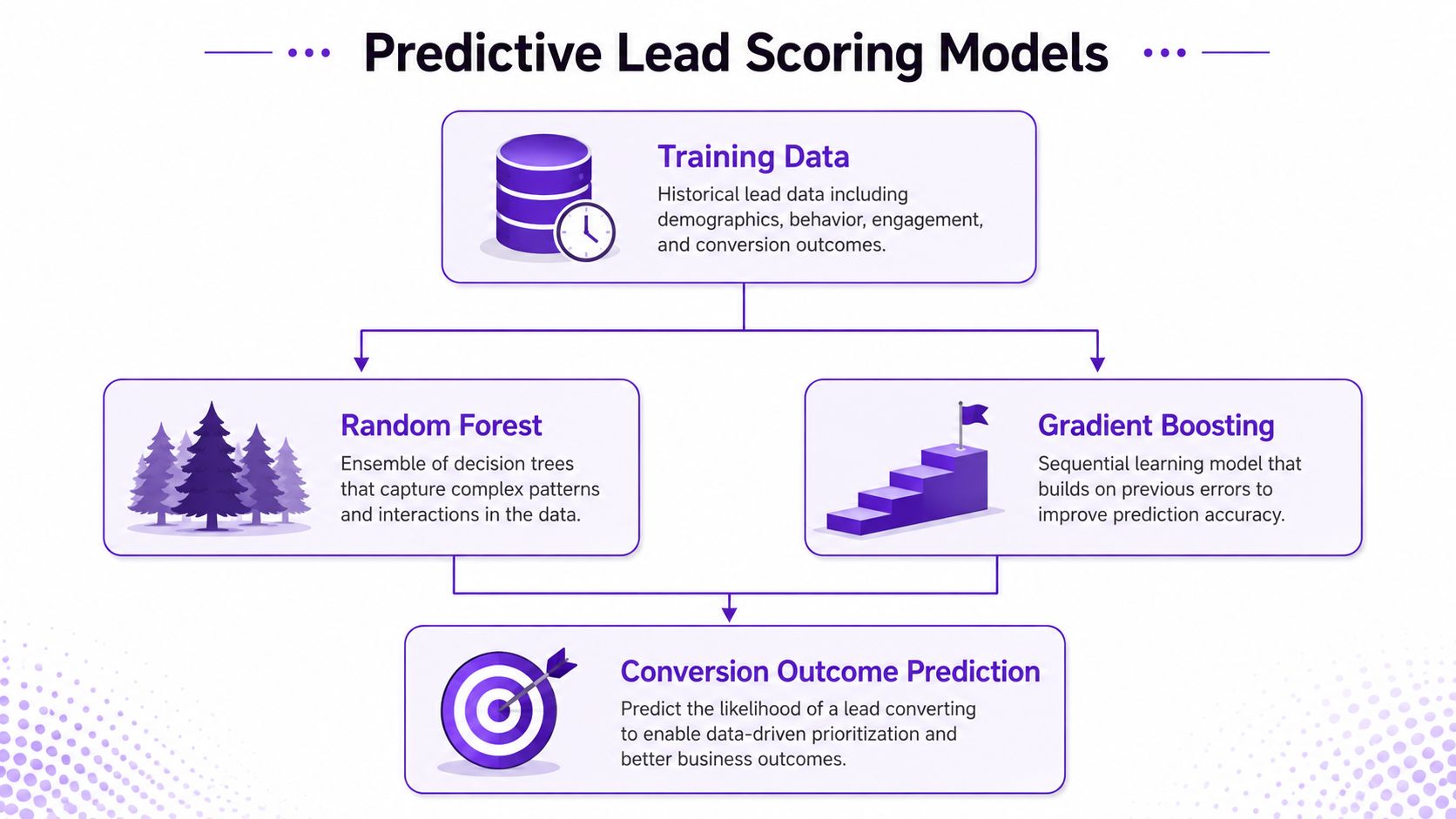
The useful takeaway is operational, not academic. Feed the model clean conversion history, consistent timestamps, and enough behavioral variety to detect patterns. If all you give it is a pile of page views and a few job titles, it'll do its best, but it won't have much to work with.
Intent data matters here because it expands the model beyond what your site can see. That's where the scoring conversation gets more interesting, and a lot messier.
The Intent Signal Gap Most Models Miss
First-party engagement data is useful, but it's not the whole buying story anymore. Prospects research vendors in LinkedIn comments, compare tools in private conversations, and follow creators long before they visit your site. If your score only reacts after a form fill or a pricing-page visit, you're already late.
That's why the old definition of “qualified” keeps getting narrower in practice. A lead can look cold in your CRM and still be active in the market. The problem isn't that the person lacks intent, it's that the intent is happening outside your first-party channels.
Social noise versus real intent
Teams often dismiss LinkedIn engagement as fluffy social activity because it's hard to separate casual scrolling from real buying behavior. That instinct makes sense, but it also leaves money on the table. The stronger approach is to treat external behavior as one layer inside a broader prioritization system, not as a vanity metric on its own.
Modern scoring systems are widening beyond internal engagement into signals like third-party research activity, funding events, hiring trends, and executive changes. A 2026 B2B study found that traditional firmographic variables can be enriched by a two-stage model, and current product docs still spend more time on setup than on signal quality or explainability (ActiveCampaign predictive lead scoring discussion). That gap matters because external intent can sharpen timing, but it can also mislead you if it isn't filtered against fit.
One operational example is RoverLead AI, which tracks LinkedIn engagement, including comments, content interactions, and pricing or demo discussions, then turns that behavior into ICP-matched prospecting context. That kind of workflow makes sense when you want to catch intent before prospects ever raise their hand in your own stack.
The trick is not to confuse activity with opportunity. Someone can comment on a competitor's post, follow five industry creators, and still be a terrible fit. Someone else can look quiet on your site and be exactly the right account at exactly the right moment. That's the gap multi-signal workflows are trying to close.
Why this matters for social selling
LinkedIn-led outbound works best when it respects timing. If a rep reaches out because a prospect is newly active around a topic, the message feels relevant instead of random. If the same rep blasts the same person because they appeared in a list, the message feels like another interruption.
The point isn't to replace first-party data. It's to stop pretending first-party data is the full market. A better score blends internal behavior, external intent, and ICP fit, then keeps the system honest when the signals conflict.
Deploying Predictive Scoring Without Breaking Your Workflow
Deployment usually fails for boring reasons, not technical ones. The model is fine, but the handoff rules are vague, the sales team doesn't trust the score, and marketing keeps changing definitions mid-quarter. That's how a smart system turns into one more field in the CRM that nobody respects.
Start with the workflow you already have. HubSpot and Salesforce can handle native scoring for teams that want a contained setup, while third-party platforms make more sense when you need richer intent inputs and more flexible signal layers. If your stack already has enough data to learn from, keep it simple. If it doesn't, don't pretend native scoring will invent context out of thin air.
A deployment checklist that won't wreck your ops
Pick the handoff threshold carefully. Sales should know exactly what score triggers action, and why.
Route fast when the probability is high. High-probability leads should land with a rep or sequence immediately.
Test the routing logic on one segment first. A pilot exposes weird edge cases before they spread.
Set a decay rule. Old activity shouldn't count forever just because it was once exciting.
Build a feedback loop. Reps need a way to mark scores as useful, stale, or nonsense.
Audit drift regularly. If the model starts rewarding temporary spikes, fix the signal mix before the team loses trust.
Practical rule: don't let the score become a political compromise. If marketing thinks it means “engaged” and sales thinks it means “ready,” the system is already broken.
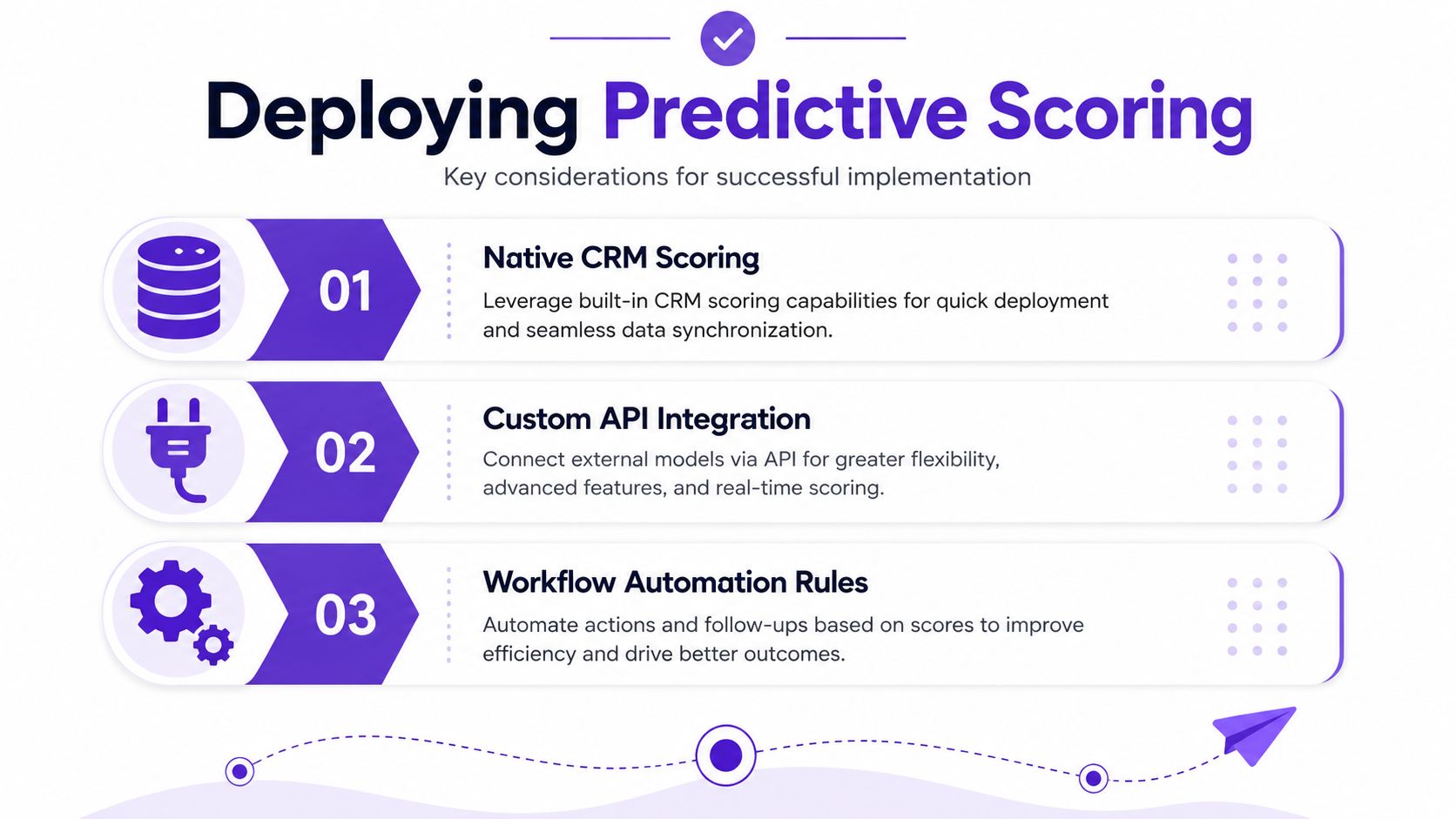
CRM data enrichment also matters here because bad records poison the workflow before the model even gets a chance to help. Clean contact data, consistent timestamps, and clear lifecycle stages make the score more actionable and the routing less embarrassing.
The teams that get this right usually do one more thing, they keep the score close to the rep's daily workflow. If reps have to jump tabs, decode a dashboard, or guess what the number means, adoption drops fast.
When Predictive Scoring Delivers Results
Predictive lead scoring pays off when lead volume is high, the buying path is messy, and manual sorting is wasting rep time on the wrong names. That pattern shows up often in complex B2B deals, where several stakeholders research in parallel and no single click tells you much. In that setting, a better prioritization layer can change how fast the team gets to real opportunities.
The fit is weaker when volume is low, the sales motion starts with a long relationship, or the company is still early enough that process discipline matters more than model complexity. A clean scoring framework and consistent follow-up can do more than an advanced model in those cases. No score fixes a weak offer or an ICP that is too broad.
The decision point is practical. If your team is buried in signals, missing solid prospects, or treating website activity as a proxy for revenue intent, predictive scoring belongs in the stack. If pipeline is small and every lead already gets direct human attention, keep the system simple until the gap between engagement and buying intent gets wider.
The first audit should be blunt: what does your current score reward? If it is mostly first-party engagement, that is usually the first place where the model stops telling the truth. Many buyers spend time on LinkedIn, with competitors, or around industry topics long before they submit a form, and that external intent often matters more than another site visit.
That gap is the test. Traditional scoring is good at measuring familiarity with your own assets, but modern buying behavior usually spans outside the CRM. If LinkedIn activity, competitor research, and topic-level intent are part of the journey, the model needs to account for those signals without letting a noisy spike outrank durable buying behavior.
The trade-off is signal quality. External intent can sharpen prioritization fast, but only if you treat it as part of a multi-signal workflow instead of a single trigger that overpromises readiness. A rep should see a score that reflects real buying patterns, not just whatever channel happened to light up last.
RoverLead AI turns LinkedIn engagement into daily, high-intent leads matched to your ICP, so reps can work from living intent instead of stale lists. If you want to see how multi-signal prospecting fits into a modern predictive lead scoring workflow, visit RoverLead AI and look at how it handles LinkedIn-driven intent in practice.