Lead Gen Funnels That Convert in 2026

Most advice about lead gen funnels starts with the same prescription: drive more traffic, publish more content, add another lead magnet, and celebrate when the form-fill count rises. That playbook is backwards. A funnel can produce plenty of leads and still starve sales if the leads lack ICP fit, arrive without meaningful intent, or disappear during the marketing-to-sales handoff.
The numbers explain why. A 2026 benchmark puts average visitor-to-lead conversion at 2% to 3%, lead-to-MQL at about 25%, and MQL-to-SQL at about 13%. The same benchmark estimates that roughly 1 in 11,000 visitors becomes a customer at average funnel rates, so a small improvement in qualification or timing can matter more than another burst of low-quality traffic (2026 B2B lead generation funnel benchmarks).
The practical answer is an ICP-first, signal-led funnel. Forms still have a role, but they shouldn't be treated as the only evidence that someone is buying. LinkedIn engagement, competitor conversations, pricing discussions, and role-specific trigger events often tell you more than a polite download.
Table of Contents
Why Most Lead Gen Funnels Leak Before Sales Ever Talks to Anyone
More traffic will not repair a broken lead gen funnel. Revenue leaks when marketing treats weak interest as qualified demand, sales receives little context, and no one owns the gap between a download and a real buying conversation.
The funnel math makes that gap visible. Website visitors convert to leads at roughly 2% to 3%, leads become MQLs at about 25%, MQLs become SQLs at about 13%, SQLs become opportunities at 46%, and opportunities become customers at 15% to 22%, according to the 2026 benchmark report. Early conversion rates matter, but the MQL-to-SQL handoff determines whether captured demand reaches sales with enough fit, intent, and timing to act.

Traffic isn't the same as pipeline
A form fill proves only that someone traded information for an offer. It does not establish market fit, buying influence, an active problem, or interest in a sales call. Sending every conversion to SDRs turns sales into a costly sorting function.
LinkedIn engagement, repeat visits, competitor discussions, pricing research, and role-specific trigger events can reveal intent before a prospect completes a form. Those signals need a place in the workflow, with clear rules for when marketing nurtures, when sales follows up, and what context the rep receives.
The operating question is, “Which accounts are showing the right behavior, and how quickly can we help them take the next step?” That redirects budget and attention toward qualification quality, timing, and handoff design.
Operator rule: If sales rejects most MQLs, don't buy more traffic. Repair the definition of an MQL.
The handoff is where revenue gets stranded
An MQL needs a concrete reason to exist. It should match the ICP, show behavior consistent with evaluation, and reach sales with enough context for an intelligent follow-up. An SQL means sales has accepted responsibility for active pursuit. It should never mean an automated score crossed an arbitrary line.
Build the handoff around three tests:
Fit: Does the account resemble customers you can serve well?
Intent: Is the person or account showing behavior linked to an active problem?
Timing: Can a rep respond while that behavior remains fresh?
Static databases describe company characteristics. Dark-funnel signals show what buyers are doing now. Treat both as inputs, then measure whether the handoff produces accepted SQLs and qualified opportunities, rather than rewarding form volume alone.
The Four Stages Every B2B Lead Gen Funnel Actually Has
A practical B2B funnel has four operating stages: attract, qualify, engage, and convert. These are not decorative labels for a CRM dashboard. Each stage has a distinct job, owner, exit condition, and metric.
Attract earns relevant attention
Marketing owns the first stage. The task is to reach people who could plausibly become customers through search, paid media, partnerships, events, communities, and LinkedIn content. The metric isn't raw reach. It's the quality of attention from the accounts and roles that matter.
A useful landing page gives visitors a clear problem, a credible point of view, and one sensible next action. Don't bury the offer beneath a museum exhibit of navigation links. Don't ask for a sales-ready commitment from someone who has only just discovered the problem.
Qualify separates fit from curiosity
Qualification combines account data and observed behavior. Firmographics might include industry, geography, company size, or business model. Technographics can show whether the account uses systems your product supports. Role seniority and buying responsibility add useful context, but they don't replace evidence of a live problem.
MQL means marketing believes the person or account deserves a structured next step. SQL means sales agrees and accepts responsibility for pursuing it. If marketing and sales can't explain those definitions in plain language, the funnel isn't operationally aligned.
Engage creates a relevant conversation
Engagement isn't an endless nurture sequence. It's a timely exchange based on what the buyer has done. Someone researching pricing needs different material from someone reading an educational article. Someone commenting on a competitor's positioning needs a different opener from someone who filled out a generic newsletter form.
Marketing can provide context and assets. Sales should contribute objection patterns, disqualification reasons, and language buyers use in real calls.
Convert makes the next commitment easy
Conversion may mean a booked meeting, a qualified opportunity, or another agreed commercial step. The page, form, calendar, routing rule, and follow-up sequence should remove friction without pretending that every visitor is ready to buy.
A simple ownership matrix helps prevent the classic “I thought your team had it” failure:
Stage | Primary owner | Exit condition | Core question |
|---|---|---|---|
Attract | Marketing | Relevant attention or response | Did we reach the right audience? |
Qualify | Marketing and revenue operations | ICP fit plus meaningful signal | Is this worth sales capacity? |
Engage | Sales development and sales | Two-way buying conversation | Is there a live problem to explore? |
Convert | Sales and revenue operations | Agreed next step | Did interest become pipeline? |
The two dangerous handoffs are attract to qualify and qualify to engage. Both need written rules, CRM fields, and feedback from the receiving team.
Benchmarks That Actually Matter by Channel and Segment
A single funnel average is convenient, but it's a poor operating model. B2B SaaS benchmark data shows 1.4% visitor-to-lead overall, 41% lead-to-MQL, 39% MQL-to-SQL, 42% SQL-to-opportunity, and 31% opportunity-to-close. Enterprise SaaS can fall to 0.7% visitor-to-lead and 1.3% overall lead-to-customer conversion, according to B2B SaaS funnel conversion benchmarks.
Those differences change how you judge a channel. A source with fewer initial conversions may produce better opportunities. Another may generate impressive form volume but leave sales with a queue of poor-fit contacts. Comparing both with the same threshold is how teams accidentally reward noise.
Stage | B2B SaaS overall | Enterprise SaaS | Outbound-led |
|---|---|---|---|
Visitor to lead | 1.4% | 0.7% | Model from delivered account and response data |
Lead to MQL | 41% | Not specified in the benchmark | Set by ICP and signal rules |
MQL to SQL | 39% | Not specified in the benchmark | Judge by accepted conversations |
SQL to opportunity | 42% | Not specified in the benchmark | Judge by qualified next steps |
Opportunity to close | 31% | Not specified in the benchmark | Judge by opportunity quality |
The outbound-led column should stay operational rather than pretending there's a universal benchmark. Outbound starts from account selection and observed behavior, so its denominator isn't identical to website traffic. If you force outbound into a website visitor model, you'll make the numbers look tidy and the decisions worse.
Build separate models
Create a model for each meaningful combination of segment, source, offer, and motion. Paid search, SEO, partner referrals, and outbound should not share identical MQL rules when buyer intent and context differ.
Use the model to answer practical questions:
Which source produces the highest share of ICP-fit leads?
Which segment survives the MQL-to-SQL handoff?
Where do accepted SQLs become opportunities?
Which signals predict a useful conversation?
The cost-per-acquisition framework can help connect acquisition expense to downstream outcomes, but don't stop at cost per lead. Cheap leads are expensive when reps spend their week disqualifying them.
Mapping Your ICP and Reading the Dark Funnel
An ICP shouldn't be a paragraph about “fast-growing companies that value innovation.” That description is so broad it could target half the internet. A usable ICP is a filter that tells a rep who to prioritize, who to ignore, and what evidence justifies outreach.
Start with four dimensions:
Firmographics: Define the industries, geographies, business models, and organizational characteristics where your offer has a credible advantage.
Technographics: Record the systems, workflows, and technical environment that make implementation plausible or reveal a strong use case.
Role seniority: Identify the people who feel the problem, influence the decision, approve the purchase, or control the workflow.
Trigger events: Track hiring, funding, leadership changes, product launches, market moves, and public conversations that suggest the problem is becoming urgent.
A strong ideal customer profile also includes negative criteria. If a segment repeatedly stalls, needs unsupported functionality, or requires uneconomic service effort, mark it as a disqualifier rather than hoping better copy will rescue it.

Treat behavior as evidence
The dark funnel is the research and intent activity you can't reliably see through a form. Industry coverage says buyers complete more than 70% of purchase research before contacting a vendor, and reports that signal-driven precision can outperform volume-based playbooks by 3 to 5 times on pipeline per dollar spent (lead generation trend coverage). That makes pre-form behavior too important to ignore.
LinkedIn is especially useful because buyers publicly reveal topics, objections, comparisons, and urgency. Watch for:
Comments on relevant creator posts.
Replies in competitor discussions.
Mentions of pricing, demos, implementation, or alternatives.
Engagement with content tied to a known pain point.
Repeated activity from multiple people at the same account.
Don't treat a single like as a buying signal. Combine fit, relevance, recency, and repetition. A senior operator at a target account commenting thoughtfully on a competitor's pricing discussion deserves more attention than an untargeted contact who downloaded a broad guide.
Build the worksheet
Create one page with five columns: account fit, target roles, tracked topics, observable signals, and approved actions. For each signal, define the evidence required, the owner, the response window, and the disqualification rule.
EU prospects require disciplined consent mechanics. GDPR consent must be unambiguous, affirmative, specific, freely given, and informed, and consent language should be explicit rather than hidden in a generic privacy checkbox, with consent logged in the CRM alongside a timestamp (GDPR funnel guidance). Signal-led selling doesn't mean bypassing privacy obligations. It means using visible buying behavior responsibly.
Designing the Workflow From Signal to Booked Call
A signal-led workflow should make the rep faster without making the outreach creepier. The system identifies a plausible account, explains why it surfaced, and gives the rep enough context to write like a person rather than a database export.
The operating sequence
On day one, define the ICP, tracked keywords, competitors, experts, and disqualifiers. Add the signals your team can act on, such as relevant LinkedIn comments, pricing conversations, demo discussions, hiring activity, or content engagement from several people at one account.
On day two, route the feed into the CRM or a controlled Slack channel. Each alert should include the account, person, role, source of the signal, relevant text or topic, fit rationale, and suggested next action. A score can combine account fit with signal recency, but the score must remain explainable.
By the first working week, reps should review the feed, accept or reject alerts, and record why. Those decisions improve the rules. If reps keep dismissing a signal, retire it or narrow it. If they accept a signal but can't find a valid contact path, fix the workflow rather than blaming the rep.

Use the behavior in the opener
Suppose an operations leader at a target company comments on a competitor's pricing post. A weak message says, “I help companies optimize their sales process. Do you have fifteen minutes?” It could have been sent to anyone.
A contextual opener is more useful:
“Saw your comment on the pricing discussion. Teams usually get stuck comparing the headline cost with the operational work that sits behind it. Are you evaluating options now, or were you pressure-testing the assumptions?”
The opener names the behavior without pretending to know the buyer's private situation. It asks a genuine diagnostic question. If the person says they aren't evaluating anything, disqualify or nurture. If they describe an active project, the rep has a conversation worth continuing.
Automate the mechanics, not the judgment
Use CRM routing, Slack alerts, calendar workflows, and controlled follow-up to reduce manual work. A practical lead generation automation workflow should preserve the signal and the reasoning behind the alert, not just create another task.
RoverLead AI is one option for teams that want a daily feed of high-intent LinkedIn engagement matched to an ICP, with context and an AI-written opener. It monitors signals such as interactions with creators, competitors, topics, pricing, and demo discussions, then supports routing into a prospecting workflow.
Keep the cadence human. One relevant message beats a sequence of generic nudges. Stop when the person declines, the account fails the ICP filter, the signal goes stale, or the conversation reveals there's no credible use case.
Measuring What Matters Without Lying to Yourself
A dashboard can report accurate numbers and still push the team toward bad decisions. Traffic, downloads, and raw lead volume are easy to display, but they do not show whether sales is receiving accounts worth pursuing. Measure the handoff, fit, intent, and seller time instead.
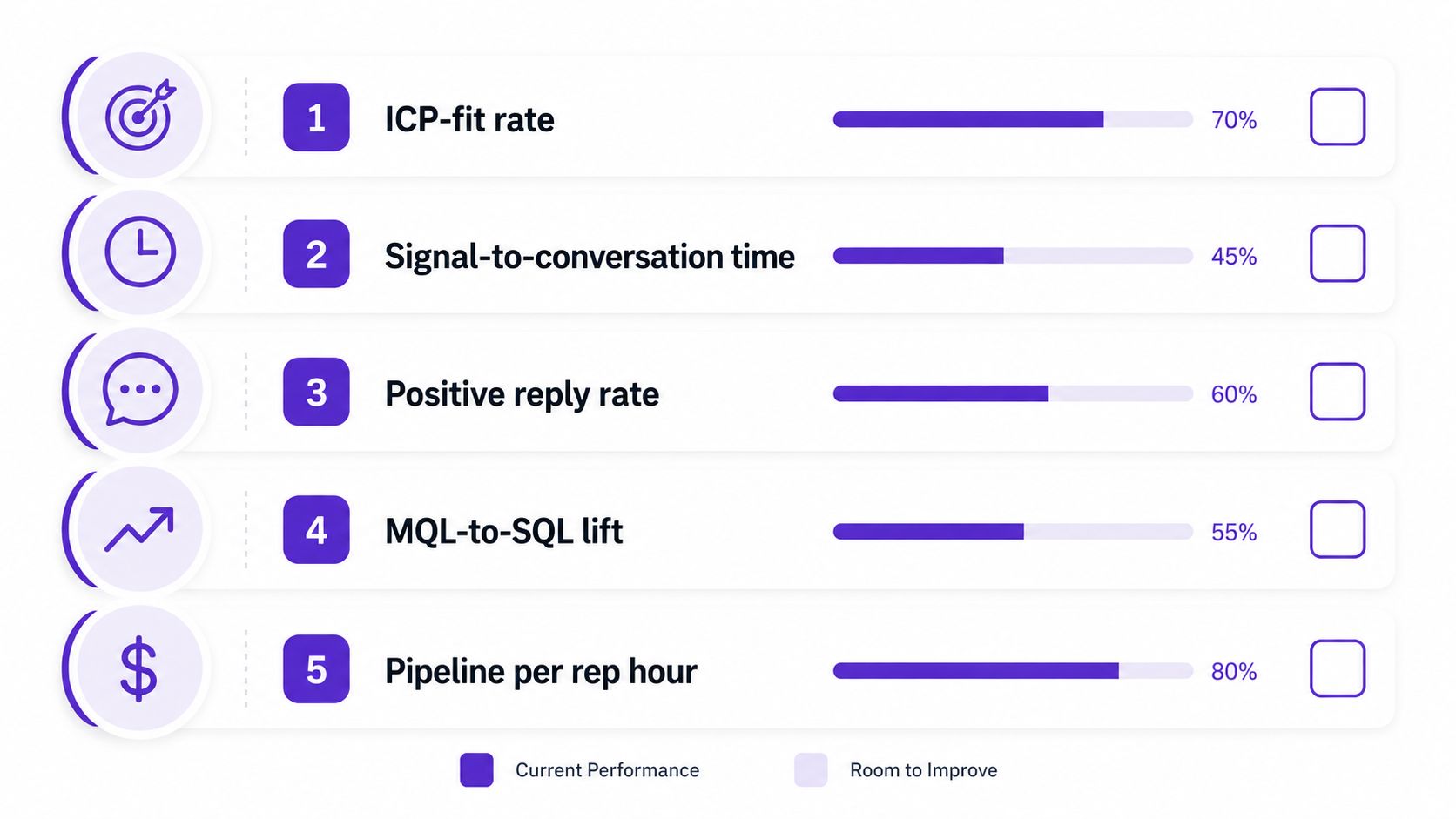
Track five indicators:
ICP-fit rate: The share of captured or surfaced leads matching the account and role criteria.
Signal-to-conversation time: The time between meaningful buying behavior and the team's response.
Positive reply rate: The share of outreach that earns a substantive, favorable response.
MQL-to-SQL lift: Whether new qualification rules improve sales acceptance.
Pipeline per rep hour: Whether the workflow gives sellers more time for productive selling.
Benchmark context helps set expectations. One benchmark reports median visitor-to-MQL at 1.8%, MQL-to-SQL at 13.7%, and ICP-fit leads closing at 4.7 times the rate of non-ICP leads (2026 demand generation funnel benchmarks). The operational lesson is direct: improve fit before chasing more volume.
Avoid three attribution traps
Last-touch worship gives all credit to the final form or meeting source. It erases the LinkedIn posts, discussions, and site visits that built familiarity before conversion.
Lead-source conflation puts SEO, paid search, outbound, and referrals into one bucket. Their buyer behavior and denominators differ, so the combined number hides channel quality.
Dark-funnel blindness records only clicks and forms. If a buyer engaged with a competitor discussion before requesting a call, preserve that context in the CRM, even when no standard attribution field captures it.
Run a 30-minute weekly review. Examine accepted and rejected leads, stale signals, response time, positive replies, and pipeline created. Change one rule or workflow element at a time, and record why. A dashboard should guide decisions, not reward activity with green arrows.
Use this revenue attribution model guide to separate contribution from simplistic source credit. That distinction matters when LinkedIn engagement, repeat visits, and sales conversations influence an opportunity without producing the final form fill.
Your 30-Day Lead Gen Funnel Rollout and FAQ
Use the first week to define the ICP, disqualifiers, signals, owners, and consent fields. Use the second to connect CRM routing, alerts, scoring, and response templates. Use the third to run a controlled prospecting motion and inspect every accepted or rejected alert. Use the fourth to remove noisy signals, tighten the ICP, and review pipeline quality rather than celebrating activity.
When reply rates flatten, check relevance before rewriting every message. When alerts become noisy, narrow the signal or raise the fit requirement. When the ICP drifts, compare recent opportunities with the original criteria and update the rules deliberately.
Frequently asked questions
How should we expand the ICP?
Add one adjacent segment at a time and give it separate scoring, messaging, and reporting. Don't weaken the original filter to accommodate a new market.
When should we retire a signal?
Retire it when reps repeatedly reject it, conversations lack a real problem, or the signal no longer produces useful next steps.
How long should we wait before judging replies?
Wait until the team has enough consistent outreach and response handling to compare patterns. Don't change the system after a handful of messages.
Are form fills still useful?
Yes, but treat them as one input. A form fill becomes valuable when fit and behavior support the qualification decision.
How do we avoid LinkedIn spam?
Reference public behavior accurately, keep the message relevant, respect a clear decline, and stop automated follow-up when the person isn't interested.
What does an SQL mean?
It means sales has accepted the lead for active pursuit under a shared definition, not merely that marketing assigned a score.
Should every MQL go to sales?
No. Route only leads that meet the agreed fit and intent threshold. Others belong in nurture or disqualification.
What should sales send back to marketing?
Send rejection reasons, missing-fit patterns, useful buyer language, and evidence about which signals produce real conversations.
Is AI-written outreach safe to use?
Use AI for research summaries and drafts, then review every message for accuracy, relevance, privacy, and tone.
What should we fix first?
Fix the MQL-to-SQL handoff. If sales doesn't trust the inputs, more traffic and more automation will only scale the waste.
RoverLead AI turns LinkedIn engagement into daily, ICP-matched prospects with signal context and AI-written openers, so your team can act on buying behavior instead of static lists. Visit RoverLead AI to see how a signal-led workflow can support faster, more relevant conversations.