
What Is Behavioral Data and Why It Drives B2B Sales

Behavioral data is the record of what people do across digital touchpoints, page views, clicks, comments, logins, purchases, and other actions, and it's the closest thing B2B teams have to live buying intent. In practice, it's the difference between guessing who might care and seeing who's already leaning in.
That matters because cold outbound still burns time on people who fit the spreadsheet but aren't in motion, while the buyers who are showing real interest often never make it into the list. Behavioral data fixes that blind spot by shifting attention from static profiles to observed actions, which is where modern pipeline usually starts to get interesting.
Table of Contents
The Pipeline Problem Behavioral Data Solves
The usual SDR scene is painfully familiar. A rep pulls a clean-looking list from Sales Navigator, blasts connection requests, sends the same follow-up sequence to everyone, and wonders why replies are flat. Meanwhile, the people raising their hands, the ones reading your content, circling your competitors, or poking around the same niche topics, never get the right attention.
That's the gap behavioral data closes. It captures what people do across digital touchpoints, not who they are on paper, and that includes page views, clicks, comments, content downloads, demo requests, and similar actions recorded as event-level signals. That action-based view is why teams use it as the raw material for understanding intent and engagement across websites, apps, email, CRM systems, and other connected systems as defined in Snowplow's overview of behavioral data.
Why this shift matters in B2B sales
Static firmographics still matter, but they're weak on timing. A company can match your ideal customer profile and still be months away from a buying decision, while a smaller account might be actively comparing vendors right now. Behavioral data gives you the second layer, the part that says someone isn't just a fit, they're moving.
Practical rule: if a prospect is behaving like a buyer, treat them like a buyer, even if the org chart isn't glamorous.
That's why intent-based prospecting outperforms “spray and pray” outreach in real life. If someone visits your pricing page, downloads a comparison guide, and keeps showing up around the same problem, that's a much more useful signal than a job title alone. The old playbook guessed at relevance. Behavioral data lets you earn it.
For a fuller view of how leads move through a buying journey, the structure of a B2B lead generation funnel helps frame where these signals surface.
Implicit vs Explicit Behavioral Signals
Not every signal means the same thing. Some actions whisper interest, others practically shout it from the rooftop, and good sales teams learn the difference before they start routing leads around.
The signal strength test
Implicit signals are passive. A prospect lands on a page, scrolls, comes back later, views a LinkedIn profile, or reads a post without filling anything out. Explicit signals are active. They fill a form, request a demo, ask about features in a comment, or visit a pricing page when they're already evaluating options. LinkedIn profile views and repeated visits often show up early, while direct asks usually show up later when someone is closer to action.
Signal Type | Examples | Intent Strength |
|---|---|---|
Implicit | Page views, time on page, scroll depth, repeated visits, LinkedIn profile views | Lower to medium, useful as early movement |
Explicit | Form fills, demo requests, pricing page visits, direct comments asking about features | Higher, often closer to purchase motion |
A lot of teams make the mistake of treating all activity as equal. They're not equal. Someone who fits your ICP and occasionally lurks is interesting. Someone who keeps returning to your pricing page and commenting on a competitor's post is telling you where their attention is going.
For contrast, it helps to separate behavior from demographic targeting. Demographic data describes who someone is, while behavior tells you what they're doing, which is why the demographic data category is useful for segmentation but not enough for timing.
A quiet pattern beats a perfect profile when you're trying to catch a deal before your competitors do.
That's especially true in B2B sales, where the earliest signal often isn't a form fill. It's repeated engagement, a return visit, or a competitor comparison hiding in plain sight.
Where Behavioral Data Comes From
Behavioral data doesn't live in one place, and that's part of the headache. It shows up in your own stack, across the open web, and in places most reps never bother to watch closely enough. Good teams pull it together; lazy ones keep blaming lead quality.

The five places worth watching
Website analytics still matter because they show click paths, repeat visits, and friction points. CRM activity logs add deal-stage movement, call notes, and task completion. Email engagement shows who opens, clicks, replies, or forwards. LinkedIn interactions surface comments, shares, profile views, and connection requests. Ad interactions show impressions, clicks, form fills, and retargeting triggers.
That's the useful part. The less obvious part is that behavioral data isn't limited to your own property. A prospect commenting on a competitor's pricing post, engaging with a creator in your niche, or repeatedly showing up around a topic you sell into can be just as revealing as a demo request on your site.
If you want to track visitors before they convert, the workflow in how to identify web visitors is a practical companion to this view.
High-intent signals usually have some combination of repetition, specificity, and proximity to a buying conversation. Low-intent signals still matter, but they need context. A single like is noise. Repeated interaction with a pricing discussion, a comparison post, or a decision-maker thread is the sort of thing a rep should probably not ignore.
Turning Signals Into Intent-Based Prospecting
Behavioral data only pays off when someone turns it into action fast enough to matter. That's where many teams stumble. They collect signals, admire the dashboard, and still send outreach like it's 2018.
From raw activity to a useful feed
The practical workflow is simple enough, even if the tooling isn't. First, define the behaviors that map to buying motion in your market. Then monitor those actions across LinkedIn, content, competitors, and owned channels. Finally, route the best signals into a feed that gives reps enough context to write a relevant opener instead of a generic “just circling back.”
RoverLead AI follows that model by tracking LinkedIn engagement tied to an ICP, competitors, keywords, and niche topics, then turning comments, content interactions, and pricing discussions into a daily lead feed with context and an AI-written opener. That's useful because it shifts the work from manual list-building to responding to live behavior.
Timing matters more than volume once you know who's warm.
In practical terms, the sales motion changes a lot. A rep sees a prospect repeatedly engaging with a topic, checks the context, and sends outreach while the conversation is still warm. That beats guessing from a static list every time. When intent signals drive outreach, teams commonly report 2–3x positive reply rates and 30–50% more meetings, because relevance lands faster than generic persistence.
For a broader look at that motion, the B2B sales prospecting playbook is where the method and the messaging meet.
The real unlock isn't automation for its own sake. It's shortening the gap between a meaningful signal and a relevant message. If a rep can say, “I noticed your team has been active around X,” the outreach feels timely because it is.
The Limits and Risks of Behavioral Data
Behavioral data is useful, but it's not mind reading. It tells you what people did, not always why they did it, and those are not the same thing. A LinkedIn comment may mean curiosity, comparison shopping, research for a colleague, or plain old doomscrolling during lunch.
Where interpretation goes wrong
The biggest mistake is treating behavior as a perfect proxy for intent. It isn't. Missing context can make a signal look hotter than it is, especially when datasets are fragmented or only partially visible. If your stack captures web visits but misses social engagement, or email clicks without CRM follow-through, the picture gets distorted fast.
That's why richer interpretation usually needs more than a click trail. A rep should combine behavior with qualitative context, talk tracks, account knowledge, and basic common sense. Otherwise the team starts chasing every signal like it's a deal, which gets expensive and a little embarrassing.
Governance matters just as much. Privacy regulation, first-party data requirements, and platform access limits are tightening, so teams can't rely on broad, surveillance-style aggregation the way some older marketing stacks did. The safer model is owned, compliant signal collection across websites, apps, CRM systems, and connected digital events, then using that data in workflows that respect consent and platform rules as framed in BlueConic's behavioral data guidance.
Behavioral data works best when it's treated as evidence, not verdict. The moment a team stops asking “what else could explain this action?” it starts over-reading the funnel.
Best Practices for Implementing Behavioral Data in Sales
The cleanest behavioral systems aren't the noisiest. They're the ones that know which actions matter, which ones don't, and where to send the signal once it shows up.
What actually works
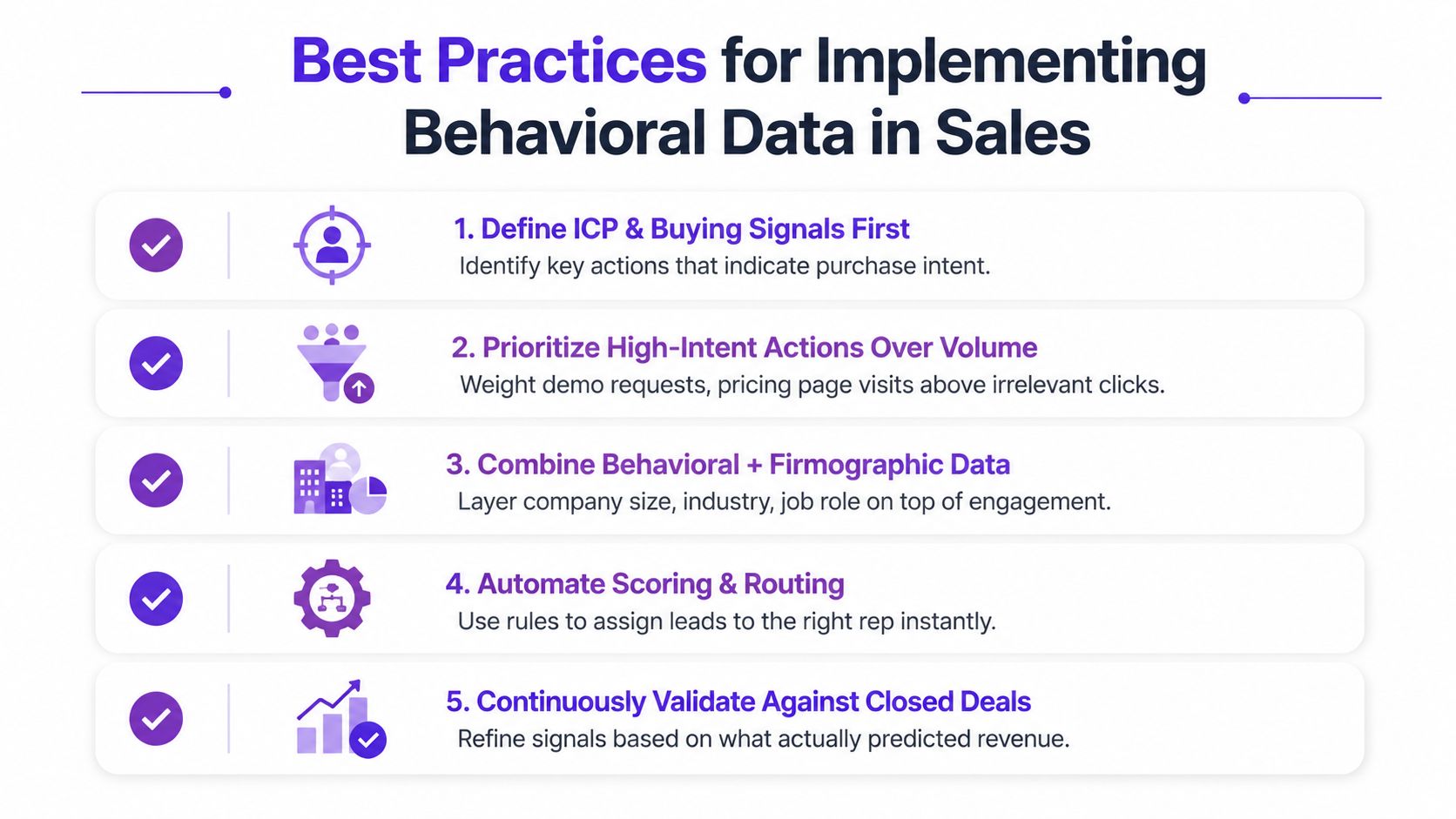
Define your buying signals first. Decide which actions indicate real purchase intent before you start scoring everything that moves.
Prioritize high-intent actions. Demo requests, pricing visits, and repeated competitor engagement should outweigh casual clicks.
Layer behavior with firmographics. Company size, industry, and job role still help, but they work better as context than as the main event.
Automate routing and scoring. The point is to get the right rep on the signal quickly, not to let leads age in a spreadsheet.
Validate against closed deals. Check which behaviors showed up before revenue, then keep adjusting.
Tools like RoverLead AI fit here if you want a system that turns LinkedIn engagement into a working prospect feed instead of another dashboard to babysit. The important part is not the tool name, it's whether the workflow helps a rep write a better message on the same day the signal appears.
Audit your current prospecting flow this week. Find the one high-intent behavior you're ignoring, then decide where it should trigger action.
If you want behavioral signals turned into a repeatable pipeline motion instead of another pile of tabs, explore RoverLead AI. It's built to turn LinkedIn engagement into daily high-intent leads with context, so your team can reach out while the conversation is still warm.