SaaS Lead Generation That Actually Books Calls in 2026

You're probably staring at a CRM that looks busy and a pipeline that feels weirdly silent. MQLs keep coming in, SDRs keep grinding through static lists, and yet the calendar still has that same few meetings nobody wants to talk about in pipeline review. That's the gap this guide cares about, because in SaaS, more leads and more booked calls stopped meaning the same thing a long time ago.
The hard truth is that SaaS funnel math is ugly even in mature markets. Salesforce benchmark data cited in 2025 reporting says only 13% of MQLs convert to sales-qualified opportunities across B2B SaaS, while the sales-accepted lead rate sits at 26%. The same benchmark set puts median cost per SQL at $762 and median cost per MQL at $198, which is a polite way of saying you can spend a lot and still miss the point, especially if the lead never had real buying intent in the first place. That benchmark sample covered 5,500 sales professionals across 27 countries (benchmark source).
Table of Contents
Why Your SaaS Pipeline Feels Quiet Even With Plenty of Leads
Channel Strategy Across Content LinkedIn Paid Partnerships and Product-Led
Measurement That Finds the Broken Stage Instead of Bragging About Volume
Sample Workflows Messaging Templates and a 30 60 90 Implementation Plan
Why Your SaaS Pipeline Feels Quiet Even With Plenty of Leads
Your team has probably seen this pattern before. Content goes out, a list gets bought, a cadence gets launched, and the dashboard starts showing activity. Then the week ends with a few form fills, a couple of polite no's, and a long trail of prospects who were never close to buying.
The real issue is activity without intent
That mismatch is what breaks most SaaS lead generation efforts. Cold calling success was reported at 2.3% in 2025, down from 4.82% in 2024, while email marketing was estimated to return $36 to $42 for every $1 spent and LinkedIn was credited with generating 80% of B2B social media leads with 97% adoption in lead-generation workflows (channel shift data). Buyers have not disappeared. They have moved into channels where they can show intent before anyone interrupts them.
A quiet pipeline usually means SDRs are working from stale firmographics instead of live buying behavior. A static list can tell you who fits your ICP, but it cannot tell you who is researching now, who changed jobs last week, or who just started engaging with a competitor. That is why the teams that win stop asking, “How many leads did we get?” and start asking, “Which in-market accounts are active right now?”
Practical rule: if your team cannot name the trigger that made a prospect worth contacting today, you are probably doing database management, not demand generation.
The five-part fix
The fix is straightforward, even if it is not glamorous. Tighten ICP definition, use signal-rich channels, instrument funnel-stage metrics, trigger outreach from live intent, and run a 30/60/90 plan that changes behavior. The rest of the playbook only works if those five parts are connected.
Here is the blunt version. If your pipeline feels quiet, you do not need more optimism, you need better timing. In SaaS, timing beats reach more often than teams want to admit.
What SaaS Lead Generation Means Today
SaaS lead generation is not about stuffing a form with names and calling it progress. That old definition creates busy dashboards and weak revenue conversations. The job is to turn buyer intent into qualified sales conversations with the right account at the right moment.
Start with the ICP, not the tactic
Everything starts with the Ideal Customer Profile, because ICP tells you who deserves attention and who does not. A useful ICP statement covers industry, company shape, role, a trigger event, and a disqualifier. Without that, channels drift, messaging blurs, and sales ends up calling everyone, which is another way of saying they are calling nobody.
The funnel exposes the problem fast. If only 13% of MQLs become SQLs in B2B SaaS, then lead capture by itself is not enough, as shown in the benchmark source. The issue is matching, not volume. The question is not whether someone downloaded something. It is whether they have shown enough behavior to justify a real sales conversation.
Intent beats firmographics when buyers are already online
Firmographics still matter, but intent tells you whether a buyer is moving. LinkedIn matters because it is where a large share of B2B social lead activity lives and where people signal interest through comments, follows, and content engagement. For a practical view of how teams use that motion, see this LinkedIn lead generation guide. If your workflow still starts with a spreadsheet of companies that “look right,” you are behind.
A clean ICP frame is simple.
Industry fit: the verticals where your offer solves a real, repeated pain.
Company shape: size, growth stage, or operating model that can absorb the product.
Role fit: the people who feel the pain and can move the deal.
Trigger events and disqualifiers belong in the same definition, but this is enough to keep the model usable. The full signal-engine treatment lives in Section 4, where the point is not just who fits, but who is ready now.
That is the mental model. SaaS lead generation today is matching live buying signals to a defined ICP through channels where those signals are visible.
Channel Strategy Across Content LinkedIn Paid Partnerships and Product-Led
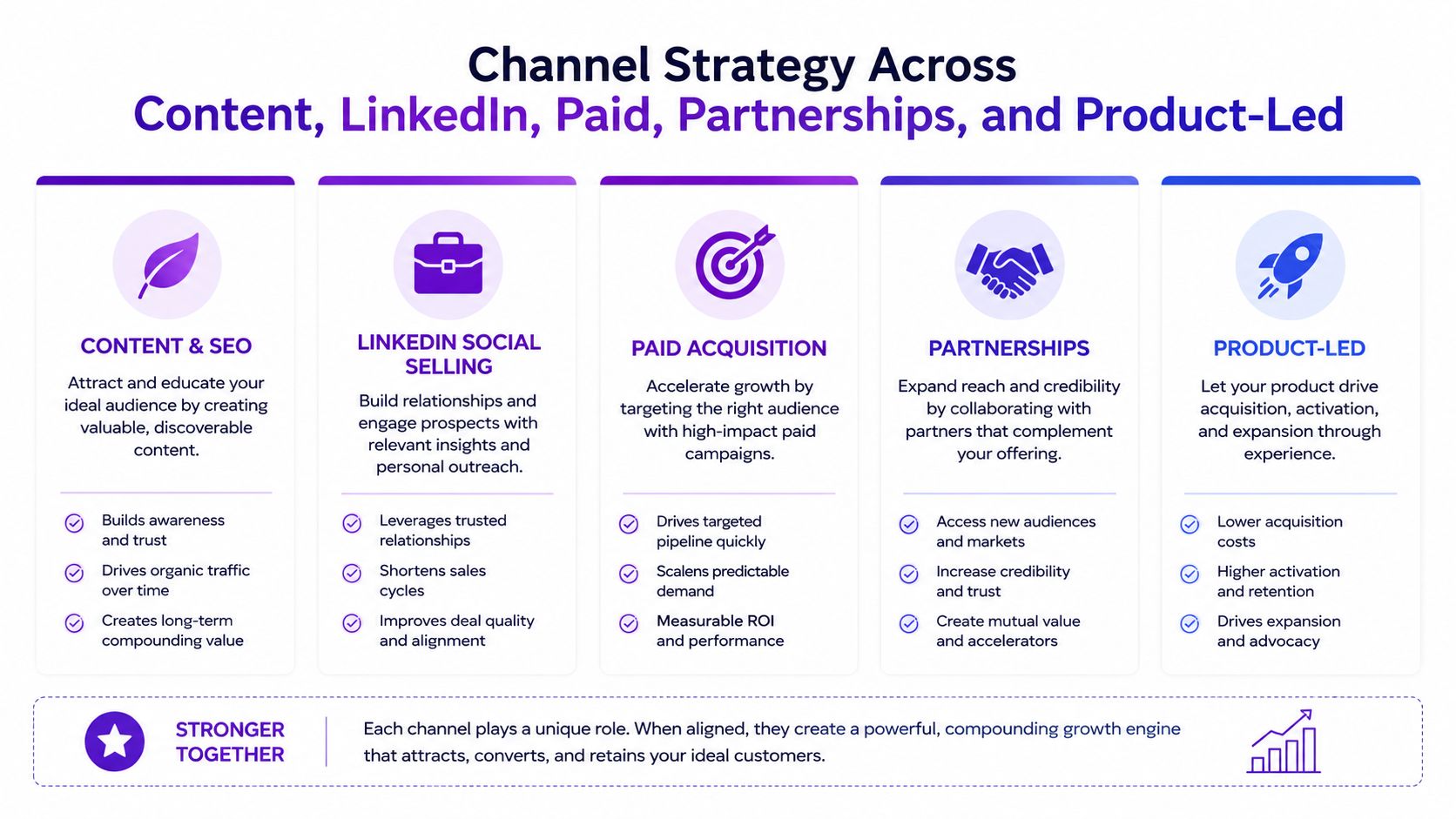
SaaS teams waste a lot of time arguing about channels because they start with volume instead of buyer motion. The better question is which channels surface in-market accounts fast enough to create real sales conversations, and which ones just add activity. Rank every channel by intent quality, relative cost, and time to pipeline, then build the mix around the motion your team can effectively execute.
Comparison is the point, not channel worship
Channel | Intent Quality | Relative Cost | Time to Pipeline |
|---|---|---|---|
Content and SEO | High when search intent is clear | Moderate | Medium to slow |
LinkedIn Social Selling | High when signal-led | Moderate | Fast |
Paid Acquisition | Mixed unless retargeting or search intent is strong | High | Fast |
Partnerships and Ecosystems | High through trust transfer | Moderate | Medium |
Product-Led Growth | High after usage starts | Low to moderate | Medium |
The point of the table is simple. Each channel solves a different part of the funnel. Content and SEO create discoverability, partnerships borrow trust, product-led motions capture usage intent, and LinkedIn shortens the gap between a buying signal and a conversation. Paid still matters, but it works best when it amplifies demand that already exists.
Why LinkedIn and email keep winning
A lot of teams pretend channel choice is still open-ended. It is not. Email remains a strong demand-capture channel, and LinkedIn continues to show up in B2B social lead generation because buyers signal interest there through comments, follows, and content engagement. For a practical breakdown of how teams run that motion, see this LinkedIn lead generation guide for SaaS teams. The mistake is treating LinkedIn like a cold blast tool instead of a place where live behavior can be identified and acted on.
Partnerships deserve more respect than they usually get. A solid co-marketing or ecosystem relationship creates warmer conversations than a paid campaign because trust transfers immediately from one brand to another. Product-led growth works from the other side, since actual usage becomes the first qualification layer before sales gets involved.
If you want a tighter practical lens on one of these motions, use the internal guide on LinkedIn lead generation for SaaS teams, because the channel only works when the outreach follows visible behavior, not generic sequences.
Use the channel that matches your sales reality
Early-stage teams: use LinkedIn and founder-led content because speed matters.
Mid-market motions: combine SEO, partnerships, and signal-led outreach to widen coverage.
Product-led SaaS: use product activity as the first qualification layer, then route high-intent users into sales.
Channel selection should follow your sales motion, not a generic growth playbook. If your team still treats cold calling as the backbone, buyers are already ahead of you. They spend time online, and they leave cleaner signals there than they ever do in a phone queue.
Building the ICP Signal Engine That Powers Daily Outreach
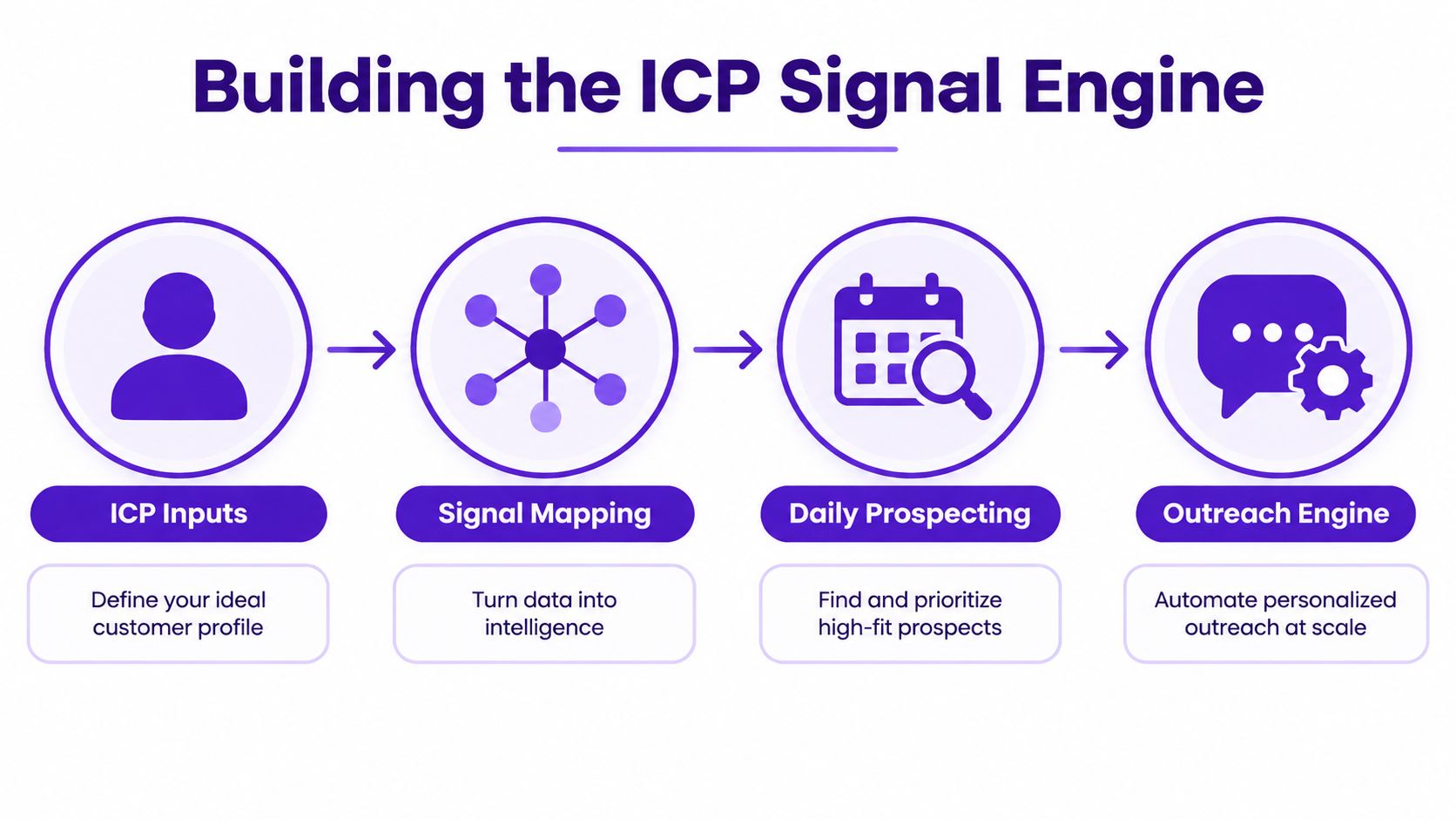
The old workflow was brutal in its simplicity. Pull a list, enrich it, sequence it, repeat. That system only works if the list itself is alive, and most of the time it isn't. A signal engine is better because it tells you who's heating up now, not who matched your filters six weeks ago.
Build from inputs to triggers
Start with the ICP inputs you already know, then layer in signals that point to active buying behavior. Recent guidance on trigger-based prospecting emphasizes hiring changes, tech-stack shifts, competitor renewals, and recent engagement on review or comparison surfaces as the sort of cues that separate curiosity from movement (trigger guidance). That's the right direction. Static firmographics tell you the who, but signals tell you the when.
A practical signal stack for SaaS usually includes competitor engagement, pricing-page visits, hiring patterns, tech-stack changes, creator interactions, and demo discussions. You don't need all of them to start. You need enough to spot momentum and enough discipline to ignore noise.
Practical rule: prioritize accounts touched by intent surfaces in the last 14 days, because recency matters more than a perfect profile.
Five minutes is enough to start
The setup doesn't need to turn into a six-week ops project. Define your ICP, choose a short list of buying signals, decide which of those signals should trigger outreach, and let the system learn from your behavior. If a prospect engaged with a competitor comparison post, that's a different motion from somebody who just changed jobs into RevOps. One deserves a context-led opener, the other deserves a relevance check.
For the internal reference point on profile design, the guide on what ICP means in business is a useful companion. The operational takeaway is simple, though. A working signal engine should make daily prospecting feel less like hunting and more like filtering.
What daily prospecting should look like
Scan recent signals first: look for fresh activity, not yesterday's batch list.
Score by recency and relevance: a high-fit account with a weak signal is still weak.
Write context before copy: the trigger should shape the opener, not the other way around.
Route to humans fast: automation should surface the moment, not replace the conversation.
RoverLead AI is one example of a tool built around this model. It monitors LinkedIn engagement signals, matches prospects to an ICP, and surfaces daily high-intent accounts with AI-written openers, which is exactly the kind of workflow that replaces static list building with live timing.
Measurement That Finds the Broken Stage Instead of Bragging About Volume

MQL volume is a vanity metric with a better haircut. It's easy to report and usually the least useful thing to optimize, because the leak is often somewhere else in the funnel. If you want to know whether the problem is targeting, qualification, or closing, you need stage-level diagnostics.
Track pipeline, not applause
The right KPI stack starts with Lead Velocity Rate. In SaaS benchmarks, LVR sits at 15% to 25% month-over-month growth in qualified leads, while MQL-to-SQL conversion should live in the 15% to 25% band and demo show-up rates should be above 60% (metric guidance). If those numbers are off, the issue is probably upstream targeting or downstream qualification, not traffic volume.
There's a more useful benchmark view too. Independent analysis recommends replacing MQL volume as the primary KPI with pipeline contribution and uses 2025 B2B SaaS ranges for visitor-to-lead at 2.3%, lead-to-MQL at 31%, MQL-to-SQL at 15% to 21%, SQL-to-opportunity at 30% to 59%, and opportunity-to-close at 22% to 30% (funnel-stage analysis). Those ranges matter because they help you spot where the funnel is cracking.
Use the benchmark to diagnose the leak
If visitor-to-lead is weak, your offer or landing page is the problem. If lead-to-MQL is decent but MQL-to-SQL is lousy, your qualification logic is too loose. If SQL-to-opportunity is soft, sales is either talking to the wrong accounts or the handoff is messy. That's the operational question teams avoid, because it's less flattering than saying “we need more top-of-funnel.”
The same logic applies to attribution. If you want to understand where pipeline is coming from, the internal piece on revenue attribution models is a useful reference. The headline point is still the same, though. Measure the stage that's failing, not the metric that makes the dashboard look busy.
One-page KPI sheet worth using
LVR: are qualified leads growing at a healthy pace?
MQL-to-SQL: is qualification sharp enough?
Demo show-up rate: are prospects serious enough to attend?
Pipeline contribution: is marketing creating opportunities, not just contacts?
If you can't answer those four, the team doesn't have a lead gen issue, it has a measurement issue.
Sample Workflows Messaging Templates and a 30 60 90 Implementation Plan
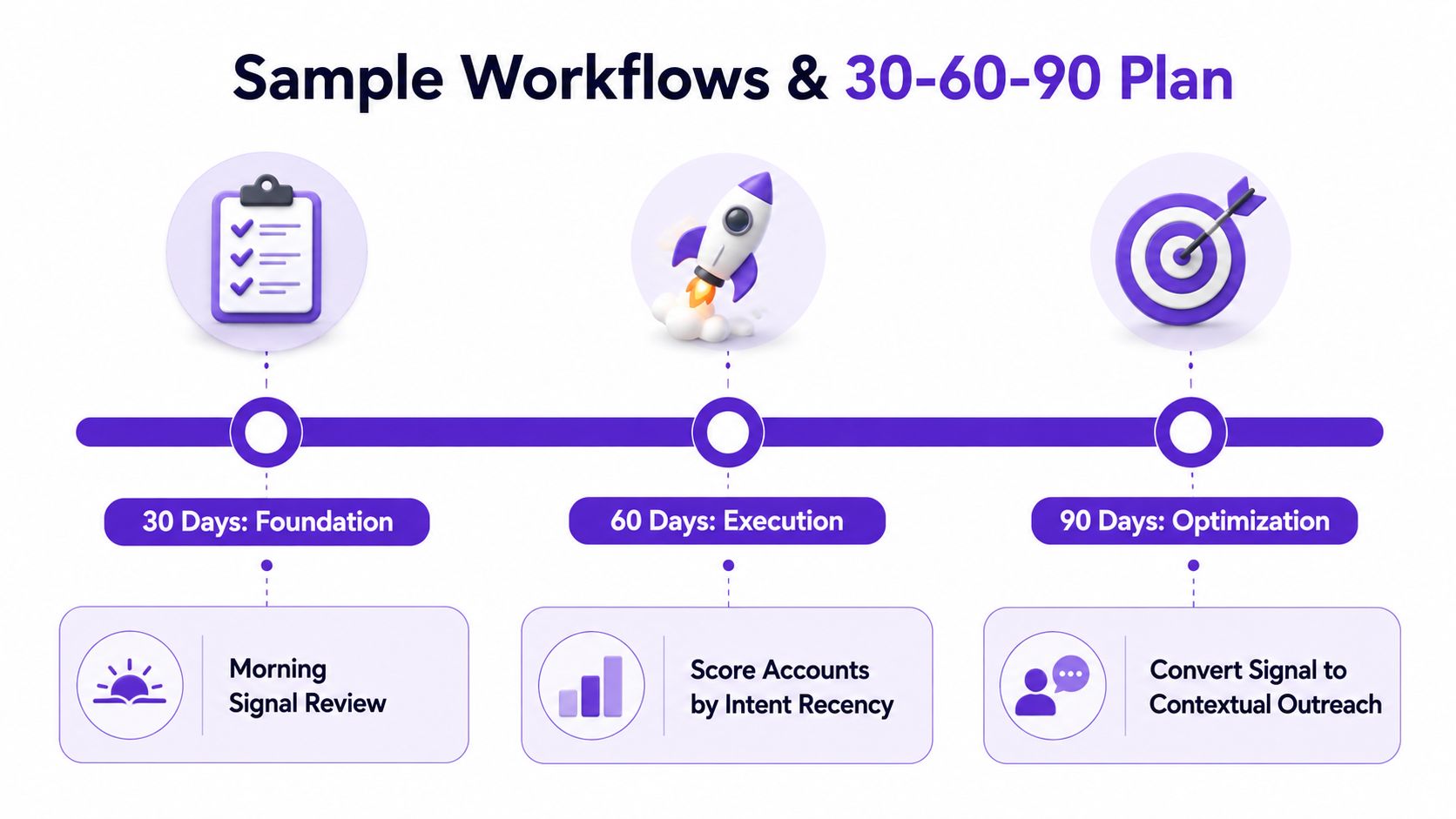
The best signal-driven teams don't “do outreach” in a vague way. They review signals in the morning, decide which accounts deserve a response, and write openers that sound like a person who noticed something relevant. That rhythm is boring in the best possible sense, because it's repeatable.
A few messaging templates that don't sound robotic
If someone engages with a competitor's pricing content, don't start with your product pitch. Start with the trigger.
Template 1: Saw your team looking at competitor pricing details. If you're comparing options, I can share the questions buyers usually miss before they pick a platform.
If a hiring signal shows up in a target account, reference the change and the likely workload.
Template 2: Noticed the new hiring activity on your team. That usually means more process ownership, so I figured I'd reach out with one short idea that helps teams avoid manual prospecting drift.
If a creator or influencer in your niche gets engagement from a target account, anchor on that behavior.
Template 3: I saw your team engaging with [creator/topic]. That usually means this pain is already on the radar, so I thought I'd send a quick note with something relevant, not a generic pitch.
The point is not cleverness. The point is context. Your message should sound like it came from someone who paid attention.
The 30 60 90 plan that makes this real
Phase | Focus | Key Deliverable |
|---|---|---|
30 Days | Foundation | Finalize ICP, define signals, set KPIs |
60 Days | Execution | Launch signal-driven outreach and one paid test |
90 Days | Optimization | Tighten qualification, expand the playbook |
The workflow should feel human from day one. If you're using a cold email template, make it behavior-led, not feature-led, and keep the CTA light enough that it doesn't scare off an in-market buyer.
A good internal companion here is the cold email template guide, because the message still has to earn the reply. Automation can surface the account, but the seller still has to write like a person.
What to do first
Days 1 to 30: lock ICP, pick signals, and define your dashboard.
Days 31 to 60: start signal-led outbound alongside content and one paid experiment.
Days 61 to 90: refine qualification, expand what's working, and cut the dead weight.
SaaS Lead Generation Questions Operators Actually Ask
How fast will signal-based outreach show results? Start by looking for reply quality, not just meetings. If the ICP and trigger are tight, you should see signal-led conversations before you see broad pipeline lift.
Does intent data replace SDR research? No, it replaces the boring parts of SDR research. Let intent find the account, then let the human add judgment and context.
What KPI should I instrument first? Track MQL-to-SQL conversion first, because that's usually where the funnel tells the truth.
How do I avoid LinkedIn compliance problems? Keep outreach behavior-led, avoid spammy mass patterns, and use context from visible engagement rather than aggressive automation.
Does product-led growth kill outbound? No. It gives you another qualification layer. Outbound still matters for accounts that show intent before they use the product.
Should we still care about MQLs? Only as a checkpoint, not as the headline metric. Pipeline contribution matters more.
What if my team has no usable intent stack yet? Start with LinkedIn engagement, competitor interactions, and hiring signals. That's enough to stop guessing.
Do partnerships matter in SaaS lead generation? Yes, especially when they compress trust and shorten the path to a conversation.
Is SEO still worth it? Yes, but only when it captures clear buyer intent, not just traffic.
What's the fastest way to make outreach feel less cold? Anchor the message to a recent trigger. Relevance beats volume every time.
If you want a prospecting motion built around live LinkedIn intent instead of static lists, RoverLead AI turns those signals into daily outreach opportunities matched to your ICP. Visit RoverLead AI if you want your team spending less time hunting and more time talking to accounts that are already warming up.